
How to calculate the CBD dosage in homemade baked goods and butter (calculator)
How much CBD remains in the dough after baking, how to calculate the nominal content per serving, why fat changes absorption, and what the EFSA says today about safe dosing.
Baked goods with CBD oil seem to be the simplest way to achieve a repeatable dose: you measure the oil, divide the dough into twenty pieces, and everything seems to be calculated. In practice, several stages stand between the number on the bottle and what enters the bloodstream, none of which are precisely measured in a home kitchen. This text separates two things that usually blend in culinary recipes: the arithmetic that can be done reliably and the variables that cannot be estimated without a laboratory. You will see how to calculate the nominal CBD content in a serving, why loss coefficient tables for baking lack empirical support, and how much fat in a meal alters the concentration of CBD in the blood. At the end, you will find what the latest assessment from the European Food Safety Authority says about safe consumption.
KEY INFORMATION
• EFSA established a temporary safe dose of CBD in 2026 at 0.0275 mg per kilogram of body weight per day, or about 2 mg daily for a person weighing 70 kg (EFSA, PMC12884199).
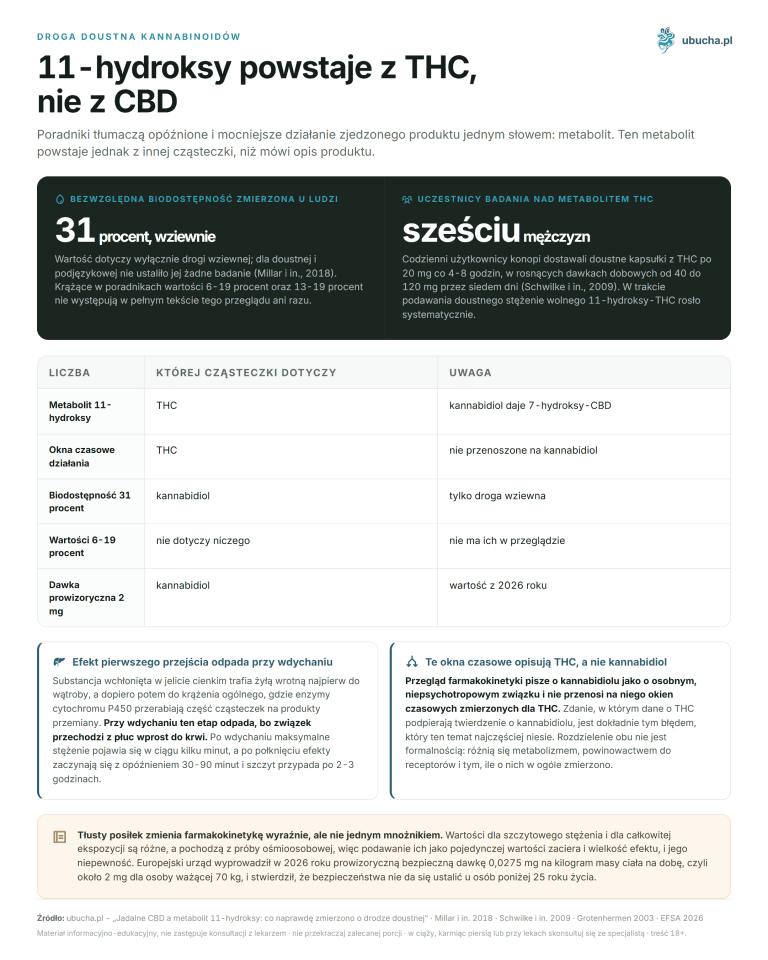
• No one has measured the absolute bioavailability of CBD after oral administration in humans; the only measured value pertains to smoking and is 31 percent (Millar et al., 2018).
• A high-fat meal raised the maximum concentration of CBD in the blood fourteenfold in patients (Birnbaum et al., Epilepsia, 2019).
• There are no published loss coefficients for CBD in home baking, so any retention table is an unsupported estimate.
• CBD is not authorized as a novel food in the European Union, and the sanitary notification of this status does not change.
Why is it impossible to calculate the CBD dosage in homemade baked goods accurately?
Because there are five unknowns between measuring the oil and consuming a portion, and none of them can be measured in the kitchen. You can only calculate how much CBD you poured into the bowl. Everything else is an approximation, and approximations multiply.
The first unknown is the raw material itself. The declared concentration of the oil may be a starting point, not a measurement of your bottle, and only a batch testing report indicates how much it actually corresponds to. The second is mechanical losses: some oil remains on the walls of the bowl, on the mixer spatula, and on the baking tray. The third is the distribution in the dough, as CBD is lipophilic and travels where the fat is, not where you want it to go. The fourth is thermal processing, described in the next section. The fifth is the portion size, as cookies cut by eye can differ in weight by even several dozen percent.
Additionally, there is variability on the part of the consumer. The EFSA assessment from 2026 explicitly notes that the bioavailability of CBD is variable and depends on the carrier and whether the substance was taken with food. Therefore, two people who eat identical cookies may have distinctly different concentrations in their blood. Thus, the only fair term for the calculation result is "nominal content": this is how much CBD ended up in the dough per portion, assuming even distribution and no losses.
What happens to cannabinoids during baking?
The direction of change is not obvious, as baking simultaneously breaks down cannabinoids and converts their acidic forms into neutral ones. The net effect can be positive, meaning the content measured after baking can be higher than before.
The closest published measurement regarding this situation pertains to bread. Lindekamp and colleagues measured 19 cannabinoids using liquid chromatography with mass spectrometry in 31 commercial hemp products and in 72 loaves of bread baked for the study. Temperature and time significantly affected the profile, with the change in delta-9-THC content ranging from minus 7 to plus 53 percent, due to decarboxylation. However, the most important conclusion from the authors is different: the final cannabinoid content was determined more by the variability of the raw material than by the conditions of the process (Lindekamp i wsp., Food Chemistry, 2025).
Circulating tables of retention coefficients found online, assigning specific percentage losses to various temperature ranges, have no basis in published measurements for homemade baked goods. Data on the distribution of CBD at high temperatures mainly come from gas chromatograph dispensers, where the sample spends seconds at temperatures around 250 degrees, so they do not translate to the oven in any meaningful way. A number given with a precision of one percent suggests a measurement that does not exist. The practical conclusion remains simple: bake at the lowest temperature required by the recipe, and do not add oil to ingredients that will be heated directly over the flame.
How to calculate the nominal CBD content in a portion?
The calculation boils down to two steps and does not require any correction factor. First, you determine how many milligrams of CBD you introduced into the dough, then divide that by the number of portions. The result indicates how much CBD is in each portion, not how much you should eat.
The concentration of the oil is calculated directly: oil described as 5 percent contains 50 mg of CBD per milliliter, and oil described as 10 percent contains 100 mg per milliliter. So, if 5 ml of oil described as 10 percent was added to the dough, there is nominally 500 mg of CBD in the entire mass. Divided into 20 equal portions gives 25 mg per portion, and for 40 portions, it gives 12.5 mg. The number of portions is the only variable you have full control over after baking, so dividing the finished baked good into smaller pieces is a simpler tool than any calculation of the oil before baking.
| Step | Co liczysz | Where do you get the number |
|---|---|---|
| 1 | Concentration of oil in mg per ml | Etykieta, najlepiej potwierdzona raportem z badania partii |
| 2 | Volume of oil used in the recipe | Measuring syringe, not a teaspoon |
| 3 | CBD content in the entire mass | Iloczyn kroku 1 i kroku 2 |
| 4 | Number of servings | Calculated after dividing, not planned before baking |
| 5 | Nominal content per portion | Krok 3 podzielony przez krok 4 |
Two things enhance the credibility of this calculation more than any factor. The first is measuring the oil with a syringe instead of a teaspoon, as sticky oils leave a significant portion of their content on the spoon. The second is weighing the portions instead of cutting by eye. The difference between swallowing and sublingual administration is explained in a separate text about the first-pass effect.
How to prepare butter with CBD oil?
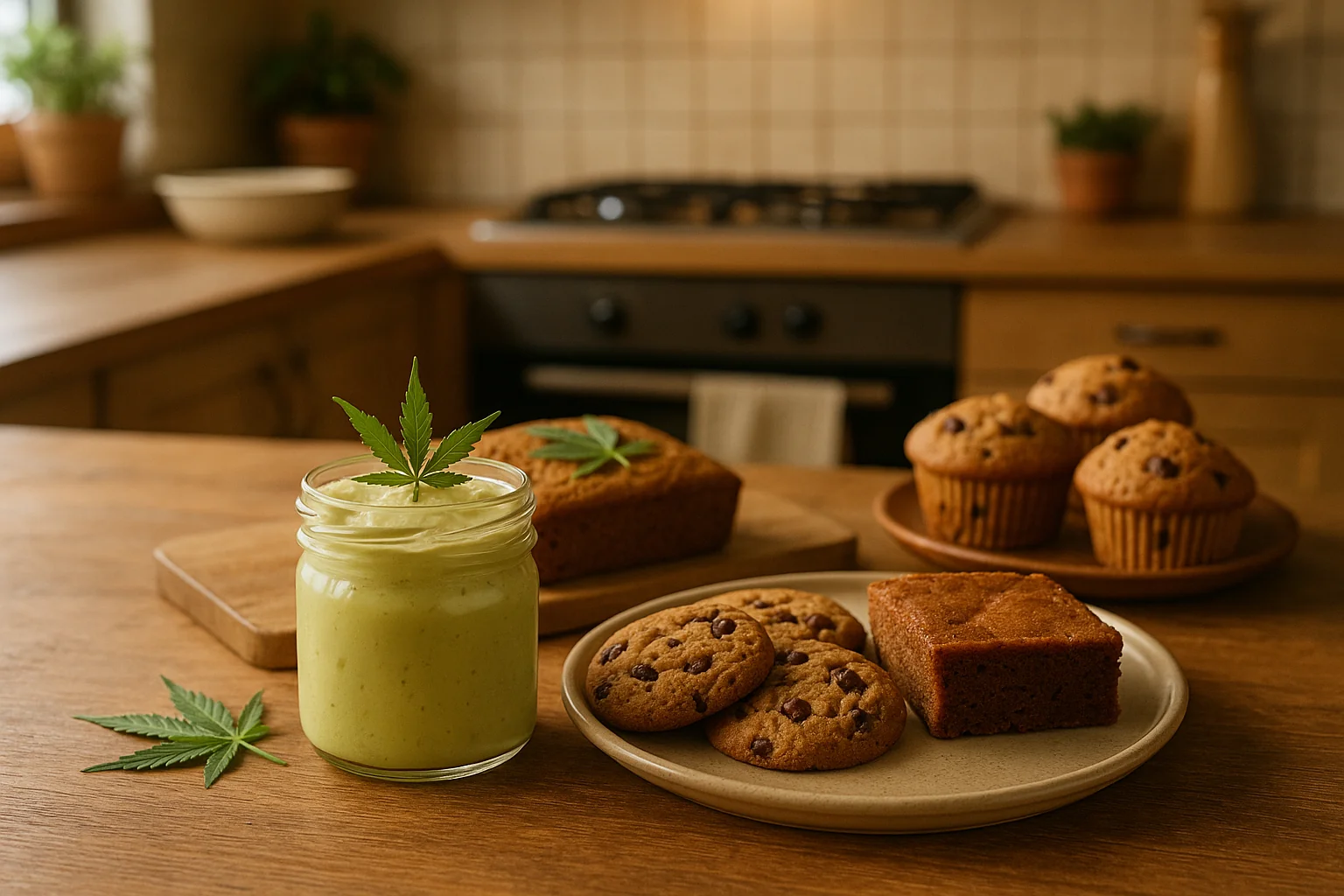
The simplest way is to combine the ready oil with melted butter away from the heat source. This method does not require prolonged heating, and the butter evenly distributes the oil throughout the mass, which solves the problem of uneven distribution in the dough.
Melt 250 g of unsalted butter in a water bath, meaning in a bowl over a pot of hot water, so that the butter does not have direct contact with the flame. Once the fat is completely liquid, remove the bowl from the bath and let it cool; a kitchen thermometer is more convenient here than guessing. Pour the measured portion of oil into the lukewarm butter and whisk for about two minutes until the mixture is uniform. Pour into a container with a lid and place in the refrigerator for a few hours until it solidifies.
Keep the prepared butter in the refrigerator and use it within two weeks, and freeze portions intended for longer storage. Before using it for creaming with sugar, take it out of the refrigerator in advance to regain a plastic consistency. The order of combining ingredients is practically significant: oil introduced first into the fat spreads evenly, while added to flour or milk creates clusters, causing portions from the same tray to differ in content. The variant prepared with raw material instead of ready oil, along with the decarboxylation and filtering stage, is described in the recipe for hemp butter step by step.
Why does fat change the absorption of CBD from food?
Because CBD dissolves in fats, and fat in the meal triggers the secretion of bile and the formation of micelles, allowing more substances to pass from the intestine into circulation. The scale of this effect has been measured directly and is greater than is usually reported.
Birnbaum and colleagues administered a single dose of capsules containing 99 percent pure CBD to adult patients with drug-resistant epilepsy, once on an empty stomach and once after a high-fat meal of 840-860 calories, and then collected blood for 72 hours. The study was completed by eight patients. The maximum concentration of CBD in the blood was on average fourteen times higher after the meal than on an empty stomach, and the area under the concentration curve over time was four times higher; the 90 percent confidence interval for the ratio of maximum concentrations ranged from 7.47 to 31.86 (Birnbaum et al., Epilepsia, 2019).
It is also important to know what science has not established about CBD. The systematic review by Millar and colleagues included 24 studies providing pharmacokinetic parameters for CBD in humans and states explicitly that absolute bioavailability was measured only for smoking, where it was 31 percent, and for no other route of administration has this been done (Millar i wsp., Frontiers in Pharmacology, 2018). The ranges repeated in guides such as "6-19 percent orally versus 13-35 percent sublingually" do not come from measurements of absolute bioavailability, although they are presented as such. However, the authors of the review note the same as Birnbaum: maximum concentration increases after a meal and with fat carriers. Differences between routes of administration are organized in a separate compilation about bioavailability of CBD.
How much CBD does EFSA currently consider safe daily?
The temporary safe dose established in 2026 by the EFSA panel is 0.0275 mg per kilogram of body weight per day, which is about 2 mg daily for a person weighing 70 kg. This is a ceiling, not a recommendation, and is significantly lower than the amounts found in baking recipes.
The panel derived this value using the benchmark dose method from subchronic studies, applying an uncertainty factor of 400. The caveats are significant. This value applies only to supplements with at least 98 percent CBD purity, free of nanoparticles, produced through a safe manufacturing process, and with excluded genotoxicity; it does not refer to other forms. Animal studies have shown consistent liver toxicity, and human data indicate a potential hepatotoxic risk, especially when taken alongside medications. The panel also notes the transfer of CBD across the placenta and the lack of any studies on immunotoxicity (EFSA, 2026).
However, the most important sentence of this assessment concerns not the number, but its boundaries. The safety of CBD cannot be established for individuals under 25 years of age, for pregnant and breastfeeding women, and for those taking medications simultaneously. Additionally, there is a formal issue: CBD is not authorized as a novel food in the European Union, and submitting a health notification does not change this status. For these reasons, you will not find any dosages to measure or dosage tables based on body weight here. Discuss how much CBD makes sense in your situation with your doctor, especially if you are on regular medication. Oils with various concentrations, along with the declared content on the packaging, can be found in the category oils.
Frequently Asked Questions
How much CBD is lost during baking?
It is unknown, as no one has measured this for home baking. In a study of hemp breads, temperature and time changed the delta-9-THC content by a range of minus 7 to plus 53 percent, as decarboxylation raises the measured content. The outcome was more influenced by the variability of the raw material than by the baking conditions (Lindekamp et al., Food Chemistry, 2025).
How to calculate the CBD content in one serving of baked goods?
Multiply the concentration of oil in milligrams per milliliter by the number of milliliters used, and divide the result by the number of servings. Oil described as 10 percent contains 100 mg per milliliter, so 5 ml in dough for 20 servings gives a nominal 25 mg per serving. This is the nominal content, not a recommendation.
Does CBD from baked goods work the same as oil under the tongue?
No, but the scale of the difference has not been measured. A review by Millar et al. from 2018 states that the absolute bioavailability of CBD in humans has only been measured for smoking, where it was 31 percent. There is no such measurement for oral and sublingual routes, although concentration comparisons indicate a slower onset of action after ingestion.
At what temperature should I add CBD oil to baked goods?
The safest way is to add fat away from the heat source, i.e., to melted and cooled butter or coconut oil, rather than to a hot pan. For products requiring high temperatures, add the oil to the finished, cooled product, such as frosting or icing, instead of exposing it to prolonged baking.
How to make butter with CBD oil?
Melt 250 g of unsalted butter in a water bath, remove from heat, and let cool. Pour the measured portion of oil into the warm fat and whisk for about two minutes until the mixture is uniform. Chill in the refrigerator, store for up to two weeks, and freeze any excess in smaller portions.
What dose of CBD does EFSA consider safe?
The temporary safe dose is 0.0275 mg per kilogram of body weight per day, about 2 mg daily for a person weighing 70 kg. This applies only to supplements with at least 98 percent purity of CBD, without nanoparticles. Safety cannot be established in individuals under 25 years of age, pregnant or breastfeeding women, and those taking medications.
This article is for informational and educational purposes only and does not constitute medical advice. Before starting to use hemp or CBD for therapeutic purposes, consult your doctor, especially if you are taking other medications, are pregnant, or breastfeeding.
Author: Michał Waluk · Opublikowano: 2026-07-10 · Aktualizacja: 2026-08-16