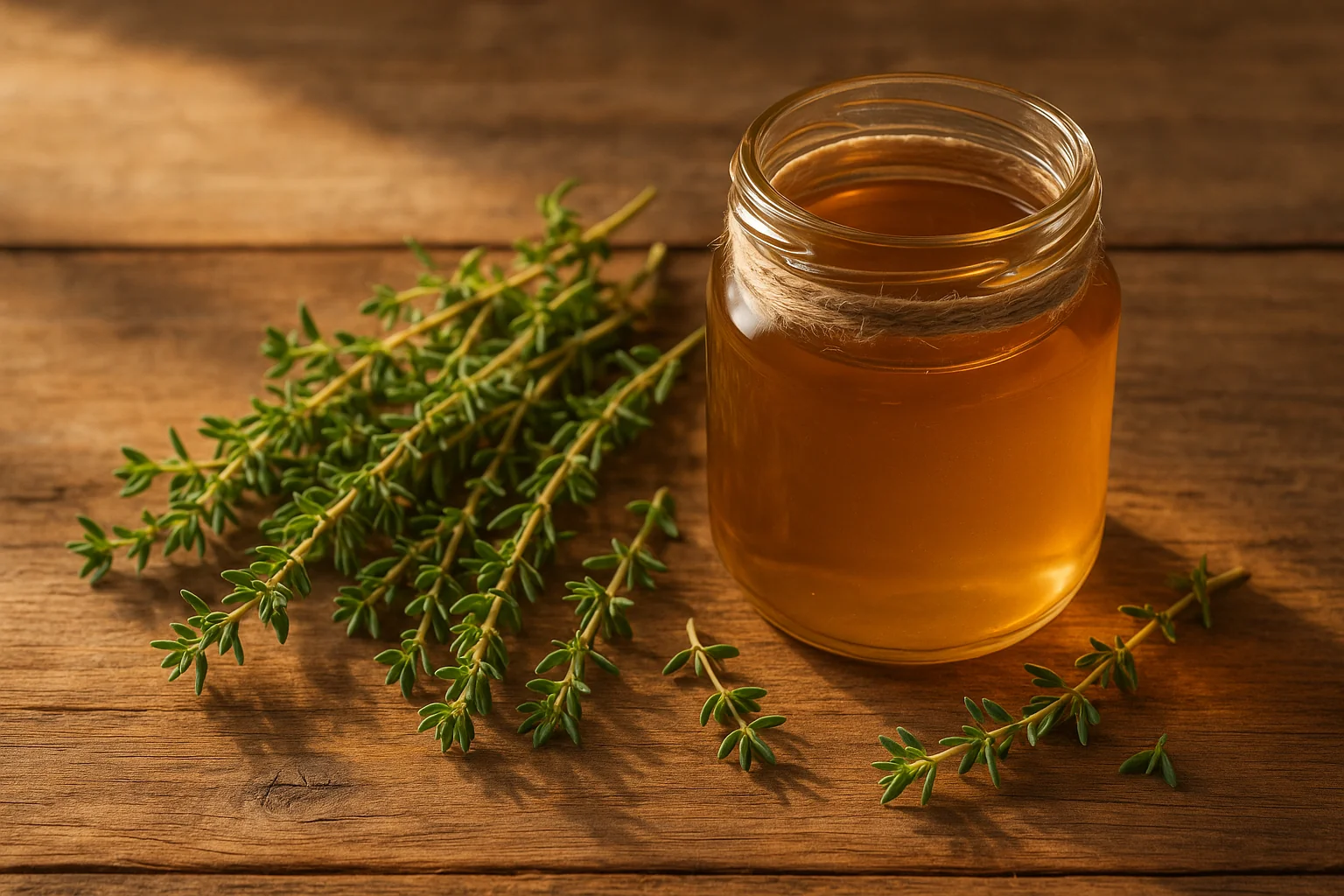

Thyme for cough and respiratory tract: what studies say (table)
Thyme has traditional product status in the EMA, not as an herb with established use. We check which studies concern the herb itself and which concern mixtures.
Tymianek pospolity (Thymus vulgaris L.) is among the most commonly recommended herbs for cough, but its evidence position is weaker than most guides suggest. The European Medicines Agency has classified thyme herb as a product of traditional use, not as a herb with established use, and it did so after reviewing the available literature. The reason is simple: there is almost no research on the herb itself, and the most frequently cited studies concern preparations combined with primrose root or ivy leaves. This article separates these two matters. It shows what the monograph actually says, what studies have been conducted, who they involved, and what this means for someone brewing an infusion at home.
KEY INFORMATION
• The European Medicines Agency granted thyme herb the status of traditional use, not established use (monograph EMA/HMPC/342332/2013).
• The indication from the monograph states: wet cough accompanying a cold. There is no mention of rhinitis or sinusitis.
• The EMA assessment report found one study on the herb itself: 60 patients, without a placebo group. The prominent trials concerned mixtures with primrose or ivy.
• The monograph does not mention a single reported interaction with medications, and its use during pregnancy and breastfeeding is not recommended due to a lack of data.
• Thyme is not available for sale as a separate raw material at the store ubucha.pl.
What status does thyme have in the European Medicines Agency monograph?
Thyme herb has a European herbal monograph solely in the category of traditional use. The column "well-established use" reserved for raw materials with sufficient clinical documentation is empty in this document. The indication states: a traditional herbal medicinal product used for wet cough accompanying a cold.
The distinction is not a formality. Traditional use means that the committee recognized the action as credible based on at least thirty years of use, including fifteen in the European Union, while lacking sufficient evidence from clinical trials. Established use requires something entirely different: data from trials that withstand regulatory scrutiny. The statement "the EMA monograph confirms the effectiveness of thyme" confuses these two categories and elevates the source.
Monografia obejmuje dwa gatunki, Thymus vulgaris L. i Thymus zygis L., and their mixture. The scope excludes sand thyme (Thymus serpyllum), sold in Poland under the name "wild thyme" and being a different species of the same genus. The scope also excludes thyme oil, which has its own document and a much stricter set of warnings.
The monograph indicates another boundary that guides usually cross. The indication pertains to wet cough, meaning one with expectoration. Rhinitis, sinusitis, and dry cough are not included. The document adds that if symptoms persist for more than a week, as well as in cases of shortness of breath, fever, or purulent sputum, one should see a doctor.
What does thyme herb contain, and what does it really mean?
The European Pharmacopoeia defines thyme herb as whole leaves and flowers separated from dried stems, with an essential oil content of no less than 1.2 percent, in which thymol and carvacrol together constitute at least 40 percent. This is the only hard number that applies in this matter, and it concerns the quality of the raw material, not its action in patients.
The composition of the oil is very variable. The EMA assessment report noted at least six chemotypes Thymus vulgaris with different oil profiles, of which only one has thymol as the dominant component. Plants of the same species, collected in different locations, can therefore yield infusions with distinctly different compositions. This undermines any statement about the "action of thyme" formulated without specifying the preparation.
The experimental works cited in the report concern isolated compounds and animal models. Thymol and carvacrol exhibited concentration-dependent bronchodilatory effects on rat trachea stimulated by acetylcholine, potassium ions, or barium. However, the authors of that work added a caveat that must not be overlooked: extracts with very low thymol content were also active, so other unmeasured components are also responsible for the effect.
The herb also contains rosmarinic acid, and the antioxidant activity of extracts in laboratory tests correlated with its content. However, the path from activity in vitro to effect in humans with a cough is long, and none of these studies bridge that gap.
Do clinical studies concern thyme or mixtures?
Almost exclusively mixtures. The EMA assessment report found one study on a preparation with thyme as the only active ingredient and rejected it as a basis for indication. Large trials concerned combined preparations, and the committee's assessment is clear: the results of studies on thyme mixtures with other plants can only be used to assess safety.
| Study | Preparation | Kto i ilu | Time | Outcome |
|---|---|---|---|---|
| Knols 1994, according to the EMA assessment report | thyme syrup, the only active ingredient | 60 people with wet cough after infection | 5 days | no significant difference compared to bromhexine; without a placebo group, preparation not described |
| Eskandarpour 2024, PMID 38186189 | syrop z Thymus vulgaris, 20 mg/kg every 8 hours, added to standard treatment | 60 dzieci w wieku 5 do 12 lat w zaostrzeniu astmy | 1 week | less exertional cough (p = 0.042) and higher FEV1 (p = 0.048); wheezing and shortness of breath showed no difference |
| Kemmerich 2006, PMID 17063641 | liquid extract: thyme herb and ivy leaf (Bronchipret Saft) | 361 adults with acute bronchitis | 11 dni | napady kaszlu w dniach 7 do 9: spadek o 68,7 procent wobec 47,6 na placebo |
| Kemmerich 2007, PMID 17966760 | tablets from dry extracts: thyme herb and primrose root | 361 adults with acute bronchitis | 11 dni | a 67.1 percent reduction in cough attacks compared to 51.3 on placebo |
| Gruenwald 2005, PMID 16366041 | drops: liquid extract of thyme and tincture of primrose root | 150 adults with acute bronchitis | 7 do 9 dni | no symptoms at the end of the study: 58.7 percent compared to 5.3 on placebo |
The three lower rows share a feature that is easy to overlook: they studied branded combination products, not the herb. The second row requires a separate note, as the study was published eleven years after the monograph was adopted, and its participants were children experiencing asthma exacerbations, not individuals with colds.
Conclusion: the numbers from trials on mixtures do not translate to an infusion made from the herb itself. This is confirmed by a review of phytotherapy for respiratory infections in children from 2025: out of 45 reports, only nine had a double-blind setup with placebo, and the evidence was deemed sufficient for one product, which was not any product containing thyme (Kamin 2025, PMC12078267). Similarly, the foundation looks weak when dziewannie i przy babce lancetowatej.
How to prepare an infusion of thyme so as not to lose the oil?
The monograph describes the form of the infusion: the crushed raw material is poured with boiling water and steeped like herbal tea. The rest of the preparation recommendations are herbal practice, not the content of the regulatory document, and should be read as such.
The principle of brewing under cover makes sense. Thymol and carvacrol are components of the essential oil, and thus volatile substances that escape from an uncovered vessel along with the steam. Covering the cup with a saucer allows the steam to condense and return to the infusion. We did not find a study measuring how much oil is lost when brewing without a cover, so we do not provide any numbers with this advice. Versions circulating on the internet, with specific percentages of loss, have no source.
The second point concerns the quality of the raw material. The pharmacopoeial minimum oil content applies to freshly dried herb, and the oil decreases over time, so old herb no longer meets the description we refer to. Raw material stored in a sealed, dark container retains a distinct, spicy aroma. Herb that smells like hay has lost what was supposed to work, although it has not become harmful.
The third point is the very sense of reaching for an infusion. The monograph covers wet cough due to colds and sets a time limit of one week. A cough lasting longer requires diagnostics, as it can be a symptom of asthma, reflux, chronic bronchitis, or an infection requiring antibiotics. The infusion does not treat any of these causes.
Where did reports of thyme interactions with medications come from?
From confusion over species and scale. The EMA monograph in the section on interactions with other medicinal products has one sentence: no interactions have been reported. Warnings about warfarin, macrolides, and thyroid medications, repeated in Polish guides, have no basis in this document.
The trace from which the story about inhibiting the CYP3A4 enzyme likely grew is detailed in the assessment report. A methylated flavone isolated from Thymus saturoides, which is from a different species than the one used in tea, turned out to be an inhibitor of CYP1A2 and CYP3A4 under laboratory conditions. The substitution of one species for a related one is often a way in herbal texts to turn a test tube result into a clinical warning.
The warning about warfarin contains an internal error. It is justified by the content of vitamin K, but vitamin K acts oppositely to warfarin: it weakens its effect, not enhances it. Thus, the argument undermines the very conclusion it was supposed to support.
What the monograph actually lists is shorter and less impressive. The contraindication is hypersensitivity to thyme and other plants from the Lamiaceae family. Among the adverse effects, gastrointestinal complaints of unknown frequency are mentioned. Safety during pregnancy and breastfeeding has not been established, so use during this period is not recommended. Most forms are not recommended for those under 12 years of age, while two liquid extracts are allowed from the fourth year.
Frequently Asked Questions
Does the EMA monograph confirm the effectiveness of thyme for cough?
Not in the sense that most guides read it. Thyme herb has the status of traditional use, which is granted precisely when there is a lack of evidence from clinical studies, and long-term use makes the effect credible. The category of established use, based on clinical data, remains empty for this raw material.
What study concerned thyme itself, without additives?
One, described in the EMA assessment report. Sixty patients with wet cough received either thyme syrup or bromhexine for five days. No difference was found, but the trial did not have a placebo group, was small, and the preparation itself was not described in enough detail to be reproducible. The committee deemed it insufficient.
Does thyme work for dry cough?
The indication from the monograph includes wet cough accompanying a cold and nothing more. Laboratory studies on the bronchodilatory effect of thymol on animal trachea are sometimes cited as a basis for dry cough, but this is based on isolated tissue, not from a patient. For dry cough, the monograph has a different indication with another raw material, such as marshmallow root.
Can thyme be given to children?
It depends on the form. The monograph does not recommend most thyme preparations for children under 12 due to a lack of data, while two liquid extracts are allowed from the age of four. A study from 2024 involving sixty children concerned syrup given as an adjunct to asthma treatment under medical supervision, not self-administered infusions.
Does thyme interact with medications?
The EMA monograph states that no interactions have been reported. The circulating warnings regarding warfarin and macrolide antibiotics have no basis in it, and the enzymatic trace from which they arose comes from another species of thyme studied in vitro. People taking medications regularly should still discuss any herb with their doctor.
Can I buy thyme at the store ubucha.pl?
Not as a separate raw material. We reviewed all items for sale, and none have thyme in the name, either in the form of dried herb or extract. This does not exclude the presence of thyme in the composition of mixtures, which simply list herbs on the label. If you are looking for pure thyme herb, you need to look outside our assortment.
Other herbs from this cycle, including those with monographs from the European Medicines Agency, fall into the category herbs. We write about the mucilaginous raw material, which acts completely differently than thyme, in the text about marshmallow.
This article is for informational and educational purposes and does not constitute medical advice. Before starting supplementation, consult your doctor, especially if you are taking medications regularly, are pregnant or breastfeeding, or have a chronic illness.
Author: Michał Waluk · Opublikowano: 2026-07-10 · Aktualizacja: 2026-08-16