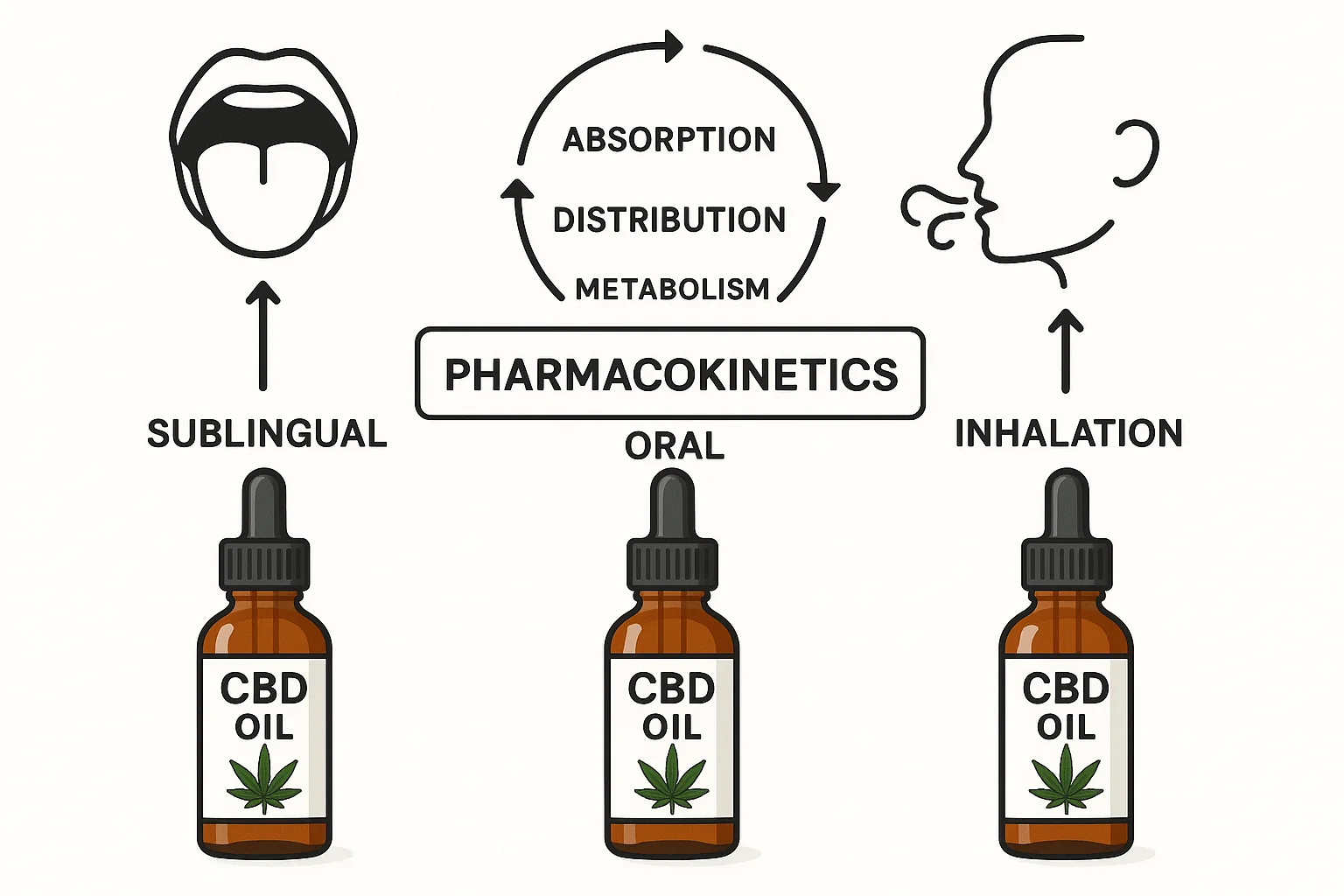

CBD Bioavailability - why sublingual, oral, and inhalation methods work differently (table)
Bioavailability of CBD: comparison and what studies really show. Table from u Bucha.
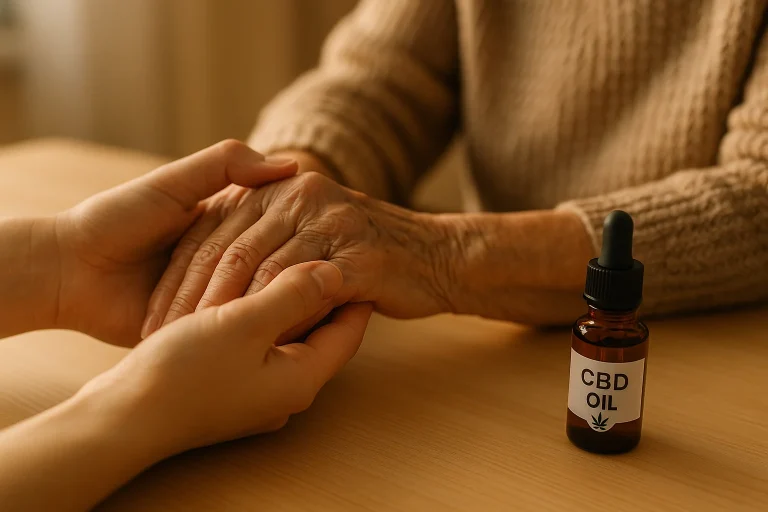
You can take the same dose of CBD in three different ways and get completely different amounts of active substance into the bloodstream. The study by Millar et al. showed that the bioavailability of CBD with oral administration is only 6-13%, while with inhalation it reaches 10-35% - even several times the difference with the same nominal dose (Millar et al., Pharmaceuticals, 2019). This article explains why this happens and which form to choose depending on your goal.
KEY INFORMATION
• CBD bioavailability: inhalation 10-35%, sublingual 13-19%, oral 6-13% - differences can reach several times the same nominal dose.
• The first-pass effect through the liver is the main reason for low oral bioavailability - CYP3A4/CYP2D6 enzymes metabolize most of the CBD before it reaches the blood.
• A fatty meal increases the oral bioavailability of CBD fourfold (Millar et al., 2019).
• Onset time: inhalation 2-10 min, sublingual 15-45 min, oral 30-120 min.
• The choice of administration route should depend on the goal: fast action vs long-lasting concentration.
What is bioavailability and why does it matter with CBD?
Bioavailability is the percentage of the administered dose of a substance that reaches the general circulation in an active form. With intravenous administration, bioavailability is by definition 100% - the substance goes directly into the blood. With any other route of administration, bioavailability is lower due to absorption barriers and metabolism before reaching the bloodstream.
For the CBD consumer, this means a specific financial and dosing difference. If a CBD oil has a bioavailability of 13% with oral administration and 19% with sublingual, the difference is 46% more CBD in the blood with the same bottle of product - simply due to a different method of use. Understanding bioavailability allows for more effective dosing and avoids situations where a product does not work not because it is ineffective, but because it is used incorrectly.
The first-pass effect - why swallowing CBD is ineffective?
When you swallow CBD oil or a capsule, CBD is absorbed through the intestinal walls and goes through the portal vein directly to the liver - before it even reaches the heart and general circulation. In the liver, cytochrome P450 enzymes, mainly CYP3A4 and CYP2D6, metabolize a significant portion of CBD into inactive or less active metabolites. This mechanism - known as the first-pass effect - is the reason for the low bioavailability of CBD with oral administration.
A review of the pharmacokinetics of CBD published by Millar et al. states that oral bioavailability is at 6-13% (Pharmaceuticals, 2019). This means that from a capsule containing 25 mg of CBD, only about 1.5-3.25 mg actually reaches the blood. Manufacturers using advanced formulation technologies - nanoemulsions, liposomes, cyclodextrins - can increase oral bioavailability to 20-30%, but standard capsules and oils with carrier oil fall within the lower range.
A fatty carrier in CBD oils (MCT, olive oil) partially compensates for the first-pass effect. Fat creates lipid micelles in the intestines that transport CBD through the lymphatic system, partially bypassing the liver. This is why MCT-based CBD oil has higher bioavailability than the same dose of CBD in fat-free tablets.
CBD Bioavailability - Comparison Table of Administration Routes
The table below compares three main routes of CBD administration: inhalation, sublingual, and oral. The data comes from the review by Millar et al. (2019) and secondary pharmacokinetic reviews. It is important to remember that the ranges provided are medians from studies - individual values may vary depending on metabolism, body weight, and concurrent fat intake.
| Parameter | Inhalation | Sublingual | Oral (swallowing) |
|---|---|---|---|
| Bioavailability | 10-35% | 13-19% | 6-13% |
| Time to onset (Tmax) | 2-10 minutes | 15-45 minutes | 30-120 minut |
| Duration of action | 2-3 hours | 4-6 hours | 6-8 hours |
| First-pass effect | None (absorption through pulmonary vesicles) | Partial (part swallowed) | Full (through the liver) |
| Typical product | Vaporization of flower/concentrate | CBD oil (sublingual) | Capsules, gummies, tea |
| Ease of dosing | Difficult (depends on inhalation) | Good (dropper) | Very good (capsule) |
| Food impact | Minimal | Moderate | High (+4× with fatty meal) |
| Best use | Quick relief | Daily supplementation, balance | Long-lasting effect, night sleep |
Sublingual Administration - Why Does 60-90 Seconds Matter?
Sublingual administration involves holding CBD oil under the tongue for 60-90 seconds before swallowing. Under the tongue and at the bottom of the oral cavity, there are dense networks of blood vessels and lymphatic vessels with very thin epithelium - lipophilic substances like CBD are absorbed directly into the bloodstream, bypassing the liver and the first-pass effect.
The difference between 60 seconds and immediate swallowing is significant. In the study by Millar et al., the sublingual bioavailability of CBD was 13-19% - clearly more than 6-13% with direct swallowing (Pharmaceuticals, 2019). With 10% CBD oil (1000 mg in 10 ml), one dropper contains about 50 mg of CBD. Sublingually, about 6.5-9.5 mg reaches the blood, while swallowing the same dropper yields only about 3-6.5 mg. This difference is particularly important with lower doses.
A practical tip for sublingual technique: hold the oil under your tongue for a full 60 seconds, preferably 90 seconds. Do not eat or drink for the next 5 minutes after swallowing the rest of the oil. Hot beverages speed up the movement of the oil through the mouth and shorten the contact time of the mucous membrane with CBD.
Inhalation - Highest Bioavailability, but Shortest Duration of Action
Inhaling CBD through vaporizing hemp flower or concentrate is the route with the highest bioavailability among non-invasive forms. CBD is absorbed through the alveoli directly into the blood - without the first-pass effect through the liver - and the enormous surface area of the lungs (about 70-80 m²) ensures rapid and effective absorption. Inhalation bioavailability ranges from 10-35% depending on the inhalation technique, depth of breath, and retention time of smoke/vapor in the lungs (Millar et al., Pharmaceuticals, 2019).
A key difference between vaporization and smoking: temperature directly affects the profile of substances delivered to the lungs. Vaporizing at 170-210°C evaporates CBD and terpenes without burning plant material - which eliminates products of incomplete combustion (benzo[a]pyrene, CO, acrolein). Smoking produces these compounds in significant amounts. For therapeutic and supplemental purposes, vaporization is a much safer form of inhalation than smoking.
A drawback of inhalation is the difficulty in precise dosing - the amount of CBD depends on the depth and duration of inhalation, moisture of the material, and temperature of the vaporizer. An additional limitation is the duration of action: the effect of inhaled CBD lasts only 2-3 hours, which with chronic supplementation would require multiple uses throughout the day.
How Carrier Fat Affects CBD Bioavailability - MCT vs Olive Oil
The choice of carrier oil has a measurable impact on CBD bioavailability with oral administration. CBD is a lipophilic substance - it dissolves well in fats, and the presence of fat in the digestive system activates lipid transport mechanisms that carry CBD into the bloodstream. The study by Millar et al. showed a fourfold higher bioavailability of CBD consumed with a fatty meal compared to fasting (Pharmaceuticals, 2019).
MCT (medium-chain triglycerides, derived from coconut oil) is the preferred carrier for several reasons. First, MCTs are absorbed by the intestines faster than long-chain fatty acids - which accelerates CBD bioavailability. Second, some MCTs are transported through the lymphatic system, bypassing the liver - which reduces the first-pass effect of CBD carried by MCT. Third, MCTs are flavor-neutral, making it easier to formulate CBD oils with acceptable sensory qualities.
Olive oil as a carrier acts more slowly due to the long-chain composition of fatty acids, but it has its own benefits - the polyphenols in olive oil may support CBD absorption by affecting intestinal membrane permeability. A detailed comparison of MCT vs olive oil as a CBD carrier is described in a separate article on the u Bucha blog.
Nanoemulsions and Liposomes - Do New Technologies Really Increase CBD Bioavailability?
Manufacturers are increasingly advertising CBD oils as "nano CBD", "liposomal CBD", or "bioavailable CBD". These technologies have real scientific foundations - but require a critical look at clinical data, not just marketing claims. Nanoemulsions are formulations in which CBD is broken down into droplets with a diameter of 10-100 nm. Such small particles penetrate intestinal and lymphatic membranes more easily, and the larger surface area in contact with the aqueous environment of the gastrointestinal tract potentially accelerates absorption.
The study by Cherniakova et al. showed that CBD nanoemulsion reaches peak blood concentration much faster than standard MCT-based oil, although total exposure (AUC - area under the concentration-time curve) was similar in some formulations (Pharmaceutics, 2019). This means that nano CBD may act faster, but not necessarily 'more' CBD reaches the blood overall. For applications requiring a quick effect (acute stress, immediate pain), nanoemulsion has an advantage; for long-term supplementation, the difference is less pronounced.
Liposomes encase CBD in a phospholipid bilayer - mimicking the structure of cell membranes. Theoretically, this facilitates fusion with intestinal epithelial cells and direct transfer of CBD into the cell. However, studies on liposomal CBD are more limited than on nanoemulsions, and clinical data in humans are still scarce. Most evidence comes from studies of liposomal formulations of other active substances, whose results are extrapolated to CBD.
Key Practical Conclusion: Both nanoemulsions and liposomes may offer a real advantage in terms of speed of action - but their bioavailability compared to a good quality MCT oil taken with a fatty meal is lower than marketing suggests. The simple rule of "take CBD with fat" provides a 300-400% increase in bioavailability at zero additional formulation costs. Advanced technologies make sense as a supplement, not as a revolution replacing the fundamentals of pharmacokinetics.
How to check if the CBD product you are using is actually biologically active?
A CoA (Certificate of Analysis) from an independent laboratory is the minimum standard for verifying the quality of a CBD product. The CoA should include a cannabinoid profile (amount of CBD, THC, CBG, and other phytochemicals in mg/ml), results of tests for heavy metals, pesticides, and solvent residues. The absence of a CoA or a CoA issued by a laboratory affiliated with the manufacturer are warning signs.
Beyond CoA, subjective observation of one's own reaction during structured titration (see the article on sweet spot dosing) is the only real way to assess whether a specific product works for a specific person. Bioavailability variability between individuals can reach several times the same dose - metabolism, body weight, concurrent fat intake, and genetic polymorphism of CYP enzymes create an individual "pharmacokinetic fingerprint". Therefore, information about a product's bioavailability is a guideline, not a guarantee of effect.
Final Practical Conclusion: Before spending more money on a "nano" or "liposomal" product in hopes of higher bioavailability, make sure you are using your current oil correctly - sublingually for 90 seconds, with a fatty meal, and at a consistent time of day. These three changes in the usage protocol have a greater impact on actual bioavailability than switching to a more expensive product with a marketing label of advanced technology. Pharmacokinetic data consistently indicate that the context of administration is more important than the formulation itself.
Frequently Asked Questions
What is the bioavailability of CBD with different routes of administration?
CBD bioavailability varies significantly: inhalation 10-35%, sublingual 13-19%, oral (swallowing) 6-13%. Thus, the same nominal dose yields very different blood concentrations depending on the form and method of intake (Millar et al., Pharmaceuticals, 2019). Changing the method of use may be more effective than increasing the dose.
Why does orally taken CBD have such low bioavailability?
Swallowed CBD undergoes the first-pass effect through the liver: CYP3A4 and CYP2D6 enzymes metabolize most of the CBD before it enters systemic circulation. From 25 mg of oral CBD, realistically only about 1.5-3.25 mg reaches the blood. The presence of fat in the meal significantly improves this result due to lymphatic transport bypassing the liver.
How long does CBD stay in the blood depending on the route of administration?
Duration of action is inversely proportional to the speed of absorption: inhalation provides effects in 2-10 minutes but lasts only 2-3 hours; sublingual administration lasts 4-6 hours; oral - the longest, 6-8 hours. For supporting nighttime sleep, capsules or oil swallowed with a fatty meal are most appropriate - providing stable concentrations throughout the night.
Does eating a fatty meal increase the bioavailability of CBD?
Yes - dramatically. The study by Millar et al. showed a fourfold higher bioavailability of CBD when consumed with a fatty meal compared to fasting (Pharmaceuticals, 2019). CBD is lipophilic, so fats form micelles that protect CBD from hepatic metabolism and facilitate transport across intestinal membranes. The MCT carrier oil in CBD oils partially serves this function even without an additional meal.
Which route of administration of CBD is the best?
It depends on the purpose. For quick on-demand action - inhalation (onset 2-10 min). For daily supplementation - sublingual oil (balance of bioavailability and convenience). For long-lasting, stable nighttime concentration - capsules or oil swallowed with a fatty meal. There is no one best route - there is a best route for a specific application.
This article is for informational and educational purposes and does not replace consultation with a doctor. If you are pregnant, breastfeeding, taking medications, or have chronic conditions, consult the use of supplements or herbs with a specialist.
Author: Michał Waluk · Published: 2026-05-04 · Updated: 2026-05-04