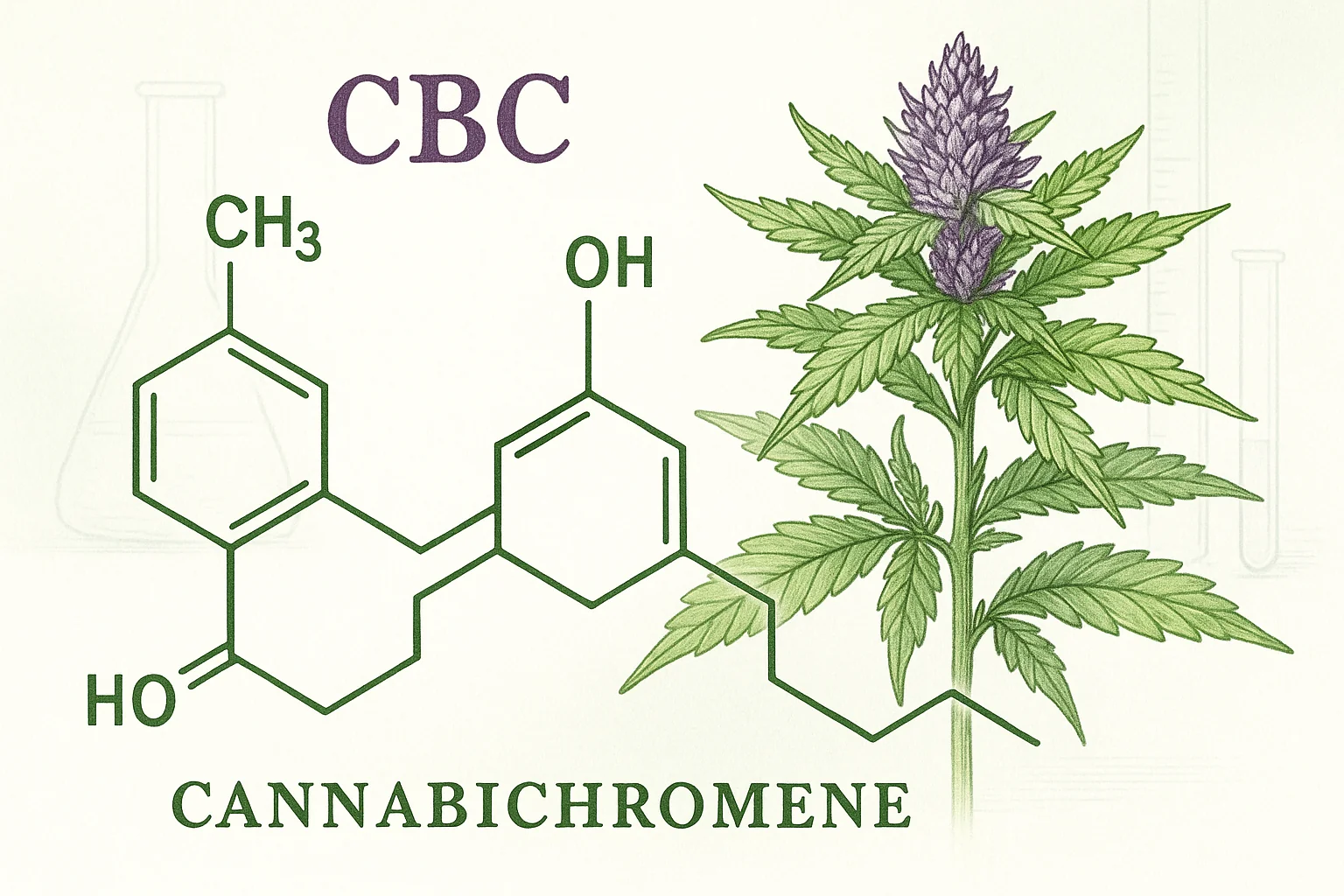

CBC (cannabichromene) - what it is, effects, and properties (guide)
CBC — co to, jak dziala i na co. Zrozumialy przewodnik u Bucha.
CBD and THC are the most well-known, but Cannabis sativa L. produces over 100 different phytocannabinoids. CBC (cannabichromene) is the third or fourth most abundant phytocannabinoid in the plant - depending on the strain, it can account for several percent of the total cannabinoid profile (Russo & Marcu, Progress in the Chemistry of Organic Natural Products, 2017). Nevertheless, it remains one of the least known cannabinoids among consumers. This guide explains what CBC is, how it works, and why researchers are paying increasing attention to it.
KEY INFORMATION
• CBC (cannabichromene) is one of the six main phytocannabinoids - non-psychoactive, legal in Poland and the EU.
• Main mechanisms of action: blocking TRPA1/TRPV1 receptors (pain), inhibiting FAAH (increasing anandamide), anti-inflammatory effects through COX-2 inhibition.
• Studies on rodents indicate neuroprotection and support for neurogenesis - potentially interesting in the context of neurodegenerative diseases.
• CBC shows synergy with CBD in the entourage effect - full-spectrum products with CBC may work more effectively than CBD isolate.
• Large clinical studies on humans with CBC do not exist - most data comes from in vitro studies and animal models.
Where does CBC come from in the cannabis plant?
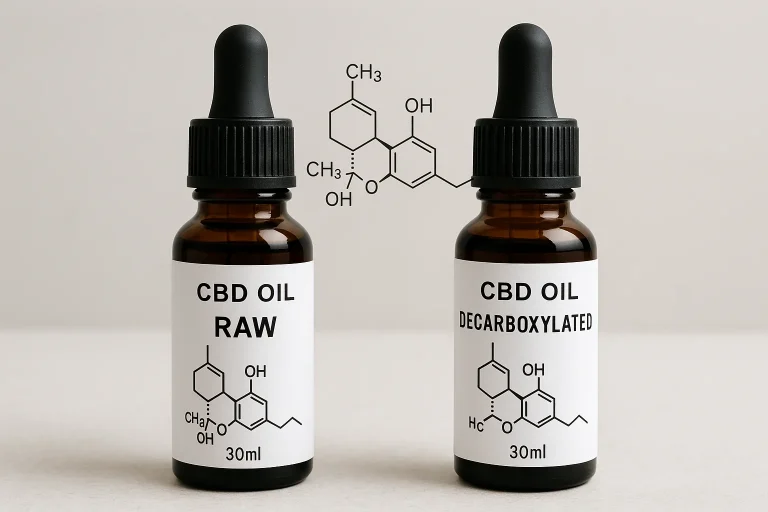
All phytocannabinoids share a common precursor: cannabigerolic acid (CBGA). Enzymes in the plant convert CBGA into acids: THCA, CBDA, or CBCA. Decarboxylation (through heat or time) converts the acids into active phytocannabinoids: THC, CBD, and CBC (from CBCA). This means that in the process of producing CBD oil, some CBGA always enters the CBCA/CBC pathway - which is why CBC is naturally present as a trace component in full-spectrum products.
The CBC content in the plant depends on the strain and growing conditions. Some industrial hemp strains with low THC content may contain relatively high levels of CBC - especially young plants, where CBCA has not yet been decarboxylated. Research on selective breeding of hemp for cannabinoid profiles conducted by European research centers indicates that obtaining strains with increased CBC content is possible through genetic selection, although it is a niche market.
How does CBC work at the cellular level?
CBC has a different receptor profile than CBD. It does not show significant affinity for CB1 or CB2 receptors of the endocannabinoid system - which explains the lack of psychoactive effects. Its biological activity occurs through different pathways.
TRPA1 and TRPV1 receptors
CBC is a strong agonist of TRPA1 (Transient Receptor Potential Ankyrin 1) receptors and a partial agonist of TRPV1 - so-called vanilloid receptors involved in pain perception, inflammation, and temperature. Activation, followed by desensitization of these receptors by CBC, may lead to analgesic and anti-inflammatory effects - a mechanism similar to capsaicin, but without the burning effect (De Petrocellis et al., British Journal of Pharmacology, 2011).
Inhibition of FAAH and increase of anandamide
FAAH (fatty acid amide hydrolase) is an enzyme that breaks down anandamide - an endogenous cannabinoid known as the "bliss molecule." CBC, like CBD, inhibits FAAH, leading to increased levels of anandamide in the blood and tissues. Higher anandamide translates to stronger activation of CB1 and CB2 receptors by the endogenous ligand - an effect without direct binding by CBC. This is an indirect mechanism for enhancing the endocannabinoid system.
Inhibition of COX-2 and anti-inflammatory action
Cyclooxygenase-2 (COX-2) is an enzyme crucial for the synthesis of prostaglandins - mediators of inflammation and pain. Standard NSAIDs (ibuprofen, diclofenac) work by inhibiting COX-2. In vitro studies have shown that CBC inhibits COX-2 activity, which explains its anti-inflammatory properties. In the context of the entourage effect - the combination of CBD and CBC may exhibit synergistic anti-inflammatory action, as each acts through different enzymatic pathways.
| Biological pathway | Action of CBC | Clinical effect (preclinical) |
|---|---|---|
| TRPA1 / TRPV1 | Agonism → desensitization | Analgesic, anti-inflammatory |
| FAAH (inhibition) | Increase of anandamide | ECS modulation, potential antidepressant effect |
| COX-2 (inhibition) | Reduction of prostaglandins | Anti-inflammatory |
| CB1 / CB2 | Low affinity - lack of direct binding | No psychoactivity |
| Neurosphere formation (brain) | Stimulation of brain stem cells (in vitro) | Potential neuroprotection |
Neurogenesis and neuroprotection - one of the most promising directions
The study by Shinjyo and Di Marzo from 2013 showed that CBC stimulates the differentiation of neuronal progenitor cells (NSC) in neurospheres in vitro - thus supporting the formation of new nerve cells (Shinjyo & Di Marzo, Neurochemical Research, 2013). Neurogenesis in adults mainly occurs in the hippocampus and is associated with learning, memory, and mood regulation. Neurogenesis disorders are observed in depression and neurodegenerative diseases.
Importantly, the study found that CBC exhibited stronger proneurogenic effects than CBD in this model. This reverses the popular narrative that CBD is the "main" neuroprotective cannabinoid. Of course, this is an in vitro study - we do not know if CBC actually stimulates neurogenesis in humans and to what extent. But the direction of research is clear and justifies interest in CBC in the context of neurodegenerative diseases.
An interesting aspect is the comparison with CBD: both cannabinoids inhibit FAAH and raise anandamide, but CBC does this through a different allosteric mechanism than CBD. In the theory of the entourage effect - that is, the synergistic action of multiple phytocannabinoids together - the combination of CBD + CBC could be more effective than each alone precisely because they attack FAAH from two different binding sites.
CBC and pain - what do specific studies say?
Pain is one of the best-researched areas of CBC activity. DeLong and colleagues (2010) conducted a study on mice assessing the analgesic effect of CBC in a model of inflammatory pain induced by acetic acid. The results showed that CBC exerted statistically significant analgesic effects comparable to ibuprofen at much lower doses - although through a different mechanism (TRPA1 receptors, not COX-1/COX-2) (DeLong et al., Psychopharmacology, 2010). This is an interesting comparison, as NSAIDs have serious gastrointestinal side effects with long-term use - cannabinoids do not exhibit these.
In the context of neuropathic pain, studies on animal models indicate a particular synergistic activity of CBC with CBD. Both substances modulate TRPV1 and inhibit FAAH, but through slightly different allosteric pathways - the combination of both may block pain transmission at two levels simultaneously. Clinical studies of this combination in humans do not yet exist, but molecular biology suggests that this is a justified direction for research.
CBC in the context of mood and depression
The study by El-Alfy and colleagues (2010) was the first to systematically evaluate the potential antidepressant effect of CBC in the forced swimming and tail suspension tests in mice - standard behavioral tests used to assess antidepressant potential. The results were positive: CBC showed comparable effects to fluoxetine (Prozac) at doses that did not impair locomotion or other behavioral parameters (El-Alfy et al., Pharmacology Biochemistry and Behavior, 2010).
The mechanism of the potential antidepressant effect of CBC is multifaceted: raising anandamide by inhibiting FAAH (anandamide has documented antidepressant effects), activation of TRPV1 receptors in the limbic system, and potentially also stimulation of neurogenesis in the hippocampus - the structure of the hippocampus is reduced in depression, and its restoration through neurogenesis is one of the mechanisms of action of antidepressant drugs. No clinical study in humans has confirmed the antidepressant effect of CBC - data remains at the animal level.
CBC and the entourage effect - why full-spectrum may have an advantage
Ethan Russo formulated the entourage effect theory in a key article from 2011 (British Journal of Pharmacology): phytocannabinoids and terpenes act synergistically - together they exhibit different and often stronger effects than each component alone (Russo, British Journal of Pharmacology, 2011). CBC is one of the elements of this synergistic system.
Specifically: in the context of neuropathic pain, studies on rodents have shown that the mixture of CBD + CBC provided a stronger analgesic effect than either cannabinoid alone. In the context of mood - CBC raises anandamide, while CBD modulates 5-HT1A, attacking both main mood regulation pathways simultaneously. Therefore, full-spectrum products containing a natural cannabinoid profile (with CBC, CBG, CBN, and terpenes) have a theoretical advantage over CBD isolate - especially in complex conditions.
Frequently Asked Questions
What is CBC (cannabichromene)?
CBC (cannabichromene) is one of the six main phytocannabinoids of Cannabis sativa L. - alongside CBD, THC, CBG, CBN, and CBDV. It is formed from the decarboxylation of CBCA (cannabichromenic acid), which is a product of the enzymatic transformation of CBGA - the common precursor of all phytocannabinoids. CBC is non-psychoactive and legal in Poland and the EU.
What properties does CBC have?
Preclinical studies indicate: anti-inflammatory properties (COX-2 inhibition and blocking TRPA1/TRPV1), analgesic properties (desensitization of pain receptors), potential effects on mood (by raising anandamide through FAAH inhibition), neuroprotection, and stimulation of neurogenesis in in vitro models (Shinjyo & Di Marzo, Neurochemical Research, 2013). There are no large RCTs on humans.
Is CBC psychoactive?
No. CBC does not bind to CB1 receptors with sufficient affinity to produce a psychoactive effect. It does not cause a "high" or perceptual disturbances. In terms of lack of psychoactivity, CBC is comparable to CBD and CBG - all three are non-psychoactive phytocannabinoids with different biological profiles.
How does CBC differ from CBD?
Both are non-psychoactive phytocannabinoids, but they have different chemical structures and receptor profiles. CBD binds, among others, to the 5-HT1A receptor and modulates CB1/CB2 receptors indirectly. CBC primarily binds to TRPA1 and TRPV1 - its pain-relieving mechanism is more strongly TRPA1-dependent. Clinical research on CBD is significantly more advanced than on CBC. Both are natural components of full-spectrum oils.
Is CBC legal in Poland?
Yes - CBC is not listed among controlled substances in Poland or the EU. Like CBD and CBG, it is a phytocannabinoid without the status of a psychotropic substance. Products containing CBC can be sold as dietary supplements or cosmetics provided they meet standard legal requirements and have CoA certificates.
This article is for informational and educational purposes and does not replace consultation with a doctor. If you are pregnant, breastfeeding, taking medications, or have chronic conditions, consult the use of supplements or herbs with a specialist.
Author: Michał Waluk · Published: 2026-05-04 · Updated: 2026-05-04