
Choline - for the liver, brain, and memory: dosage (FAQ)
Choline: answers to frequently asked questions and what studies say. u Bucha.
Choline is a nutrient that the vast majority of people have not heard of - yet over 90% of the population does not meet the daily requirement for it (Wallace et al., Nutrients, 2018). EFSA recognizes choline as an essential nutrient, although it does not formally classify it as a vitamin. It participates in three key processes: the synthesis of acetylcholine (the neurotransmitter of memory and attention), the construction of cell membranes, and fat metabolism in the liver. This article answers the most common questions about choline - how much we need, where to get it, and when it is worth reaching for a supplement.
KEY INFORMATION
• Over 90% of the population does not meet the daily requirement for choline - EFSA AI is 400 mg (women) and 550 mg (men) (EFSA 2016).
• Choline is a precursor to acetylcholine - the neurotransmitter of memory and attention - and a key factor in fat metabolism in the liver.
• Alpha-GPC has the highest bioavailability and best penetrates the blood-brain barrier among supplemental forms.
• Choline deficiency is one of the confirmed causes of non-alcoholic fatty liver disease (NAFLD).
• Pregnant and breastfeeding women have higher requirements - 480 and 520 mg per day, respectively.
What is choline and where can it be obtained from the diet?
Choline is an organic nitrogen-containing compound synthesized in the liver through the process of threefold methylation of ethanolamine by the enzyme PEMT (phosphatidylethanolamine N-methyltransferase). However, endogenous synthesis only covers part of the requirement - the rest must come from diet or supplements.
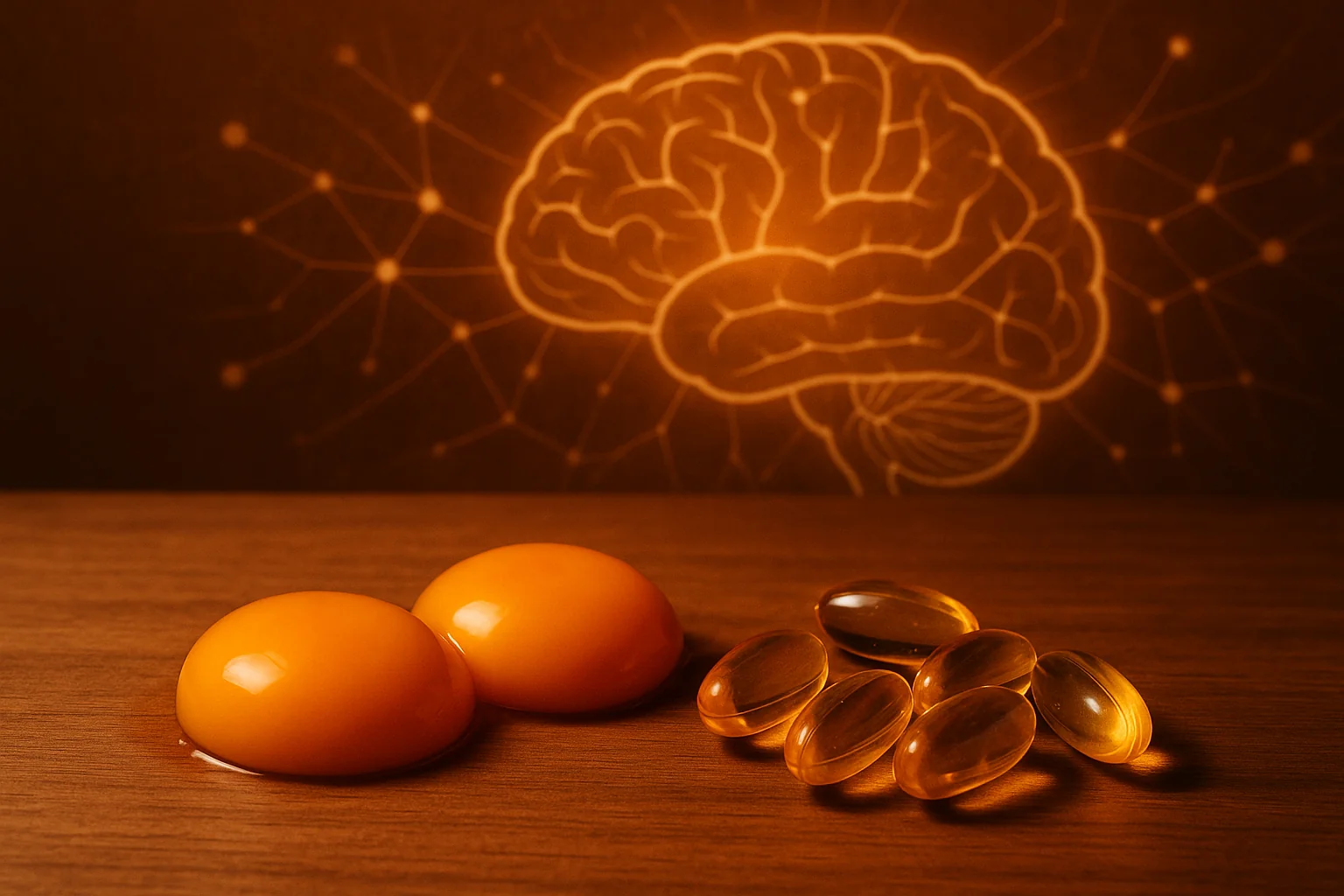
The richest source of choline in the diet is egg yolks - one large egg provides about 147 mg of choline, which constitutes over 1/4 of the daily requirement for an adult man. Other good sources include: beef liver (~356 mg/100 g), salmon (~91 mg/100 g), chicken (~84 mg/100 g), milk (~38 mg/200 ml), soybeans (~107 mg/100 g). Individuals on a plant-based diet without soy and eggs have difficulty meeting the AI solely from diet.
A nutritional experiment conducted by Zeisel and colleagues showed that adult men consuming a choline-poor diet (for 3 weeks) developed markers of liver (increased aminotransferases) or muscle damage, which reversed after choline supplementation (Zeisel and da Costa, Nutrition Reviews, 2009). This is one of the few nutritional studies that clearly documents the consequences of isolated deficiency.
How does choline affect the brain and memory?
Acetylcholine is the main neurotransmitter in the parasympathetic system and in the cholinergic system of the brain - structures critical for forming memories (hippocampus) and attention (prefrontal cortex). Cholinergic neurons are the first to degenerate in Alzheimer's disease, which is one of the reasons why acetylcholinesterase (the enzyme that breaks down acetylcholine) is a target for drugs used in this disease.
Does choline supplementation improve memory in healthy individuals? Studies in this group yield moderate results. A systematic review from 2022 found evidence of improved episodic memory with alpha-GPC supplementation in individuals with mild cognitive impairment (Sagaro et al., Nutrients, 2022), but the effects in healthy young adults were weaker. Conclusion: choline is important as a prevention of deficiency, not as a "superpower" in already well-nourished individuals.
The role of choline is particularly important in the first 1000 days of life. Clinical studies have shown that higher choline intake by pregnant women (above 450 mg per day) is associated with better attention and working memory test results in children at age 7, regardless of other factors (Caudill et al., FASEB Journal, 2018). Choline modulates the expression of genes involved in hippocampal neurogenesis through epigenetic mechanisms - mainly DNA methylation and histone modifications. This is one of the rare examples of a nutrient whose deficiency in the prenatal window can leave lasting marks on brain architecture.
Little-known fact: the PEMT gene polymorphism rs7946 (present in about 25% of premenopausal women) impairs endogenous choline synthesis. Women with this variant have an increased risk of developing choline deficiency even with an average diet, especially after menopause, when the protective role of estrogen in inducing PEMT decreases. Testing for this polymorphism is not routine, but it explains why some individuals on a cholesterol-rich diet may still require supplementation.
Choline and the liver - why does a deficiency lead to NAFLD?
One of the key functions of choline in the liver is the formation of phosphatidylcholine (PC) - a component of the VLDL lipoprotein shell. VLDL are "trucks" that transport triglycerides synthesized in the liver to peripheral tissues - muscles and adipose tissue. When there is insufficient choline, PC synthesis decreases, the VLDL shell is incomplete, and triglycerides accumulate in hepatocytes. This is a direct mechanism leading to steatosis.
Clinical studies confirm this relationship. A meta-analysis from 2020 showed that higher dietary choline intake is inversely proportional to the risk of NAFLD in women, although the relationship was weaker in men with high alcohol consumption (Li et al., European Journal of Nutrition, 2020). It is worth emphasizing that choline supplementation is a complement, not a substitute for dietary treatment and weight reduction in NAFLD.
Questions about choline in cases of liver steatosis come to us from individuals who have heard from their doctor, "you have liver steatosis" and are seeking supplemental support. The most common mistake: they focus on milk thistle and silymarin (which work differently - as hepatoprotection, not as "fat reducers"). Choline directly addresses the mechanism of fat accumulation, while milk thistle protects liver cells from oxidative stress. Both have a place in liver support programs, but they serve different roles.
Alpha-GPC, CDP-choline, or bitartrate - which form to choose?
The form of the supplement is very important, especially when the goal is cognitive effect. Alpha-GPC (alpha-glycerophosphorylcholine) is the most researched form in the context of brain health. It contains about 40% choline by weight, is quickly absorbed in the intestines, and effectively crosses the blood-brain barrier. Clinical studies confirm its effectiveness in improving attention and working memory at doses of 300-600 mg per day.
CDP-choline (cytidine) contains about 18% choline by weight, but after absorption, it also provides cytidine - a precursor of uridine, which participates in neurotransmitter synthesis and neuronal membrane repair. This makes it an interesting option for neuroprotection and support after a stroke (several European countries allow it as a medication for stroke). Dosage: 250-500 mg per day.
Choline bitartrate (choline chloride) is the cheapest form, about 41% choline by weight. It is well absorbed but has limited brain penetration. Suitable for covering basic metabolic needs and supporting the liver, less effective as a nootropic. Dosage: 500-1,000 mg per day to meet AI.
Frequently Asked Questions
What is choline and why is it essential?
Choline is a nutrient classified by EFSA as part of the B-vitamin group. It is a precursor of acetylcholine - a neurotransmitter crucial for memory and attention - and a component of phosphatidylcholine in cell membranes and VLDL shells in the liver. A deficiency leads to liver steatosis, memory impairment, and muscle function disorders. The body synthesizes some choline endogenously, but this does not cover the full requirement.
How much choline does an adult need daily?
EFSA (2016) established the adequate intake (AI) of choline at 400 mg per day for adult women and 550 mg for adult men. Pregnant women need 480 mg, and breastfeeding women - 520 mg. The upper limit (UL) is 3,500 mg per day. Over 90% of the European population does not meet the daily AI from diet alone.
What form of choline is best for supplementation?
Alpha-GPC has the highest bioavailability and best penetrates the blood-brain barrier - recommended for cognitive functions (300-600 mg/day). CDP-choline also provides cytidine, making it a good neuroprotective option (250-500 mg/day). Choline bitartrate is the cheapest and suitable for covering basic needs and liver support (500-1,000 mg/day), but works less effectively as a nootropic.
Does choline help with liver steatosis?
Yes - choline deficiency is a direct cause of NAFLD due to the limitation of phosphatidylcholine synthesis needed for VLDL formation. Choline supplementation in individuals with confirmed deficiency may reduce fat accumulation in the liver. However, it does not replace dietary treatment or weight reduction - it is a supplement, not the only intervention.
Is choline safe - what are the side effects?
At doses up to 550 mg per day, choline is safe for healthy adults. The EFSA UL is 3,500 mg/day. Above 3-4 g per day, side effects may include: fishy body odor caused by TMAO (trimethylamine N-oxide), nausea, vomiting, and hypotension. At nootropic doses of alpha-GPC (300-600 mg), side effects are rare - occasionally headaches at higher doses in sensitive individuals.
Does a vegan diet increase the risk of choline deficiency?
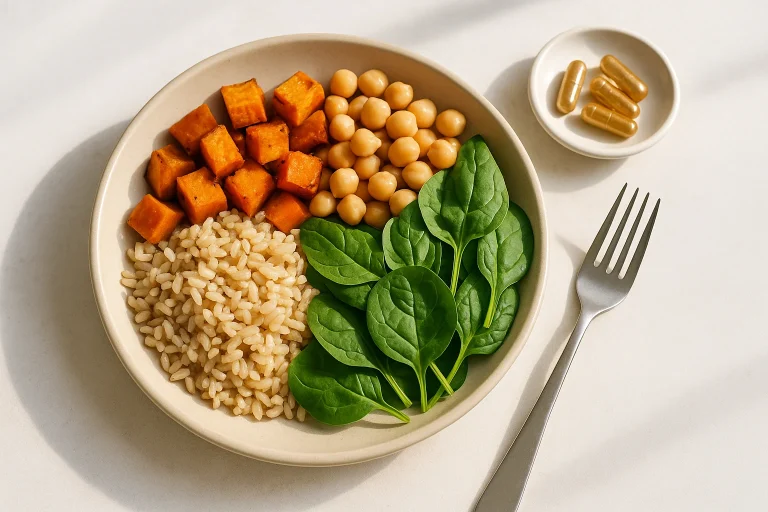
Yes - individuals on a plant-based diet without eggs and dairy products have significantly reduced access to choline. Eggs are the only widely available and very rich source of choline (~147 mg each). Vegans must rely on soy and soy products (~107 mg/100 g), peanuts (~52 mg/100 g), and kohlrabi (~17 mg/100 g) - achieving 400-550 mg per day from these sources requires conscious planning. Choline supplementation (bitartrate or alpha-GPC) is particularly justified for vegans when the diet is low in soy and nuts.
Can choline cause a fishy odor at normal dosing?
At physiological doses (up to 550 mg per day), fishy body odor is very rare. It occurs at high doses (3-4 g per day and more), when TMAO metabolism cannot keep up with the oxidation of trimethylamine produced from choline. Individuals with a rare deficiency of the FMO3 enzyme (flavoprotein monooxygenase 3) may be more sensitive even at lower doses - this is a genetically conditioned predisposition. With standard supplementation (300-600 mg of alpha-GPC or 500-1000 mg of bitartrate), there is no basis for concern about this effect.
This article is for informational and educational purposes and does not replace consultation with a doctor. If you are pregnant, breastfeeding, taking medications, or have chronic conditions, consult the use of supplements or herbs with a specialist.
Author: Michał Waluk · Published: 2026-05-04 · Updated: 2026-05-04