
How to increase the dose of CBD (titration): step-by-step scheme (table)
CBD titration without a ready dosage scheme: how long to wait between changes, what to observe, how to convert drops, and what EFSA says about safe dosing.
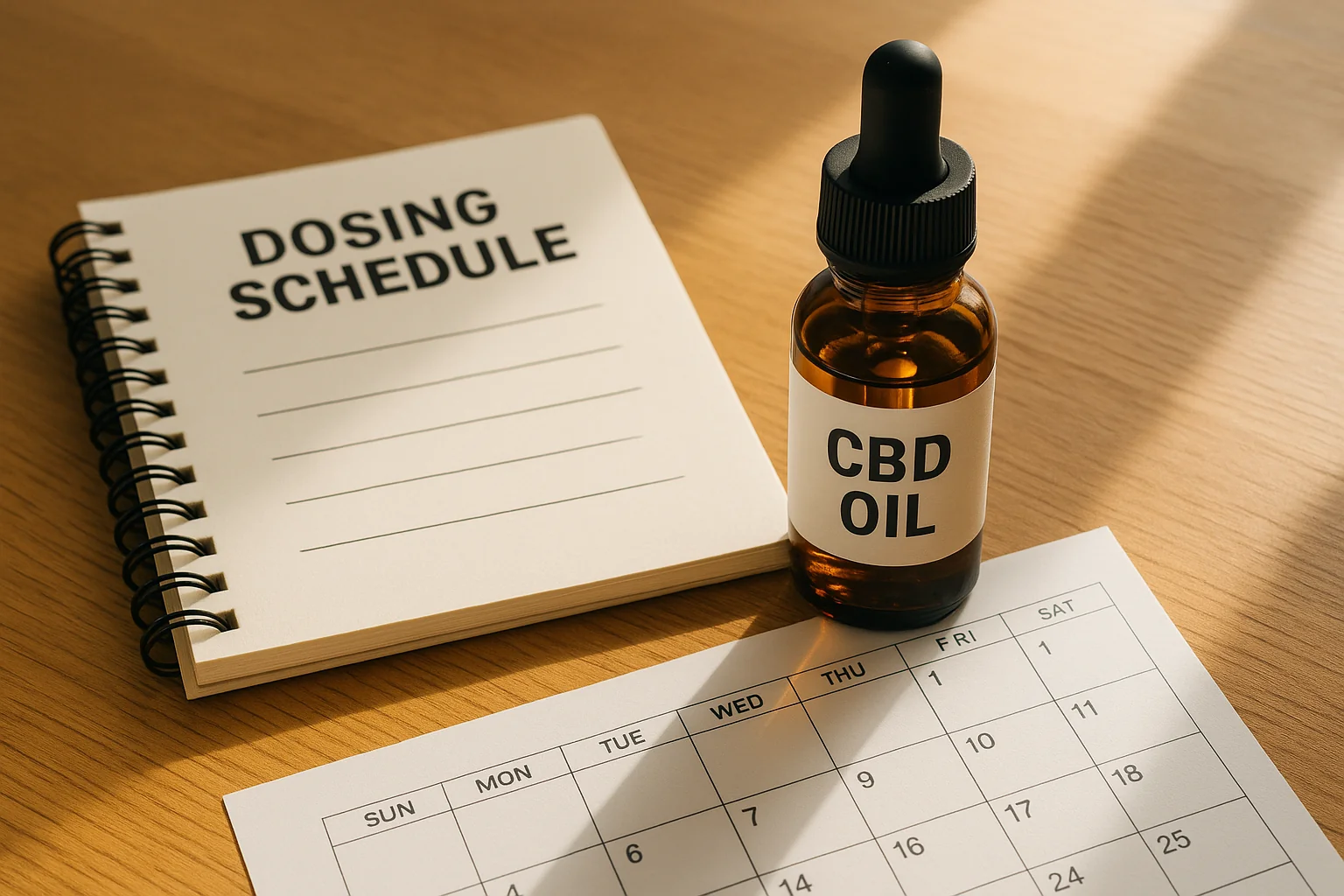
Titration is a methodical approach to finding the dose: in small steps, with breaks to assess the effect. In texts about cannabidiol, it is usually presented as a ready table of milligrams spread over weeks and body weight. This article does not contain such a table, and below I explain why it is not here. However, it includes what can actually be based on data in titration: how much time is needed before the assessment of the effect makes sense, what to observe between steps, how to convert the contents of the package into drops, and why the method of administration changes the result more than a slight change in the number of milligrams. The most common mistake with cannabidiol is not a poorly chosen number, but assessing the effect after three days, with changing times of administration and without any record of the baseline state. With such an approach, no dose will prove to be correct because there is nothing to compare the result to.
KEY INFORMATION
• This article does not provide a dosing schedule in milligrams. The choice of dosage, especially when dealing with illness or taking medications, is up to the doctor.
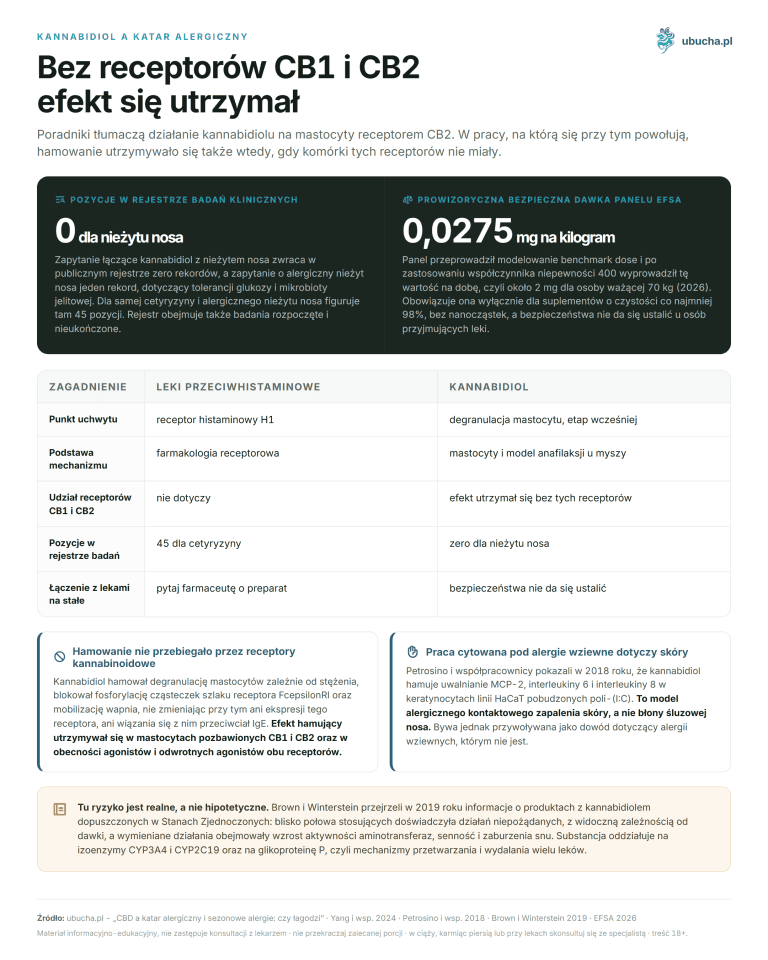
• EFSA (2026): the provisional safe dose of cannabidiol is 0.0275 mg/kg of body weight per day, which is about 2 mg for a person weighing 70 kg; safety cannot be established for individuals under 25 years of age, for pregnant and breastfeeding women, and for those taking medications.
• After repeated oral administration, the half-life of cannabidiol is 2-5 days, so the concentration stabilizes only after about two weeks.
• Evaluating the effect before this time cannot be distinguished from normal fluctuations in well-being.
• A fatty meal alters exposure to cannabidiol several times more than any change in dosage.
Will this article provide a ready dosing schedule in milligrams?
It will not, and this is a conscious decision. Publishing a table like "week one this many milligrams, week three that many" appears concrete, but in reality, it substitutes a recommendation in a place where there is no data. Text on the internet does not know the reader's diagnosis or their medications, and these two factors are what determine safety.
The second reason is numerical. The EFSA panel derived a provisional safe dose of cannabidiol in 2026 at 0.0275 mg per kilogram of body weight per day, which is about 2 mg per day for a person weighing 70 kilograms, using an uncertainty factor of 400. This value applies only to supplements with a purity of at least 98% and without nanoparticles (EFSA, EFSA Journal, 2026). Titration schemes circulating online lead to values several dozen times higher, so rewriting them here would mean providing a number contrary to the latest regulatory assessment.
The third reason directly concerns the reader of such an article. The same panel stated that the safety of cannabidiol cannot be established for individuals under 25 years of age, for pregnant and breastfeeding women, and for those taking medications. The last group is numerous among people seeking information about dosing, as they usually turn to it with a specific health issue. Instead of a number, you get a method and what is known about it from pharmacokinetics.
Why is titration based on time rather than on the number of milligrams?
Because the rate at which the body establishes the concentration of cannabidiol is better known than any relationship between dosage and effect. A systematic review of pharmacokinetic studies in humans included 24 works and reported the half-life of cannabidiol as 2-5 days with repeated oral administration (Millar i in., Frontiers in Pharmacology, 2018).
From this one number, everything else follows. Steady state, which is the moment when the amount taken balances the amount eliminated, is reached after four to five half-lives. With a range of 2-5 days, this gives from eight days to over two weeks. Until that time, the concentration in the blood continues to rise with an unchanged dose, so a change in well-being does not necessarily mean that more is needed.
There is another reason that is less frequently discussed. A review of the evidence on cannabidiol in anxiety disorders states that data on humans almost exclusively pertains to single administration, and there is little research on chronic administration (Blessing i in., Neurotherapeutics, 2015). In other words, there is no body of work from which a weekly schedule could be derived, as such long studies measuring effect have hardly been conducted. A method based on time and observation is therefore not only more cautious but also more honest regarding the state of knowledge.
How long should you wait between changes and what should you record?
No less than two weeks at each stage, as that is how long it takes for the concentration to stabilize. A shorter break does not answer the question of whether the change is due to the dosage: with unchanged procedures, the concentration during this time still increases.
The second issue is methodological and determines the value of the entire endeavor. Self-assessment from a month ago is unreliable, so comparisons must be made with a record, not with memory. A simple note with one number daily on a straightforward scale is sufficient. Without a starting point, after six weeks, it is impossible to distinguish improvement from habituation.
The third principle concerns the number of variables. If the dosage, the time of administration, and whether the preparation is taken on an empty stomach are all changed simultaneously, the result does not provide any information about any of those factors. One change per stage, the rest unchanged.
| Stage | Ile trwa | What to record | What not to do |
|---|---|---|---|
| Establishing a starting point | A week before the first dose | Sleep quality, tension, severity of the target symptom on a simple scale | Starting without recording the baseline state |
| Dochodzenie do stanu ustalonego | Od 8 dni do ponad 2 tygodni | Tolerance, time of administration, presence of fat in the meal | Assessing effectiveness after a few days |
| Ocena po kroku | Not earlier than after 2 weeks | Comparison with the baseline record, not with memory | Changing both the dosage and the time of administration at once |
| Decyzja o kolejnym kroku | After a full assessment | Is the improvement noticeable, partial, or none | Increase the dose without consulting when ill or on medication |
| Drowsiness during the day, persistent dry mouth, dizziness, or stomach issues are signals to return to the previous stage, not to wait it out. | |||
The determination of when to stop adjusting is described separately in the text about finding the dose that is sufficient.
How to convert the oil content into drops?
The conversion is based on three data points from the label: the concentration of the product, the bottle capacity, and the number of drops per milliliter. The first two are always on the packaging, the third is provided by some manufacturers, and if it is missing, the entire calculation becomes an approximation.
The percentage concentration indicates how much cannabidiol is present in 100 milliliters, so the content of the bottle is concentration times capacity times ten. A 5% oil in a 10-milliliter bottle contains 500 mg of cannabidiol, a 10% oil in the same bottle contains 1000 mg, and a 15% oil contains 1500 mg. To find the content of a single drop, this number is divided by the number of drops in the entire package.
With the commonly administered twenty drops per milliliter, a 10-milliliter bottle yields 200 drops. Thus, a drop of 5% oil carries 2.5 mg of cannabidiol, a drop of 10% oil carries twice that amount, and a drop of 15% oil carries proportionately more. It's worth checking this number on the packaging, as droppers vary between products, and it affects the entire conversion. These calculations serve to read the label, not to determine how much to take. More on the calculations is written in the guide to converting drops and milligrams.
Does the method of intake change how much cannabidiol reaches the bloodstream?
Yes, and more significantly than a slight adjustment in the number of milligrams. The effect of a meal is the best documented. In a study with eight adults, the same single dose of cannabidiol in capsules was given once fasting and once after a fatty meal of about 850 kilocalories.
After the meal, the maximum concentration in the blood was on average fourteen times higher, and the total exposure calculated as the area under the curve was four times higher than when fasting (Birnbaum i in., Epilepsia, 2019). Thus, the same content of the package provides a completely different exposure depending on when it is taken. A pharmacokinetic review confirms the trend: maximum concentration increases after a meal and with fatty forms.
However, it is important to know what is not included in this data. The circulating values of sublingual bioavailability of around several percent found online do not come from measurement. A systematic review states directly that the absolute bioavailability of cannabidiol in humans has only been measured for the inhalation route, where it was 31%, and no one has attempted such a trial for other routes of administration. The practical conclusion is simple: since a meal changes exposure several times, the conditions of intake must be stabilized before any conclusions about the dose can be drawn.
When to stop increasing the dose?
When the goal has been achieved, and when the next stage has not brought anything new. The goal of titration is the lowest dose that is sufficient, not the highest that can be tolerated. This distinction determines whether the process ever comes to an end.
Reasons to stop include: a noticeable improvement in the record maintained for two consecutive weeks, no additional benefit after the last change, and the emergence of symptoms that were not present before. The last point can be confused with an adjustment period, but in a stable condition, a symptom that does not subside after a few days is not temporary.
Separately, there is a boundary beyond which titration ends regardless of the outcome. If the reason for using cannabidiol is illness, if you are taking medication regularly, or if the symptom worsens, the next step is to talk to a doctor, not to make another change. The regulatory assessment clearly states that when taking medications simultaneously, the safety of cannabidiol cannot be established, and reports of liver burden have concerned such situations. The starting point for those who are just beginning is described in przewodnik po dawkowaniu CBD, a same preparaty do odmierzania kroplami znajdziesz w kategorii oils.
Frequently Asked Questions
How long to wait between successive steps of titration?
At least two weeks. The half-life of cannabidiol with repeated oral administration is 2-5 days, and steady state is reached after four to five half-lives (). This means that the effect is not immediate and dosing requires patience.). An earlier assessment does not distinguish the effect of the dose from ordinary fluctuations in well-being.
Why does this article not provide a scheme in milligrams?
Because the choice of dose depends on the diagnosis and medications taken, which the text does not know. EFSA stated in 2026 that the safety of cannabidiol cannot be established in individuals under 25 years of age, in pregnant and breastfeeding women, and in those taking medications. The numbers are determined by a doctor.
Does a meal change the effect of the oil?
Yes, and significantly. In a study with eight adults, a fatty meal raised the maximum concentration of cannabidiol in the blood fourteenfold, and total exposure fourfold compared to fasting administration (Birnbaum et al., 2019). Therefore, it is worth stabilizing the conditions of intake.
How much cannabidiol is in one drop of oil?
It depends on the concentration and the dropper. A 10-milliliter bottle contains 500 mg of cannabidiol at a concentration of 5% and 1000 mg at a concentration of 10%. With twenty drops per milliliter, this gives 200 drops in the package, so a drop of 5% oil carries 2.5 mg.
How to recognize that the dose is too high?
Drowsiness during the day, persistent dry mouth, dizziness, and gastrointestinal discomfort are typical signals. In a steady state, a symptom that does not subside after a few days is not transient and indicates a return to the previous stage, not just waiting it out.
This article is for informational and educational purposes only and does not constitute medical advice. Before starting to use hemp or CBD for therapeutic purposes, consult your doctor, especially if you are taking other medications, are pregnant, or breastfeeding.
Author: Michał Waluk · Opublikowano: 2026-07-10 · Aktualizacja: 2026-08-11