
Is CBD Flower a Drug? Government Withdraws the Ban
The government bill banning the sale of CBD flower for smoking was removed. The July 3, 2026 law does not include it. Check what applies from August 27.
Since July 2024, the Polish hemp industry has been focused on one question: will selling CBD flower for smoking become a crime? The Ministry of Health’s bill, listed as UD 85, proposed up to one year imprisonment for introducing fibrous hemp into trade for purposes other than industrial, food, or cosmetic. We reviewed the entire legislative process in documents from the Government Legislation Center and parliamentary prints. The answer is clear: the ban provisions were removed at the Standing Committee of the Council of Ministers stage, and the law passed on July 3, 2026, contains no trace of them. Below you will find the text of the withdrawn provisions, a timeline reconstruction, a description of what actually comes into force on August 27, 2026, and practical conclusions for flower buyers.
KEY INFORMATION
• Flower with a sum of delta-9-THC and THCA up to 0.3% dry mass remains legal as fibrous hemp (Art. 4 point 5 of the Act, wording from Journal of Laws 2022 item 763).
• The government bill UD 85 sought to punish selling flower for smoking with up to one year imprisonment and advertising with fines.
• Provisions on fibrous hemp trade disappeared from the draft in the text published on January 21, 2026.
• The July 3, 2026 law (Journal of Laws 2026 item 1004) comes into force on August 27, 2026, and does not concern flower sales.
• EFSA set a temporary safe daily intake of CBD in February 2026: about 2 mg per day for a 70 kg person.
Is CBD flower legal in Poland today?
Yes. Flower from industrial hemp, where the sum of delta-9-tetrahydrocannabinol and tetrahydrocannabinolic acid does not exceed 0.3% dry mass, is fibrous hemp under Article 4 point 5 of the Anti-Drug Act of July 29, 2005. It is not a narcotic, so Article 62 of the Act on penalties for possession does not apply.
This threshold has applied since May 7, 2022. It was introduced by the Act of March 24, 2022, Journal of Laws 2022 item 763, raising the limit from the previous 0.2%. Note the second sentence of the definition, rarely mentioned: the sum is rounded to one decimal place. A batch with 0.34% fits the definition, but 0.35% does not. In disputes with authorities, this single digit decides the product’s classification.
The second threshold works oppositely. Cannabis herb other than fibrous hemp is any aboveground plant part, excluding seeds, containing more than 0.3% of the same sum. The limit is strict and based solely on lab results, not appearance or smell.
The consequences differ drastically. Possession of narcotics contrary to the Act’s provisions under Article 62 paragraph 1 carries imprisonment up to 3 years, with significant amounts punished by 1 to 10 years, and smaller amounts by fines or restriction of liberty. Flower within the 0.3% limit is not a narcotic, so none of these apply.
The Act does not regulate the consumer’s purpose for using legally purchased flower. This gap has justified selling flower as a collector’s item or for aromatherapy. It also became a point of contention for the bill described below.
Until August 2026, nothing changed in this structure despite two years of work on an amendment that would alter it. The status described here was established as of August 15, 2026, based on texts published in the Journal of Laws and documents from the Government Legislation Center.
What exactly did the government bill UD 85 propose?
The bill did not explicitly say CBD flower is a drug. It worked more subtly: it closed the list of allowed trade purposes, making everything else illegal. The effect for hemp shops would be the same as listing flower as a narcotic, but without changing the definition in Article 4.
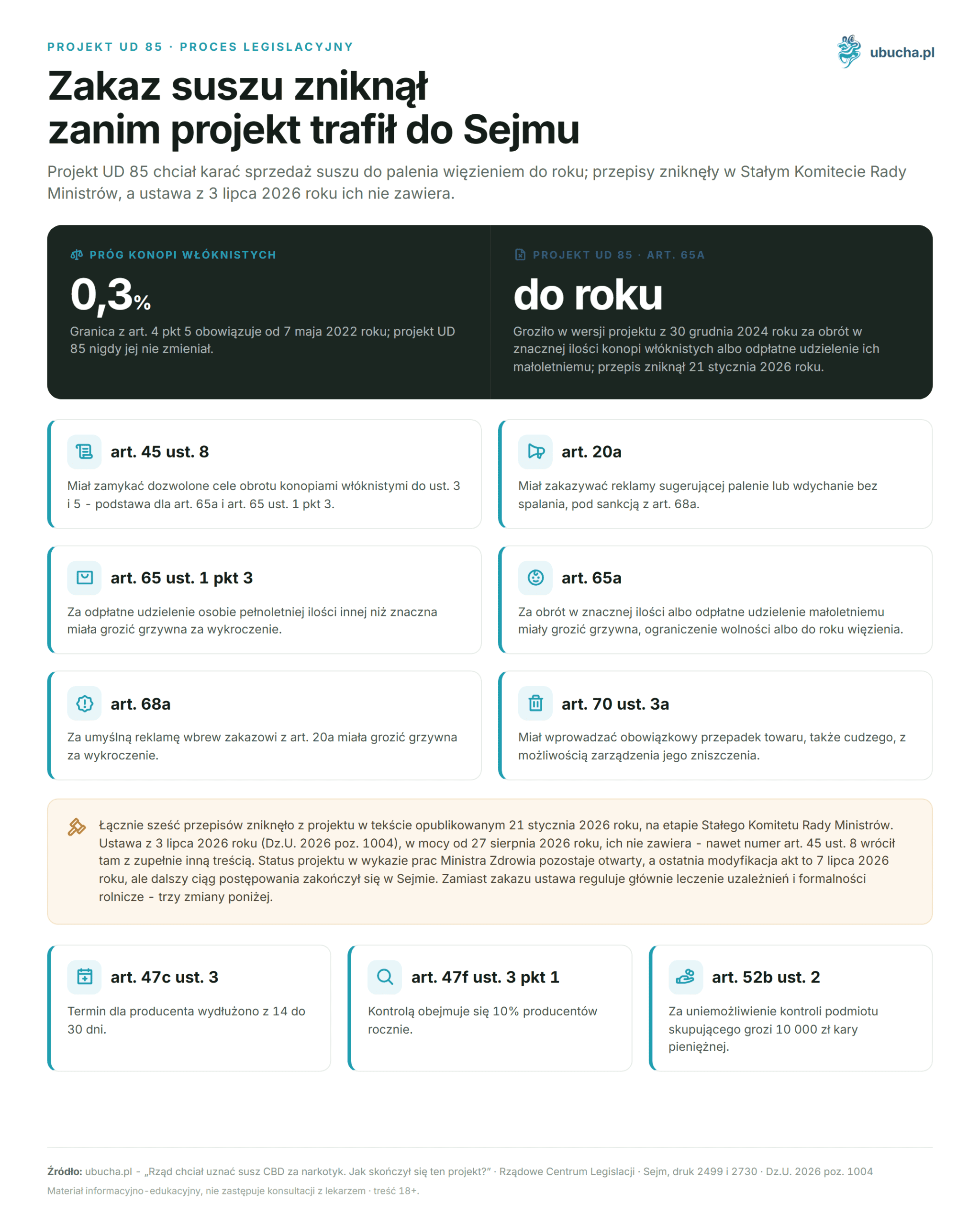
The December 30, 2024 version, available in the project files at the Government Legislation Center, contained six related provisions. The core was proposed Article 45 paragraph 8 stating: “Fibrous hemp and products made from it may be introduced into trade or used for financial gain only for the purposes listed in paragraphs 3 and 5.”
| Proposed Provision | What It Provided | Sanction |
|---|---|---|
| Art. 45 para. 8 | Trade in fibrous hemp only for purposes in paras. 3 and 5 | Basis for two criminal provisions |
| Art. 20a | Ban on advertising suggesting smoking or inhaling without combustion | Reference to Art. 68a |
| Art. 65 para. 1 point 3 | Paid provision to adult of non-significant amount | Fine for misdemeanor |
| Art. 65a | Trade in significant amount or paid provision to minor | Fine, restriction of liberty, or imprisonment up to one year |
| Art. 68a | Intentional advertising against Art. 20a ban | Fine for misdemeanor |
| Art. 70 para. 3a | Mandatory confiscation of goods, including third-party | Possible order of destruction |
The bill also amended the definition of introduction into trade in Article 4 point 34, adding fibrous hemp and products made from it. Without this correction, the other provisions would have nothing to prohibit, as the previous definition covered only narcotics, psychotropic substances, precursors, and new psychoactive substances.
Notably, the bill did not change the 0.3% threshold, did not list flower as a narcotic, and did not alter the fibrous hemp definition. Flower would remain an agricultural product, but selling it for smoking would become prohibited. This distinction is important: the consumer would not be liable for possession, but the seller for sale.
The bill provided a six-month vacatio legis for this part of the regulation to allow shops to sell off stock. The rest of the changes would come into force 14 days after publication.
What was the Ministry of Health’s reasoning?
It hinged on one word: “consumption.” The bill’s justification assumed that cultivating fibrous hemp for food purposes is legal, but inhaling by smoking or without combustion is not consumption. The authors even cited the PWN dictionary definition, where to consume means to introduce food through the mouth into the stomach.
From this, they concluded that smoking and vaporizing are use, not consumption, so cultivation for such purposes is outside the allowed list. Article 45 paragraph 3 of the current Act lists five groups of cultivation purposes for fibrous hemp.
- Textile, chemical, cellulose-paper, cosmetic, pharmaceutical, and energy needs
- Seed production and scientific research
- Breeding fibrous hemp varieties and land reclamation and remediation
- Food, veterinary, feed, beekeeping, fertilizer, insulation purposes
- Production of composite materials, building materials, and natural plant protection agents
Smoking is not and never was on this list. Proposed Article 45 paragraph 8 would not add a direct ban but would close the list from the trade side.
The justification called this a normative deficit. The authors noted that only selling would be punishable, not use. Offering flower to a friend socially would be outside penalization, as such acts lack social harm or have negligible harm.
The justification also addressed cross-border trade. The authors wrote that the gap results in consumers buying products of unknown origin abroad that may cause intoxication and addiction. The advertising ban in Article 20a was to close this loophole. The provision would cover advertising visible to users with Polish IP addresses, regardless of server location.
The bill’s authors explicitly expected an educational effect. The justification stated that new prohibited acts would start shaping legal awareness and reduce interest in these substances among current users. The argument was based not only on health protection but also on changing attitudes.
We noted something missed in press comments: proposed Article 45 paragraph 8 would also cover products beyond flower and e-liquids. The justification explicitly mentioned future forms of administration, e.g., injection or nasal inhalation.
When did the ban provisions disappear from the draft?
In the text published on January 21, 2026. The draft returned then to the Standing Committee of the Council of Ministers as a new text, already without provisions regulating fibrous hemp trade. From the first version in July 2024, one and a half years of inter-ministerial consultations, opinions, and public consultations had passed.
Comments were submitted by the Ministry of Infrastructure, Ministry of Finance, Ministry of Internal Affairs and Administration, Government Legislation Center, Ministry of National Defense, Ministry of Agriculture and Rural Development, and Ministry of Justice. The RCL files contain dozens of such positions, some dated May and June 2025.
| Date | Stage |
|---|---|
| July 11, 2024 | First version of UD 85 sent for consultations |
| October 16, 2024 | Second version of the draft |
| December 30, 2024 | Third version, still with Art. 45 para. 8, Art. 65a, and Art. 68a |
| September 23, 2025 | Draft at Standing Committee of the Council of Ministers |
| January 21, 2026 | New text without fibrous hemp trade provisions |
| March 2 and 31, 2026 | Legal Committee |
| April 30, 2026 | Draft submitted to Sejm as print 2499 |
| June 11, 2026 | Sejm passes the law |
| June 25, 2026 | Senate resolution, print 2730 |
| July 3, 2026 | Sejm considers Senate amendments, law date |
| July 27, 2026 | Publication in Journal of Laws under position 1004 |
| August 27, 2026 | Entry into force |
The project’s status in the Ministry of Health’s work list remains open, with the latest modification dated July 7, 2026, at the Standing Committee of the Council of Ministers. Open status does not mean ongoing processing: the procedure continued in the Sejm and ended there.
It is worth comparing these dates with media coverage. Articles describing the bill as a current threat appeared as late as spring 2026, although the provisions had disappeared from the text sent forward in January. The gap between public discourse and legislative status was several months.
The original version of this article described the status as of April 25, 2026, speaking of the ban projects in the future tense. By that date, the provisions on fibrous hemp trade no longer existed, and five days later the draft without them was submitted to the Sejm. We correct this explicitly, as the date of status is part of legal content, not decoration.
What does the July 3, 2026 law actually change?
Mainly provisions on addiction treatment, trade in narcotics in medical entities, and agricultural formalities. The text published in the Journal of Laws 2026 item 1004 contains no mention of “advertising,” “inhaling,” or significant amounts of fibrous hemp.
We checked the full law text against the six provisions from the table above. None survived. Articles 20a, 65a, and 68a simply do not exist in the published version. Curiously, Article 45 paragraph 8 was reused but with completely different content than in the draft.
| Amended Provision | Nature of Change |
|---|---|
| Art. 45 paras. 8 and 9 | Definitions of own processing and cultivation for own needs |
| Art. 47c para. 3 | Deadline for producer extended from 14 to 30 days |
| Art. 47f para. 3 point 1 | Control covers 10% of producers annually, no obligation to revisit same farms yearly |
| Art. 52b para. 2 | 10,000 PLN fine for obstructing control of purchasing entity |
| Art. 65 para. 2 | No misdemeanor if cultivation area difference caused by weather losses |
| Art. 44c para. 11 | New name of EU body: European Union Agency for Drugs |
The main weight of the amendment lies outside agriculture. The law expands access to treatment for addicted persons and simplifies procedures for public institutions. It also organizes medical aid abroad, e.g., during disasters, and reporting to the Chief Pharmaceutical Inspector.
One notable criminal provision change is Article 57 paragraph 2, which now provides up to 3 years imprisonment for preparation of crimes under Articles 53 para. 2, 55 para. 3, and 56 para. 3. This concerns manufacture and trade in narcotics, not fibrous hemp.
The law enters into force 30 days after publication, i.e., August 27, 2026. It does not provide a separate, longer vacatio legis for trade, as there is nothing left to postpone.
Who will the August 27 law actually affect?
Primarily farmers and purchasing points, not consumers. Changes concern deadlines, control scope, and administrative penalties in the fibrous hemp registry maintained by the National Agricultural Support Center. If you buy flower in a shop, you will not notice anything on August 27, as no new obligations arise for sellers.
The group is larger than the cultivation area suggests. According to KOWR data published October 21, 2025, the number of producers in the registry nearly quadrupled in four years, from 425 to 1606. The area grew much slower and has been practically stable since 2023. The number of small, few-hectare plantations is increasing, not the size of individual farms.
| Year | Cultivation Area | Producers in Registry | Purchasing Entities |
|---|---|---|---|
| 2022 | approx. 843 ha | 425 | 31 |
| 2023 | approx. 1,274 ha | 1,139 | 86 |
| 2024 | approx. 1,371 ha | 1,327 | 87 |
| 2025 (Sept 30) | 1,275 ha | 1,606 | 80 |
Geographically, cultivation shifted. In 2022, Lower Silesian and Greater Poland voivodeships dominated; in 2025, Lublin, Masovian, and Warmian-Masurian lead. For flower buyers, the simple conclusion is: domestic raw material is available, and sellers should be able to indicate their source.
The limit for cultivation for own needs remains unchanged at 1 hectare per year. The new definition in Article 45 paragraph 9 clarifies that such cultivation serves to obtain products used on the farm, without resale possibility. Paragraph 8 defines own processing as processing yield from own crops with intent to sell processed products.
This distinction matters practically for small farms. A farmer harvesting and selling raw material and a farmer processing and selling finished products were previously assessed based on authority practice. From August 27, 2026, both situations have statutory definitions, which should reduce disputes during inspections.
The 10,000 PLN fine for obstructing control of purchasing entities is a new instrument. Previously, sanctions mainly concerned unlawful cultivation and discrepancies in reported area; blocking control had no specific penalty.
Is CBD psychoactive?
Not in the sense THC is: cannabidiol does not stimulate the CB1 receptor, so it does not cause intoxication, impair psychomotor skills, or produce an effect that could be called being under influence. In a broader sense, including any effect on the central nervous system, cannabidiol has effects, as clinical studies showed it reduces anxiety and seizure frequency. Both statements are true but refer to different things.
This distinction has legal consequences. The statutory limit in Poland is set by THC content, not cannabidiol properties, so the debate on whether CBD is psychoactive does not affect trade. The decisive factor is the 0.3% sum of delta-9-THC and THCA in dry mass.
One caveat on sources: Polish texts often cite the 2018 WHO report to support lack of psychoactivity. We do not base this paragraph on it, as we could not access the original, and our article on addiction and intoxication consciously does not use it. The above statements rely on clinical data and verifiable legal provisions.
How does EU law limit national CBD bans?
Through the free movement of goods principle. The Court of Justice of the EU ruled on November 19, 2020, in case C-663/18, known as Kanavape, that Articles 34 and 36 TFEU oppose national bans on CBD legally produced in another member state unless a real public health risk is demonstrated.
The Court also rejected the claim that CBD extracted from the whole cannabis plant is a narcotic under the 1961 Single Convention. It justified this by the lack of psychoactive properties confirmed by scientific knowledge.
This shield has clear limits rarely discussed in Poland. The ruling protects goods brought from another EU country, not goods produced and sold entirely in Poland. Member states retain the right to restrictions if based on reliable risk assessment and proportional measures. The Court noted that the French ban would not cover synthetic CBD with the same properties and that confirming this would indicate inconsistency.
The case concerned e-cigarette oil made in the Czech Republic from the whole cannabis plant and sold in France, where only fibers and seeds were allowed. The Court found the French ban equivalent to a quantitative restriction, which Article 34 TFEU excludes.
It also resolved a technical issue relevant in subsidy disputes. Regulations 1307/2013 and 1308/2013, governing direct payments and common market organization, do not apply to national measures banning CBD sales. Agricultural law arguments will not work in trade ban disputes.
A member state may still invoke Article 36 TFEU restrictions but must base them on the most reliable scientific data. Mere uncertainty about safety is insufficient evidence of harm.
If UD 85 had entered into force as originally drafted, a dispute over compliance with Article 34 TFEU would be almost certain. The construction based on use purpose, not chemical composition, would also cover flower legally imported from Czechia or Germany.
What CBD flower is and how it differs from marijuana is explained in a separate guide.
What did EFSA say about CBD safety in 2026?
That data are still lacking but for the first time gave a number. On February 9, 2026, EFSA’s Nutrition Panel set a temporary safe intake level of 0.0275 mg per kilogram body weight per day, about 2 mg per day for a 70 kg adult (EFSA Journal, 2026). The value was derived by benchmark dose method with an uncertainty factor of 400 and applies only to supplements with at least 98% pure cannabidiol, without nanoparticles.
The panel closed its opinion with a statement to be read with this number: CBD safety cannot be established for persons under 25 years old, pregnant or breastfeeding women, and those taking medications. This is not a marginal note but a conclusion alongside the dose, covering three groups that include a significant portion of readers.
This updates the 2022 position, where the panel could not identify a no observed adverse effect level among 19 applications. A literature review to June 2024 confirmed gaps remain due to short study durations, non-standardized protocols, and concomitant medication use.
Four years ago, the panel explicitly noted missing data on CBD’s effect on drug metabolism, toxicokinetics in various matrices, half-life, and accumulation. The order matters: until these data exist, authorization remains suspended regardless of market size.
What specific gaps did EFSA identify?
Liver, nervous system, hormones, and reproduction, with the strongest signals from animal studies. The panel’s conclusions are cautious because data in these four areas are either animal, short-term, or from subjects taking medications.
Animal studies showed repeatable liver toxicity, with liver mass and histopathological changes as the most sensitive endpoints. Human studies indicated hepatotoxic potential, especially when combining CBD with drugs. Neurological and psychiatric safety data were insufficient, and CBD’s ability to cross the placenta was a reason for caution.
The panel also described hormonal disturbances in animals, including thyroid hormone changes, and long-lasting, sex-dependent neurodevelopmental effects after prenatal exposure. Reproductive toxicity remains a point needing more data.
Bioavailability is a separate issue. Pharmacokinetic studies confirmed CBD absorption varies by matrix and with food intake. This variability complicates extrapolating results from one study to another product and explains why the panel set a temporary, not final, level.
This assessment concerns CBD as a food ingredient under Regulation 2015/2283 on novel foods. Hemp flower is not sold as food in Poland, so formally remains outside this scope. Advocates of stricter regulation still cite these gaps, as lack of data is easily presented as risk evidence.
Does science consider CBD a narcotic?
No. The WHO Expert Committee on Drug Dependence at its 40th meeting in June 2018 recommended that preparations recognized as pure CBD not be subject to international narcotic control. The rationale was lack of psychoactive properties and no abuse or dependence potential (WHO, 2018).
The 2017 review by Iffland and Grotenhermen, one of the most cited on CBD safety, confirmed a favorable adverse effect profile compared to drugs used in epilepsy and psychotic disorders (Cannabis and Cannabinoid Research, 2017). Most reported effects were fatigue, diarrhea, and appetite and weight changes.
However, the same review identified areas needing study: CBD’s impact on liver enzymes, drug transporters, and hormonal balance. The authors noted a lack of large, long-term studies.
WHO’s recommendation had procedural consequences. The session was convened specifically to assess cannabis and related substances, with results announced at a press conference in September that year. The conclusions were submitted to the UN Narcotics Commission for classification decisions.
The Kanavape ruling relied on similar grounds. Since available knowledge does not indicate psychotropic effects, CBD does not fit the narcotic definition under the 1961 Convention. The alignment of public health authority and EU court positions is a strong argument against classifying cannabidiol itself as a drug. The distinction between psychoactive and intoxicating substances is explained in a separate article: Is CBD non-psychoactive?.
Evidence quality on benefits is a separate matter. EFSA noted most human data come from studies on Epidyolex at therapeutic doses, where adverse effects are accepted due to benefit. For food, this balance does not apply, so the same studies have less evidential value.
It is important to distinguish two questions often conflated in public debate. WHO answered whether CBD requires international narcotic control and said no. EFSA answers how much CBD can be safely consumed daily and says data are insufficient. A negative answer to the first does not determine the second.
Can CBD flower cause a positive drug test?
It can, but THC present in full-spectrum products is responsible, not CBD itself. Standard immunoassays detect the THC-COOH metabolite, which pure CBD does not produce. What matters is what accompanies cannabidiol in the product.
The best data come from Spindle et al. 2020 (Journal of Analytical Toxicology), where six healthy adults underwent all administration variants. After 100 mg pure CBD orally or by vaporization, only 1 of 218 urine samples tested preliminarily positive at a 20 ng/ml cutoff, and none exceeded the 15 ng/ml confirmation cutoff. After vaporizing CBD-rich flower containing 3.7 mg THC, nine samples were preliminarily positive, four confirmed by LC-MS-MS. The authors concluded a single dose of pure CBD does not yield a positive workplace test, but products with THC admixture can.
With longer use, the percentage rises. In an open study by Dahlgren et al. published in JAMA Psychiatry, participants took a full-spectrum product averaging 34.7 mg CBD and 0.8 mg THC daily for four weeks. After this, 7 of 14 had positive THC-COOH results, exactly half, though none reported psychoactive effects. The product contained 0.02% delta-9-THC by weight, fifteen times less than the fibrous hemp limit.
CBD concentrations in urine are sometimes confused with THC. After oral administration, mean peak concentration was 776 ng/ml, after vaporization 261 ng/ml. Standard drug tests do not detect these as they target a different compound. Also remember the difference between screening and confirmation tests: immunoassays work at 20, 50, or 100 ng/ml thresholds and give preliminary results; confirmation by chromatography at 15 ng/ml is definitive. We covered this separately in Does CBD show on drug tests?.
The conclusion for flower users is simple and sobering. THC metabolite accumulates with daily use, so a one-day break before testing does little. In Dahlgren et al., positive results correlated statistically only with creatinine concentration, not age or dose. If subject to sobriety tests, CBD isolate carries less risk than flower or full-spectrum oil.
How to buy flower so documentation protects you during inspection?
Collect three things: batch test result, proof of purchase, and original packaging. Officers cannot distinguish fibrous hemp flower from cannabis herb on the spot, as the boundary is set only by lab results. Documents shorten the path to clarifying the matter.
- Analytical certificate of the batch showing the sum of delta-9-THC and tetrahydrocannabinolic acid, not just delta-9-THC, as the legal definition counts both together.
- Batch number on packaging matching the certificate number; otherwise, the document proves nothing.
- Proof of purchase with product name and seller data, preferably an invoice retained in the seller’s system.
- Strain name from the EU hemp variety catalog, linking the product to legal cultivation.
- Producer data registered in the fibrous hemp registry, which the seller should provide on request.
Beware of documents that do not identify a specific batch. Such files sometimes circulate among offers from different sellers and say nothing about the product in your hands. If buying hemp flower, ask for the result for the specific batch before purchase, not after. Separate documentation applies to patients with prescriptions, as described in police control and medical marijuana.
Read the certificate from the header, not the results table. It should indicate the testing laboratory, sample collection date, and batch identifier. Only then look at numbers, as a result without these three elements cannot be linked to a specific product.
Also check what the sample concerned. The legal limit applies to flower or fruiting tops with resin intact, the richest cannabinoid part. Results from leaves or mixed biomass will be lower and do not answer the legal question.
Note whether the lab reported delta-9-THC alone or the sum with tetrahydrocannabinolic acid. Many chromatographic methods decarboxylate the sample during analysis and report total THC, but this is not universal. The legal definition requires the sum, so a certificate with only delta-9-THC does not directly answer the authority’s question.
Storage method also matters legally. Flower transferred to an unmarked jar loses connection with label and certificate. How to keep material in original packaging without quality loss is covered in storage accessories.
What to watch after August 27, 2026?
Three places: Journal of Laws, legislative work list, and parliamentary prints. The UD 85 history showed that fate of provisions is decided at the government stage, not parliamentary. Provisions on flower disappeared before the draft reached the Sejm, so tracking votes would not have warned.
A private member’s bill amending the Anti-Drug Act is still pending in the Sejm, submitted March 27, 2026, and referred for first reading on June 11, 2026. It concerns decriminalizing possession of small amounts of cannabis herb other than fibrous hemp and cultivation of one plant for personal use. It does not cover fibrous hemp flower but will show legislative attitude direction.
The second thread is novel food procedure. CBD applications have been with EFSA since 2019, and the February 2026 opinion set a temporary intake level, not authorization. EU-level decisions will affect oils and food, not flower, but food arguments often recur in Polish drafts.
To check legal status, two addresses suffice. eli.gov.pl shows the promulgated text with publication and entry into force dates; for fictitious acts, it simply does not open the page. The Government Legislation Center shows successive draft versions with dates, allowing to see when a provision appeared and disappeared.
Our advice from this reconstruction: compare versions, not headlines. The difference between the December 30, 2024 version and the January 21, 2026 text is six provisions simply missing, and no press summary shows this as clearly as two files side by side.
Fair to add the matter is fluid. We established the status on August 15, 2026. A new draft may appear in any minister’s work list at any time, and a one-time removal of provisions does not mean they won’t return under another number and justification.
Frequently Asked Questions
Is CBD flower legal in Poland in August 2026?
Yes. Industrial hemp with a sum of delta-9-THC and tetrahydrocannabinolic acid not exceeding 0.3% dry mass is fibrous hemp under Article 4 point 5 of the Anti-Drug Act. The government bill that aimed to change this lost the relevant provisions before submission to the Sejm.
Does the July 3, 2026 law ban the sale of CBD flower?
No. The text published in the Journal of Laws under position 1004 does not include the proposed Article 20a on advertising ban, nor Article 65a on imprisonment, nor Article 68a. The law comes into force on August 27, 2026, and mainly amends cultivation and addiction treatment provisions.
What exactly did the UD 85 bill propose?
The proposed Article 45 paragraph 8 allowed trade in fibrous hemp only for purposes listed in paragraphs 3 and 5, i.e., industrial, food, and cosmetic. Selling flower for smoking became illegal, and Article 65a provided up to one year imprisonment.
Who caused the provisions on flower to be removed?
The provisions disappeared at the Standing Committee of the Council of Ministers stage. The new draft text was published in the RCL on January 21, 2026. This was preceded by ministry comments during consultations and public consultations from July 2024 to July 2025 involving industry organizations.
Can CBD flower cause a positive drug test?
It can, but THC present in full-spectrum products is responsible, not CBD itself. In Spindle et al.’s study, after pure CBD only 1 of 218 urine samples tested preliminarily positive. In Dahlgren et al., after four weeks of full-spectrum product use, 7 of 14 participants had a positive result.
Does EU law protect the Polish CBD market from a ban?
Partially. The CJEU ruling of November 19, 2020, in case C-663/18 prohibits blocking CBD legally produced in another member state without demonstrating a real health risk. It does not protect against national regulation covering only goods produced and sold in Poland.
How much CBD daily does EFSA consider safe?
In February 2026, the NDA panel set a temporary safe intake level at 0.0275 mg per kilogram body weight per day, about 2 mg for a 70 kg adult. This applies to CBD as a food ingredient, not flower. Safety cannot be established for persons under 25 years old, pregnant or breastfeeding women, or those taking medications.
What documents should you have when buying flower?
An analytical certificate of the batch showing the sum of delta-9-THC and THCA, proof of purchase with product name, and original packaging with strain designation. The seller should also indicate the producer registered in the fibrous hemp registry maintained by the National Agricultural Support Center.
If you seek material with full batch analytics, visit the hemp flower category, and for formats with more stable regulatory status, see hemp oils.
This article is informational and educational and does not constitute legal advice. The legal status described applies as of the update date, and hemp regulations may change. Consult a lawyer or current legal acts before making decisions.
Author: Michał Waluk · Published: 2026-05-10 · Updated: 2026-08-24