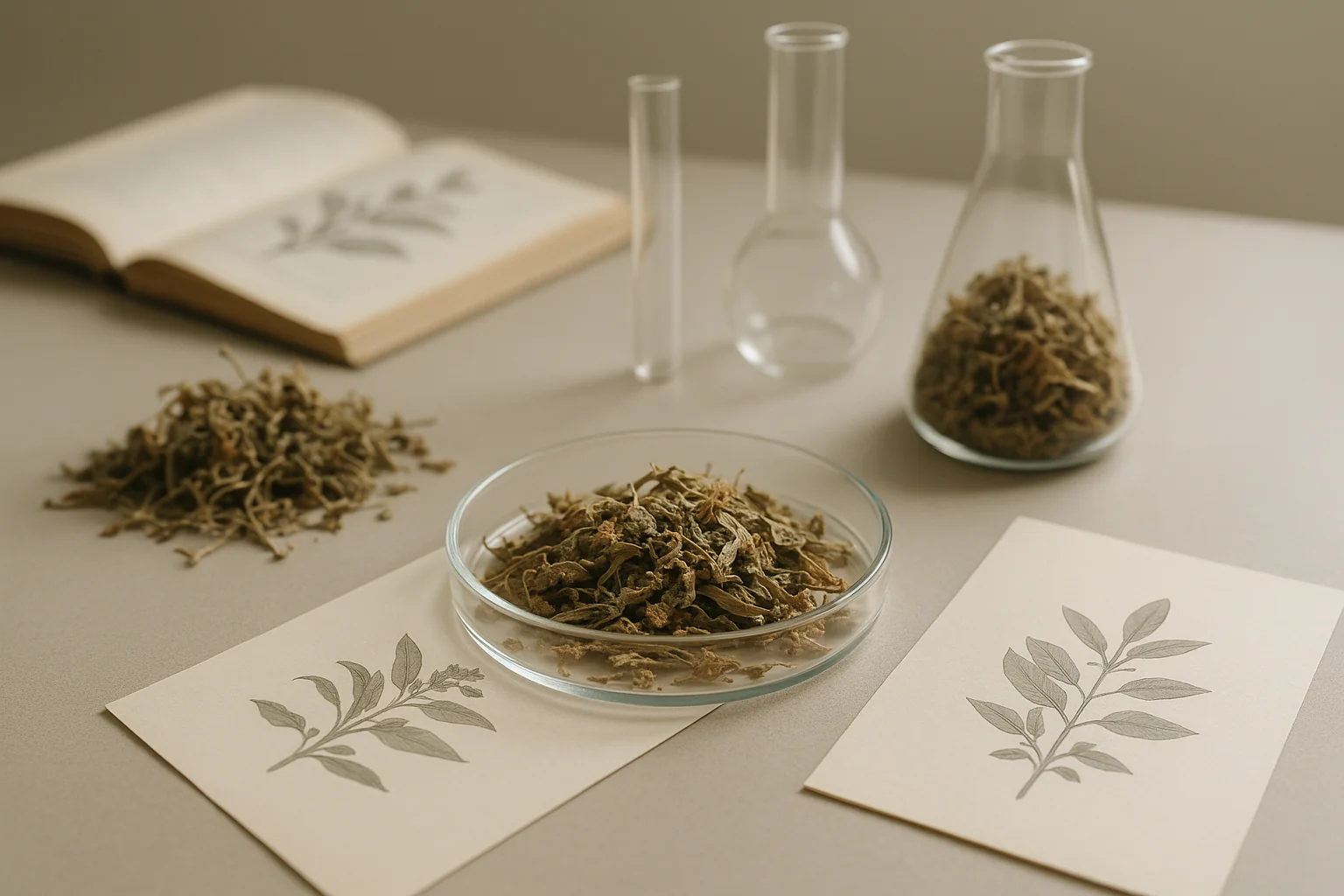

PhytoPur Bio: three strains, one registration, and data closed to the patient
PhytoPur Bio is listed on the label as the responsible entity, and its three pharmaceutical positions share one registration name. Very little can be publicly established about the origin of this raw material, and this entry states exactly what.
Who is PhytoPur Bio and where does the raw material for this brand come from?
PhytoPur Bio is a limited liability company based in Warsaw, which is listed on the pharmacy label as the responsible entity for three dried flower products, rather than as their grower. It describes itself as a pharmaceutical company and distributor. The cultivation locations are not provided in any material available without logging in.
The registration data is provided by the company itself in a leaflet for doctors and pharmacists: PhytoPur Bio sp. z o.o., al. Jana Pawła II 27 in Warsaw, KRS number 0000968820. The same address is repeated on the product cards of online pharmacies, which list this company as the producer, not any grower from outside Poland. The company states that it utilizes experience in cultivation, processing, and distribution, as well as partnerships with industry leaders across Europe. No partner is named in this statement.
The same leaflet describes the company as a leading supplier of medical marijuana in Poland. The pharmacy inventory on which this statement is based does not confirm this: the brand is responsible for three cultivars out of eighty-five and for three products out of one hundred forty-one, which is exactly the same as Suprobion and over ten times less than S-LAB. Therefore, the statement about being a leader is a commercial declaration, not a verifiable number.
Where does the raw material itself come from? One source says it is not the producer. The store blog states that the supplier of raw material for this brand is the Danish company Schroll Medical. The Schroll company's own website describes cultivation near Odense and production in Denmark and Portugal, mentions the EU-GMP certificate and export to five markets, but does not mention either Poland or the PhytoPur Bio brand. Thus, the connection is based on one commercial description, not on a document from either party.
Which PhytoPur Bio strains are available in Polish pharmacies?
Three. Big Purple Dragon and Frosted Lemon Angel are exclusive to this brand in this selection, while Gorilla Glue is supplied alongside three other producers. All three products share the same terpene profile, caryophyllene, which is not obvious given their three different lineages.
| Strain | Lineage according to available sources | Genetics in descriptions | Pharmacy products in this selection | Other producers of this name |
|---|---|---|---|---|
| Big Purple Dragon | Purple Urkle x Dragon’s Breath | hybrid | 1 | none |
| Frosted Lemon Angel | Lemon Skunk x Kosher Kush | hybrid or hybrid with indica dominance, depending on the source | 1 | none |
| Gorilla Glue | Chem’s Sister x Sour Dubb x Chocolate Diesel | hybrid or hybrid with indica dominance, depending on the source | 1 | CanPoland, Four 20 Pharma, Suprobion |
Each of them has its own entry in this listing with a profile and lineage: Big Purple Dragon, Frosted Lemon Angel and Gorilla Glue. A complete list of products available in pharmacies is maintained by the selection of medical marijuana strains, which also includes equivalents of the same names from other manufacturers.
Gorilla Glue is a special case here, as this trade name is used for dried flower from four manufacturers simultaneously in Polish pharmacies. However, the name does not carry any declarations: each of them registers its own position with its own content and its own series documentation. Moreover, in the company's 2025 brochure, Gorilla Glue does not appear at all, although two Polish pharmacy listings assign this brand exactly such a position.
Besides the dried flower, the brochure mentions two positions of a standardized extract described by the name Cairo, with a lineage of Amnesia Haze x White Widow. The extract is not dried flower and does not belong to this listing, which describes only the flower. It appears here only to clarify that the brand's portfolio is broader than the three names in our inventory.
How does PhytoPur Bio's raw material differ from other suppliers?
On paper, nothing that could be verified at the source. What distinguishes it is the registration method: two flower varieties share one number listed in the brochure, and the pharmacy profile database assigns all three the same registration name, without a designation indicating the cultivar. The rest of the differences come down to packaging and the recommended route of administration.
The registration name is "Cannabis flos PhytoPur Bio" and does not include the variety name. In the pharmacy profile database, all three cards of this brand indicate the same registration identifier, and the manufacturer's brochure assigns the same number described as the MAH number to Big Purple Dragon and Frosted Lemon Angel. Therefore, the variety name acts as a trade designation added to one registration, rather than as a separate registration position.
The result is that the registration name itself does not determine which cultivar will be in the packaging. This is only clarified by the variety designation on the series label or the wholesaler's note, and only there can you see which of the three names is being referred to.
Little more is known about the process than what is conveyed by the packaging. The dried flower comes in ten-gram packages, and the brochure indicates inhalation using a certified medical vaporizer as the recommended route of administration. Information about sterilization by beta radiation is provided in the store description, not in the company's material, so this is not data confirmed by the manufacturer.
However, nothing distinguishes it from what would allow for comparing series between suppliers. Aside from the gateway for doctors, there is no publicly available analysis certificate for any batch, no one names the plantation, and the company does not provide the manufacturing license number in open materials.
What is known, and what is not known about this manufacturer's raw material?
What is known is as much as fits on the label and one brochure. It is unknown who cultivates the raw material, in which country the plantation is located, or what results were obtained from the analysis of a specific series, as the company does not publish analysis certificates in a place accessible to patients, and its own service is closed off to them with a gateway for doctors.
On the documentation side, there is what is visible on the pharmacy label: registration name, form, ten-gram packaging, and Rpw category. Additionally, there is a brochure for medical professionals in which the company provides its own registration data, a number described as MAH, the declared content of both main compounds, and the recommended route of administration. This is the entire resource.
The company's service is not a source that a patient would consult. The site presents itself as an educational platform for medical professionals and requires a professional license number along with a statement that the entrant is a doctor before entry. Therefore, everything the company publishes about its series is behind this gateway, and from the outside, it is not possible to verify even whether analysis certificates are present at all.
On the marketing material side, the rest stands. The terpene table in the brochure adds a list of properties to each name, citing a general review work on the entourage effect from 2011 as the source, which is a text about the plant in general, not an analysis of this series. Next to it is a list of potential areas of application, including support for weight reduction, without reference to any study on this raw material.
We do not provide numerical values for the profile shares, and this is not an over-caution. For the three cards of this brand in the pharmacy profile database, the values from the shares column sum up to 78, 86, and 99, while the manufacturer's brochure for the variety where the database gives 99 lists a set summing up to 101. Four cards, four different denominators. In the Big Purple Dragon card, the list of names and the table with numbers do not even agree with each other: there are four names, and seven rows with numbers.
How quickly does this supplier's dried flower act after vaporization?
As quickly as any other dried flower administered this way. The company's brochure states that effects begin within one to two minutes and last from one and a half to four hours, but it does not indicate the measurement from which these numbers come or the series on which it was performed.
The route of administration determines the course more than the variety itself. After vaporization, the substance passes from the lungs to the blood almost immediately, so the first sensations appear after a few minutes, the intensity increases for another ten to thirty minutes, and the whole effect lasts for two to four hours. After ingestion, the raw material first passes through the intestine and liver, so the first sensations are awaited from half an hour to two hours, and the episode can last six, sometimes eight hours. Hence the most common mistake with oral administration: anyone who thinks nothing is happening after thirty minutes and takes another dose will receive both doses at once. The above ranges describe the route of administration, not this variety; pharmacokinetic studies for a single cultivar have not been published.
The leaflet provides the temperatures for releasing individual components during vaporization, ranging from 130 to 177 degrees Celsius. The leaflet does not state where these values come from or whether they were measured on this raw material, and the difference between the vaporizer setting and the temperature of the dried flower itself is discussed. osobny wpis.
What adverse effects have been reported after this manufacturer's raw material?
None, because no one collects them separately. Public listings do not separate reports by the dried flower manufacturer, and the company's brochure for doctors does not include any section on adverse symptoms at all, although it mentions potential areas of application, including those for which no study on this raw material is provided.
Reports of adverse effects are collected for medicinal products with a batch number, not for the strain name, so the following pertains to hemp dried flower as a group of raw materials. The most frequently reported symptoms are dry mouth, red eyes, and increased heart rate. Dizziness upon rapid standing, daytime drowsiness, and temporary worsening of short-term memory are less frequently described, as well as anxiety that increases with dosage. A separate issue is medications taken concurrently, especially sedatives and those affecting coagulation: their assessment requires knowledge of the entire list of preparations, not just the description of the plant. We do not provide the frequency of these symptoms numerically, as public compilations for hemp dried flower in Poland do not separate them by individual products.
In the available sources, there is not even what is sometimes found with some suppliers: a case description in the literature or an inspection announcement about halting a batch. The silence of the sources is not evidence of safety here, but rather a consequence of the brand's short presence in the market and the fact that the reporting system operates on the batch number.
Are PhytoPur Bio varieties consistently available in pharmacies?
No. Availability changes by batches and has already changed: in the pharmacy profile database, two positions of this brand have high availability status, while the third, Frosted Lemon Angel, is listed as unavailable, although it was the subject of the announcement of the first batch from the summer of 2025 when the brand entered the Polish market.
The permit pertains to the registration position, but batches reach the pharmacy, and a batch runs out. Therefore, the state from any listing, including this one, ages faster than the description of the variety: the lineage and set of terpenes remain the same, while availability can change within weeks. The current state is checked in the pharmacy or in the drug availability search engine, not in an article from a few months ago.
The brand entered Polish pharmacies late, as the announcement of the first batch falls at the turn of July and August 2025. The short presence explains some of the gaps described above, but does not explain the lack of a public analysis certificate, as this depends on the company's decision, not on the length of time in the market.
Dried flower from the pharmacy is often confused with hemp dried flower sold over the counter, and these are two different things under one word. The latter is in the dried flower category in the store and there is no pharmacy item or any product from this brand.
Frequently Asked Questions
Who is the producer of PhytoPur Bio strains?
On the pharmacy label, the responsible entity is listed as PhytoPur Bio sp. z o.o. from Warsaw, KRS number 0000968820. This is not a breeder: the company describes itself as a pharmaceutical firm engaged in the distribution of its own and other brands.
Where does the raw material for PhytoPur Bio come from?
This cannot be determined from the company's materials. The only source indicating a supplier is the store blog, which mentions the Danish company Schroll Medical. The Schroll company's website does not mention Poland or this brand, so the connection remains unconfirmed by either party.
How many PhytoPur Bio strains are available in Polish pharmacies?
Three: Big Purple Dragon, Frosted Lemon Angel, and Gorilla Glue. The first two are exclusive to this brand in this selection, while the third under the same trade name is supplied by three other manufacturers.
Does PhytoPur Bio publish analysis certificates?
Not in a location accessible to patients. The company's service only allows access after providing a medical license number, and beyond that gate, there is no analysis certificate for any batch. It cannot be verified from the outside whether any documents are behind the gate.
Do Big Purple Dragon and Frosted Lemon Angel have separate registrations?
No. The manufacturer's leaflet provides the same number for both, described as the MAH number, and the pharmacy profile database assigns the same registration identifier to all three strains of this brand. The strain name here is a trade designation added to one registration.
Can PhytoPur Bio dried flower be purchased without a prescription?
No. The dried flower of this brand belongs to the Rpw category, meaning it is issued only with a prescription marked for narcotic substances. Without such a prescription, the pharmacy will not dispense it, and it is not available in any form outside the pharmacy.
Hemp dried flower is a pharmaceutical raw material dispensed by prescription in the Rpw category. The material is informational in nature and does not replace consultations with the attending physician or advice from a pharmacist.
Editorial text: redakcja ubucha.pl.