
Medical Marijuana and CBD for Insomnia: Do Cannabis Products Help Treat Sleep Disorders? Does CBD and THC Help with Sleep?
CBD and THC and sleep: what polysomnography really showed, how to dose, drug interactions, Polish legal status, and when to see a doctor.
Insomnia is one of the most common reasons people self-medicate with cannabis. The question is whether the evidence supports this practice. The answer is less impressive than product descriptions suggest: a systematic review of 14 preclinical and 12 clinical studies states plainly that the evidence is insufficient today to recommend cannabinoids for routine treatment of any sleep disorder (Suraev et al., 2020). This does not mean nothing is known. Enough is known to distinguish THC from CBD, describe what each does to the architecture of the night, and show where supplements end and sleep medicine begins. This text organizes mechanisms, study data, dosing, drug interactions, and the Polish legal status.
KEY INFORMATION
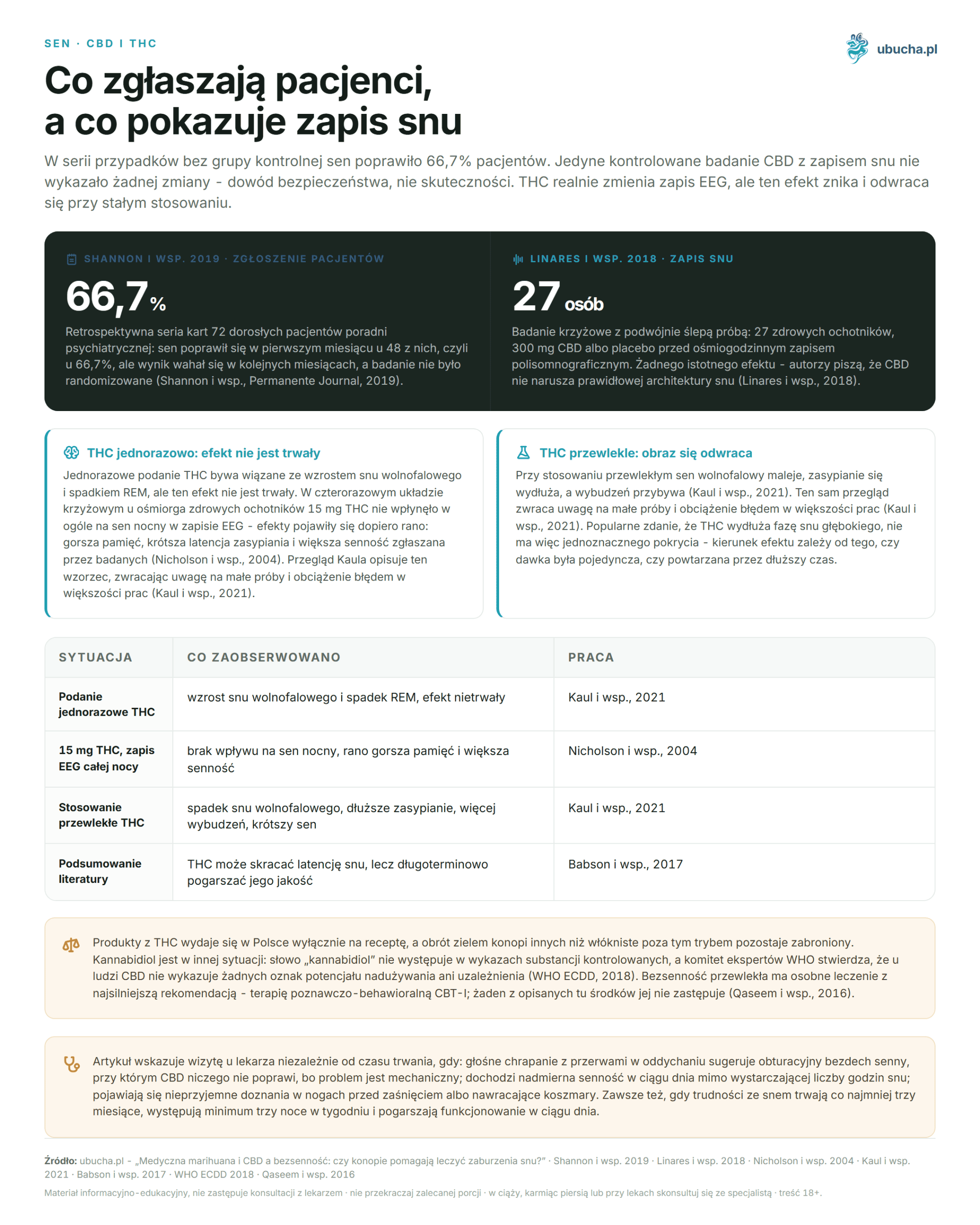
• In a retrospective series of 72 patients, sleep improved in 48, i.e., 66.7%, in the first month, but the result fluctuated over time (Shannon et al., 2019).
• Polysomnography in 27 healthy volunteers showed no significant effect after 300 mg CBD; authors state CBD does not disrupt normal sleep architecture (Linares et al., 2018).
• Single-dose THC is associated with increased slow-wave sleep and decreased REM, but the effect does not persist with chronic use (Kaul et al., 2021).
• CBT-I therapy is the initial treatment for chronic insomnia with a strong recommendation from the American College of Physicians (Qaseem et al., 2016).
• WHO states that CBD shows no signs of abuse potential or dependence in humans (WHO ECDD, 2018).
Do CBD and THC help with sleep?
Cautiously and variably. CBD has case series suggesting sleep improvement in insomnia with an anxiety component, but in a controlled polysomnographic study it changed nothing measurable. THC can act faster, but its effect on night structure weakens with chronic use.
The most often cited clinical work is a retrospective chart analysis of 72 adult psychiatric outpatients. Sleep improved in the first month in 48 of them, i.e., 66.7%, anxiety decreased in 57, i.e., 79.2%. However, authors note that the sleep result fluctuated in subsequent months and the study was not randomized (Shannon et al., 2019). This is a practice observation, not proof of efficacy.
On the other hand, a double-blind crossover study with 27 healthy volunteers receiving 300 mg CBD or placebo 30 minutes before an eight-hour polysomnographic recording found no significant effect; authors conclude CBD does not disrupt normal sleep architecture (Linares et al., 2018). This statement differs from “improves sleep” but is often cited as if it meant the same.
The difference is not a contradiction. The first study involved patients with anxiety and disturbed sleep; the second involved healthy people with no sleep to improve. Babson’s review summarizes this state in one sentence: research on cannabis and sleep is in its infancy and yields mixed results (Babson et al., 2017).
When does insomnia stop being just a bad night?
When difficulties falling asleep or maintaining sleep occur at least three times a week for at least three months and cause daytime consequences. The latter condition is often overlooked, and without it, diagnosis is absent.
Diagnostic guidelines list daytime consequences including fatigue, decreased energy, impaired attention, concentration and memory, and mood changes such as irritability and depression (Drager et al., 2023). The number of hours slept alone does not decide. A person sleeping six hours and functioning well does not have insomnia; a person sleeping seven and waking up unrefreshed may have it.
This distinction has practical consequences. Situational insomnia caused by a specific event usually resolves within weeks and rarely requires pharmacology. Chronic insomnia is a separate diagnosis with its own treatment, and supplements are not that treatment. Guidelines place cognitive-behavioral therapy here, not evening preparations.
It is also worth separating primary from secondary insomnia. The latter accompanies other diseases: depression, anxiety disorders, chronic pain, sleep apnea, or thyroid diseases. If the cause lies beneath, working on falling asleep alone gives a false effect and delays proper diagnosis. More about natural sleep methods is in the post on adult insomnia and non-pharmacological methods.
How is the night structured and why does the body need sleep phases?
Sleep is not a homogeneous state. In healthy adults, it passes sequentially through NREM stages N1 to N3, then REM appears, roughly at the 90th minute of sleep (Edwards et al., 2010). With seven to eight hours of sleep, the cycle repeats four to five times.
Phase distribution is uneven. Early cycles are richer in deep N3 sleep; later ones in REM. Thus, shortening the night by two hours does not equally remove all phases but mainly cuts REM, while going to bed earlier at the same wake time adds mostly deep sleep.
| Phase | What happens | When dominant |
|---|---|---|
| N1 | transition from wakefulness to sleep, easy to awaken | at the start of each cycle |
| N2 | sleep stabilization, sleep spindles, decreased reactivity to stimuli | largest part of the night |
| N3, slow-wave sleep | somatic regeneration, deepest awakening threshold | first half of the night |
| REM | dreaming, emotional memory consolidation, muscle atonia | second half of the night, early morning |
Why this breakdown in a cannabinoid text? Because the question “does something help with sleep” is incomplete. A substance may shorten sleep latency but impoverish the phase responsible for memory. Assessment differs when looking at subjective feeling of restfulness versus polysomnographic recording. The rest of this text adheres to the latter criterion wherever data allow.
How does the endocannabinoid system participate in sleep regulation?
CB1 receptors are distributed in the central nervous system, including structures involved in wakefulness regulation, and are the direct target of THC. CBD acts differently, and this is one of the most frequently misrepresented points in consumer texts.
A systematic review of cannabidiol’s molecular targets states that CBD does not directly interact with the endocannabinoid system outside in vitro conditions at supraphysiological concentrations, and it is very unlikely that its action in neurological diseases occurs via this system (Ibeas Bih et al., 2015). Over 65 distinct molecular targets have been described for CBD, most of which the review authors rejected as unconvincing.
The statement “CBD inhibits anandamide breakdown and therefore induces sleep” is a simplification functioning as fact in store texts. FAAH enzyme inhibition was described in lab conditions, but translation to a sedative effect in humans has not been demonstrated. This is important because the whole mechanism is often presented as established, but it is a hypothesis.
What remains in practice? THC has a clear binding point; CBD does not have a single one. Kaul’s review describes cannabinoids’ modulatory influence on sleep physiology while noting small samples and bias risk in most studies (Kaul et al., 2021). More on how cannabis interacts with circadian rhythm is in the post on cannabis effects on sleep.
How does THC affect sleep short- and long-term?
Single THC administration is associated with increased slow-wave sleep and decreased REM, but the effect on slow-wave sleep and total sleep time is not lasting. With chronic use, the picture reverses: slow-wave sleep decreases, sleep latency lengthens, awakenings increase (Kaul et al., 2021).
A controlled study version is even more cautious. In a four-way crossover with eight healthy volunteers, 15 mg THC had no effect on nocturnal sleep EEG. Effects appeared only the next morning: worse memory, shorter sleep latency, and increased sleepiness reported by participants (Nicholson et al., 2004). The popular claim that THC prolongs N3 phase thus lacks unequivocal support.
| Situation | Observed effect | Study |
|---|---|---|
| single administration | increase in slow-wave sleep and decrease in REM, effect transient | Kaul et al., 2021 |
| 15 mg THC, overnight EEG recording | no effect on nocturnal sleep, next morning worse memory and increased sleepiness | Nicholson et al., 2004 |
| chronic use | decreased slow-wave sleep, longer sleep latency, more awakenings, shorter sleep | Kaul et al., 2021 |
| literature summary | THC may shorten sleep latency but worsen quality long-term | Babson et al., 2017 |
Sleep is a frequent motive for self-medication. In a study of 170 patients at a California medical cannabis clinic, those with high PTSD scores used cannabis more often specifically to improve sleep and more frequently than others (Bonn-Miller et al., 2014). Authors question whether alternative sleep improvement methods might reduce this dependence.
What does polysomnography say about CBD and sleep architecture?
It says something very specific and it is not a promise of efficacy. After 300 mg CBD, an anxiolytic dose, an eight-hour polysomnographic recording in healthy volunteers did not differ significantly from placebo. Authors conclude: CBD does not alter normal sleep architecture (Linares et al., 2018).
This is a safety statement, not an efficacy one. It distinguishes CBD from benzodiazepines and antidepressants, which alter sleep structure, but does not prove CBD helps anyone fall asleep. The study involved healthy people and measured one night after one dose.
The oldest clinical data come from the 1970s and 1980s. In a trial with 15 insomniacs, 40, 80, and 160 mg CBD were compared with placebo and 5 mg nitrazepam. Only the 160 mg group reported significantly longer sleep than placebo; at all three doses, participants recalled dreams less often (Carlini and Cunha, 1981). Remember the proportion: the dose at which any effect appeared was many times higher than typical supplement doses.
Separately, a case of a ten-year-old girl with post-traumatic stress disorder was reported, where CBD oil brought sustained anxiety reduction and gradual improvement in sleep quality and quantity (Shannon and Opila-Lehman, 2016). This is one patient, so the evidence weight is low, though the direction aligns with the 72-case series. A summary of cannabis and sleep studies is expanded in the post on CBD in treating insomnia and other sleep disorders.
Do CBN and terpenes really induce sleep?
The claim of cannabinol as a “sleep cannabinoid” lacks clinical support in humans today. CBN forms from THC oxidation in aging material, and the belief in its sedative strength comes from observations of aged flower, not controlled trials.
A systematic review of cannabinoids in sleep disorders finds no basis for routine use of any cannabinoid, most included studies having moderate or high risk of bias (Suraev et al., 2020). CBN is not an exception but a particularly poorly studied fragment.
Terpenes are similar but more interesting. Russo’s review describes myrcene, linalool, and beta-caryophyllene as compounds with real pharmacological activity, present in diet and considered safe, hypothesizing synergy with cannabinoids. However, the author states synergy “if proven,” not as a confirmed phenomenon (Russo, 2011).
The practical conclusion is inconvenient for labels. The declaration “CBN sleep oil” describes composition, not confirmed effect. If the producer provides terpene profile in the certificate of analysis, you get more product information but still no proof that this blend will lengthen your night.
How does CBD compare to sleeping pills and melatonin?
CBD appears as a substance with a good safety profile and weakly documented sedative efficacy. Sleeping pills have the opposite balance of pros and cons, and melatonin produces a small but measured effect in meta-analysis. The choice depends on what exactly disrupts your night.
| Agent | What data show | Caveat |
|---|---|---|
| CBD | no significant effect on polysomnography after 300 mg (Linares et al., 2018) | evidence concerns sleep structure safety, not efficacy |
| melatonin | 7.06 min shorter sleep latency and 8.25 min longer sleep in 19 studies with 1683 people (Ferracioli-Oda et al., 2013) | modest effect, less than sleeping pills |
| benzodiazepines and Z-drugs | pharmacotherapy allowed only after ineffective CBT-I (Qaseem et al., 2016) | weak recommendation, low-quality evidence, shared decision with doctor |
| CBT-I | initial treatment for chronic insomnia, strong recommendation (Qaseem et al., 2016) | limited therapist availability in Poland |
Melatonin meta-analysis included 19 studies and 1683 people with primary sleep disorders. Seven-minute latency reduction sounds disappointing, but authors note the effect does not fade with continued use, unlike many sleeping pills (Ferracioli-Oda et al., 2013). Melatonin addresses a different problem than CBD: it regulates the clock, not calms tension.
If your night is disrupted by jet lag or shift work, melatonin is a more sensible starting point. If the source is evening racing thoughts, none of these agents replaces stimulus control and rhythm work described by CBT-I.
Which drugs interact with CBD?
Primarily those metabolized by the liver. A cannabinoid pharmacokinetic review indicates possible interactions via enzyme and transporter inhibition or induction, citing inhibition of clobazam metabolism by CBD as an example (Lucas et al., 2018).
The same review warns about pharmacodynamic interactions. Cannabis combined with other CNS depressants adds sedation, and combining with sympathomimetics may increase hypertension and tachycardia. Older adults are listed as a group at increased risk of adverse effects despite potential symptomatic benefits.
Iffland’s safety review confirms CBD’s favorable profile but notes that CBD’s effects on liver enzymes, drug transporters, and interactions require further clinical study. Most reported adverse effects are fatigue, diarrhea, and changes in appetite and weight (Iffland and Grotenhermen, 2017).
WHO report aligns cautiously: CBD is generally well tolerated with a good safety profile, and reported adverse effects may result from interactions with medications the patient already takes (WHO ECDD, 2018). The practical conclusion is simple: if you take anything regularly, inform your doctor before starting CBD instead of deciding alone.
What adverse effects does CBD cause?
The best documented symptom is diarrhea. A meta-analysis of randomized placebo-controlled trials including 12 studies and 803 participants, excluding pediatric epilepsy studies, found diarrhea as the only adverse effect significantly associated with CBD (Chesney et al., 2020).
This distinction is important as it changes the meaning of the full list. CBD was also associated with somnolence, sedation, decreased appetite, more frequent study withdrawal, and abnormal liver tests. Associations with somnolence and abnormal liver tests were limited to pediatric epilepsy studies where CBD was combined with clobazam or valproate at doses incomparable to supplements.
Iffland’s safety review lists fatigue, diarrhea, and appetite and weight changes as most common reported symptoms, noting CBD’s profile is better compared to drugs used for the same indications (Iffland and Grotenhermen, 2017). However, some toxicological parameters, e.g., hormonal effects, remain unstudied.
Conclusions for someone wanting to take CBD nightly long-term are twofold. First, data come mainly from short trials, and chronic administration in adults without epilepsy is poorly studied. Second, the most serious signals appeared where CBD was combined with other drugs, so caution is warranted primarily in combinations, not the product alone.
How to dose CBD for insomnia?
The principle from the pharmacokinetic review is “start low and go slow,” carefully observing desired and adverse effects (Lucas et al., 2018). No specific daily doses for insomnia have been established because no studies have done so.
It is useful to know the dose range from studies cited in consumer texts. In a series of 72 cases, almost all patients received 25 mg CBD daily in capsules, a few 50 or 75 mg, and one person had the dose gradually increased to 175 mg (Shannon et al., 2019). The often repeated “25 to 175 mg” thus describes extremes, not a typical dose.
| Form | When to take | Absorption info |
|---|---|---|
| sublingual oil | 30 to 60 minutes before sleep | half-life after oral spray 1.4 to 10.9 hours; absolute bioavailability in humans not measured |
| capsule | 60 to 120 minutes before sleep | peak concentration 0 to 4 hours post-dose, higher after food |
| inhaled form | rarely sensible in the evening | only route with measured absolute bioavailability in humans, about 31% after smoking |
Numbers in the last column come from a systematic review of CBD pharmacokinetics in humans (Millar et al., 2018). Authors emphasize limited and sometimes conflicting data. Popular tables giving exact bioavailability percentages for oral and sublingual routes are unsupported here because such measurements in humans have not been performed.
Practically, this means one thing: keep a sleep diary and change one thing at a time. Without recording, you cannot distinguish product effect from natural night variability, which is often large in insomnia.
Why is CBT-I first-line treatment?
Because that is the highest strength recommendation in guidelines. The American College of Physicians recommends every adult with chronic insomnia receive cognitive-behavioral therapy as initial treatment; this is a strong recommendation based on moderate-quality evidence (Qaseem et al., 2016).
Pharmacotherapy appears only as a second step, and conditionally. ACP recommends shared decision-making after discussing benefits, harms, and costs of short-term drug use in patients where CBT-I was ineffective. The recommendation is weak, evidence low quality.
Brazilian 2023 guidelines state this even more strongly, calling multicomponent CBT-I the gold standard for chronic insomnia treatment (Drager et al., 2023). Therapy includes stimulus control, sleep restriction, relaxation techniques, cognitive restructuring, and education.
From this framework, cannabinoids have a place, but not first. A supplement may reduce evening tension enough to facilitate behavioral techniques but does not replace them or diagnostics. Reversing this order is the most common error of those self-managing insomnia.
When does insomnia require a doctor visit?
Always when it meets chronic insomnia criteria: lasting at least three months, occurring at least three nights per week, and impairing daytime functioning (Drager et al., 2023). Self-treatment with supplements delays diagnosis of the cause.
Some symptoms warrant specialist referral regardless of duration. Loud snoring with breathing pauses suggests obstructive sleep apnea, which CBD will not improve as the problem is mechanical. Excessive daytime sleepiness despite sufficient sleep, unpleasant leg sensations before sleep, and recurrent nightmares also require diagnosis.
It is useful to know what doctors use. The basis is history and a sleep diary kept for one to two weeks, supplemented by insomnia severity questionnaires. Polysomnography is not routine for insomnia; it is performed when apnea, parasomnias, or other disorders requiring recording are suspected.
A separate category is secondary insomnia due to disease that must be treated first. Depression, anxiety disorders, hypothyroidism or hyperthyroidism, iron deficiency, and chronic pain can fully explain disturbed sleep. In such cases, night improvement comes with treating the cause, not separately.
What is the legal status of medical marijuana and CBD in Poland?
THC-containing products are dispensed in Poland only by prescription, and outside this mode, trade in cannabis other than fiber hemp remains prohibited. Cannabidiol is in a different situation: the word “cannabidiol” does not appear in controlled substance lists even once.
The threshold distinguishing fiber hemp from others is 0.3% dry weight, counted as the sum of delta-9-THC and tetrahydrocannabinolic acid, rounded to one decimal place. The basis is Article 4 point 5 of the Act of July 29, 2005 on counteracting drug addiction (consolidated text Dz.U. 2023 item 1939), as amended by the Act of March 24, 2022 (Dz.U. 2022 item 763), effective May 7, 2022.
This distinction changes laboratory test results, so it is not a formality. The threshold concerns the sum of two compounds, not just delta-9-THC alone, which for plant material yields values clearly higher than measuring one fraction. Until May 6, 2022, the national threshold was 0.20%, so older texts give a different number.
It is worth correcting one repeated sentence. The Polish threshold corresponds to the EU threshold of 0.3% in Regulation (EU) 2021/2115 but does not derive from it: these are two separate regulations with the same numeric value. The earlier Regulation 1307/2013, cited in many articles, set 0.2% and was repealed on January 1, 2023.
What does this mean for the reader?
The picture is less clear than product descriptions suggest, and that is the most honest conclusion of this text. A systematic literature review finds no basis for routine cannabinoid use in sleep disorder treatment, and most available studies are assessed as having bias risk (Suraev et al., 2020).
Three things are worth remembering. CBD at anxiolytic doses does not disrupt normal sleep architecture, which argues for safety, not efficacy. THC acts faster but its effect on night structure reverses with chronic use. Chronic insomnia has its own treatment with a strong recommendation, and it is not any evening preparation.
If you still want to try, do so methodically: one change at a time, lowest reasonable dose, sleep diary for at least two weeks, and talk to your doctor if you take anything regularly. Without this, you cannot distinguish product effect from normal night variability.
Separately, watch the boundary between supplement and medicine. THC products require a prescription in Poland, and CBD sold without prescription is not registered as a medicinal product for insomnia treatment. If a seller describes a product as a medicine, that is a warning sign about the seller, not product information.
Finally, often omitted in supplement texts on sleep: the improvement you seek usually does not come from one substance but from changing several conditions at once: consistent wake time, limiting time in bed awake, and avoiding weekend catch-up sleep. These are elements of cognitive-behavioral therapy, not lifestyle advice, and have the strongest recommendation of anything described here.
Frequently Asked Questions
Does CBD help with insomnia?
The data are inconclusive. In a retrospective series of 72 patients, sleep improved in 66.7% during the first month, but the result fluctuated over time, and the study was not randomized (Shannon et al., 2019). A systematic review finds no basis for routine cannabinoid use in sleep disorders.
What CBD dose for sleep is supported by research?
No established dose exists. In a series of 72 cases, almost all received 25 mg per day, a few 50 or 75 mg, and one person up to 175 mg (Shannon et al., 2019). In an older trial with insomniacs, longer sleep was reported only by the group taking 160 mg.
Does THC help to fall asleep?
Short-term it is associated with increased slow-wave sleep and decreased REM, but the effect does not persist chronically, and with regular use slow-wave sleep decreases and awakenings increase (Kaul et al., 2021). In Poland, THC products are dispensed only by prescription.
Does CBD alter sleep phases like THC?
Not in available polysomnographic recordings. After 300 mg CBD in 27 healthy volunteers, no significant differences compared to placebo were found, and the authors state that CBD does not disrupt normal sleep architecture (Linares et al., 2018). This is a safety conclusion, not efficacy.
Is CBD addictive?
The WHO Expert Committee report states that CBD shows no signs of abuse potential or dependence in humans and is generally well tolerated (WHO ECDD, 2018). Reported adverse effects may result from interactions with concurrently taken medications.
Which drugs interact with CBD?
Primarily those metabolized in the liver. A pharmacokinetic review indicates possible interactions via enzyme and transporter inhibition, citing inhibition of clobazam metabolism by CBD as an example (Lucas et al., 2018). Combining with CNS depressants adds sedation.
Can CBD be given to a child with insomnia?
Only under medical supervision. A case of a ten-year-old patient with post-traumatic stress disorder was described, where CBD oil reduced anxiety and gradually improved sleep quality and quantity (Shannon and Opila-Lehman, 2016). This is a single case report and not a basis for parental self-decision.
Does CBD replace CBT-I therapy?
It does not replace it. The American College of Physicians recommends cognitive-behavioral therapy as the initial treatment for chronic insomnia in all adult patients, with the highest strength recommendation (Qaseem et al., 2016). Pharmacotherapy is considered only after ineffective CBT-I.
If after reading you want to compare available products, visit the hemp oils section.
This article is for informational and educational purposes and does not constitute medical advice. Before starting cannabis or CBD for therapeutic purposes, consult a doctor, especially if you take other medications, are pregnant, or breastfeeding.
Author: Michał Waluk · Published: 2026-05-11 · Updated: 2026-08-10