
CBG vs CBD: when to choose which? Comparison of 7 indications
CBG vs CBD in seven indications: pain, intestines, glaucoma, anxiety, appetite, bacteria, epilepsy. What was measured in humans and what only in animals. Doses and prices 2026.
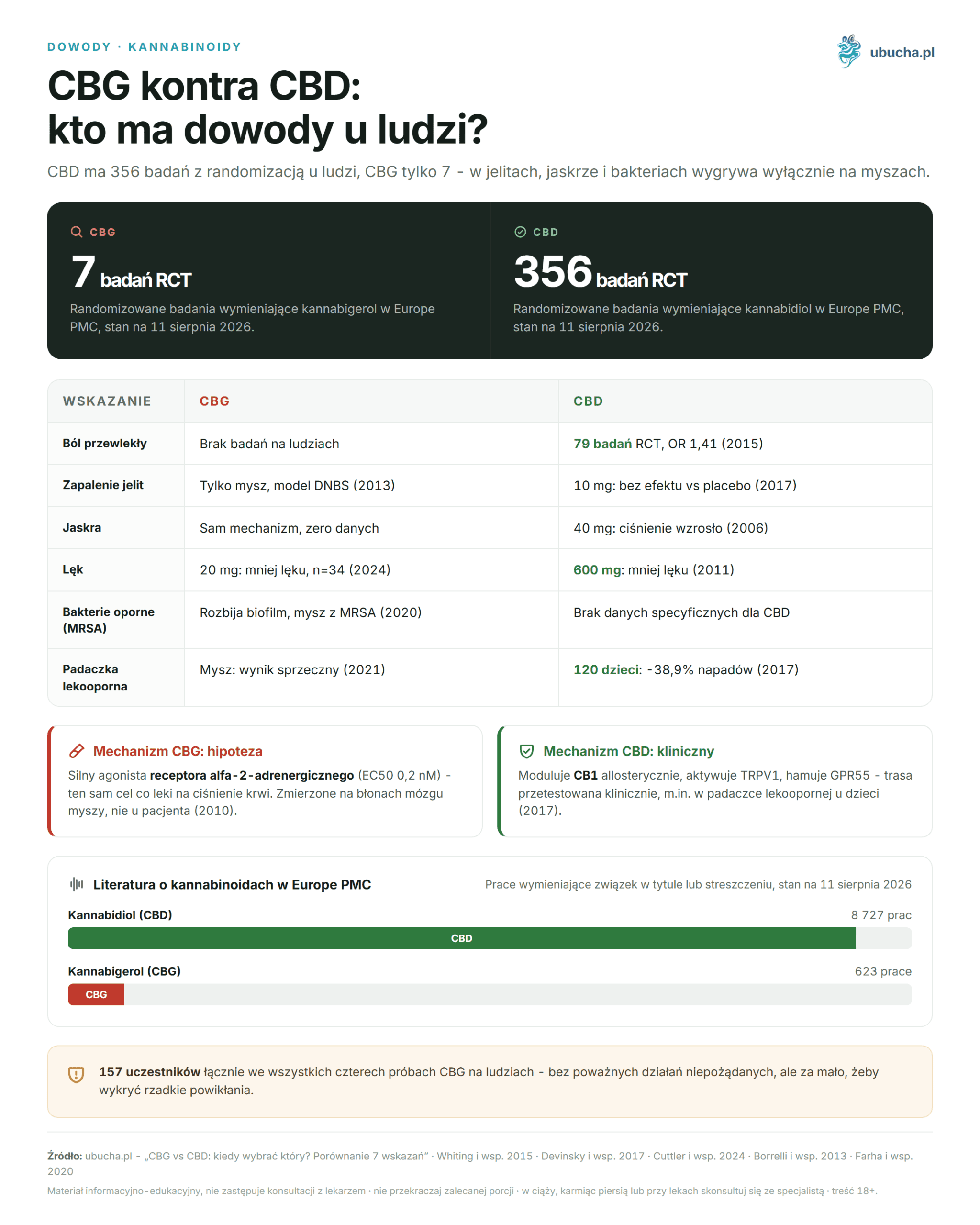
Europe PMC indexes 8,727 papers mentioning cannabidiol in the title or abstract, and 623 papers on cannabigerol. There are 356 and 7 randomized clinical trials respectively, and after filtering those where CBG appears only marginally, four trials remain with actual CBG administration to humans (as of August 11, 2026). This is the real ratio of knowledge about both compounds, although product labels suggest parity. In this comparison, I go through seven indications and for each separate three things: what was measured in humans, in animals, and only in cell cultures. You will also find doses given to humans in studies, mixture ratios, and regulations applicable in Poland.
KEY INFORMATION
• Europe PMC records 356 randomized studies on CBD and 7 on CBG (as of August 11, 2026).
• CBD has drug registration for epilepsy, CBG has none.
• CBG’s advantage in intestines and against bacteria is based on rodents and cell cultures, and for glaucoma on mechanism only.
• The only completed CBG sleep trial was inconclusive.
CBG or CBD: what to choose if deciding today?
Choose CBD. For anxiety, chronic pain, sleep disorders, and drug-resistant epilepsy, it is the only cannabinoid with randomized controlled human studies. Consider CBG as a supplement after a few weeks if CBD alone is insufficient.
The meta-analysis by Whiting et al. (JAMA, 2015) included 79 randomized studies with 6,462 participants. Cannabinoids increased the chance of at least 30% pain reduction versus placebo, with an odds ratio of 1.41 and 95% confidence interval 0.99 to 2.00. The result is moderate but comes from human studies. There is simply no equivalent meta-analysis for CBG.
Our heuristic used in conversations with store clients is simple. Nervous system problems - anxiety, sleep, neuropathic pain, and seizures - are CBD territory. Problems with a clear inflammatory or infectious component are areas where CBG is an interesting hypothesis, currently unconfirmed in humans.
The third scenario is full-spectrum extracts where CBG naturally occurs alongside CBD in trace amounts. You don’t need to add anything then, though don’t expect CBG amounts comparable to those in studies. The certificate of analysis will tell you how much cannabigerol is really in the bottle.
The reverse order, starting with CBG, makes sense only if you have already tried CBD and found drowsiness bothersome. In the only trial measuring cognitive performance, CBG did not worsen reaction time or memory, so it is sometimes chosen for daytime use. The price paid for this comfort is much less certainty about the effect itself.
How does CBG differ from CBD in practice?
Both compounds are non-psychoactive and come from the same plant, but differ in raw material content, price, receptor profile, and above all, amount of evidence. CBG is the decarboxylated form of cannabigerolic acid, the precursor from which the plant builds THC, CBD, and CBC.
The table below compares eight dimensions that realistically influence product choice. Pharmacological data come from the review by Calapai et al. (2022) and the WHO ECDD report on cannabidiol (2018), the price row from the store catalog, and the legal status row from the anti-drug act.
| Feature | CBG (cannabigerol) | CBD (cannabidiol) |
|---|---|---|
| Content in typical plant | fraction of a percent of dry mass | several percent in fiber varieties |
| Main molecular targets | α2-adrenergic receptor, 5-HT1A, TRP channels, COX | CB1 (allosteric modulation), 5-HT1A, PPAR-γ, TRPV1, GPR55 |
| Randomized human studies | four trials with CBG administration | hundreds of trials, including epilepsy registration |
| Strongest preclinical data | intestinal inflammation, MRSA, appetite stimulation | seizures, inflammatory pain, neuroprotection |
| Doses given to humans in studies | 20-50 mg in four trials | from below 1 to 50 mg/kg body weight in 35 clinical studies |
| Cytochrome P450 interactions | metabolized by CYP2J2, sparse interaction data | documented inhibition of CYP3A4, CYP2C19, CYP2C9 |
| Price at same concentration (Bucha oil category, August 11, 2026) | about one and a half times higher | reference point |
| Legal status in Poland | legal if raw material is fiber hemp | legal if raw material is fiber hemp |
One number from this table explains most others. Since the plant produces CBG in trace amounts and CBD in several percent, the producer must process many times more biomass for the same milligram of substance. Hence the price difference and the much smaller research budget so far allocated to CBG.
How much of the promises around CBG have actually been measured in humans?
Four studies. That is how many trials with CBG administration to humans were found in Europe PMC as of August 11, 2026, among 623 papers mentioning this compound. The rest are cell cultures, mice, and rats. For comparison, cannabidiol alone has 356 randomized studies.
This does not mean CBG does not work. It only means statements like “CBG is more effective in inflammatory conditions” describe mouse results, not patient data. Below is the full list of what has been tested in humans so far.
| Study | What was given | Participants | Result |
|---|---|---|---|
| Cuttler et al., Scientific Reports 2024 | 20 mg CBG single dose, tincture | 34 healthy adults | Reduced anxiety and stress versus placebo, better verbal memory test, no intoxication effects |
| Emerson et al., Medical Cannabis and Cannabinoids 2026 | 25 mg/day for 2 weeks, then 50 mg/day for 2 weeks | 63 veterans with sleep disorders | Sleep improved in both groups equally, no difference versus placebo, good tolerance |
| Story et al., Cannabis and Cannabinoid Research 2024 | 25 mg CBG single dose, two carriers | 20 adults, pharmacokinetic study | Fatty meal raises blood CBG concentration more than carrier emulsion |
| Peters et al., JISSN 2023 | 50 mg CBG with 35 mg CBD and beta-caryophyllene | 40 exercising individuals | Muscle soreness interfered less with daily activities, objective measures unchanged |
Note two things. First: doses in these studies range from 20-50 mg, exactly where typical manufacturer recommendations lie. Second: the Cuttler et al. (2024) trial was the first published clinical trial of CBG in the history of this compound.
How do CBG and CBD act at the receptor level?
Differently, which explains most differences in effects. CBG is a very strong agonist of the α2-adrenergic receptor, the same target as blood pressure-lowering drugs. CBD does not affect this target but modulates cannabinoid signaling and anti-inflammatory pathways.
The study Cascio et al. (British Journal of Pharmacology, 2010) measured this on mouse brain membranes: CBG activated α2 receptor at half-maximal effect concentration of 0.2 nM and blocked 5-HT1A receptor with apparent constant 51.9 nM. These are in vitro measurements, not patient data.
| Molecular target | CBG | CBD |
|---|---|---|
| CB1 receptor | moderate affinity, antagonist at high concentrations | negative allosteric modulator, suppresses THC excitation |
| CB2 receptor | partial agonist | weak direct action |
| α2-adrenergic receptor | strong agonist, EC50 0.2 nM | no significant effect |
| 5-HT1A receptor | antagonist | agonist, linked to anxiolytic effect |
| TRP channels | strong TRPA1 agonist, blocks TRPM8 | TRPV1 agonist, suppresses pain transmission |
| PPAR-γ and cyclooxygenases | COX inhibition described in cell studies | PPAR-γ agonism, anti-inflammatory effect |
| Liver metabolism | mainly CYP2J2 | inhibits CYP3A4, CYP2C19, CYP2C9 |
A practical conclusion concerns blood pressure. Someone prone to hypotension or taking clonidine or beta-blockers should introduce CBG cautiously and preferably after consulting their doctor. For CBD, the analogous caution concerns drugs metabolized by cytochrome P450.
Remember concentration scale. Nanomolar values at which CBG activates α2 receptor in cell membranes do not indicate how much substance reaches tissue after oral oil drops. Human CBG pharmacokinetics is described by one study so far, whose main conclusion was that absorption depends on fat content in the meal.
Which cannabinoid has stronger data for chronic pain?
CBD, without much competition. The Whiting et al. 2015 meta-analysis collected 79 randomized studies, with best results in neuropathic and cancer pain. No published pain trial with patients exists for CBG.
CBD’s pain mechanism is multifaceted. TRPV1 agonism reduces pain channel sensitivity, PPAR-γ agonism adds anti-inflammatory component, and GPR55 blockade relates to inflammatory pain. The hypothesis of endocannabinoid deficiency in fibromyalgia and migraine is discussed by Russo (Cannabis and Cannabinoid Research, 2016), citing objective data on anandamide levels in cerebrospinal fluid of migraine patients. This remains theory, not clinical trial result.
The only human signal for CBG in pain comes from the 2023 pilot by Peters et al., where 40 exercising people received a drink with 50 mg CBG, 35 mg CBD, beta-caryophyllene, and amino acids. Muscle soreness interfered less with daily activities, but objective measures did not change, and CBG’s contribution cannot be separated from the mix.
Our store observation: people with mixed pain, e.g. fibromyalgia with irritable bowel, usually stick to full-spectrum CBD and add CBG after a month. Protocol details are described in the post on CBD for chronic pain.
One more thing to say clearly. The odds ratio 1.41 from Whiting’s meta-analysis means cannabinoid efficacy in pain is moderate and some patients simply do not respond. The lower confidence interval dropped below one, so the result is not fully conclusive. This argues for giving a few weeks to assess and stopping without regret if nothing happens.
What is really known about CBG in intestinal inflammation?
It is known to help mice. Borrelli et al. (Biochemical Pharmacology, 2013) induced colitis in mice with dinitrobenzene sulfonic acid, and CBG reduced intestine mass-to-length ratio, myeloperoxidase activity, and inducible nitric oxide synthase expression. Interleukin 1β, interleukin 10, and interferon γ levels normalized.
This is good preclinical work and still the most cited argument for CBG. However, it has two limitations marketing ignores: DNBS is chemically induced inflammation in rodents, not Crohn’s disease, and thirteen years passed without a single human trial.
For CBD, patient data exist but are mixed. In Naftali et al. (Digestive Diseases and Sciences, 2017), low dose pure CBD, 10 mg twice daily, was safe but ineffective versus placebo. Four years later, the same team tested a hemp oil rich in CBD with THC admixture at 160 to 40 mg per milliliter.
In this 2021 trial on 56 patients, disease activity index and quality of life improved significantly, but endoscopic appearance and inflammatory markers did not. Symptoms resolved but mucosal inflammation remained. The oil contained CBD with THC, so the effect cannot be attributed to cannabidiol alone, and no cannabigerol was present.
Does CBG lower intraocular pressure in glaucoma?
No human data. The hypothesis is that CBG stimulates α2-adrenergic receptor, the same target as brimonidine and apraclonidine, standard eye drops reducing aqueous humor production. However, mechanism similarity does not guarantee clinical efficacy.
The problem scale is real. Meta-analysis Tham et al. (Ophthalmology, 2014) estimated 76 million glaucoma patients in 2020, projected to 112 million in 2040. According to WHO, glaucoma remains a leading cause of irreversible blindness.
For CBD, the answer is known and inconvenient. In Tomida et al. (Journal of Glaucoma, 2006), six patients with ocular hypertension received sublingual THC or CBD. A 20 mg CBD dose did not lower eye pressure; 40 mg temporarily raised it from 23.2 to 25.9 mm Hg. Miller et al. (2018) in mice showed CBD has two opposing effects on eye pressure and blocks THC’s lowering effect.
The practical conclusion is clear. If you treat glaucoma, do not stop your drops or replace them with oil. High-dose CBD may counteract therapy goals, and CBG remains a hypothesis needing human eye studies.
Another difficulty is administration form. Even if CBG lowered eye pressure, oral oil would have to reach sufficient concentration in the anterior chamber, and cannabinoids poorly dissolve in water and penetrate the cornea. Work on cannabinoid eye drops has been ongoing for years but remains at formulation stage, not mechanism.
What did CBG and CBD studies show for anxiety and insomnia?
Both cannabinoids have randomized data for anxiety; only CBD looks promising for insomnia, and the only CBG sleep trial was inconclusive. This is a rare area where both compounds can be compared at the same evidence level.
For CBD, the reference is Bergamaschi et al. (Neuropsychopharmacology, 2011): a single 600 mg dose reduced anxiety in untreated social phobia patients during a simulated public speaking test. A case series Shannon et al. (The Permanente Journal, 2019) included 72 people: anxiety scores dropped in 79%, sleep quality improved in 67% in the first month. However, this was observational without control group.
For CBG, the picture is fresher and more interesting than older texts suggest. In the 2024 trial by Cuttler et al., 34 healthy people received 20 mg CBG and placebo alternately in a double-blind crossover with a one-week washout. CBG reduced anxiety and stress versus placebo, improved verbal memory test, and caused no intoxication effects.
However, CBG did not affect sleep. In the 2026 study by Emerson et al., 63 veterans took 25 mg daily for two weeks and 50 mg for two more. Sleep improved equally in both groups, so no difference versus placebo was shown. Practical protocols are collected in the post Does CBD help with sleep.
Which cannabinoid stimulates appetite and which suppresses it?
In rodent studies, directions are opposite: CBG increases food intake, CBD decreases it. Neither effect has been confirmed in humans, so treat this difference as a clue, not a basis for planning oncology patient nutrition.
In Brierley et al. (Psychopharmacology, 2016), rats received oral CBG doses from 30 to 240 mg/kg body weight after meals. At 120 and 240 mg/kg, food intake more than doubled, and meal number increased. CBG did not impair motor skills or grip strength.
The opposite effect was described by Farrimond et al. (Psychopharmacology, 2012), where CBD reduced food intake in rats, while cannabinol acted oppositely. The same group showed in 2019 that CBG at 120 mg/kg reduced weight loss in cisplatin-treated rats from 6.3% to 2.6% after 72 hours (Brierley et al., Journal of Cachexia, Sarcopenia and Muscle 2019).
Dose conversion is crucial here. Effective 120 mg/kg in rats is incomparable to 20-50 mg taken by humans, and direct body weight dose scaling is methodologically wrong. Patients with cancer cachexia should discuss any supplement with their oncologist.
This caution is not only formal. Cannabidiol inhibits liver enzymes responsible for metabolizing many cytostatics, so adding supplements during chemotherapy may alter drug blood levels. For CBG, such interaction data are practically absent, which is sometimes mistakenly read as safety proof. Lack of studies means lack of knowledge, not confirmation of no risk.
Does CBG handle antibiotic-resistant bacteria?
In vitro and in mice, yes; in humans, untested. This is the strongest preclinical data set for CBG and also the area where translation to patient use is hardest, as bactericidal concentration must be reached at infection site.
The team of Appendino et al. (Journal of Natural Products, 2008) compared five cannabinoids against methicillin-resistant Staphylococcus aureus strains. All five inhibited bacterial growth at 0.5 to 2 µg/ml, and acidic cannabinoid forms retained activity.
Twelve years later, Farha et al. (ACS Infectious Diseases, 2020) showed CBG disrupts Gram-positive bacterial cytoplasmic membrane, destroys mature biofilm, and acts in mice with systemic MRSA infection. Combined with polymyxin B, cannabinoids also acted on Gram-negative bacteria.
Context matters. A Lancet analysis (2022) attributed 1.27 million deaths in 2019 to bacterial resistance. Still, oral oil is not an antibiotic: human studies are lacking, and topical forms for skin and mucous membranes seem more realistic.
The obstacle is more prosaic than mechanism. Cannabinoids bind strongly to plasma proteins, so free bactericidal substance concentration in blood is much lower than total concentration. The 2020 authors note this limitation and position cannabinoids as starting points for new molecule design rather than ready drugs.
For readers, the simple rule is: if bacterial infection is suspected, see a doctor, not a supplement store. CBG oil can safely accompany standard treatment if it does not replace antibiotics and the doctor is informed.
Why does only CBD matter in drug-resistant epilepsy?
Because CBD is the only cannabinoid to complete full registration. The study Devinsky et al. (New England Journal of Medicine, 2017) included 120 children and young adults with Dravet syndrome. A 20 mg/kg daily CBD dose reduced median seizure frequency by 38.9% versus 13.3% with placebo over 14 weeks.
Based on this, Epidiolex was approved by the US FDA in 2018 and soon after by the European Medicines Agency. The mechanism is not fully explained but likely involves GPR55 blockade, calcium channel effects, and adenosine uptake inhibition. According to WHO, epilepsy affects about 50 million people, and well-chosen antiepileptic drugs free up to 70% from seizures. The rest remain without effective treatment.
For CBG, there are not even clear preclinical data. The study Anderson et al. (British Journal of Pharmacology, 2021) tested cannabigerolic acid, CBG’s precursor, in a mouse Dravet model. The compound was anticonvulsant against heat-induced seizures but proconvulsant in the 6 Hz test, and high doses increased spontaneous seizure frequency.
The conclusion is cautious and intentionally so. A person with epilepsy using CBD should not add CBG or full-spectrum products without neurologist knowledge, as drug interactions pose real risks.
The difference between supplement and drug is best seen here. The registered product has defined substance content per batch, tested bioavailability, and a leaflet with interaction list. Store oil has a certificate for one batch and dosing recommendations based on manufacturer practice. For seizures, this difference ceases to be formal.
What doses were given to humans in CBD and CBG studies?
Very varied and always under supervision. The review Millar et al. (British Journal of Clinical Pharmacology, 2019) covered 35 clinical studies in 13 indications. Effective doses ranged from below 1 to 50 mg/kg body weight daily, with epilepsy randomized trials averaging 15 mg/kg. This shows how wide the range is and how imprecise label recommendations can be.
For CBG, the reference is the four trials described above. Cuttler gave 20 mg single dose to 34 healthy people, Emerson 25 mg daily for two weeks then 50 mg for two weeks to 63 veterans, Story 25 mg single dose to 20 adults in a pharmacokinetic study, and Peters 50 mg in a mix to 40 exercising people. No one gave humans higher doses, so effects of higher doses are unknown.
The upper limit for CBD is now set by the European Food Safety Authority. The novel food panel in 2026 derived a provisional safe dose of 0.0275 mg/kg body weight per day, about 2 mg daily for a 70 kg person, using benchmark dose method with uncertainty factor 400 (EFSA, 2026). This applies only to supplements with at least 98% pure CBD, without nanoparticles. The same document states CBD safety cannot be established for people under 25, pregnant or breastfeeding women, or those taking medications.
All above describes studies and safety assessment, not a reader recommendation. This text does not say how much to take or provide a drop-to-milligram converter. Supplementation decisions, size, and appropriateness with your medications are made by your doctor.
In what ratios to combine CBG with CBD?
The most common ratios are 1:1 and 1:2 favoring CBD, but none have been tested in randomized trials. Treat the table below as a description of market practice, not evidence-based recommendation.
| CBG to CBD ratio | When used | Evidence level |
|---|---|---|
| 1:1 | universal start, when tension and intestinal symptoms coexist | market practice |
| 1:2 | chronic pain with inflammatory component | market practice |
| 2:1 | skin and gastrointestinal complaints | animal data only |
| 1:3 | severe generalized anxiety | indirectly from CBD studies |
The theoretical basis is the entourage effect described by Russo (British Journal of Pharmacology, 2011), where cannabinoids and terpenes enhance each other, and full-spectrum extract acts broader than isolate. This is a hypothesis review, not a clinical trial.
Three terpenes are most often mentioned. Beta-caryophyllene from pepper and cloves stimulates CB2 receptor, myrcene from hops is calming, limonene from citrus peels was studied for tension reduction. Their profile is in the product certificate, and we described them in the post on hemp terpenes.
A practical note on label ratios. Producers usually describe concentration ratios in the bottle, not dose ratios you actually take. If dosing two separate oils, calculate milligrams from each and record the sum, otherwise after two weeks you won’t recall the actual ratio combined.
The only study administering CBG and CBD together to humans used 50 mg CBG and 35 mg CBD, about 1.5 to 1 ratio. This is too narrow a basis to declare a standard, but at least one combination was tested against placebo and was well tolerated.
What to check in the COA certificate before purchase?
Five items: cannabinoid profile, THC content, pesticides, heavy metals, and microbiology with mycotoxins. Without a current certificate of analysis, you buy a label declaration, which can be unreliable even in mature markets.
The study Bonn-Miller et al. (JAMA, 2017) tested 84 CBD products bought online. Label compliance, defined as deviation within 10%, was found in less than 31%, and detectable THC was found in 18 of 84 samples (21.43%), with concentrations up to 6.43 mg/ml. The Polish market has not had a similar analysis, but discrepancy mechanisms are the same.
- Cannabinoid profile, declared CBG or CBD content within 10% of label
- THC content, legal threshold is sum of delta-9-THC and THCA, not delta-9-THC alone; also check delta-8
- Pesticides, below method detection limit
- Heavy metals, lead, cadmium, mercury, arsenic within European norms
- Microbiology and mycotoxins, no exceedances for salmonella, E. coli, aflatoxins
Also check test date and batch number. A certificate three years old or without batch number says nothing about the bottle you hold. How to read such a document line by line is shown in the CBD certificate COA guide.
For CBG products, one more trap exists. Some products labeled as CBG mainly contain CBD with a small cannabigerol addition because it’s cheaper. The certificate resolves this in one line: look for a separate CBG entry with milligrams per milliliter, not just total cannabinoids.
Lastly, consider the lab. A certificate issued by an external accredited lab carries more weight than a result from the producer’s own lab. The name and accreditation number usually appear in the document header; their absence is itself information.
Why does CBG cost more than CBD?
For two reasons at once. The plant produces CBG in trace amounts, so many times more biomass must be processed for the same milligram than for CBD. Also, raw material must be harvested early before cannabigerolic acid converts to THC and CBD precursors.
Early harvest means lower yield per area. The producer pays doubly: lower extraction efficiency and less flower mass. Breeding varieties selected for high CBG content gradually reduces this difference, though on Polish shelves the effect is still barely visible.
You can see this difference on your own shelf. In the hemp oil category at Bucha, cannabigerol oil costs about one and a half times more than the corresponding cannabidiol oil at the same concentration and volume (as of August 11, 2026). Check specific package prices on the category page, as they change faster than the article.
For the household budget, a more important calculation than this ratio is the monthly cost, not bottle price. The same milligram number costs noticeably more in the cannabigerol version, and over longer use the difference accumulates. It’s worth calculating before purchase, not after the third bottle.
What is the legal status of CBG and CBD in Poland?
Both are legal if the raw material is fiber hemp. The definition is in Article 4 point 5 of the Act of July 29, 2005, on counteracting drug addiction: plants where the sum of delta-9-THC and tetrahydrocannabinolic acid in flower tops does not exceed 0.3% of dry mass, rounded to one decimal place.
Two details of this definition are often lost in store descriptions. First, the threshold counts as the sum of delta-9-THC and THCA, not delta-9-THC alone, so the “total THC” position on the certificate, converted by factor 0.877, does not match the law value. Second, the threshold applies to the plant, not the finished product. The 0.3% value has applied since May 7, 2022, when the limit was raised from 0.2% (Journal of Laws 2022 item 763). The national threshold matches the EU threshold from Regulation 2021/2115 but they are separate regulations with the same value.
For consumers, this means three things. Products meeting the threshold can be legally bought, possessed, and used. Producers cannot attribute medicinal properties, as the law reserves such claims for registered medicinal products. Third, oil and capsules have clear status, cosmetics too, but dried flower sold as a collector’s item remains in a gray zone, as its consumption by vaporization is sometimes questioned.
Current regulations can be checked on the Ministry of Health website, and the acts themselves in the ELI register. Cannabis regulations have changed several times in recent years, so for wholesale purchases or border transport verify legal status on the transaction date.
Travel issues are separate. The 0.3% threshold and calculation method apply in Poland, but cannabis and cannabinoid regulations differ by country; outside the EU, total bans occur. Legally bought oil in Poland may be illegal at the destination airport, and a certificate does not replace knowledge of local law.
What adverse effects and interactions are involved?
CBD is well studied and well tolerated but interacts with many drugs. CBG looks safe in short studies, though observations are too few for a full profile. Common CBD side effects are drowsiness, diarrhea, appetite loss, and increased aminotransferase activity.
The review Iffland and Grotenhermen (Cannabis and Cannabinoid Research, 2017) collected clinical and animal data. They rated the safety profile as favorable but noted CBD’s effects on liver enzymes, drug transporters, and drug interactions require further study. Below are four situations where consulting a doctor before supplementation is not a formality.
| Drug or group | What happens | Consequence |
|---|---|---|
| Clobazam | CBD inhibits CYP2C19, active metabolite concentration rises | increased drowsiness, dose adjustment needed |
| Warfarin | slower metabolism via CYP2C9 | increased INR and bleeding risk |
| Statins | competition for CYP3A4 | higher statin levels, muscle pain risk |
| Blood pressure drugs | CBG stimulates α2 receptor, same as clonidine | possible additional blood pressure drop and slowed heart rate |
In CBG human trials totaling 157 participants, no serious adverse events were reported. Four studies are too few to detect rare complications, so treat this profile as preliminary, not confirmed long-term safety.
When is it sensible to take both cannabinoids at once?
When the problem has several overlapping mechanisms and CBD alone after four to six weeks gives incomplete effect. Full-spectrum extracts already contain trace CBG, so the question is whether to add it in higher dose, not whether to take it at all.
Five situations where such combination has mechanistic logic but no clinical trial confirmation:
- Irritable bowel coexisting with tension and poor sleep
- Fibromyalgia with a clear inflammatory component
- Psoriasis or atopic dermatitis with inflammatory itch
- Supportive oncology care, after consulting the attending physician
- Migraine with light sensitivity
One rule remains regardless of numbers. Changing two things at once makes it impossible to attribute improvement or worsening to a specific ingredient, so if the doctor agrees to add the second cannabinoid, introduce it separately and record the date.
Our store observation: the most common reason for CBG disappointment is not lack of effect but adding it to a CBD product the reader never used regularly. Without notes, after a few weeks no one recalls what and when changed.
Summary: how to decide?
Start with CBD, patiently adjust dose, and consider CBG as a supplement if after a month the effect is incomplete. This order follows directly from evidence distribution: hundreds of randomized studies on one side and four on the other.
Separating evidence levels is more important than comparing mechanisms. CBG’s advantage in intestines, glaucoma, and bacteria is based on mice and cell cultures. CBD’s advantage in epilepsy, anxiety, and pain is based on patient studies. Both are interesting, but only one allows predicting what happens after swallowing drops.
Three things we do ourselves before every purchase: check the certificate of analysis with batch number, calculate monthly dose cost instead of bottle price, and record dose and effect for the first four weeks. Without notes, after two months no one remembers what and when worked.
Also set in advance when you will consider the trial failed. A reasonable term is six weeks at the upper dose range without an effect noticeable in notes. A supplement that changes nothing after this time only generates cost and sustains hope.
Finally, a sentence too rarely said in cannabinoid texts. Neither CBD nor CBG cure chronic diseases, and neither replaces therapy prescribed by a doctor. Sensibly used, they are adjuncts that reduce symptom burden, and only in this role do these two compounds have data support today.
Frequently Asked Questions
CBG or CBD to start with, which to choose?
Start with CBD. It has hundreds of randomized human studies, is cheaper, and covers a broader spectrum of issues, from anxiety to chronic pain. CBG has four human trials, so as a first choice it lacks data support. Discuss supplementation size with your doctor, especially if you take medications.
Does CBG have any human studies?
Yes, but very few. As of August 2026, four studies have been published where CBG was actually administered to humans: the anxiety trial by Cuttler et al. (2024), a sleep study in veterans by Emerson et al. (2026), a pharmacokinetic study by Story et al. (2024), and a post-exercise recovery pilot by Peters et al. (2023).
Can I combine CBG and CBD in one dose?
Yes, no dangerous interactions between these two cannabinoids have been described. The most common ratios are 1:1 and 1:2 CBG to CBD. You can use one product containing both ingredients or dose two oils separately. However, the effectiveness of such mixtures has not been tested in randomized trials.
Is CBG better than CBD for intestinal inflammation?
In a mouse colitis model, CBG performed well: Borrelli et al. (2013) described decreased myeloperoxidase activity and normalization of cytokine levels. No human trials of CBG in Crohn’s disease or ulcerative colitis have been conducted, so CBG’s advantage remains a hypothesis.
Why does CBG cost more than CBD?
Because in typical hemp varieties, CBG constitutes a fraction of a percent of the dry flower mass, while CBD is several percent. To obtain one kilogram of CBG, many times more biomass must be processed, and the raw material is harvested early in flowering. Breeding CBG-rich varieties gradually lowers the price.
Does CBG have psychoactive effects?
No. In the trial by Cuttler et al. (2024), 20 mg of CBG caused no subjective intoxication effects or impairment of motor and cognitive performance in 34 participants. CBG’s action on the CB1 receptor is too weak to cause the euphoria typical of THC.
Are CBG and CBD legal in Poland in 2026?
Yes, provided the raw material is fiber hemp. According to Article 4 point 5 of the Act of July 29, 2005, on counteracting drug addiction, the sum of delta-9-THC and THCA in flower tops must not exceed 0.3 percent of dry mass. Producers cannot attribute medicinal properties to such products.
Will CBG and CBD affect a drug test?
Pure isolates should not, as tests detect THC and its metabolites. Full-spectrum products contain trace THC and with regular high-dose use may yield a positive result. People subject to workplace testing should choose isolates or THC-free extracts.
If you want to start with a well-described product with a current certificate of analysis, browse hemp oils available at Bucha store and compare monthly dose cost, not package price.
This article is for informational and educational purposes and does not constitute medical advice. Before starting cannabis or CBD for therapeutic purposes, consult a doctor, especially if you take other medications, are pregnant, or breastfeeding.
Author: Michał Waluk · Published: 2026-05-11 · Updated: 2026-08-11