
Supplements for hair loss: what really works and what to absolutely avoid
Biotin, iron, zinc, vitamin D, saw palmetto, and collagen for hair loss. We check what research confirms in humans and what can be harmful.
Biotin is the most commonly purchased ingredient in hair products and one of the least well-documented. A literature review from 2024 found only three studies meeting basic quality criteria, and the strongest of them showed no difference between biotin and placebo. The issue goes beyond ineffectiveness, as high doses of biotin can skew blood test results, including thyroid hormones and troponin. Meanwhile, hair loss has several completely different causes, and no capsule will work if the cause lies elsewhere. In this text, you will find what can be supported by research in humans: where supplementation makes sense, where evidence is simply lacking, and which products can themselves cause hair loss.
KEY INFORMATION
• The review by Yelich et al. (J Clin Aesthet Dermatol, 2024) found only three studies on biotin, and the best of them showed no advantage over placebo.
• Biotyna od 5 mg dziennie zaburza immunotesty TSH, PTH i troponiny.
• In 2851 women with telogen hair loss, low ferritin was found in 46.5% of tests.
• Excess vitamin A and selenium can cause hair loss.
Why won't a supplement work if you don't know the cause of hair loss?
Because hair loss is a symptom of several different conditions, not a single disease. Androgenetic alopecia, telogen hair loss, iron deficiency, hypothyroidism, and alopecia areata have different mechanisms. A supplement only corrects a deficiency, so it will help only if that deficiency drives the problem.
| Przyczyna | What it usually looks like | Czy suplement ma sens |
|---|---|---|
| Androgenetic alopecia | Long-term thinning of the crown, receding temples | Nie, mechanizm jest hormonalny |
| Wypadanie telogenowe | Diffuse loss 2-3 months after illness, childbirth, or diet | Yes, if tests show a deficiency |
| Iron deficiency | Fatigue, pallor, low ferritin | Tak, po potwierdzeniu wynikiem |
| Thyroid diseases | Hair loss plus changes in body weight and dry skin | Nie, potrzebne jest leczenie hormonalne |
| Alopecia areata | Well-defined patches of smooth skin | Nie, to proces autoimmunologiczny |
The authors of the review Almohanna i wsp. (Dermatology and Therapy, 2019) summarize this cautiously: micronutrients participate in the hair follicle cycle, but their role is not fully understood, and large double-blind placebo-controlled studies are needed to assess the effectiveness of supplementation. We noticed, while reading the leaflets of popular products, that this caution completely disappears in marketing descriptions.
What is the difference between telogen and androgenetic hair loss?
Telogen effluvium is diffuse and temporary. It usually appears 2-3 months after a triggering factor: fever, surgery, childbirth, a strict diet, or deficiency. Androgenetic alopecia progresses over the years, affecting the crown and temples, and is based on the sensitivity of follicles to androgens.
The scale of the first of these in clinics is significant. In a retrospective analysis Karakoyun i wsp. (Journal of Cosmetic Dermatology, 2025) 2851 women diagnosed with telogen effluvium were included, mostly aged 18-45. Reduced ferritin was found in 1123 out of 2413 examined, which is 46.5% of the measurements, iron deficiency in 29.5%, and vitamin B12 deficiency in 5.8%. Anemia, measured by hemoglobin, affected only 11.1% of patients, which shows that normal morphology does not rule anything out.
Androgenetic alopecia follows a different logic. A review Cortez i wsp. (Anais Brasileiros de Dermatologia, 2025) describes it as a process of follicle miniaturization with a genetic and hormonal basis, where therapeutic options with high levels of evidence are limited. Minoxidil and finasteride are medications, not supplements: they have registration, a leaflet, and side effects, and the decision to include them is made by a doctor. Mixing them in the same category as pharmacy capsules is the most common mistake in hair guides.
Does biotin actually strengthen hair?
For a person without a confirmed deficiency, there is no good evidence for this. A review Yelich i wsp. (Journal of Clinical and Aesthetic Dermatology, 2024) searched the literature for oral biotin used for hair growth or quality. After excluding case reports, three studies remained.
The strongest of the three, with a double-blind trial and a placebo group, showed no difference between biotin and placebo. The other two concerned narrow groups, patients taking isotretinoin and women after sleeve gastrectomy, and were burdened with a risk of error. The authors conclude that there is a significant discrepancy between the common belief in the effectiveness of biotin and the scientific literature.
The evidence table in the review by Almohanna et al. says the same in different words: biotin levels may be reduced in people complaining of hair loss, but the effectiveness of its administration is not supported by studies, and biotin monotherapy has not been studied at all. Biotin deficiency in a healthy person eating a varied diet is rare, as this vitamin is provided by eggs, nuts, fish, and whole grain products, and is partially produced by gut microbiota.
Why can biotin skew blood test results?
Because dozens of laboratory tests use biotin binding with streptavidin. An excess of biotin in the sample disrupts this mechanism and shifts the result up or down, depending on the test design. This applies to thyroid hormones, sex hormones, parathyroid hormone, and troponin, which is a marker for heart attack.
The American FDA issued a warning for patients and laboratories regarding falsely low troponin results. A specific case of such an event was described Rosner i wsp. (Cureus, 2019). Their 67-year-old patient was taking 5 mg of biotin daily. The results showed reduced TSH and parathyroid hormone with elevated calcium, raising suspicion of hyperthyroidism and cancer. After discontinuing the supplement and repeating the tests a month later, all three parameters returned to normal.
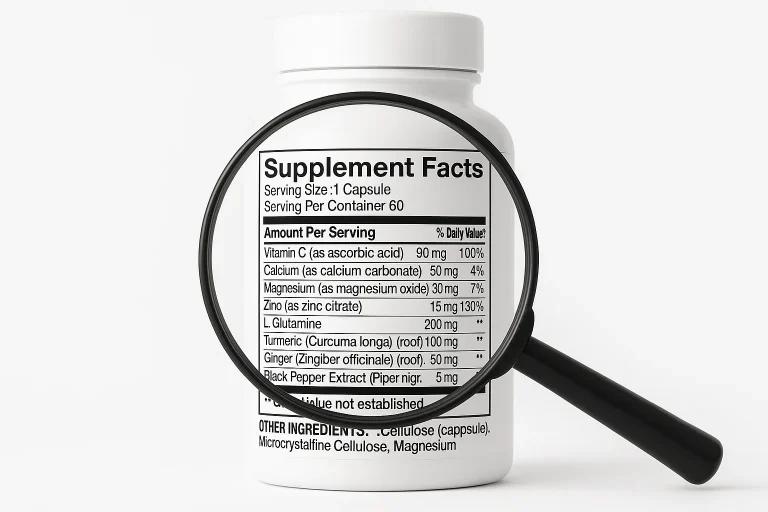
Hair and nail products can be dosed at 5000 or even 10,000 µg of biotin, which is hundreds of times above the daily requirement. This makes an ingredient with unproven effectiveness a real diagnostic problem. If you are taking biotin, inform your doctor and the blood draw point before the tests. Discontinuing the supplement a few days before the draw is usually sufficient, but leave the timing decision to the person ordering the tests.
What do the data say about iron and ferritin in relation to hair loss?
The association is well documented, but the threshold and supplementation itself are not. A meta-analysis Ahmed i wsp. (Skin Appendage Disorders, 2026), encompassing 29 studies, showed lower ferritin in individuals with telogen effluvium than in controls, with a standardized mean difference of -0.57 and high heterogeneity of results.
Liczba 40 µg/l, powtarzana w poradnikach jako granica, nie pochodzi z uzgodnionego stanowiska. Rushton (Clinical and Experimental Dermatology, 2002) states directly that the ferritin level appropriate for individuals with increased hair loss has not been definitively established, proposing 70 µg/l with a normal ESR below 10 mm/h. Almohanna et al. also cite the observation that some women with ferritin below 40 µg/l have no symptoms related to hair.
The practical conclusion is the opposite of the advertising one. Iron is not taken prophylactically, but only after measuring ferritin and morphology, and the dose and duration are determined by a doctor. Ferritin is an acute phase protein, so it increases in inflammatory states and can mask deficiency. A review Watt i wsp. (Family Practice, 2025) regarding iron supplementation in individuals without anemia summarizes the data on harms as low quality and inconsistent, and urgently calls for studies assessing the risk of gastrointestinal disorders and iron overload.
Do zinc and vitamin D have a documented connection with hair loss?
They do, but only in the form of observational links. Studies compare zinc levels in individuals with hair loss and healthy individuals, which is different from demonstrating that administering a supplement restores hair. The latter has not been shown for zinc.
W pracy Kil i wsp. (Annals of Dermatology, 2013) 312 patients with four types of hair loss were compared to 30 controls. The average serum zinc concentration was 84.33 compared to 97.94 µg/dl in the control group. Values below 70 µg/dl were more common in alopecia areata and telogen effluvium. This is a cross-sectional study without a treated arm. Almohanna et al. noted in their evidence table that information on the effectiveness of zinc supplementation is insufficient, and Rushton went further, stating that the hypothesis of zinc as a cause of hair loss is unsupported by data.
Witamina D ma mocniejsze zaplecze obserwacyjne. Metaanaliza Liu i wsp. (Dermatology and Therapy, 2020) It included 1585 individuals with alopecia areata and 1114 controls from 19 studies. The concentration of 25(OH)D was on average 9.08 units lower in patients, and the chance of deficiency was over four times greater (OR 4.14). The authors recommend screening for deficiency rather than blind supplementation.
Do saw palmetto, collagen, and keratin have studies in humans?
They do, but these are single and small trials. For saw palmetto, the best evidence remains a 16-week randomized placebo-controlled study, while for hydrolyzed keratin, there is one study involving fifteen women. The scale of these studies does not allow them to be placed alongside medications used for androgenetic alopecia.
Sudeep i wsp. (Clinical, Cosmetic and Investigational Dermatology, 2023) They assigned 80 individuals with mild to moderate androgenetic alopecia to four arms, so 20 per group. Oral saw palmetto oil reduced hair loss by 29% compared to baseline, and density increased by 5.17%. The ratio of hairs in the growth phase to resting hairs did not change significantly, and the study was sponsored by the raw material producer.
The situation for protein supplements is weaker. Glynis (Journal of Clinical and Aesthetic Dermatology, 2012) It studied hydrolyzed keratin in women experiencing hair thinning, in a double-blind scheme lasting 180 days. The group consisted of 15 individuals, ten on the supplement and five on placebo, in one center. The reported increase in terminal hair count from 271 to 609 over an area of 4 cm² is difficult to accept with such a small sample size without repetition in a larger trial. Collagen provides glycine and proline, not cysteine and methionine, which make up hair keratin.
Which supplements cause hair loss on their own?
Primarily vitamin A and selenium when taken in excess. Both elements have a narrow safety window, and their excess manifests as hair loss, precisely what they were supposed to protect against. This is the most commonly overlooked part of the conversation about hair products.
Almohanna et al. state that for adults, the upper tolerable intake level of preformed vitamin A is 10,000 IU per day and that excessive intake or excessive supplementation of this vitamin causes hair loss. The form also matters: carotenoids of provitamin A from vegetables do not have an established upper limit, while preformed vitamin A from supplements and liver does.
Selenium acts similarly, but more quickly. Intake above 400 µg per day can cause symptoms of poisoning. MacFarquhar i wsp. (Archives of Internal Medicine, 2010) They described a case of acute selenium poisoning after a liquid dietary supplement that contained 200 times more selenium than declared on the label. 201 cases were identified in ten states, with a median intake of 41,749 µg per day against a recommended intake of 55 µg. Hair loss was reported by 72% of the affected individuals, and after 90 days, it persisted in 29%. Rushton concludes his review with the same warning: excessive intake of supplements can itself cause hair loss and is not recommended without confirmed deficiency.
What tests should be ordered and when to see a dermatologist?
Start with a complete blood count, ferritin, TSH, and 25(OH)D, and if on a plant-based diet, add vitamin B12. This panel has most frequently shown abnormal results in individuals with hair loss in the cited studies. Interpret the results with a doctor, not with a calculator on the manufacturer's website.
See a dermatologist immediately if sharply defined patches without hair, redness, scaling, pain, or itching of the scalp appear. Scarring and atrophy of follicle openings indicate scarring alopecia, where the response time determines how many hairs can be saved, and no supplement will change the course. An urgent consultation is also warranted for sudden, rapid hair loss and for hair loss lasting longer than six months despite normal results.
In the office, the examination begins with an interview about events from 2-3 months prior, medications, and diets, followed by an assessment of the scalp using trichoscopy. In more difficult cases, the dermatologist takes a skin biopsy. We noticed, comparing costs, that a complete set of basic blood tests in Polish laboratories is within the price of one large package of hair products, and it answers a question that no capsule can resolve. If you are looking for products with transparent ingredients, check the section supplements.
Frequently Asked Questions
Does biotin help with hair loss?
Outside of rare, confirmed deficiency, there is no good evidence for this. Yelich i wsp. (2024) They found only three studies on oral biotin and hair growth. The strongest of these, with a double-blind trial and placebo, showed no difference between biotin and placebo.
What level of ferritin is considered too low for hair loss?
Progu nie ustalono definitywnie. Rushton (2002) It proposes 70 µg/l with a normal ESR below 10 mm/h, not 40 µg/l as repeated online. The result is interpreted by a doctor together with the complete blood count, as ferritin also rises in inflammatory states.
What is the difference between telogen and androgenetic hair loss?
Telogen effluvium is diffuse and temporary, usually appearing 2-3 months after illness, childbirth, or a strict diet. Androgenetic alopecia progresses over years, affecting the crown and temples, resulting from follicle sensitivity to androgens. A supplement corrects a deficiency, so it only pertains to the first.
Can high doses of biotin be harmful?
Biotyna zaburza immunotesty stosowane w laboratoriach. Rosner i wsp. (2019) They described a patient taking 5 mg of biotin daily, whose low TSH and PTH with hypercalcemia raised suspicion of cancer. Results returned to normal a month after discontinuing the supplement.
Can a supplement itself cause hair loss?
Yes. Overdose of vitamin A and selenium is documented as a cause of hair loss. In the selenium poisoning described by MacFarquhar i wsp. (2010) hair loss was reported by 72% of the 201 affected individuals, and after 90 days, it persisted in 29%.
When should you see a dermatologist for hair loss?
When clearly defined patches without hair, redness, pain, or scarring of the scalp appear, when loss lasts longer than six months, or when accompanied by other general symptoms. A dermatologist will assess the scalp using trichoscopy and will take a biopsy if necessary.
If you are interested in how the evidence assessment looks for other groups of products, check the texts Supplements for concentration and memory and Collagen: when to take and what to combine it with.
This article is for informational and educational purposes and does not constitute medical advice. Before starting supplementation, consult your doctor, especially if you are taking medications regularly, are pregnant or breastfeeding, or have a chronic illness.
Author: Michał Waluk · Opublikowano: 2026-06-22 · Aktualizacja: 2026-08-08