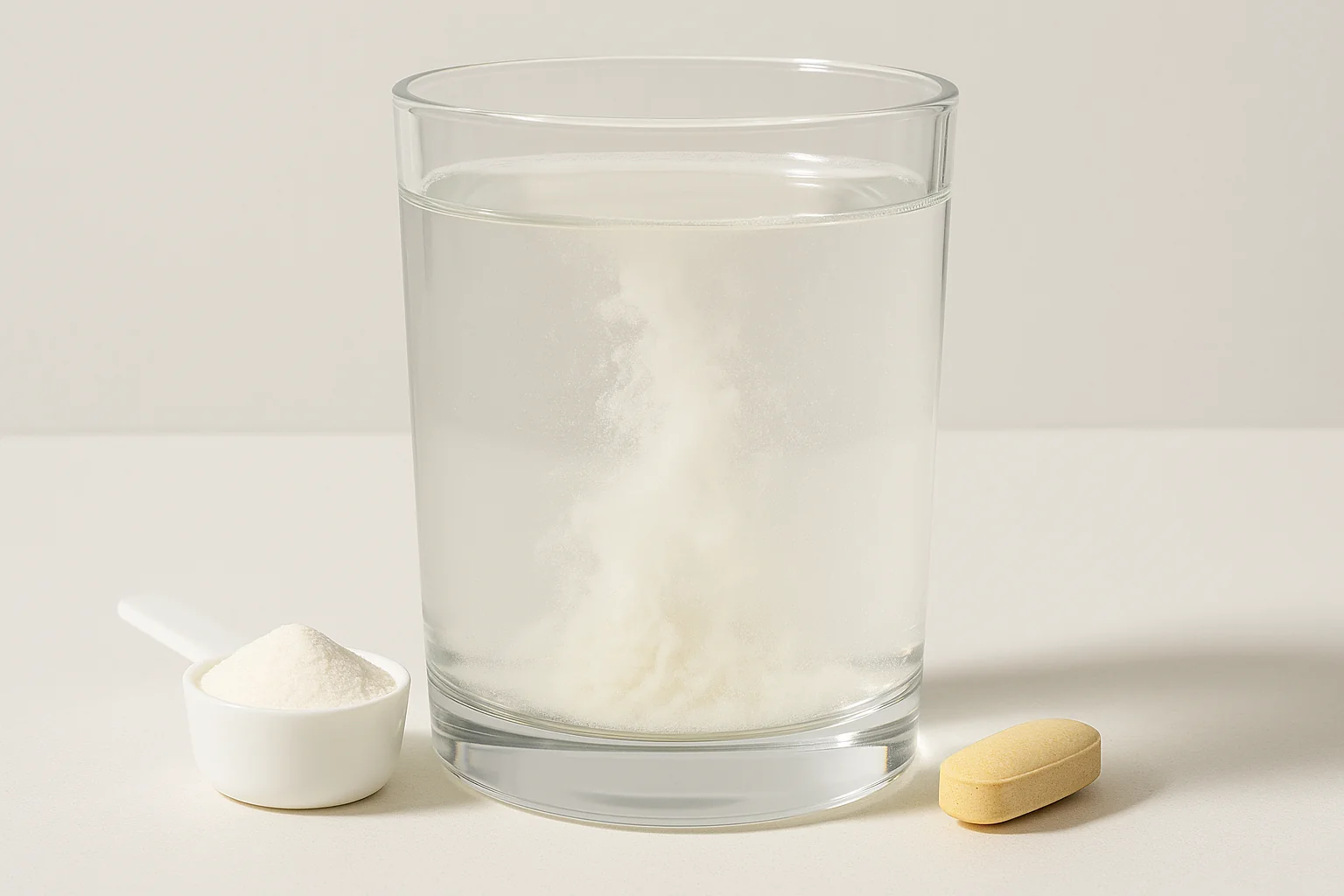

Collagen at night or in the morning: when to take it and what to combine it with for the best effects
Collagen in the morning supports tendons, while in the evening it improves sleep thanks to glycine. Check the dosages, why vitamin C is needed, and how long it realistically takes to see effects.
Collagen is one of the most frequently purchased supplements, and the question of when to take it comes up in every discussion about it. The answer is: it depends on the goal, and this is not an excuse. Gelatin with vitamin C taken an hour before short exercise doubled the blood marker for collagen synthesis, as shown in a study from the American Journal of Clinical Nutrition. In the evening, a completely different mechanism based on glycine, which constitutes about one-third of the amino acid residues in collagen, is at work. Below you will find dosage ranges confirmed in studies, a list of combinations that make sense, and those that are better spaced out in time. At the end, we compare seven collagen products available in the u Bucha store, calculated for the cost of 10 g of collagen.
KEY INFORMATION
• 15 g of gelatin with vitamin C taken an hour before exercise doubled the blood marker for collagen synthesis (Shaw et al., AJCN, 2017).
• 3 g of glycine before sleep reduced fatigue the next day (Bannai et al., Front Neurol, 2012).
• Without vitamin C, the triple helix of collagen does not form (Peterkofsky, AJCN, 1991).
• Skin responds to 2.5-10 g daily for 8-24 weeks, joints to 10 g daily for 24 weeks.
When to take collagen before training and what does it provide?
Before training, collagen makes sense when the goal is tendons, ligaments, or cartilage. In a randomized crossover study, eight healthy men took 5 or 15 g of gelatin enriched with vitamin C or a placebo one hour before six minutes of jumping rope, three times a day for three days (Shaw i wsp., American Journal of Clinical Nutrition, 2017). Participants taking a 15 g serving had twice the concentration of type I collagen propeptide in their blood after exercise, which is a direct marker of newly formed collagen.
Amino acids from gelatin peaked in the blood one hour after consumption, which sets the timing window for intake. The authors also checked what this blood does with the tissue: cultured ligaments treated with serum taken one hour after the serving had more collagen and better mechanical properties. Exercise plays the role of an address in this system, as the load directs synthesis to the tissues that are working at that moment.
We have noticed in conversations with customers that collagen ends up in the cart together with post-workout supplements and is taken after the session. This is a misunderstanding regarding the role of the product. Collagen does not have a complete amino acid profile and does not drive muscle synthesis like whey. Its value lies in connective tissue, which needs a mechanical stimulus when the peptides are already in circulation.
Does collagen at night really improve sleep?
Evening collagen works through glycine, not just through tissue rebuilding. Glycine makes up about one-third of the amino acid residues in collagen, so a serving of 10-15 g of hydrolysate provides about 2-3 g of it. This is the same order of magnitude that has been studied in the context of sleep.
Badanie Bannai i wsp. (Frontiers in Neurology, 2012) restricted volunteers' sleep by one-fourth for three consecutive nights and administered 3 g of glycine or placebo before sleep. The group with glycine reported significantly less fatigue the next day and performed better on the psychomotor vigilance test. Sleepiness also decreased, although this difference remained at a trend level.
The mechanism was outlined using an animal model. Oral glycine shortened the time to sleep in rats and lowered body temperature by increasing blood flow to the skin. The effect disappeared after administering NMDA receptor antagonists, but not after strychnine blocking glycine receptors (Kawai i wsp., 2015). The site of action turned out to be the suprachiasmatic nucleus of the hypothalamus, which is the circadian clock. An evening dose thus provides two things at once: building blocks for the night and a gentle signal that facilitates falling asleep.
Why should collagen be taken with vitamin C?
Vitamin C is not a marketing add-on, but a requirement for a chemical reaction. Ascorbate is needed for the hydroxylation of proline residues in procollagen, and the resulting hydroxyproline stabilizes the triple helix and allows the mature fiber to be secreted outside the cell (Peterkofsky, American Journal of Clinical Nutrition, 1991). In case of deficiency, collagen is poorly hydroxylated and breaks down more quickly even inside the cell. Hence the symptoms of scurvy affecting the gums and blood vessels.
That’s why the study by Shaw et al. administered gelatin enriched with vitamin C, not just gelatin alone. Providing amino acids without a cofactor is like delivering bricks without mortar.
In practice, you don’t need mega doses. The daily requirement for an adult is around 75-100 mg, which you can find in a glass of orange juice or in one kiwi. Products with added vitamin C are convenient, but there is no data to suggest that this form works better than a natural source consumed together with the portion. If you take collagen in the evening, just check if your dinner actually includes vegetables or fruits.
On an empty stomach or with food, and what not to combine with collagen?
An empty stomach is not a condition for effectiveness. The hydrolysate is already broken down into short peptides, and in the blood after drinking 9-23 g of such a preparation, the dipeptide Pro-Hyp predominates. Its concentration peaks 1-2 hours after the dose and drops to half that value after four hours (Iwai i wsp., 2005). A hearty meal shifts this peak but does not cancel it.
Three things are worth spacing out in time:
- Alcohol before sleep. It worsens sleep quality, which is exactly the opposite of the reason you take collagen in the evening.
- A very fatty meal just before training. It delays the peak concentration of peptides, and with a pre-workout dose, that moment is crucial.
- A large portion of whey protein. Space both preparations by an hour if you want a clear amino acid signal from collagen.
The popular warning against hot drinks is, however, a misunderstanding. Collagen hydrolysate is already broken down by definition, so hot coffee has nothing to denature in it. Caution with temperature concerns gelatin and its gelling ability, not the absorption of short peptides. Therefore, soluble collagen coffees are entirely justified.
How much collagen daily and how long should you take it?
The dose depends on the tissue, not body weight. A systematic review of eleven randomized studies involving 805 people describes for skin a hydrolysate in the range of 2.5-10 g daily for 8-24 weeks, with improvements in hydration and elasticity (Choi et al., 2019). In a study on joint pain, 147 athletes were randomized to 10 g of hydrolysate daily or to placebo for 24 weeks, and the active group reported less exercise-related pain (Clark et al., 2008).
A separate category is undenatured type II collagen, where the scale of doses is completely different. 40 mg daily for 180 days improved the WOMAC scale score in 191 people with knee osteoarthritis more than glucosamine with chondroitin (Lugo et al., 2016). Do not convert these two worlds into each other: 40 mg of type II preparation is not a smaller version of 10 g of hydrolysate.
The time horizon was set by the research protocols themselves. Nothing on this list works in two weeks, and stopping after a quarter reverses what has been built.
Jakie preparaty kolagenowe ma sklep u Bucha?
There are currently seven collagen preparations for consumption in the catalog, and you can find all of them in the category supplements. They differ not only in packaging price but primarily in the amount of collagen in the daily portion, and only this second number allows for a fair comparison. We calculated each preparation based on the cost of 10 g of collagen, which is the dose studied for joints.
| Preparation | What distinguishes | Kolagen w porcji | Price | Koszt 10 g kolagenu |
|---|---|---|---|---|
| Divine Collagen grass-fed with tremella, 315 g | type I and III peptides from grass-fed beef | 10,000 mg | 118.99 PLN | 3.97 PLN |
| Aura Care Collagen Power of Beauty, 500 ml | liquid with hyaluronic acid and bamboo silica | 12,000 mg | 139.00 zł | 5.79 PLN |
| Aura Care Collagen Power of Youth, 500 ml | liquid with MSM and plant extracts | 11,000 mg | 139.00 zł | 6.32 PLN |
| Aura Care PREMIUM Collagen Activity, 200 g | with glucosamine, chondroitin, and MSM | 5 500 mg | 129.00 zł | 7.82 PLN |
| Aura Care PREMIUM Collagen Beauty, 200 g | with organic silica and biotin | 5 500 mg | 129.00 zł | 7.82 PLN |
| Aura Care Kawa Kolagenowa Arabica, 220 g | kolagen rybi w rozpuszczalnej kawie | 2 000 mg | 99.00 PLN | 13.75 PLN |
| Aura Care Esencja Kolagenowa, 50 ml | concentrated liquid with B vitamins | 733 mg | 99.00 PLN | 45.02 zł |
Products with a large daily dose are the cheapest per gram, while collagen coffee and essence primarily offer convenience and extras, not just the dose itself. Prices are from the Store API of the shop, as of 2026-08-08, and may change.
Frequently Asked Questions
When is the best time to take collagen, in the morning or in the evening?
Both timings are justified, but by different mechanisms. In the morning, 30-60 minutes before exercise, collagen supports synthesis in tendons and cartilage (Shaw i wsp., 2017). In the evening, glycine works to lower the body's internal temperature and facilitate sleep. For the skin itself, the timing doesn't matter; consistency is key.
Do you need to take collagen on an empty stomach?
No, it's not necessary. The hydrolysate is already broken down into short peptides, mainly Pro-Hyp, and their concentration in the blood peaks 1-2 hours after consuming a dose (Iwai i wsp., 2005). A rich, fatty meal delays this peak but does not eliminate absorption. Consistency is more important here than having an empty stomach.
Why combine collagen with vitamin C?
Vitamin C is required for the hydroxylation of proline residues in procollagen, and the resulting hydroxyproline stabilizes the triple helix and allows collagen to be secreted from the cell (Peterkofsky, 1991). Without it, the body cannot build mature fibers from the supplied amino acids. A glass of orange juice or one kiwi is enough for a serving.
How much collagen should be taken daily?
A review of eleven studies involving 805 people describes doses of 2.5-10 g daily for the skin over 8-24 weeks (Choi et al., 2019). For joint pain in athletes, 10 g daily for 24 weeks was effective. Undenatured type II collagen was studied on a completely different scale: 40 mg daily.
How long does it take to see the effects of taking collagen?
Skin studies lasted from 8 to 24 weeks, while those on joints lasted 24 weeks or longer (Clark et al., 2008). Assume that the first honest assessment occurs after two months, and for cartilage after six months. The effects accumulate slowly and fade after discontinuation.
Does glycine from collagen really improve sleep?
3 g of glycine before sleep reduced fatigue the next day and improved psychomotor vigilance test scores in individuals with shortened sleep (Bannai i wsp., 2012). The mechanism was studied in rats: glycine acts through NMDA receptors in the suprachiasmatic nucleus and lowers the body's internal temperature.
If you want to compare compositions and servings on your own, a complete list of products is available in the category supplements in the u Bucha store.
This article is for informational and educational purposes and does not constitute medical advice. Before starting supplementation, consult your doctor, especially if you are taking medications regularly, are pregnant or breastfeeding, or have a chronic illness.
Author: Michał Waluk · Opublikowano: 2026-06-22 · Aktualizacja: 2026-08-08