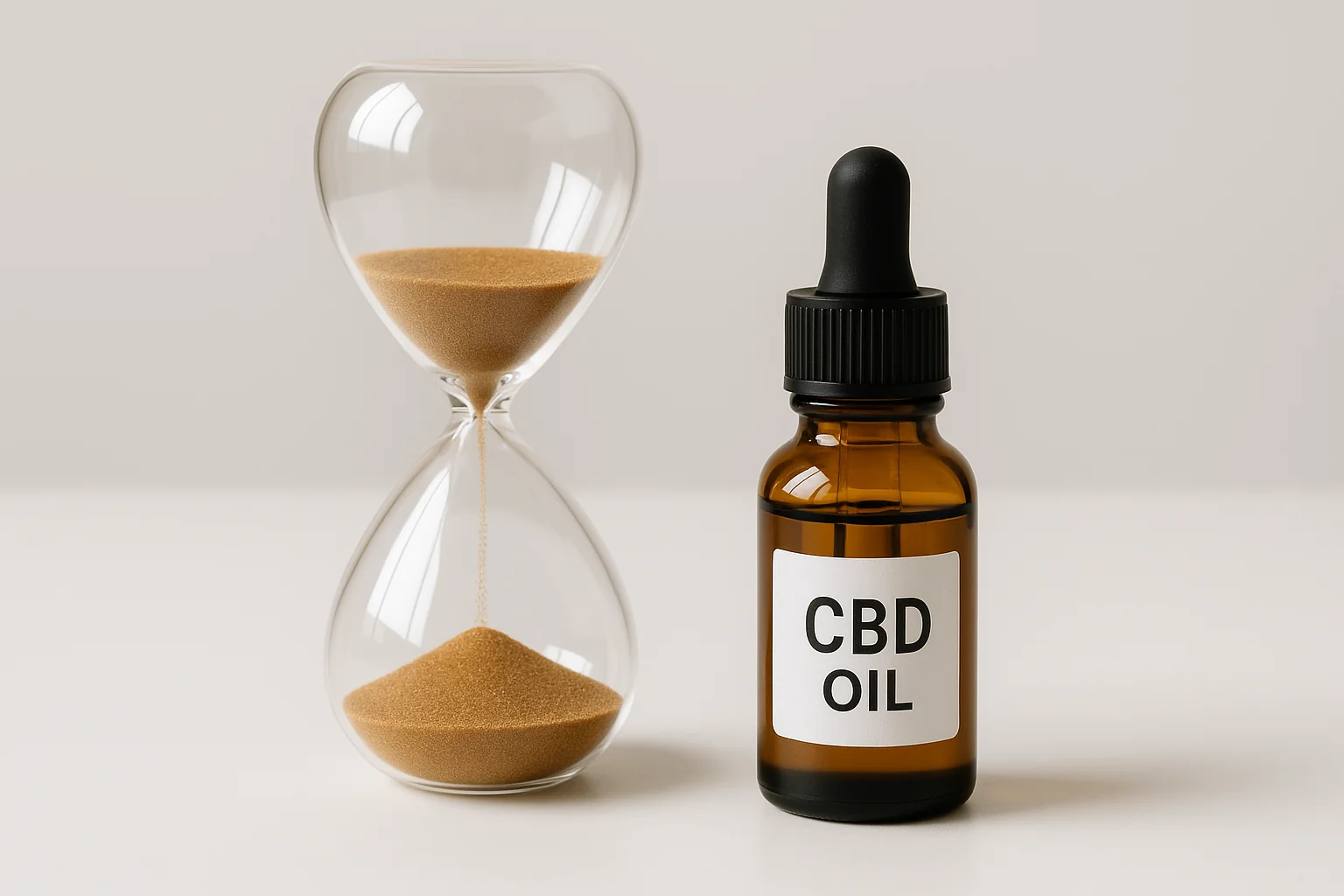

How long does it take for CBD to work? When are the first effects of the oil and gummies visible
How long does it take for CBD to work? How quickly does CBD oil work compared to gummies? When are the first effects noticeable and why might CBD not work immediately? Answers from clinical studies 2026.
One of the most common reasons for abandoning CBD is disappointment after a few days: "I took 5 drops and felt nothing." This is a common expectation error - CBD does not work like ibuprofen or coffee, whose effects are visible within minutes or hours. Time and regularity are just as important as dosage when it comes to CBD. But "how long does it take for CBD to work" is a question with several different answers depending on what you mean: effects of a single dose, short-term effects after a few days, or long-term effects after weeks of regular use. This article distinguishes these three levels and provides specific time frames for each.
KEY INFORMATION
• CBD oil sublingually: first effects after 15-45 min; gummies and capsules: after 1-3 hours.
• CBD half-life: 18-32 hours with regular use (Millar et al., Pharmaceuticals, 2019).
• Lasting clinical effects on anxiety, pain, and sleep: after 4-8 weeks of regular use.
• CBD with a fatty meal works faster and 9.7× more effectively than on an empty stomach (Saals et al., Scientific Reports, 2025).
• Effects after 1-2 weeks of use are usually subtle - this is normal, not a reason to give up.
When do the first effects appear - minutes or weeks?
The answer to the question “how long does it take for CBD to work” depends on what we understand by “working.” There are three different time horizons worth distinguishing:
1. Efekty jednorazowej dawki (minuty do godzin): CBD taken sublingually begins to be absorbed into the bloodstream through the sublingual mucosa immediately after administration. The first detectable concentration in the blood appears after about 15 minutes. Subjective effects (slight relaxation, reduced tension, slight mood improvement) may be felt after 15-45 minutes. The peak concentration of CBD in the blood when taken sublingually is reached after about 1-2 hours.
2. Efekty w pierwszych 1-2 tygodniach: At this stage, the endocannabinoid system adapts to the regular influx of CBD. Some people experience noticeable effects after just a few days, especially with clear underlying pathology (severe anxiety, acute pain, serious insomnia). For many others, the effects are subtle or difficult to identify - this is not a sign that CBD "does not work", but that adaptation is gradual.
3. Lasting clinical effects (4-8 weeks): Clinical studies use 4-8 week protocols as the standard for assessing the effectiveness of CBD for anxiety, pain, and sleep. The Cochrane review on chronic pain indicated a minimum of 4 weeks as the time needed for assessment. Shannon et al. (Permanente Journal, 2019) reported that the effects on sleep and anxiety were stronger in the 2nd month than in the 1st month of using CBD - suggesting a cumulative effect over time.
The action time of CBD oil vs gummies and capsules
The form of the CBD product has a significant impact on how quickly CBD begins to work and how long the effects last. The differences arise from varying bioavailability and absorption pathways.
CBD Oil Sublingual - the gold standard of speed of action. CBD in oil taken sublingually and held for 60-90 seconds is absorbed through a rich network of capillaries directly into the bloodstream, bypassing the liver (first-pass effect). Bioavailability: 13-19% according to Millar et al. (Pharmaceuticals, 2019). Time to effect: 15-45 minutes. Duration of action of a single dose: 4-6 hours.
CBD gummies and capsules - slower onset, but convenient form. CBD must pass through the digestive tract, be absorbed in the small intestine, and transported through the liver (where part is metabolized) to the bloodstream. Bioavailability: 4-8%. Time to effect: 1-3 hours. Duration of action: potentially longer (5-8 hours) due to gradual release. When using gummies with a fatty meal, bioavailability significantly increases - an effect observed in the study by Saals et al.
Inhalacja (waporyzator CBD) - fastest onset. Effects visible within 1-5 minutes. Duration: 1-3 hours. Bioavailability: 34-46%. Vaporization is not discussed in this article as a form of supplementation - but it's worth knowing that in cases of extreme urgency (migraine attack, panic attack), it is the pharmacologically fastest route of administration.
Why CBD may not work right away - 5 most common reasons
The lack of noticeable CBD effect in the first days or weeks is a common phenomenon, but it usually has specific causes. It is not a reason to give up, but a signal for analysis:
1. Za niska dawka. This is the most common reason. Many people start with a symbolic 1-2 mg of CBD (at once) and expect an effect. Clinical studies used 25-75 mg/day for anxiety and sleep, 15-50 mg/day for pain. If you take 5 mg and feel nothing - the dose is probably just too low. Gradually increase by 5 mg each week.
2. Poor administration technique. CBD swallowed immediately (without holding under the tongue) has a bioavailability of 4-8% instead of 13-19%. This is almost a threefold difference in the amount of CBD actually absorbed. Holding it under the tongue for 60-90 seconds is crucial and often overlooked by new users.
3. Lack of fat during intake. CBD is a lipophilic substance. Saals et al. (Scientific Reports, 2025) They demonstrated a 9.7-fold higher absorption of CBD with a fatty meal vs. fasting. If you take CBD oil on an empty stomach without any fat - you lose most of the dose. A simple rule: take the oil under your tongue, wait a minute, eat something fatty.
4. Poor product quality. Studies have shown that up to 70% of CBD products on the market contain less CBD than declared. If you take "25 mg CBD" from a product without a COA certificate, you may actually be taking 10-15 mg. Product verification by COA is fundamental before concluding that "CBD doesn't work."
5. Evaluating the effect too early. The first effects of a single dose are usually subtle - not dramatic. The endocannabinoid system needs several weeks of regular stimulation to set homeostasis at a new point. Assessment after 3-5 days is premature for therapeutic goals such as anxiety, chronic pain, or sleep.
Our observations: One of the main reasons for "CBD not working" is a combination of low dose and poor administration technique. When these two factors are corrected simultaneously, many people who previously considered CBD useless notice a significant improvement - with the same bottle they had. Before buying another product, first check these two elements.
How long does it take for the full effect - CBD timeline
A realistic timeline of CBD effects with regular daily use:
The first 15-45 minutes (after sublingual administration): Possible subtle effects - gentle relaxation, slight reduction in tension, calming of racing thoughts. Not everyone feels this at low starting doses (5-10 mg).
Dni 1-7: Adaptation phase of the endocannabinoid system. Effects may be minimal, and there may even be a temporary change in sleep (vivid dreams, temporary worsening of sleep). This is normal and passes. Continue.
Tygodnie 2-3: Most users start to notice the first more pronounced effects - better sleep, less morning tension, milder response to stressors. This is the time to start keeping a journal (rating 1-10 for the main goal).
Tygodnie 4-6: If the dose is right, there should be a clear change compared to the baseline. Shannon et al. reported a 66.7% improvement in sleep and a 79.2% improvement in anxiety right in this window. If there is still no effect - it's time to adjust the dose or consult.
Tygodnie 7-12+: Further development of effects or stabilization. Some users notice improvement over the first 3 months. After achieving a stable effect, one can consider reducing the dose to a maintenance level. More about dosing and CBD usage schedule can be found in the article How much CBD can you take daily.
How long does CBD stay in the body?
The half-life of CBD - the time after which the concentration of CBD in the blood decreases by half - is 18-32 hours with regular daily use. With a single intake, the half-life is shorter (about 2-5 hours). Millar et al. (Pharmaceuticals, 2019) They summarized pharmacokinetic data from multiple studies and indicated that the half-life depends on the route of administration and the regularity of use.
With daily use, CBD accumulates in fatty tissue and blood, creating a stable concentration. This is important for two reasons: first, the effects of CBD overlap, and each subsequent dose "supplements" the previous one - enhancing cumulative effects. Second: complete elimination of CBD from the body after cessation of use can take several days to several weeks, depending on the duration of use, dosage, and individual metabolism.
Practical implication: if you have been using CBD for several weeks and want to see what happens after stopping - the effects fade gradually, not immediately. Usually within 1-2 weeks after cessation. This also allows for a gradual dose reduction (by 20-30% each week) if you decide to stop, rather than a sudden withdrawal.
Frequently Asked Questions
How long does it take for CBD oil to work?
With sublingual administration, the first effects of CBD may appear after 15-45 minutes. Peak blood concentration after 1-2 hours. Lasting clinical effects for anxiety, pain, and sleep require regular use for 4-8 weeks - as confirmed by clinical studies. Shannon et al. (Permanente Journal, 2019).
How long does the effect of CBD last?
The duration of action of a single dose of sublingual oil: 4-6 hours. The half-life of CBD with regular use: 18-32 hours, which means building a stable concentration in the blood with daily intake. Gummies may work a bit longer (5-8 hours) due to slower absorption from the digestive tract.
Why doesn't CBD work immediately?
CBD works by gradually modulating the endocannabinoid system, which adapts over weeks - not days. The most common reasons for lack of effect: too low a dose, swallowing without holding under the tongue, taking on an empty stomach without fat, poor quality product. Effectiveness assessment requires a minimum of 4 weeks of regular use at the proper dose.
When do CBD gummies work faster than oil?
Gummies never work faster than sublingual oil - the time to effect is 1-3 hours vs. 15-45 minutes for oil. Gummies also have lower bioavailability (4-8% vs. 13-19%). Gummies have other advantages: convenience, discretion, and a consistent measured dose without a dropper. In urgent need of a quick effect, sublingual oil is always the better choice.
How long do you need to take CBD regularly to assess its effectiveness?
A minimum of 4 weeks of daily use at the proper dose. Clinical studies for pain, anxiety, and sleep use 4-8 week protocols. Earlier assessment is prone to error: CBD effects accumulate, and the first 1-2 weeks are often an adaptation phase with subtle responses. Keeping a journal throughout this time is the best method for objective evaluation.
This article is for informational and educational purposes and does not constitute medical advice. Before starting to use cannabis or CBD for therapeutic purposes, consult a doctor, especially if you are taking other medications, are pregnant, or breastfeeding.
Author: Michał Waluk · Published: 2026-05-04 · Updated: 2026-05-04