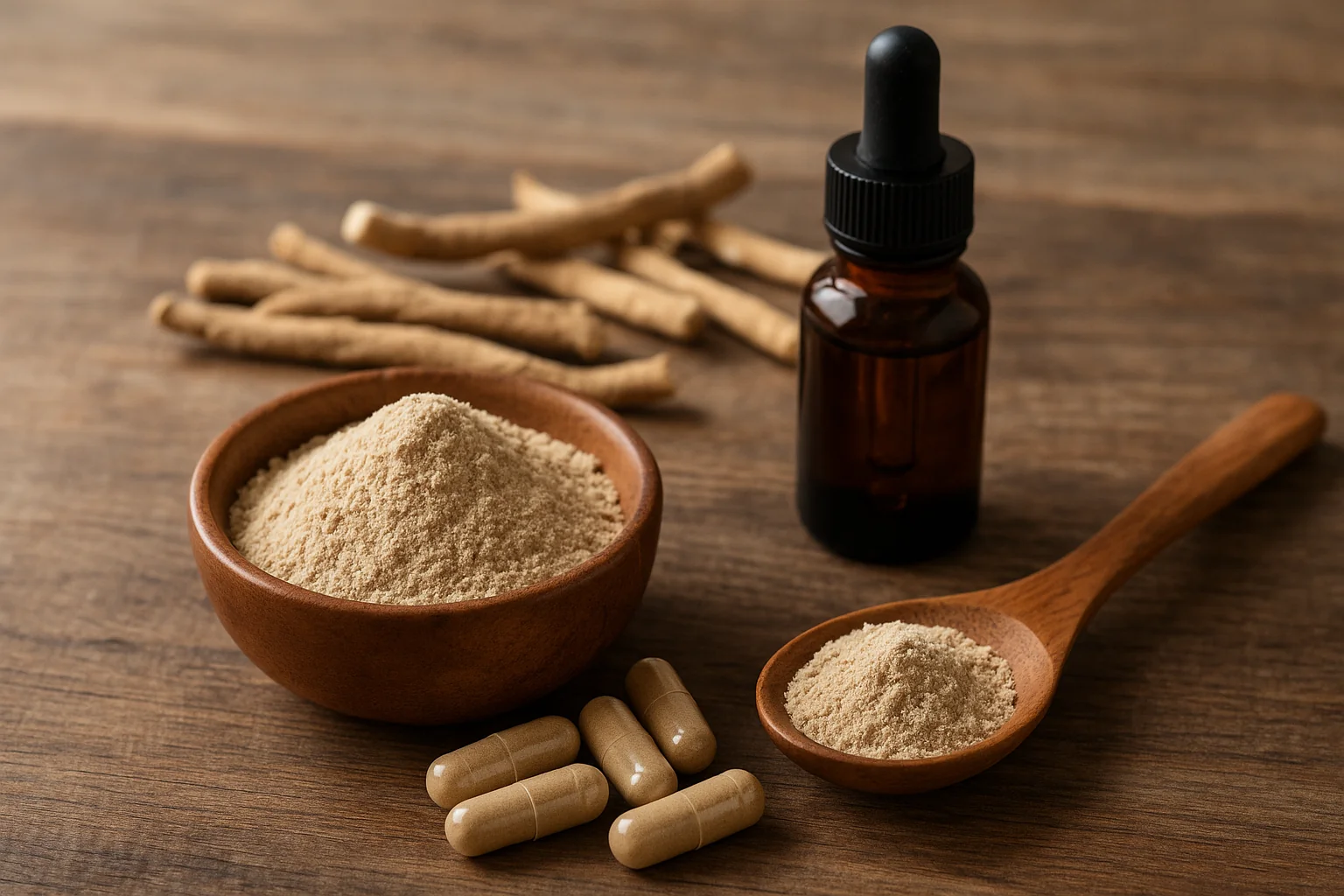

Ashwagandha drops vs capsules: which form works faster and how to dose
Drops or capsules with ashwagandha? We compare forms, prices, and daily portion costs, and check how many withanolides are allowed in Polish supplements.
Drops or capsules? This question arises with ashwagandha more often than any other, and the answer repeated in guides is: drops absorb faster. The problem is that no one has measured this difference in humans. A 2024 review of withanolide pharmacokinetics found only four studies involving humans that measured these compounds in plasma, and none compared tincture with capsule. Instead, something else was measured that influences the outcome much more than the packaging form: the standardization of the extract. Below you will find what is really known about both forms, how many withanolides can be declared in Polish supplements, and how much a daily portion of each form available at u Bucha costs.
KEY INFORMATION
• Standardization weighs more than form: an extract with 35% withanolide glycosides yielded 226 times greater area under the curve per gram than a 5% extract (Rathi and Kim, 2025).
• The Polish limit is 10 mg of withanolides in the daily portion (resolution no. 7/2020).
• Effects in studies appeared after 60 days and after 10 weeks, not after minutes.
• Cases of liver damage after single-ingredient preparations have been reported (Philips et al., 2023).
What is the difference between ashwagandha in drops and ashwagandha in capsules?
The difference lies in the solvent and who measures the portion. Drops are a liquid extract that you place under your tongue and hold there for a moment. A capsule or tablet contains dry extract or oil macerate, which you swallow whole, and the portion size is determined by the manufacturer on the label.
In practice, four different raw materials stand next to each other in the store, not two forms. A powdered extract standardized to 5% withanolides is sold loose, in packages of 5 and 10 g, and you measure the portion yourself on a scale. Himalaya tablets contain 250 mg of root extract per piece. Aura Care gel capsules contain oil macerate, which is raw material extracted in fat, in an amount of 700 mg per portion of two capsules. Drops from the same line are the same macerate, only in a 15 ml bottle, from which the manufacturer counts about 400 drops.
Names can be misleading. The liquid extract Cosma Pure Herbs in a 30 ml bottle is a drop form, but its card does not provide either standardization or daily portion size, so it cannot be compared numerically with anything. Evening gummies do exactly the opposite and declare 7.7 mg of withanolides in a portion of two pieces. This is the only item in the entire comparison given in a unit that allows for any comparison.
We noticed while browsing product cards that the form of administration is described everywhere, while the content of withanolides is almost nowhere. This is the opposite of what really matters when choosing.
Do ashwagandha drops work faster than capsules?
There is no study that has tested this. A review of withanolide pharmacokinetics gathered twenty papers measuring these compounds in plasma, of which only four concerned humans (Speers i wsp., Nutrients 2024). None compared sublingual administration with swallowing.
Popular numbers circulating in guides, such as 10 to 20 minutes for drops versus 30 to 60 minutes for capsules, do not come from any measurement of withanolides. This is a direct transfer of the characteristics of sublingual medications, which are small molecules well-soluble in fats. Withanolides are steroid lactones, and their glycosides, known as withanosides, are large and water-soluble molecules. The surface area of the mucous membrane under the tongue is small, and the drop manufacturer recommends keeping them there for one to two minutes, after which the liquid is swallowed anyway.
Instead, something else was measured, and the result is much more interesting. In a crossover study involving 16 healthy volunteers, four standardized extracts were compared, each administered to provide 185 mg of withanolides (Rathi i Kim, Current Therapeutic Research 2025). The area under the concentration curve per gram of extract was 226 times greater for the preparation with 35% withanolide glycosides than for the 5% extract and 268 times greater than for the 2.5%. All four were administered orally, in the same form.
The conclusion is simple and inconvenient for marketing. The amount of substance that enters the bloodstream depends on the composition of the extract, not on whether you swallow it from a capsule or place it under your tongue. With a raw material whose effects in studies are measured over weeks, a difference of several minutes does not change anything.
How many withanolides are allowed in a daily portion in Poland?
Ten milligrams. This is the maximum content of withanolides in the recommended daily portion of the supplement according to resolution no. 7/2020 of the Dietary Supplements Team from February 7, 2020. The same resolution indicates that powdered root of Withania somnifera can be used in amounts below 3 g per day.
This number changes the entire discussion about dosing. The protocol from the most frequently cited study, which used 600 mg of extract standardized to 5% withanolides, provides 30 mg of withanolides per day, which is three times the Polish limit. Therefore, products sold legally in Poland are clearly lower: evening gummies declare 7.7 mg per serving, and a Himalaya tablet contains 250 mg of extract, for which the manufacturer does not provide any standardization.
The resolution also imposes an obligation to include a warning on the packaging. The product should not be consumed when using sedatives, sleeping pills, and anticonvulsants. Additionally, the document excludes its use by children and women who are pregnant or breastfeeding. This is not a precautionary statement from the manufacturer, but content indicated by the body reviewing the composition of dietary supplements.
The practical consequence for the loose 5% extract is this: to fit within 10 mg of withanolides, you measure about 0.2 g of powder daily. A 10 g package then lasts for about fifty days.
What forms of ashwagandha are available in the store and how much does a daily portion cost?
The catalog features six products with ashwagandha in the name and twelve others that include it in their blend. Below are those for which the cost of one daily portion can be calculated, as only such a conversion allows for a comparison of powder with drops and gummies.
| Product | Form | What distinguishes | Price | Koszt porcji dziennej |
|---|---|---|---|---|
| Ashwagandha ekstrakt 5%, 10 g | proszek sypki | standardization of 5% withanolides indicated in the name | 6.00 PLN | 0.12 PLN at 0.2 g daily |
| Ashwagandha ekstrakt 5%, 5 g | proszek sypki | sample package, portion measured on a scale | 6.00 PLN | 0.24 PLN at 0.2 g daily |
| Himalaya Ashwagandha, 60 tabletek | tabletki | 250 mg ekstraktu z korzenia w tabletce | 20.99 PLN | 0.70 PLN at 2 tablets |
| Cosma Pure Herbs Ashwagandha, 30 ml | liquid extract | the cheapest entry into liquid form | 20.98 PLN | producent nie podaje porcji dziennej |
| NIGHT REGENERATION gummies with ashwagandha | jelly candy | 7.7 mg of withanolides per serving, value stated directly | 55.00 PLN | 3.67 PLN at 2 gummies |
| Aura Care Adaptogeny Spokojny Sen, 15 ml | sublingual drops | 630 mg of ashwagandha extract per serving, with melatonin | 99.00 PLN | 3.71 PLN for 15 drops |
| Aura Care Adaptogeny Energia, 15 ml | sublingual drops | 360 mg of ashwagandha extract alongside rhodiola and poppy | 99.00 PLN | 3.71 PLN for 15 drops |
| Aura Care Ashwagandha, 60 capsules | gel capsules | 700 mg maceratu olejowego w porcji, bez alkoholu | 119.00 PLN | 3.97 PLN for 2 capsules |
Prices come from the Store API, as of August 8, 2026. The range of daily serving costs is over thirtyfold: from 12 groszy for loose extract to 3.97 PLN for capsules with oil extract. For this difference, you pay for convenience and a ready serving, not for a greater amount of withanolides. Encapsulated and drop products fall into the category supplements, sypki ekstrakt w herbs, while the liquid version is in plant extracts.
What do clinical studies on ashwagandha really show?
The strongest data concerns stress and sleep, not the speed of action. A meta-analysis of twenty-two randomized studies showed improvements in stress, anxiety, and depressive symptoms, with high heterogeneity of results and still undefined optimal dosing (Alsanie i wsp., Complementary Therapies in Medicine 2026).
Study Chandrasekhara i wsp. (Indian Journal of Psychological Medicine, 2012) involved 64 adults with chronic stress who took 300 mg of full-spectrum root extract twice daily for 60 days. Cortisol levels decreased by 27.9% in the treatment group compared to 7.9% in the placebo group, and the perceived stress scale score improved by 44% compared to 5.5%. Contrary to what many studies repeat, the study did not use the PSQI questionnaire. The often-cited improvement of 69.7% refers to the anxiety and insomnia subscale of the GHQ-28 questionnaire.
Sen mierzono osobno. Langade i wsp. (Cureus, 2019) they administered 300 mg of extract twice daily for 10 weeks to 60 individuals with insomnia, monitoring results with actigraphy. Sleep onset time decreased to 29.0 minutes compared to 33.9 minutes in the placebo group, and sleep efficiency increased from 75.6 to 83.5 with a change from 75.1 to 79.7 in placebo.
Strength training is the third area. Wankhede i wsp. (Journal of the International Society of Sports Nutrition, 2015) they observed 57 young men for 8 weeks. The increase in load during bench pressing was 46.0 kg compared to 26.4 kg in placebo, and the cross-sectional area of the arm muscle increased by 8.6 cm² compared to 5.3 cm². The marker for muscle damage was creatine kinase. In a separate study on men with infertility, 5 g of powdered root daily for three months raised testosterone levels by 10% to 22%, depending on the subgroup (Mahdi i wsp., 2011).
It is worth noting the limitations of this data: most studies are funded by extract manufacturers, and there are few independent replications.
When should you take ashwagandha and how should you dose it?
The serving is determined by the label of the specific product, not a general rule from the internet. The reference point in Poland is 10 mg of withanolides per day, so the first question is: does the manufacturer even provide this value? If not, comparing products based solely on milligrams of extract leads nowhere.
Lower doses are not automatically ineffective doses. In a randomized study of 131 individuals with elevated stress, a water extract from the root and leaf reduced perceived stress already at 125 mg per day for 8 weeks, in a dose-dependent manner (Pandit i wsp., Nutrients 2024). This is important given the Polish limit, as it shows that servings within it are supported by data.
The time of day depends on why you are reaching for this raw material. Evening formulations have ashwagandha in the highest dose across the entire line and add melatonin, so the manufacturer associates them with bedtime, not meals. Morning formulations spread the dose over several moments of the day and specify that the last one should be taken five to six hours before sleep. The differences between adaptogens are described separately in the text about adaptogenach dla kobiet.
Withanolides are lipophilic, so dry forms should be taken with a meal containing fat. Oil extracts have this problem solved at the formulation level, as the carrier is oil. In a study comparing four extracts, they were administered on an empty stomach, so its results say nothing about the influence of meals.
Who should avoid ashwagandha?
Resolution No. 7/2020 lists situations directly: sedatives, sleeping pills, and anticonvulsants, childhood, as well as pregnancy and breastfeeding. This warning is to be printed on the packaging of every supplement with this raw material sold in Poland.
The liver is a separate topic, more serious than most guides suggest. A team from India described 23 cases of liver damage after ashwagandha from 2019-2022, including 8 from single-ingredient products (Philips i wsp., Hepatology Communications 2023). The dominant picture was cholestatic hepatitis. In three individuals with a prior chronic liver disease, acute failure occurred on this basis, and all three died during observation. Chemical analysis of the products did not show any adulteration or contamination, so the raw material itself was responsible.
The thyroid is the second point of attention. A review of the impact of ashwagandha on the hormonal system describes an increase in the secretion of triiodothyronine and thyroxine and a subsequent decrease in TSH (Wiśniewski et al., International Journal of Molecular Sciences 2023). In the case of hyperthyroidism or when treating with levothyroxine, this means a real possibility of destabilizing parameters, so the decision about supplementation should be made with an endocrinologist.
Symptoms that indicate the need to discontinue the preparation and consult a doctor are easy to recognize:
- yellowing of the skin or the whites of the eyes
- ciemny mocz przy jasnym stolcu
- persistent skin itching
- pain in the right upper quadrant
In the case of diagnosed chronic liver disease, it is better to avoid this substance altogether.
Frequently Asked Questions
Does ashwagandha in drops work faster than in capsules?
It's unclear, as no one has measured this in humans. A 2024 review of withanolide pharmacokinetics found only four studies involving humans that measured these compounds in plasma, and none compared sublingual administration with swallowing. The popular figures of 10 to 20 minutes come from the pharmacology of sublingual drugs, not from measurements on ashwagandha.
How many withanolides can an ashwagandha supplement contain in Poland?
A maximum of 10 mg in the recommended daily portion, according to resolution no. 7/2020 of the Dietary Supplements Team. The same resolution allows powdered root in amounts below 3 g per day and requires the product introducer to provide a quantitative specification confirming the withanolide content in the daily portion.
Do ashwagandha drops contain alcohol?
They don't have to. A classic tincture is made with ethyl alcohol, but the drops available at u Bucha are oil macerates, with the manufacturer declaring no alcohol, glycerin, or glycol. The solvent here is fat, which makes sense for withanolides, as they are lipophilic compounds.
How Long Does It Take for Ashwagandha to Start Working?
In clinical studies, effects were measured after weeks. Chandrasekhar et al. assessed the outcome after 60 days of intake, Langade et al. after 10 weeks, and the study of doses of the aqueous extract was conducted over 8 weeks. None of them reported an effect after a single dose, so expecting a change in the first week is unrealistic.
When to take ashwagandha: in the morning or evening?
It depends on the formulation you purchased. Evening variants have the highest doses of ashwagandha in the entire line and include melatonin, so the manufacturer associates them with bedtime rather than meals. Morning variants spread the dose over several moments of the day and recommend taking the last one five to six hours before sleep.
Does ashwagandha harm the liver?
In some individuals, yes. A series of cases from India described 23 liver injuries after ashwagandha, including 8 after single-ingredient preparations, with cholestatic inflammation as the dominant picture. Three individuals with pre-existing chronic liver disease died during observation. In the case of liver disease, this substance should be avoided.
Forms with ashwagandha, from loose extract to sublingual drops, can be found in the categories supplements i herbs, the chewable version in the category jelly candy, and other adaptogenic substances in the category adaptogens.
This article is for informational and educational purposes and does not constitute medical advice. Before starting supplementation, consult your doctor, especially if you are taking medications regularly, are pregnant or breastfeeding, or have a chronic illness.
Author: Michał Waluk · Opublikowano: 2026-06-22 · Aktualizacja: 2026-08-08