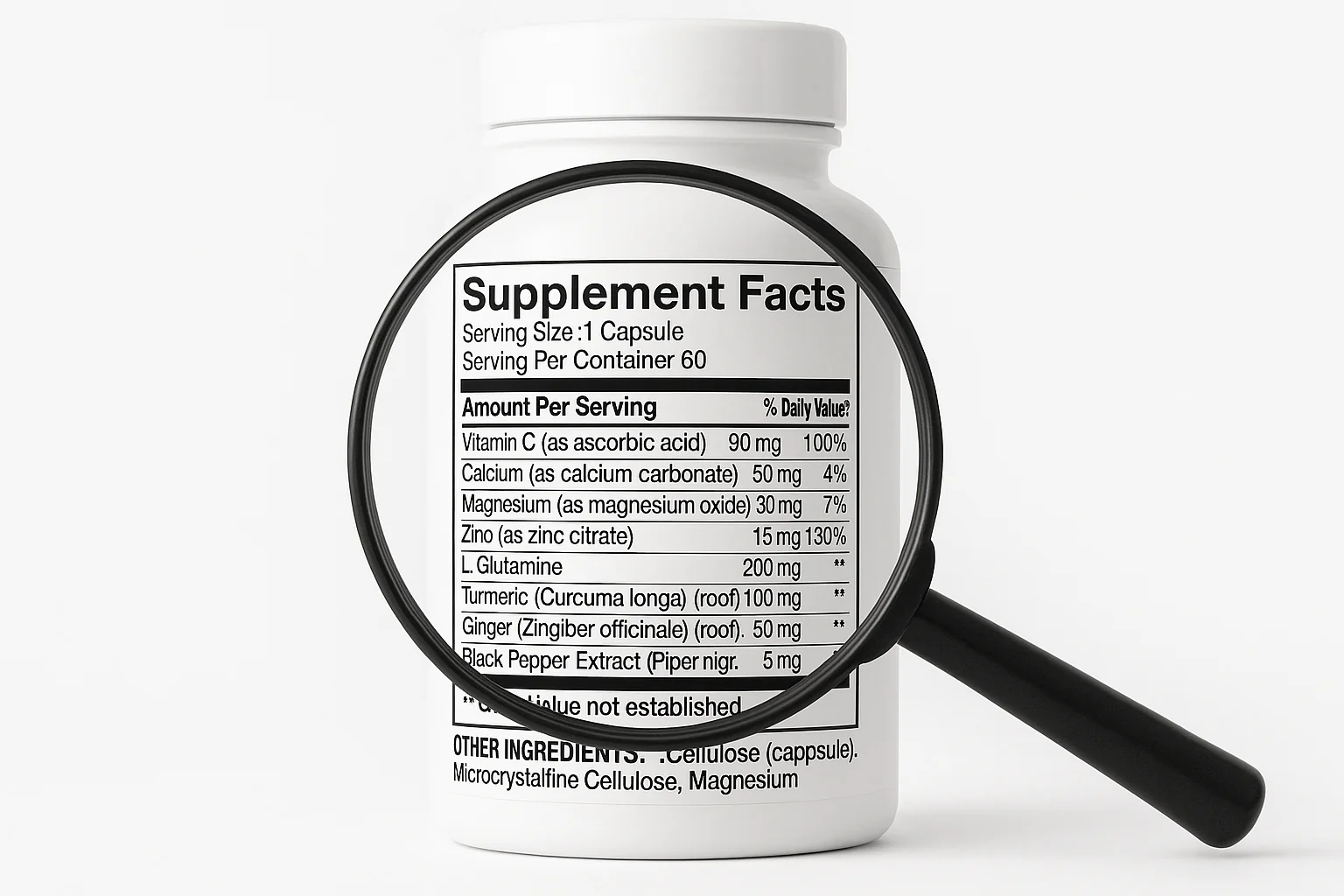

How to read a dietary supplement label - what to pay attention to
There are over 50,000 dietary supplements registered on the Polish market - more than over-the-counter drugs. A manufacturer can introduce a supplement to the market without proving its effectiveness, just a notification to the Chief Sanitary Inspector (
). This means that behind an attractive package and a list of ingredients, there can be both an excellent product and a preparation of questionable value. The ability to read a label is the first line of defense - this article teaches what to look for, what to ignore, and what warning signals should raise suspicion.GIS, 2024• There are over 50,000 registered supplements on the Polish market - registration does not require proof of effectiveness.
KEY INFORMATION
• Allowed health claims on the label are strictly defined by EU Regulation 1924/2006 - any claim of "treatment" is illegal.
• NRV (Nutritional Reference Value) to unijna norma referencyjna: 100% NRV = dawka fizjologiczna, nie „maksymalna skuteczna”.
Anatomy of a supplement label - what must be included
• NSF, USP Verified, or Informed Sport certifications confirm independent verification of laboratory composition.
• The form of the ingredient (e.g., methylfolate vs. folic acid, D3 vs. D2) is more important than the dose expressed as a percentage of NRV.
Mandatory elements: product name and designation "dietary supplement", list of ingredients with quantities, recommended daily portion, warning "Do not exceed the recommended daily dose" and "Do not use as a substitute for a varied diet", information on storage out of reach of children, expiration date and batch number, manufacturer or importer data and country of origin. GIS notification (number or mention) is mandatory for products placed on the market after 2003.
European Union law precisely defines what must be included on a dietary supplement label. Directive 2002/46/EC and regulation 1169/2011 impose specific obligations on the manufacturer (EUR-Lex, Directive 2002/46/EC). The absence of any of the following elements is a warning sign.
The label cannot contain any claim that the supplement "cures", "prevents" or "eliminates" diseases. The only allowed health claims are those approved by the European Commission based on Regulation 1924/2006 - e.g., "vitamin C contributes to the proper functioning of the immune system". If you see the phrase "effectively treats inflammation" or "regenerates cartilage" on the packaging - this is a violation of the law and a serious warning signal regarding the reliability of the manufacturer.
Hidden form of the ingredient under a general name e.g. "calcium" without specifying the form (carbonate, citrate, chelate)
Table: key elements of the label and how to interpret them
The following checklist will allow you to quickly assess the quality of each supplement before purchase. Check each point systematically.
| Label element | What to pay attention to | Warning signal |
|---|---|---|
| Composition and form of the ingredient | Active forms: D3 (not D2), methylfolate (not folic acid), methylcobalamin (not cyanocobalamin), mineral chelates (not oxides) | 100-300% NRV is usually a safe range for water-soluble vitamins; for A and D check UL |
| Dose vs. NRV | Doses >500% NRV for accumulating vitamins (A, D, E, K) without clinical indications | Fillers, carriers, anti-caking agents - should be listed |
| List of excipients | Lack of any external verification; vague "tested in a laboratory" without specifying the laboratory | Titanium dioxide (E171), synthetic azo dyes (E102, E110, E129), EDTA in daily supplements |
| Quality certificates | NSF International, USP Verified, Informed Sport, GMP certificate | Claims compliant with EU Regulation 1924/2006 - specific, measurable |
| Health Claims | "Cures", "regenerates", "eliminates disease" - illegal and indicative of the manufacturer's unreliability | Gluten, lactose, soy, shellfish, nuts - mandatory labeling |
| Allergens | Gluten, lactose, soy, shellfish, nuts - mandatory labeling | No information about allergens in complex compositions |
| Dane producenta | Full name, address, country of production or import | Tylko adres e-mail lub skrzynka pocztowa - brak fizycznego adresu firmy |
Forms of ingredients - why they matter more than dosage
Manufacturers often boast about "high dosage" prominently on the packaging. But the dosage expressed in milligrams or NRV percentages is only part of the picture. The chemical form of the ingredient determines its bioavailability - that is, how much of that dosage actually enters the bloodstream and target tissues.
Magnesium is a classic example. Magnesium oxide (MgO) contains 60% elemental magnesium by weight, so it looks great on the label. But its bioavailability is only 4% (Lindberg et al., Journal of the American College of Nutrition, 1990). Magnesium citrate is absorbed at 30-40%, magnesium glycinate - best, because the amino acid chelate is recognized by intestinal transporters. The same dosage of 300 mg of magnesium from oxide provides the body with ~12 mg of Mg²⁺ ions, while citrate provides ~90-120 mg.
Calcium and iron work similarly. Calcium carbonate is cheap and widely used, but requires an acidic stomach environment - people on PPIs or with atrophic gastritis absorb it poorly. Calcium citrate is absorbed regardless of acidity. Iron in the form of fumarate is better tolerated and less likely to cause constipation than the popular ferrous sulfate.
Premium manufacturers are increasingly indicating on the label not only the amount of the supplement but also "elem. Mg" (elemental magnesium) - that is, the actual amount of mineral ions, not the weight of the entire chemical compound. This is a fair practice. If the label only states the mass, e.g., "magnesium citrate 500 mg" without indicating the content of elemental Mg, do the calculation - magnesium citrate contains ~11% elemental Mg, so 500 mg of citrate = ~55 mg of elemental Mg.
B vitamins are another area where form is crucial. Vitamin B12 is available as cyanocobalamin (a cheap synthetic form) or methylcobalamin and adenosylcobalamin (coenzyme forms). The body must convert cyanocobalamin into active forms - in individuals with MTR or MTRR polymorphisms, this step is less efficient. Vitamin B6 as pyridoxine requires phosphorylation to PLP (pyridoxal-5-phosphate) - the active form P-5-P is bioavailable directly. For individuals with impaired phosphorylation (liver diseases, inflammatory conditions), choosing P-5-P instead of pyridoxine has real clinical significance. It is worth looking for labels that clearly indicate the form of B6 as "pyridoxal-5-phosphate" or "P-5-P" - this is a sign of a manufacturer who pays attention to ingredient details.
Co oznacza „kompleks” lub „ekstrakt” na etykiecie?
The word "complex" in a product name is a marketing term, not a legal one. The manufacturer can use it freely. "Magnesium complex" can mean a mixture of several forms of magnesium (which can be beneficial) or simply one magnesium compound with fillers.
Herbal extracts should be described by their degree of standardization - e.g., "ashwagandha root extract standardized to 5% withanolides." Standardization means that the manufacturer controls the content of active substances, not just raw biomass. The lack of information on the degree of standardization makes it difficult to assess the actual dosage of the active substance.
Analyzing customer questions about supplements, we notice that the most common mistake is buying supplements based on price and the marketing description on the front of the package, without looking at the composition on the back label. A few minutes spent reading and comparing ingredient forms can prevent the purchase of a product that, despite beautiful packaging, is made from the cheapest, poorly absorbable forms of active substances.
Frequently Asked Questions
What is NRV and how to interpret it on the label?
NRV (Nutritional Reference Value) is the EU reference value established by EFSA for individual vitamins and minerals. The NRV percentage on the label indicates how much of the daily norm is provided by a serving of the product. 100% NRV is a physiological dose - a supplement with 500% NRV is not automatically better, and with accumulating vitamins (A, D, E, K) it can be risky with long-term use.
What is the difference between a dietary supplement and an OTC drug?
Dietary supplements are subject to food law - the manufacturer does not have to prove efficacy before registration, just notify the GIS. An OTC drug requires clinical documentation of efficacy and safety, approved by the Office for Registration of Medicinal Products. The label of a supplement cannot contain claims about treating diseases - that is reserved for medications.
What health claims are allowed on a supplement label?
Only claims approved by the European Commission based on Regulation (EC) No. 1924/2006, based on EFSA opinions. Example: "vitamin D contributes to the maintenance of normal blood calcium levels." Claims about treating, preventing, or eliminating diseases are illegal and indicate the manufacturer's unreliability.
What does the GIS notification number mean?
The manufacturer or importer must notify the Chief Sanitary Inspector before introducing the supplement to the market. Notifying the GIS does not equate to approval of efficacy - the GIS mainly verifies compliance of the composition with food law, not the clinical action of the product.
How to check if a supplement is safe and compliant with the declared composition?
NSF International, USP Verified, or Informed Sport certifications indicate independent laboratory verification of composition and purity. In Poland, you can check the product in the GIS notification database. The absence of a certificate does not disqualify the product, but its presence is one of the few objective signals of credibility in a market without mandatory pre-market control.
Co oznacza „dawka terapeutyczna” na etykiecie suplementu?
The term "therapeutic dose" is not a legal concept in relation to dietary supplements - the manufacturer cannot legally treat the supplement as therapy. If you see this phrase on the packaging, treat it as a marketing signal, not a medical one. Reliable information is providing the dose in milligrams or micrograms with reference to NRV or - for ingredients without an established NRV - to the AI (Adequate Intake) or UL values established by EFSA. Look for a manufacturer that provides specific numbers and refers to EU regulations, not their own "therapeutic standards."
Does the expiration date of a supplement matter for its efficacy?
Yes, and it's more significant than commonly believed. The expiration date on a supplement package indicates the date until which the manufacturer guarantees the declared content of active substances - not just the absence of harm from the product. Vitamins are particularly sensitive to degradation: vitamin C oxidizes under light and heat, vitamin D3 loses activity in moisture, and omega-3 acids become rancid after opening the package. Store supplements according to the label's recommendations (usually in a dry, dark place at room temperature) and do not use products after the expiration date - the declared composition may then significantly deviate from the actual one. Probiotics are particularly prone to loss of bacterial viability even before the date if stored in warmth - always choose those requiring refrigeration or packaged in barrier films.
This article is for informational and educational purposes and does not replace consultation with a doctor. If you are pregnant, breastfeeding, taking medications, or have chronic conditions, consult the use of supplements or herbs with a specialist.
Author: Michał Waluk · Published: 2026-05-04 · Updated: 2026-05-04