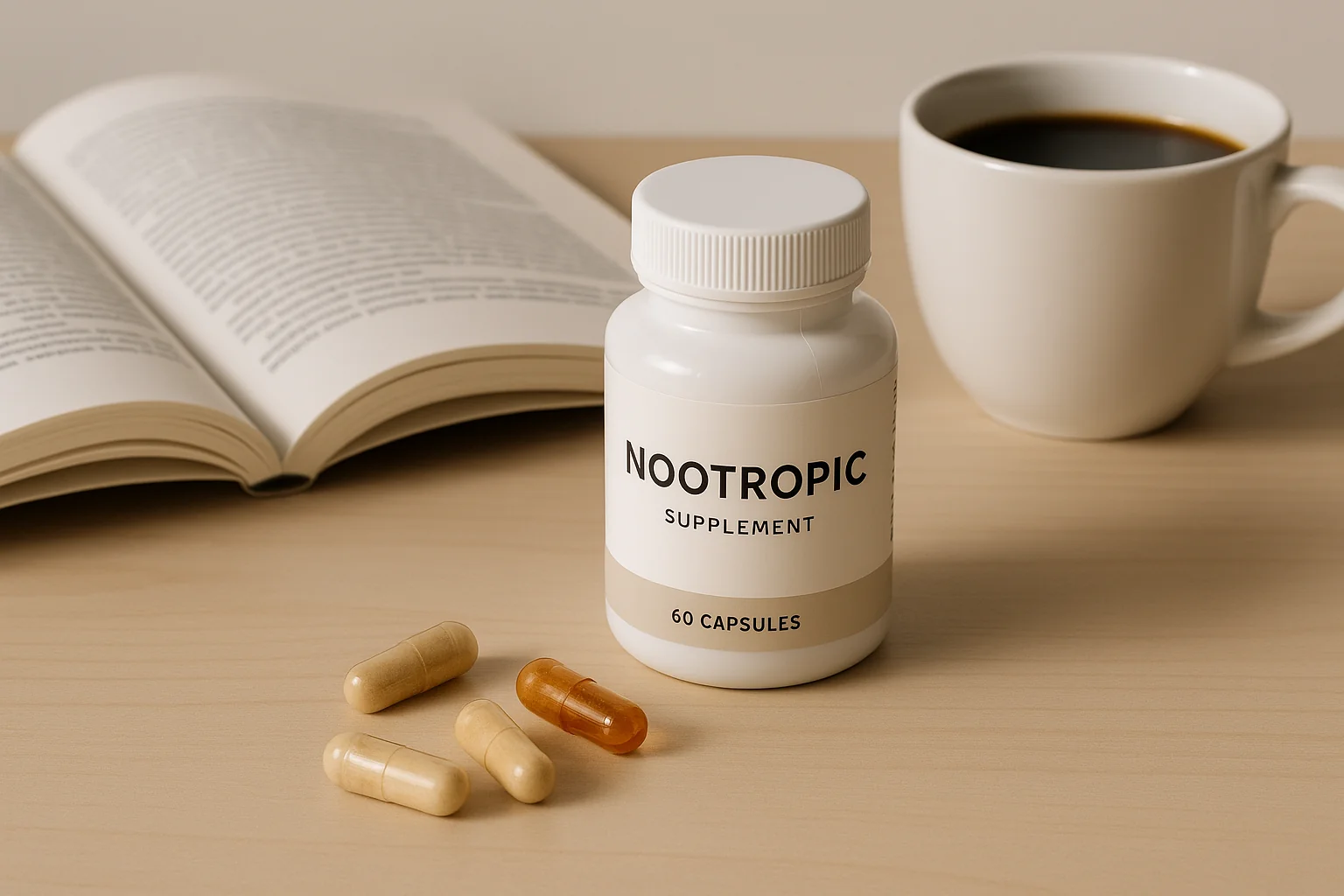

Supplements for concentration and memory: what really works according to research
Who was actually studied and what doses were used: L-theanine with caffeine, omega-3, creatine, ashwagandha, bacopa, lion's mane, and rhodiola without marketing.
Advertisements for brain supplements promise mental sharpness in just a few days. Research tells a different story: some substances have solid data, some only single trials, and some results come from cell cultures or individuals with diagnoses, not from healthy adults. This difference determines what you can expect from the packaging. We reviewed the seven most commonly sold nootropic ingredients and checked three things in the original publications for each: who was studied, what dose was administered, and for how long. The results can be more modest than the labels suggest, but they are verifiable. Below you will find what has actually been demonstrated, and what, despite the popularity of the ingredient, has not yet been measured in healthy individuals.
KEY INFORMATION
• The review by Avgerinos et al. (Experimental Gerontology, 2018) included 6 RCT studies and 281 healthy individuals: creatine may improve short-term memory, but in young participants, the results did not change at all.
• L-theanine with caffeine is the only combination with a repeated effect in healthy adults after a single dose.
• Lion's mane has one study in humans, exclusively in individuals with mild cognitive impairment.
• Rhodiola was studied in individuals with fatigue syndrome, not in healthy and rested individuals.
Does L-theanine with caffeine really improve focus?
Yes, and it is the only entry on this list with a repeated result in healthy adults. In the study Owen i in. (Nutritional Neuroscience, 2008) 27 volunteers took 50 mg of caffeine with 100 mg of L-theanine or caffeine alone. The combination improved the speed and accuracy of attention switching after 60 minutes and resistance to distracting information.
The effect was replicated with completely different doses. Haskell i in. (Biological Psychology, 2008) they administered 250 mg of L-theanine and 150 mg of caffeine in a crossover design with placebo. The combination shortened simple reaction time, accelerated response in a working memory task, and improved sentence verification accuracy. L-theanine alone performed worse than placebo in subtracting sevens and increased headache ratings, so there is nothing to look for here without caffeine.
Both studies measured a single dose and effect in a window from 30 to 90 minutes, in young healthy individuals. No one has checked what daily combinations of these substances over months provide. The popular online ratio of 1:2 does not come from any of these studies: Owen studied 1:2, Haskell 1.7:1, and both worked. The European Food Safety Authority cites 400 mg of caffeine daily as a dose without concerns for a healthy adult, counting coffee, tea, and supplements together.
What does omega-3 DHA do for the brain?
DHA is the most abundant omega-3 fatty acid in the brain and a component of neuronal membranes (Dyall, Frontiers in Aging Neuroscience, 2015). In memory studies, however, its effect is slow and moderate, and the strongest data pertains to older individuals or those reporting memory problems.
The most frequently cited number comes from observation, not from experimentation. Morris i in. (Archives of Neurology, 2003) they followed an average of 3.9 years 815 individuals aged 65 to 94. Those who ate fish once a week or more had a 60% lower risk of being diagnosed with Alzheimer's disease. This is a cohort study: it shows a correlation, not proof of the effectiveness of a capsule, and pertains to the incidence of the disease, not focus at work.
Data from randomization is more modest. Meta-analysis Yurko-Mauro i in. (PLOS ONE, 2015) included healthy adults aged 18 and over and showed a significant improvement in episodic memory in individuals reporting mild memory problems. At a dose above 1 g of DHA with EPA daily, improvement in episodic memory occurred regardless of baseline cognitive status. No differences between groups were detected in working and semantic memory. Individuals on a plant-based diet can choose DHA from algae of the genus Schizochytrium.
Does creatine improve memory in healthy individuals?
Sometimes, and not for everyone. A systematic review Avgerinos i in. (Experimental Gerontology, 2018) included 6 randomized studies and 281 healthy individuals. The authors found that creatine may improve short-term memory as well as intelligence and reasoning test scores, but in other areas, the results were inconsistent.
Two things from this review get lost in the summaries. First, in young participants, cognitive test results did not change at all. Second, vegetarians responded better than meat-eaters, but only in memory tasks. The authors did not provide any percentage improvement in working memory, so the circulating figure of 7-15% found online does not come from this work or any other we managed to track down.
Nowsza metaanaliza Xu i in. (Frontiers in Nutrition, 2024) gathered 16 RCT studies and 492 participants aged 20 to 76 years. Creatine improved memory scores, reaction time in attention tasks, and processing speed, but did not significantly affect overall cognitive performance or executive functions. The benefit was more pronounced in individuals with diseases than in healthy ones. Physiology explains this: a meat diet provides part of the daily creatine, while a plant-based diet provides almost none. We discuss the gaps in the plant-based diet in the text Supplements for vegetarians and vegans.
How does ashwagandha affect concentration and stress?
Indirectly, by lowering tension and cortisol, not by stimulation. In the study Chandrasekhar i in. (Indian Journal of Psychological Medicine, 2012) 64 individuals with a history of chronic stress took 300 mg of full-spectrum root extract twice daily for 60 days.
The group taking the extract performed significantly better than the placebo on all stress assessment scales used, and serum cortisol levels decreased more noticeably than in the control group. The summary of this study does not provide any percentage values, so the repeatedly mentioned figures of 44% and 28% are not supported by the published abstract. Adverse effects were mild and comparable in both groups.
The cognitive data comes from a clinical population. Choudhary i in. (Journal of Dietary Supplements, 2017) They studied 50 adults with mild cognitive impairment, administering 300 mg of root extract twice daily for 8 weeks. The ashwagandha group improved results in immediate and overall memory tests, executive functions, and sustained attention. The authors themselves refer to this as a pilot study. For a healthy person without a diagnosis, the conclusion is cautious: data exists for stressed individuals and those with disorders, not for a well-rested student before exams.
How long does it take for bacopa monnieri to work?
Not sooner than after a few weeks. Stough i in. (Psychopharmacology, 2001) They administered 300 mg of standardized extract or placebo to healthy volunteers, conducting tests at baseline, after 5 weeks, and after 12 weeks. The most significant differences compared to placebo appeared only in the 12th week.
The improvement concerned the speed of visual information processing, the rate of learning, and memory consolidation in the word list learning test, and at the same time, measured state anxiety decreased. This is not an effect of stimulation. The authors propose an explanation through the influence on processes dependent on the influx of information from the environment, that is, on learning and memory, rather than on momentary alertness.
Meta-analysis Kongkeaw i in. (Journal of Ethnopharmacology, 2014) They gathered 9 randomized studies with 518 participants, exclusively those in which the extract was standardized and administered for at least 12 weeks. Result: a reduction in time in the point connection test version B by 17.9 ms and a reduction in reaction time with choice. The authors summarize this as an improvement primarily in the speed of attention and explicitly state that a resolution would require a large comparative study with an existing drug. A few milliseconds in a computer test is a real statistical result, but not a noticeable improvement in daily work.
Does lion's mane have confirmed effects in humans?
It has one study, and that not in healthy individuals. Mori i in. (Phytotherapy Research, 2009) They studied 30 Japanese individuals aged 50 to 80 with diagnosed mild cognitive impairment. This is the only published trial with randomization and placebo for Hericium erinaceus in a cognitive context.
Participants took four tablets of 250 mg of powdered mushroom three times daily, totaling 3 g per day, for 16 weeks. Results on the cognitive function assessment scale increased in the 8th, 12th, and 16th weeks compared to placebo. Four weeks after discontinuation, they significantly decreased. Laboratory tests did not show any adverse effects.
The popular thesis that lion's mane stimulates the production of nerve growth factor comes from cell cultures and animal models, not from humans. This is an important difference: in rodent tissue, the concentration of protein was measured, but no one has repeated this measurement in humans. There is also no trial with this mushroom in healthy young adults. The evidence is therefore weak and narrow: 30 individuals, one clinical population, an effect that diminishes after discontinuation. This does not mean that the ingredient does not work. It means that by reaching for it, you are relying on one small study in diagnosed individuals.
Komu pomaga rhodiola rosea?
For individuals diagnosed with fatigue syndrome, as only such were studied. Olsson i in. (Planta Medica, 2009) They conducted a phase III trial on 60 individuals aged 20 to 55 who met the Swedish diagnostic criteria for fatigue syndrome.
Participants received four tablets daily of SHR-5 extract, totaling 576 mg per day, or placebo, for 28 days. Both groups improved on many measures, which in itself says a lot about the strength of the placebo effect in this area. In direct comparison, the extract outperformed placebo on the Pines burnout scale and in some attention indicators in the continuous performance test. The morning cortisol response also changed.
Rhodiola differs from ashwagandha less than marketing suggests. Both adaptogens have data in stressed or fatigued individuals and both lack data in healthy, rested adults. The difference lies in what was measured: rhodiola measured fatigue and attention, while ashwagandha measured tension, cortisol, and memory. Olsson's intervention lasted four weeks, so nothing is known about longer use. Individuals taking antidepressants should discuss rhodiola with their doctor, as none of the described studies included patients undergoing such therapy.
How to choose a concentration supplement for yourself?
Start by asking where your problem comes from, as this narrows down the options. Tension and poor sleep lead towards adaptogens, a diet lacking fish towards omega-3, a plant-based diet towards creatine, and the need for immediate focus towards caffeine with L-theanine. The table summarizes what was actually measured in each study.
| Ingredient | Kogo badano | Dawka i czas w badaniu | What improved |
|---|---|---|---|
| L-theanine with caffeine | 27 healthy adults | 100 mg z 50 mg, pomiar po 60 i 90 minutach | Attention switching, resistance to distractions |
| Omega-3 DHA | Healthy adults aged 18 and over | Above 1 g DHA with EPA daily | Episodic memory |
| Creatine | 492 osoby w wieku 20-76 lat | Monohydrat we wszystkich 16 badaniach | Memory, reaction time, processing speed |
| Ashwagandha | 50 individuals with cognitive impairments | 300 mg dwa razy dziennie przez 8 tygodni | Memory, sustained attention, executive functions |
| Bacopa monnieri | 518 individuals in 9 studies | Ekstrakt standaryzowany, minimum 12 tygodni | Attention speed, reaction time with choice |
| Lion’s mane | 30 people with cognitive impairments | 3 g proszku dziennie przez 16 tygodni | Wynik skali funkcji poznawczych |
| Rhodiola rosea | 60 people with fatigue syndrome | 576 mg ekstraktu SHR-5 przez 28 dni | Burnout, attention indicators |
We noticed when comparing labels that the most common problem is not the lack of an ingredient, but the lack of its quantity. The manufacturer provides the total amount of the blend, for example, 800 mg, without breaking it down into individual substances. It is then impossible to check whether the dose corresponds to that from the study. Products combining several substances in microdoses do not replicate any of the above protocols. We discuss how to create your own set from scratch in the text Biohacking for beginners.
Na koniec proporcje. Erickson i in. (PNAS, 2011) In a randomized study of 120 older adults, they showed that aerobic training increased the volume of the anterior hippocampus by 2%, and this increase was associated with higher serum BDNF levels. In the control group, hippocampal volume decreased. None of the supplements on this list has such a strong structural result in humans.
Does the form of the supplement affect its effectiveness?
With omega-3, yes, and quite clearly. Beckermann i in. (Arzneimittel-Forschung, 1990) they compared the absorption of EPA and DHA from triglycerides, free fatty acids, and ethyl esters in a crossover design with a baseline control in eight female volunteers.
The relative bioavailability of ethyl esters was 40% for EPA and 48% for DHA compared to triglycerides. Free fatty acids performed the best, but they were also the least tolerated, with the main side effect being burping. The study included eight participants, so it's a signal, not a conclusion. Nevertheless, it's worth checking the label to see if the fish oil is in the form of triglycerides, marked as TG or rTG.
For other ingredients, standardization matters. The meta-analysis of bacopa included only studies with standardized extracts, without accompanying medications. Both discussed studies of ashwagandha used a defined root extract, not dried herb powder. In the meta-analysis by Xu et al., monohydrate was the form of creatine in each of the 16 included studies, so more expensive forms do not have comparative data in this area. We noted that this is the only criterion that can be checked before purchase: if the label does not specify the type of extract, the degree of standardization, or the weight, you have no way to relate the product to any of the discussed publications.
Frequently Asked Questions
Do supplements really improve concentration?
Some, yes, but modestly. The repeated effect in healthy adults is only seen with L-theanine and caffeine. Creatine acts selectively: in the review Avgerinos i in. (2018) in young participants, cognitive test results did not change at all. Ashwagandha, bacopa, and rhodiola require weeks, and some data comes from clinical populations.
What combination of supplements has the most data?
No combination other than L-theanine with caffeine has been tested as a set. Owen et al. (2008) administered 50 mg of caffeine with 100 mg of L-theanine, and Haskell et al. (2008) 150 mg of caffeine with 250 mg of L-theanine. The other ingredients were tested individually, so nothing is known about their combinations.
How long does it take to see the effects of memory supplements?
It depends on the ingredient and what was measured. L-theanine with caffeine was studied in a window from 30 to 90 minutes after the dose. Bacopa Stough i in. (2001) was tested after 5 and 12 weeks, with the largest differences compared to placebo observed in the 12th week. Lion's mane was administered for 16 weeks.
Is bacopa monnieri safe?
Do metaanalizy Kongkeaw i in. (2014) included 9 randomized studies and 518 participants, in which the extract was administered for at least 12 weeks, and the risk of systematic error was assessed as low. Longer observations are lacking. Individuals receiving psychiatric treatment should discuss bacopa with their doctor.
Does creatine improve memory, not just athletic performance?
In the meta-analysis Xu i in. (Frontiers in Nutrition, 2024), including 16 studies and 492 individuals, creatine improved memory performance, reaction time in attention tasks, and processing speed. It did not improve overall cognitive performance or executive functions, and the benefit was greater in individuals with diseases.
How does lion's mane differ from other nootropics?
The amount of data, and it's not in its favor. It has one randomized study in humans: Mori et al. (2009) they studied 30 people aged 50 to 80 with mild cognitive impairments. Four weeks after discontinuation, results significantly dropped. Such a study has not been conducted in healthy adults.
Where to start if I don't eat fish?
Od omega-3. Morris i in. (Archives of Neurology, 2003) they observed 815 individuals aged 65 to 94: eating fish once a week or more was associated with a 60% lower risk of Alzheimer's disease. These are observational data in seniors, so they do not promise better focus today, but the nutritional gap is real.
You will find ashwagandha and bacopa extracts, lion's mane products, and omega-3 oils in the section supplements.
This article is for informational and educational purposes and does not constitute medical advice. Before starting supplementation, consult your doctor, especially if you are taking medications regularly, are pregnant or breastfeeding, or have a chronic illness.
Author: Michał Waluk · Opublikowano: 2026-06-22 · Aktualizacja: 2026-08-08