
CBD and serotonin receptor 5-HT1A - mechanism of anxiolytic action
CBD a receptor serotoninowy 5-HT1A — mechanizm dzialania wyjasniony prosto, w oparciu o badania. u Bucha.
Scientific studies have long tried to answer the question of why CBD has a calming effect. One of the best-documented answers leads to the serotonin receptor 5-HT1A. Russo and colleagues demonstrated in 2005 that CBD directly activates this receptor - which is surprising, as the endocannabinoid and serotonin systems were traditionally considered separate signaling networks (Russo et al., British Journal of Pharmacology, 2005). This article explains what the 5-HT1A receptor is, how CBD interacts with it, and why this discovery changes the way we understand the effects of CBD oil on anxiety and mood.
KEY INFORMATION
• CBD activates the serotonin receptor 5-HT1A at a concentration of 10-100 μM - an effect confirmed in cell and animal models (Russo et al., British Journal of Pharmacology, 2005).
• The mechanism differs from that of SSRIs: CBD does not block the serotonin transporter but directly modulates the receptor.
• The 5-HT1A receptor is abundantly present in the amygdala and prefrontal cortex - structures key to regulating anxiety.
• Blockade of 5-HT1A with the antagonist WAY-100635 in animal studies negates the anxiolytic effect of CBD.
What is the 5-HT1A receptor and where is it located?
The 5-HT1A receptor belongs to the family of G protein-coupled receptors (GPCR). Serotonin is its endogenous ligand, but the receptor can be activated by other molecules - including, as studies have shown, by CBD. In the nervous system, this receptor is a presynaptic autoreceptor in the raphe nuclei, and postsynaptically appears in the hippocampus, amygdala, and prefrontal cortex. These areas are responsible for generating and regulating anxiety-related emotions.
When the presynaptic 5-HT1A receptor is activated, it inhibits further serotonin release - acting like a safety brake. Postsynaptically, activation of 5-HT1A opens potassium channels (GIRK), which hyperpolarizes the neuron and lowers its excitability. Net effect: activation of the receptor usually calms "heated" activity of anxiety neurons. Therefore, 5-HT1A is the target of buspirone - an older anxiolytic drug that acts precisely through this receptor.
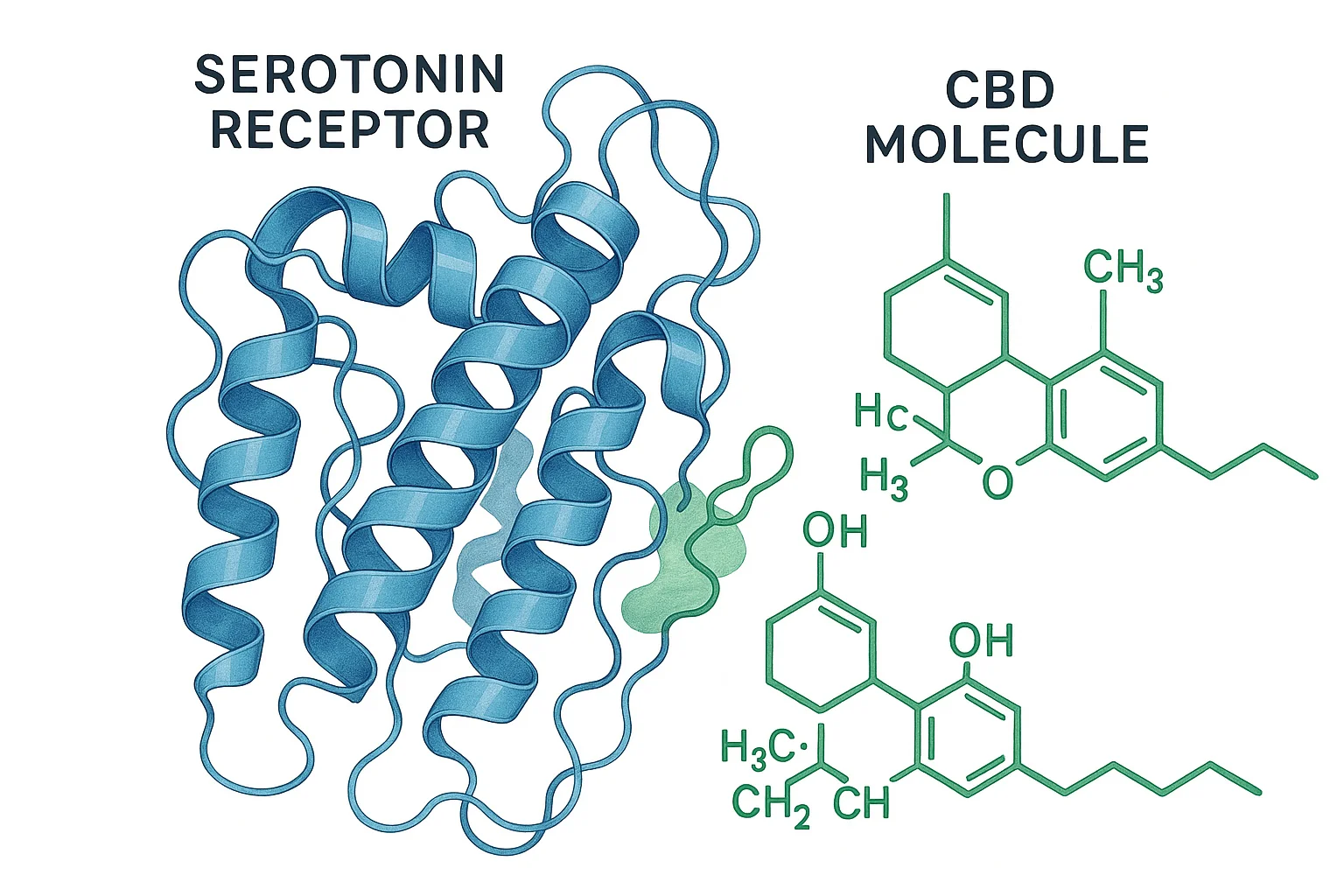
Why does CBD engage a receptor that evolutionarily "belongs" to serotonin? The answer lies in the structure of the binding site. Molecular modeling studies suggest that CBD may occupy an allosteric pocket of the receptor, which is a site different from where serotonin binds. This means that CBD and serotonin can act simultaneously without direct competition.
Jak CBD aktywuje receptor 5-HT1A - dowody naukowe
A key experiment published by Russo and colleagues in British Journal of Pharmacology It has been shown that CBD at a concentration of 10-100 μM activates the 5-HT1A receptor expressed in CHO (Chinese Hamster Ovary) cells, measured by the accumulation of cAMP. The effect was similar to buspirone, a recognized 5-HT1A agonist (Russo et al., British Journal of Pharmacology, 2005). This is the first molecular evidence of the direct action of CBD on this receptor.
We have noticed that many researchers focus solely on the endocannabinoid system when describing the mechanisms of CBD action. Meanwhile, interaction with 5-HT1A is an example of CBD's action outside the ECS - which explains why the effects of CBD can be observed even in models where CB1 and CB2 receptors have been pharmacologically blocked. The profile of CBD as a "dirty" ligand with multiple molecular targets is crucial for understanding its clinical effects.
Another important step was taken by Campos and colleagues, who in 2012 demonstrated that administering CBD to rats reduces stress-induced anxiety behaviors, but this effect is completely abolished by the 5-HT1A antagonist (WAY-100635 administered to the amygdala). This pharmacological confirmation shows that the 5-HT1A receptor is an essential link in the chain leading to the anxiolytic effect of CBD (Campos et al., Psychopharmacology, 2012).
De Gregorio and colleagues in 2019 expanded the picture, showing that chronic administration of CBD normalizes the activity of serotonergic neurons in the raphe nuclei in rats with a depression model. The effect depended on the 5-HT1A receptor and was observed at doses comparable to oral supplementation in humans (De Gregorio et al., Neuropharmacology, 2019).
5-HT1A receptor and other anxiolytic mechanisms of CBD - comparative table
CBD does not act solely through 5-HT1A. The anxiolytic effect of this molecule results from the activation of several independent molecular pathways that together create a coordinated response of the nervous system. The table below summarizes the known mechanisms of CBD's action on anxiety and unease.
| Molecular target | Mechanism | Strength of evidence |
|---|---|---|
| 5-HT1A Receptor | Partial/allosteric agonism - hyperpolarization of anxiety neurons | High (cellular + animal models) |
| TRPV1 Receptor | Activation → desensitization - reduced sensitivity to stress | Moderate (animal models) |
| Adenosine transporter (ENT) | Inhibition of adenosine uptake → increased adenosine concentration → calming effect | Moderate (animal models) |
| GABA-A Receptor | Pozytywna modulacja allosteryczna - wzmocnienie hamowania GABAergicznego | Weaker (mainly in vitro) |
| FAAH inhibition | Increased anandamide levels → indirect activation of CB1 in the amygdala | Moderate (animal + clinical pilot studies) |
The table indicates that 5-HT1A is probably the best-documented, but not the only serotonergic pathway involved in the effect of CBD. None of the mentioned mechanisms operate in isolation - it is a system of mutually reinforcing pathways.
What distinguishes the action of CBD on 5-HT1A from antidepressant medications?
SSRIs (selective serotonin reuptake inhibitors) block the SERT transporter, which increases serotonin levels in the synaptic cleft. CBD does not do the same - it does not touch SERT. Instead, it directly activates the postsynaptic 5-HT1A receptor. This is a fundamental difference, as SSRIs require weeks to induce receptor adaptation, while activation of 5-HT1A by CBD is faster and does not require this stage.
Does this mean that CBD can replace SSRIs? Absolutely not - at least not based on the available data. Clinical studies on CBD mainly concern anxiety disorders, not depression. The only cannabinoid medication approved by the FDA is Epidiolex for treatment-resistant epilepsy. There are no approved indications for CBD as a treatment for anxiety or depression. This important caveat cannot be overlooked.
Our observations indicate that questions about combining CBD with SSRIs or other antidepressants are among the most common in the context of CBD oil. This is understandable interest, but it requires absolute consultation with the attending physician. CBD inhibits the enzymes CYP2C19 and CYP3A4 involved in the metabolism of many psychiatric medications - which can raise their levels and the risk of side effects.
Clinical studies: what do we know about CBD and anxiety in humans?
The best-designed clinical studies on CBD in anxiety are a dozen small RCTs, the most frequently cited of which comes from Bergamaschi and colleagues. It showed that a single dose of 600 mg of CBD reduces anxiety induced by simulated public speaking in patients with social phobia, compared to placebo (Bergamaschi et al., Neuropsychopharmacology, 2011). The effect was measured both subjectively (anxiety scales) and objectively (heart rate and blood pressure measurements).
However, 600 mg of CBD is a dose significantly higher than most products available on the supplement market. Doses typically used in supplementation (10-30 mg daily) have much more modest clinical documentation. A meta-analysis by Kayser and colleagues from 2023 showed that CBD tends to reduce anxiety in various clinical models, but the effects are inconsistent between studies, and the methodological quality varies (Kayser et al., Frontiers in Psychiatry, 2023).
Why does the brain react differently to CBD depending on the area?
The density of 5-HT1A receptors is not uniform throughout the brain. In the raphe nuclei, where the cell bodies of serotonergic neurons are located, the receptor acts as an autoreceptor - inhibiting its own release of serotonin. In the hippocampus and amygdala, the receptor is postsynaptic and regulates synaptic plasticity. By reaching these areas, CBD modifies serotonergic tone in completely different ways depending on the location.
This is important from a clinical perspective. The amygdala is a key structure for generating anxiety responses. Brain imaging studies (fMRI) in humans have shown that CBD reduces the reactivity of the amygdala to threat stimuli - an effect observed both in acute conditions and after short-term use (Crippa et al., Journal of Psychopharmacology, 2011). Although the authors did not attribute the effect solely to 5-HT1A, the receptor's location in the amygdala and data from animal models suggest its involvement.
Frequently Asked Questions
How does CBD act on the 5-HT1A receptor?
CBD acts as a partial agonist or allosteric modulator of the 5-HT1A receptor. At a concentration of 10-100 μM, it activates this receptor more strongly than endogenous serotonin under experimental conditions (Russo et al., British Journal of Pharmacology, 2005). The 5-HT1A receptor, upon activation, inhibits the release of serotonin through an autoreceptor mechanism, which may lead to an anxiolytic effect.
Does CBD increase serotonin levels?
CBD does not act like a classic SSRI - it does not block the serotonin transporter. Instead, it activates the 5-HT1A receptor, modulating serotonergic signaling without directly raising serotonin levels in the synapse. The effect may be functionally similar, but the molecular mechanism is entirely different (De Gregorio et al., Neuropharmacology, 2019).
How long does it take for CBD to act on the 5-HT1A receptor?
The response time depends on the route of administration. Sublingual administration produces effects within 15-45 minutes - sufficient time for CBD to reach the prefrontal cortex and amygdala, where the density of 5-HT1A receptors is high. Oral intake extends this time to 1-2 hours due to the first-pass effect through the liver.
Do CBD and SSRIs work together on the serotonin receptor?
CBD and SSRI medications act on different molecular targets, but both influence serotoninergic transmission. CBD inhibits the CYP2D6 enzyme, which metabolizes many SSRIs, potentially raising their blood levels. Before combining CBD with antidepressants, consult a doctor - there is a risk of pharmacological interactions.
Is the 5-HT1A receptor responsible for all of CBD's anxiolytic effects?
The 5-HT1A receptor is one of several mechanisms through which CBD may exhibit anxiolytic effects. Others include modulation of TRPV1 receptors, inhibition of adenosine uptake, interaction with GABA-A receptors, and indirect modulation of the endocannabinoid system (Campos et al., Psychopharmacology, 2012). The anxiolytic effect of CBD is the sum of many parallel pathways.
This article is for informational and educational purposes and does not constitute legal advice. The legal status described in the article is valid as of the publication date - regulations regarding cannabis may change. Consult a lawyer or current legal acts before making decisions.
Author: Michał Waluk · Published: 2026-05-04 · Updated: 2026-05-04