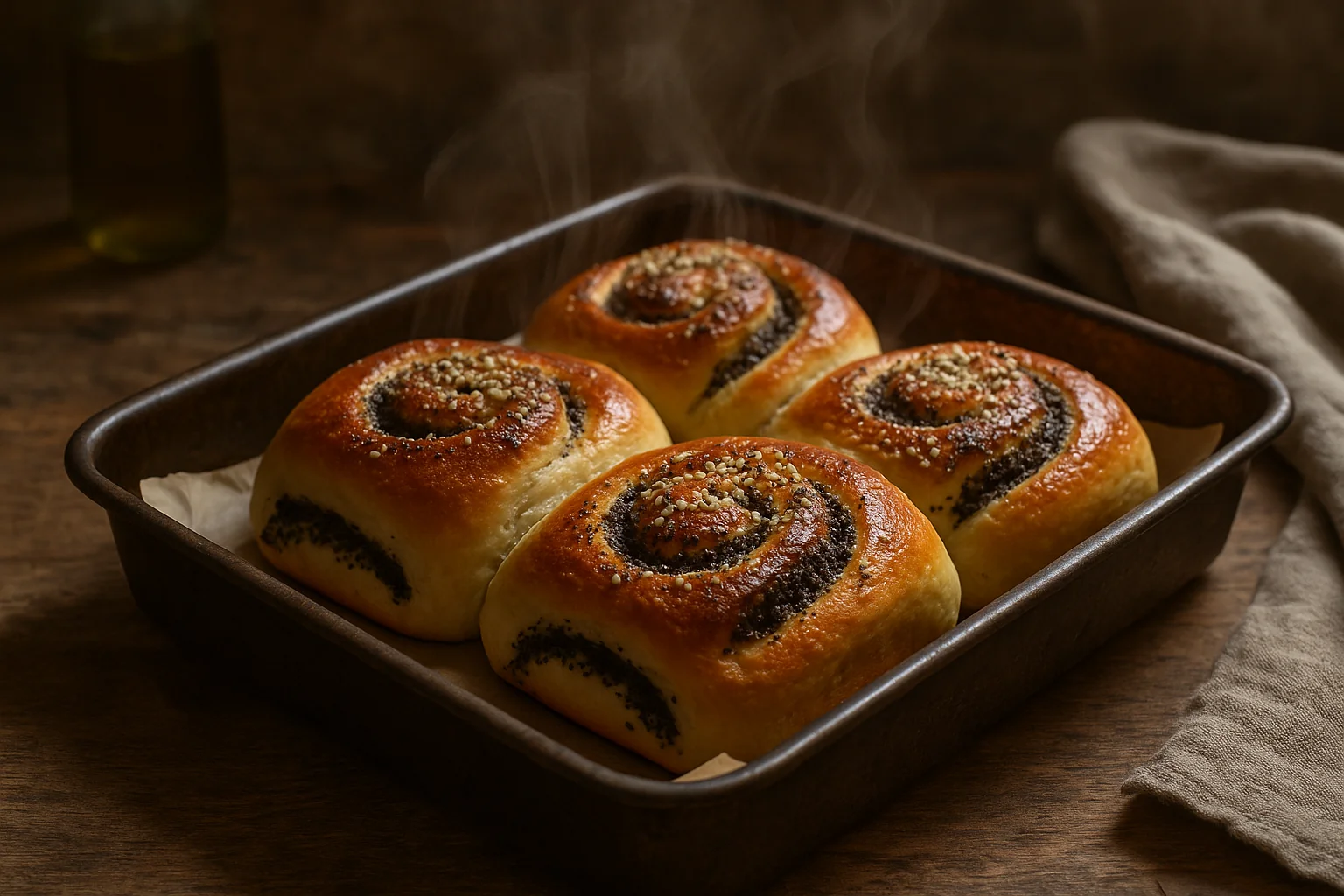

Poppy seed rolls with hemp seeds
Hemp and Poppy Seed Buns – A Step-by-Step Recipe. Traditional yeast buns with a hemp and poppy seed filling. Ready in 90 minutes.
Poppy seed pastries are a classic of Polish bakeries. Adding hulled hemp seeds to the poppy seed filling is a change that does not destroy tradition - the nutty aftertaste of the seeds complements the bitter aroma of the poppy and gives the filling a more distinct texture. Hemp seeds also bring what poppy lacks: a complete amino acid profile and omega-3 and omega-6 fatty acids in a ratio close to optimal for humans. This recipe is for someone who loves traditional baked goods but wants something more.
KEY INFORMATION
• Hulled hemp seeds contain about 31 g of protein per 100 g and all 9 essential amino acids (House et al., Food Chemistry, 2010).
• The omega-6 to omega-3 ratio in hemp seeds is about 3:1 - close to optimal for humans (Callaway, Euphytica, 2004).
• Three tablespoons of hemp seeds (30g) in the filling adds approximately 9g of protein for the entire batch of 12 buns.
• Magnesium in hemp seeds: about 210 mg/100 g - covers 50% of the daily requirement for adults (USDA, 2023).
Why do poppy seeds and hemp seeds work well together?
Poppy seeds and hemp seeds have two different flavor profiles that together create a filling that is distinctly more interesting than either alone. Poppy has an intense, bitter taste and a fine texture. Hemp seeds are soft, nutty, and delicate. The combination gives a filling with a complex, multi-layered flavor structure - something between classic poppy seed paste and peanut butter. Honey or sugar in the filling binds these profiles and softens the bitterness of the poppy.
From a nutritional perspective, hemp seeds remedy one of the deficiencies of poppy seeds. Poppy seeds are rich in calcium (approx. 1400 mg/100 g) and iron, but have an incomplete amino acid profile. Hemp seeds provide all 9 essential amino acids, including lysine and methionine, which are poorly represented in poppy seeds (House et al., Food Chemistry, 2010). Three tablespoons of seeds for the entire batch of filling (12 buns) is about 9 g of additional plant protein per batch.
Nutritional values - what does one pastry provide?
One bun (approx. 85 g with filling) provides approx. 275 kcal, 7 g protein, 9 g fat and 38 g carbohydrates. Fiber from poppy seeds and hemp seeds: approx. 2 g. Magnesium from hemp seeds (approx. 210 mg/100 g, USDA FoodData Central, 2023) accounts for about 15% of the daily requirement for adults in one pastry. Calcium from poppy (about 1400 mg/100 g) contributes about 15% RDA per serving - significantly more than a pastry without filling.
Ingredients - what do you need?
- For the dough: 400 g wheat or spelt flour, 7 g dry yeast (or 25 g fresh), 110 ml warm milk, 1 egg, 50 g butter at room temperature, 3 tablespoons sugar, a pinch of salt
- For the filling: 200 g of poppy seeds (ground or ready-made poppy seed mass), 50 g of peeled hemp seeds, 3 tablespoons of honey or maple syrup, 1 tablespoon of butter, optionally a teaspoon of vanilla extract
- For brushing: 1 beaten egg + 1 tablespoon of milk
- For sprinkling: 1 tablespoon of shelled hemp seeds
How to prepare poppy seed and hemp seed pastries - step by step?
Total time: approx. 90 minutes (including 60 minutes of rising). Active time: approx. 30 minutes.
Step 1. Activate the yeast. Mix the yeast with 1 teaspoon of sugar and 50 ml of warm milk (about 37°C). Wait for 10 minutes. The mixture should foam and rise significantly. If there's no foam - the yeast is inactive, replace it with new ones. This step is critical: inactive yeast means dough that won't rise.
Step 2. Knead the dough. Combine the flour, remaining sugar, egg, the rest of the warm milk, and active yeast. Knead for 8-10 minutes by hand or 6 minutes with a mixer hook. Add the butter in pieces and knead for another 5 minutes until you have a smooth, elastic dough that pulls away from the sides. Cover and let rise for 45-60 minutes in a warm place.
Step 3. Prepare the filling. Mix the ground poppy with honey, hemp seeds, butter, and vanilla. The mixture should be thick - spreadable but not runny. Stir in the hemp seeds at the end - not blended, so they remain visible and crunchy in the filling.
Step 4. Shape and stuff. Degas the risen dough. Roll it out on a floured surface into a 40x30 cm rectangle. Spread the filling evenly, leaving a 2 cm border around the edges. Roll it tightly into a log and cut it into 12 equal pieces with a sharp knife.
Step 5. Second rising and baking. Place pieces on a baking sheet lined with paper, cover with a cloth, and leave for 20 minutes. Brush with beaten egg mixed with milk and sprinkle with hemp seeds. Bake at 185°C for 18-22 minutes until golden. Cool on a rack.
Tips and variations
Buns with a poppy seed and hemp filling come in many varieties. A few tried-and-true recipes:
We noticed in tests that the filling with hemp seeds requires tight rolling of the roll - a loose roll causes the seeds to fall out when slicing. Before rolling, gently press the filling with your hand into the dough to adhere. Hemp seeds do not stick to poppy as well as raisins - applying strong pressure before slicing eliminates this problem.
Nut version. Add 30 g of chopped walnuts or almonds to the filling. The nuts enhance the texture and flavor, complementing the hemp seeds. Increase the honey by a tablespoon - the nuts absorb moisture from the poppy mass.
Version with orange. Add the zest of one orange to the filling. The citrusy flavor offsets the bitter poppy seed aroma and highlights the nuttiness of the hemp seeds. This classic combination in Polish holiday baking gets a hemp-infused upgrade here.
Gluten-free version. Replace wheat flour with a mixture of rice flour (250 g) and potato starch (100 g) along with psyllium (1 tablespoon) as a gluten substitute. Gluten-free dough is less elastic and requires shorter kneading (5 minutes instead of 10). Rising time may be longer - up to 75 minutes. Hemp seeds in the filling remain the same and provide all 9 essential amino acids (House et al., Food Chemistry, 2010) regardless of the cake version.
Check out ours too hemp seed oatmeal cookies - inny format, ta sama orzechowa baza.
Frequently Asked Questions
Why are my buns dense and heavy?
The most common cause is inactive yeast or too short a kneading time. Always test the yeast for 10 minutes in warm milk with sugar. Yeast dough requires at least 10 minutes of kneading for the gluten to develop its proper structure. Hemp seeds contain approximately 31 g of protein/100 g (House et al., 2010) - they do not affect the structure of the dough, as they are only in the filling.
Can hemp seeds be added to yeast dough?
You can, but be careful. Fats in hemp seeds (approx. 14 g/30 g, USDA, 2023) may impair the formation of the gluten network. It's safer to add them to the filling or as a topping, not to the kneaded dough.
How to store hemp seed buns?
In a sealed container for up to 2 days at room temperature, up to 5 days in the refrigerator. Frozen for up to 2 months - thaw in the oven at 150°C. The omega-6 to omega-3 ratio in hemp seeds is 3:1 (Callaway, Euphytica, 2004).
How many calories are in poppy seed and hemp seed buns?
One pastry (about 85 g) provides approximately 275 kcal, 7 g of protein, and 9 g of fat. Hemp seeds in the filling provide 3 tablespoons (30 g) for 12 pieces - about 0.75 g of omega fat from seeds per piece (USDA, 2023).
Are hemp seed buns suitable for children?
Yes - hemp seeds are a food product with THC below 0.3% according to EU Regulation 2022/1393. Magnesium in seeds (approx. 210 mg/100 g, USDA, 2023) is a valuable component of the diet of children over 1 year of age.
This article is for informational and educational purposes and does not replace consultation with a doctor. If you are pregnant, breastfeeding, taking medications, or have chronic conditions, consult the use of supplements or herbs with a specialist.
Author: Michał Waluk · Published: 2026-05-04 · Updated: 2026-05-04