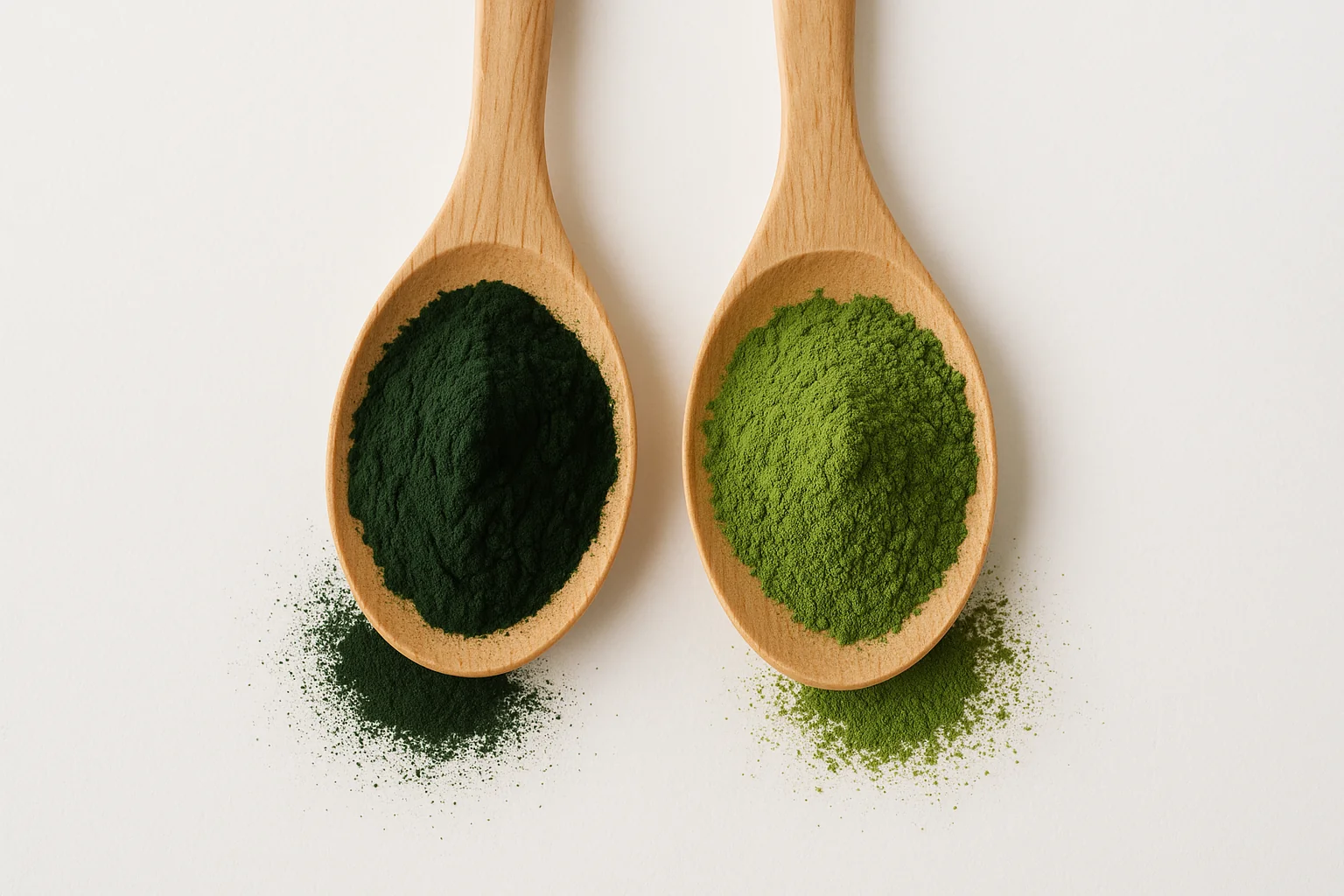

Spirulina and chlorella: superfood properties and how to incorporate algae into your daily diet
Spirulina and chlorella: what research reveals about vitamin B12, heavy metal detox, and the purity of products. Numbers from USDA and scientific publications.
Spirulina and chlorella are on the same shelf, marketed under the common superfoods slogan, and most descriptions treat them interchangeably. They are two different organisms, and many label promises look different when you look at the source data. The American USDA FoodData Central reports 57.5 g of protein per 100 g of dried spirulina, but the real serving is usually 3-5 g daily, so less protein enters the diet than from one egg. The same goes for vitamin B12, heavy metal detox, and the list of anti-inflammatory properties. Below you will find what published research indicates: where the evidence is solid, where it comes from one small trial, and where there is none at all.
KEY INFORMATION
• Vitamin B12 in spirulina is 83% pseudovitamin, inactive in humans (Watanabe et al., J Agric Food Chem, 1999).
• USDA FoodData Central podaje dla suszonej spiruliny 0,0 mikrograma witaminy B12 na 100 g.
• Microcystins were detected in all five spirulina products studied (Rhoades et al., Microorganisms, 2023).
• There is no human study in which chlorella removes heavy metals from the body.
What is the difference between spirulina and chlorella?
Spirulina is a cyanobacterium, meaning a bacterium without a cell nucleus, while chlorella is a single-celled green alga with a nucleus and a hard cellulose wall. This difference has practical consequences: chlorella passes through the intestine largely undigested without mechanical breakdown of its wall, while spirulina breaks down on its own.
Both made their way into supplements through the same marketing route, but they have different profiles. Spirulina owes its color to phycocyanin, a blue protein pigment, while chlorella is green from chlorophyll. Karkos i wsp. (Evidence-Based Complementary and Alternative Medicine, 2011) They gathered the available applications of spirulina in humans at that time and summarized them as promising, but based on few randomized trials. Fifteen years later, this assessment has aged less than one might think.
The terminology can be misleading. "Alga" in the case of spirulina is a shorthand, as Arthrospira platensis is a photosynthetic bacterium related to cyanobacteria that bloom in lakes during summer. This is not a mere taxonomic curiosity. This is why microcystins, which are cyanobacterial toxins damaging the liver, are discussed in relation to spirulina, but not chlorella.
How much spirulina actually makes it into the diet in one serving?
Significantly less than the label suggests. USDA FoodData Central reports 57.5 g of protein per 100 g of dried spirulina, but the serving recommended by manufacturers is usually 3-5 g daily. At 5 g, you get about 2.9 g of protein, which is less than from one egg.
The same mechanism applies to other ingredients. The number per 100 g is impressive, as no one consumes 100 g of algae powder. The table below converts USDA data (item 170495, dried spirulina) into a serving that is actually consumed.
| Ingredient | Na 100 g | Per 5 g serving |
|---|---|---|
| Protein | 57,5 g | 2.9 g |
| Iron | 28,5 mg | 1.4 mg |
| Magnesium | 195 mg | 9,8 mg |
| Beta-carotene | 342 mikrogramy | 17 micrograms |
| Vitamin B12 | 0,0 mikrograma | 0,0 mikrograma |
There is an additional caveat regarding iron. Masten Rutar i wsp. (Foods, 2022) They examined spirulina products from the Slovenian market and found that the declared iron content can be high, but the element mainly occurs as iron cation, which is poorly absorbed from the gastrointestinal tract. In the same study, 86.7% of the declared elemental content did not match the measurement.
Is spirulina a source of vitamin B12 for vegans?
No. Spirulina primarily contains pseudovitamin B12, an analog that the human body does not utilize. USDA FoodData Central reports 0.0 micrograms of vitamin B12 per 100 g of dried spirulina. Treating it as a safeguard against deficiency is the most serious mistake on this topic.
Watanabe i wsp. (Journal of Agricultural and Food Chemistry, 1999) They broke down spirulina tablets into their components using two methods. The microbiological assay yielded results 6-9 times higher than the method based on binding to the intrinsic factor, as the former also counts inactive analogs. Of the isolated compounds, 83% was pseudovitamin B12, and only 17% was true cobalamin. This study has been cited for a quarter of a century and has not been challenged.
The result is twofold. The deficiency is not compensated, and inactive analogs may inflate the result of a standard B12 serum test, so the control test appears correct despite a real deficit. A person on a plant-based diet relying on spirulina may remain unaware of a problem for years. More reliable are measurements of methylmalonic acid or holotranscobalamin.
Chlorella performs better here, but the evidence is thin. Merchant i wsp. (Journal of Medicinal Food, 2015) They administered 9 g of chlorella daily for 60 days to seventeen vegans and vegetarians with elevated levels of methylmalonic acid. The marker dropped by an average of about 34%. The study was open-label, without a control group and without blinding, involving seventeen individuals. This is a signal, not a conclusion.
Does chlorella remove heavy metals from the body?
There is no human study that has shown this. The studies cited in advertisements refer to other substances: dioxins with chlorella and arsenic with spirulina. Dioxins are persistent organic pollutants, while arsenic is a metalloid. None of these studies measured lead, mercury, or cadmium in humans.
The most commonly cited study under the detox banner is Nakano i wsp. (Chemosphere, 2005). It measured dioxin levels in 44 pregnant Japanese women, and 23 of them were instructed to take a preparation containing Chlorella pyrenoidosa. The total toxic equivalency in the mothers' milk was about 30% lower in the group with chlorella (p=0.0113). However, this was not a randomized or blinded trial, and the measured endpoint remained dioxins.
Po stronie spiruliny stoi Misbahuddin i wsp. (Clinical Toxicology, 2006), a randomized placebo-controlled trial involving 41 patients with chronic arsenic poisoning in Bangladesh. Twenty-four individuals received 250 mg of spirulina extract with 2 mg of zinc twice daily for 16 weeks, while seventeen received a placebo. The hair samples of the subjects showed a 47.1% reduction in arsenic. This is one small study, using extract rather than powder, in a population drinking contaminated water. Transferring this result to detoxification in a healthy person in Poland has no basis. More about what popular detox treatments actually do can be found in the post about detox without fasting.
What contaminants can end up in algae products?
Microcystins and pathogenic bacteria, and in newer analyses, also pharmaceutical residues. Spirulina is usually cultivated in open ponds, which are also home to other cyanobacteria, including species that produce liver toxins. When choosing a product, quality control is more practically significant than the vitamin composition on the label.
Rhoades i wsp. (Microorganisms, 2023) They examined five commercially available products containing spirulina, two supplements, and three food items. Microcystins were detected in all five, at levels where consumers may exceed the recommended daily limit. Bacillus cereus and Klebsiella pneumoniae were also found in the samples. The authors directly link this to the production method in open tanks.
Z metalami jest lepiej. Sochacka i wsp. (International Journal of Molecular Sciences, 2025) They analyzed 52 products containing spirulina and chlorella, 29 conventional and 23 organic. All were within EU limits for toxic metals, but the calculated aluminum content in the tolerated weekly intake was deemed concerning by the authors. They also detected drug residues: caffeine, metronidazole, and carbamazepine. Organic products did not perform better than conventional ones.
A separate issue is iodine, which instinctively appears in descriptions of algae. The problem concerns marine macroalgae such as kombu or wakame, not freshwater spirulina and chlorella. With these, focus on microcystins and aluminum, not on the thyroid.
Who should avoid spirulina and chlorella?
Individuals with phenylketonuria and those with autoimmune diseases, the latter after consulting a doctor. According to USDA, spirulina contains 2.777 g of phenylalanine per 100 g, so a 5 g serving contributes about 139 mg. In a low-phenylalanine diet, this is a number to account for, not to overlook.
The immunostimulatory effects of algae are documented, and this is precisely what raises doubts. Kwak i wsp. (Nutrition Journal, 2012) They administered 5 g of chlorella daily for 8 weeks in a randomized placebo-controlled trial involving 51 healthy individuals. NK cell activity increased, as did levels of interferon gamma and interleukin 1 beta. In a healthy person, this is a desired effect. What the same stimulus does in Hashimoto's, lupus, or psoriasis has not been studied.
They also reported isolated adverse events. Konno i wsp. (Rinsho Shinkeigaku, 2011) They presented a case of inflammatory myopathy with extensive rash after supplements containing spirulina. The description of a single case does not prove a causal relationship, but it does show that the product is not biologically inert.
There is virtually no safety data during pregnancy and breastfeeding, and no one has studied interactions with medications taken regularly. Therefore, we do not provide dosages as recommendations here. The numbers from the cited studies describe research protocols, not recommendations for the reader.
What do meta-analyses show about lipids and blood pressure?
The direction of changes is consistent, but the evidence is based on small and short trials. The largest lipid meta-analysis included 20 studies and 1076 participants, while the blood pressure meta-analysis included only 5 studies and 230 individuals. This is too little to speak of an established clinical effect.
Rahnama i wsp. (Pharmacological Research, 2023) They collected 20 studies in 23 arms involving 1076 individuals and evaluated them using the GRADE system. Spirulina lowered total cholesterol, LDL fraction, and triglycerides (standardized mean difference of -0.6) and raised HDL fraction (0.3). An earlier meta-analysis Serban i wsp. (Clinical Nutrition, 2016) included only 7 trials and reported decreases of 41-47 mg/dl. Such large effects with so few studies are more a reason for caution than enthusiasm.
Regarding blood pressure Machowiec i wsp. (Nutrients, 2021) they summed 5 randomized trials with 230 participants, doses from 1 to 8 g daily, and durations from 2 to 12 weeks. Systolic blood pressure decreased by 4.59 mmHg with high heterogeneity of results (I-squared 65%), and diastolic by 7.02 mmHg with heterogeneity of 11%. The effect is mainly seen in the subgroup of individuals with hypertension.
In allergic rhinitis, there is one cited trial with a double-blind design: Cingi i wsp. (European Archives of Oto-Rhino-Laryngology, 2008) they noted an improvement in symptoms compared to placebo. One study does not settle the matter.
How to incorporate algae into your diet without disappointment?
By treating them as an addition, not as a dietary staple. A serving of 3-5 g contributes a few percent of the daily protein and iron requirements, so the actual contribution is minimal. Choosing a product with documented quality control matters more here than the regularity of intake.
Several things stem directly from the biology of these organisms. Chlorella must have a broken cell wall; otherwise, most of the cell's contents pass through the intestine untouched. Do not cook spirulina, as phycocyanin and proteins do not tolerate high temperatures, so add the powder to cold or lukewarm dishes. Iron from algae is non-heme, and its absorption increases in the presence of vitamin C and decreases with coffee and tea.
Phycocyanin is sometimes described as a natural anti-inflammatory agent. The basis is a study Reddy i wsp. (Biochemical and Biophysical Research Communications, 2000), in which this pigment selectively inhibited the COX-2 enzyme. This was an in vitro study, with no equivalent in humans, and laboratory concentrations do not translate to a serving of powder.
In sports, the data is equally sparse. Gurney i Spendiff (European Journal of Applied Physiology, 2020) they administered 6 g of spirulina daily for 7 days to eleven untrained men in an alternating design. Hemoglobin increased from 144.1 to 154.5 g/l, and oxygen consumption and heart rate during submaximal exercise were lower. Eleven individuals and one week of supplementation is too little to draw conclusions for trained individuals.
We noticed while organizing product descriptions that the composition is given per 100 g, while the dosage is per serving. These two numbers are practically separated by a factor of twenty, so always compare using the same unit.
Frequently Asked Questions
Does spirulina contain vitamin B12?
Not in a form useful for humans. Watanabe et al. (Journal of Agricultural and Food Chemistry, 1999) showed that 83% of compounds isolated from spirulina tablets are pseudovitamin B12, and only 17% is true cobalamin. USDA FoodData Central reports 0.0 micrograms of vitamin B12 per 100 g of dried spirulina.
What is the difference between chlorella and spirulina?
Spirulina is a cyanobacterium, meaning a photosynthetic bacterium without a cell nucleus. Chlorella is a single-celled green alga with a nucleus and a hard cellulose wall that must be mechanically broken down for the cell's contents to be accessible. This difference also leads to the risk of microcystins, which concern spirulina but not chlorella.
Does chlorella detoxify the body from heavy metals?
There is no human study that has shown this. The most frequently cited work (Nakano et al., Chemosphere, 2005) measured dioxins in the milk of 44 pregnant Japanese women, not lead, mercury, or cadmium. Dioxins are persistent organic pollutants, not metals.
Czy spirulina jest bezpieczna przy chorobie autoimmunologicznej?
This has not been studied. Kwak et al. (Nutrition Journal, 2012) showed that 5 g of chlorella daily for 8 weeks increases NK cell activity and gamma interferon levels in healthy individuals. The impact of such stimulation in Hashimoto's or lupus was not the subject of research. Make decisions with your doctor.
How can you tell if an algal product is of good quality?
By the available analysis certificate covering microcystins, metals, and microbiology. Rhoades et al. (Microorganisms, 2023) detected microcystins in all five spirulina products studied. Masten Rutar et al. (Foods, 2022) found that 86.7% of declared elemental content did not match measurements.
Does spirulina lower cholesterol and blood pressure?
Meta-analyses show a decrease, but they are based on small samples. Rahnama et al. (Pharmacological Research, 2023) gathered 20 studies with 1076 participants. Machowiec et al. (Nutrients, 2021) summarized 5 studies with 230 individuals, noting a decrease in systolic blood pressure of 4.59 mmHg with high heterogeneity of results.
You can find products with spirulina and chlorella in the section supplements, and we described the broader context of a plant-based diet in the post about suplementach dla wegetarian i wegan.
This article is for informational and educational purposes and does not constitute medical advice. Before starting supplementation, consult your doctor, especially if you are taking medications regularly, are pregnant or breastfeeding, or have a chronic illness.
Author: Michał Waluk · Opublikowano: 2026-06-22 · Aktualizacja: 2026-08-08