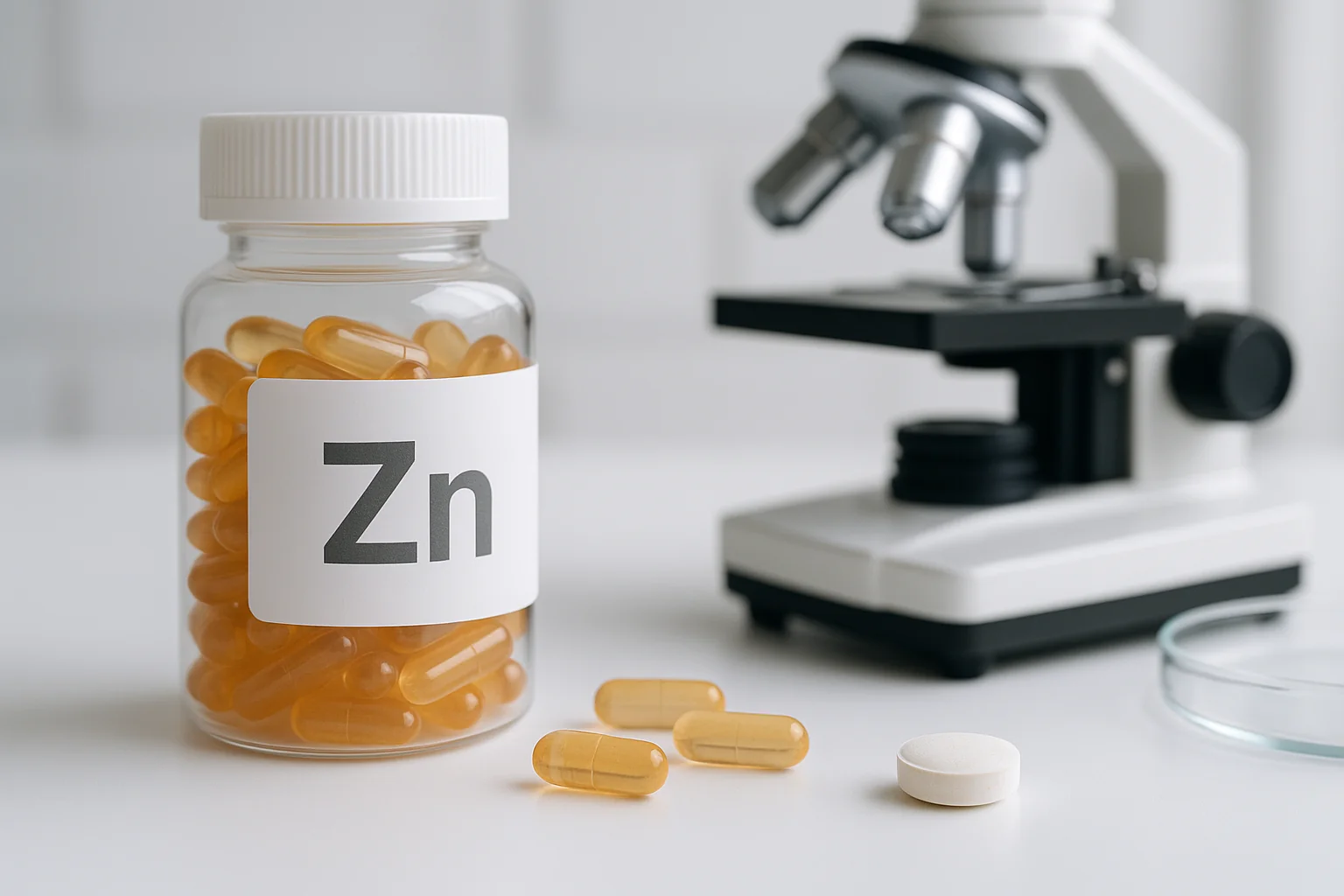

Zinc for immunity and acne: dosage, when to take it, and what effects to expect
How much zinc to take for acne and immunity? The EFSA limit is 25 mg, the FDA 40 mg. Data from studies, forms, interactions, and the risk of copper deficiency all in one place.
Zinc is one of the most studied trace elements, yet online guides can recommend doses twice the European safety limit. EFSA has set the upper tolerable intake level at 25 mg per day, while the American FDA has set it at 40 mg. The popular "dose for acne" is 30 mg, which is already above the EU threshold. This text shows what studies have really demonstrated about zinc in relation to acne and colds, where their results can be exaggerated in product descriptions, how much zinc can be taken without the risk of copper deficiency, and how the available forms differ. We checked each identifier of the cited work individually in the European PMC database.
KEY INFORMATION
• Upper tolerable intake level: 25 mg per day in the European Union, 40 mg in the USA (Schoofs et al., Molecules, 2024).
• Dreno et al. (Dermatology, 2001): 30 mg of zinc was successful in 31.2% of patients, minocycline in 63.4%.
• For colds, the data pertains to lozenges started on the first day of symptoms, and meta-analyses differ regarding the strength of the effect.
• Above 25 mg per day for more than 8 weeks, the risk of secondary copper deficiency increases.
Za co odpowiada cynk w organizmie?
Zinc is involved in over 300 enzymatic reactions, in the regulation of gene expression, in apoptosis, and in immune modulation (Schoofs i in., Molecules, 2024). The body does not store it in the same way it stores iron, so intake must be daily.
The skin is the third tissue in the body in terms of zinc content (Ogawa i in., Nutrients, 2018). Hence the clear dermatological symptoms associated with deficiency: inflammatory changes, slower wound healing, hair loss, and dry skin. Zinc is responsible for the division of keratinocytes and for collagen synthesis in the skin.
The scale of the nutritional problem is estimated by the FAO's analysis of food balances: 15% of the world's population, or 1.13 billion people, consume too little zinc (Wessells i in., Nature Food, 2024). This mainly affects regions where the diet is based on grains rich in phytates. The standards are also not uniform. The American recommendation is 11 mg for men and 8 mg for women, while EFSA (2014) the requirement is calculated depending on the phytates in the diet: 9.4-16.3 mg for men and 7.5-12.7 mg for women.
We noticed while organizing sources one thing that rarely appears in product descriptions: serum zinc concentration is a poor screening test. It only decreases with significant deficiency because the body first draws on reserves from bones and muscles, and any infection lowers the result regardless of tissue reserves. Therefore, a normal result does not close the case.
Does zinc really help with acne?
It helps, but less effectively than antibiotics. In a randomized double-blind study involving 332 patients, 30 mg of elemental zinc achieved clinical success in 31.2% of individuals, while 100 mg of minocycline did so in 63.4% (Dreno i in., Dermatology, 2001). The authors assessed the advantage of the antibiotic at 17%.
This study is often summarized online as "zinc is as effective as an antibiotic." The original conclusion is different: both substances act on inflammatory changes, but minocycline performs better. Therefore, zinc makes sense as a supplement to therapy or as an option for those who cannot take tetracyclines. It is not a substitute for treatment conducted by a dermatologist and should not delay the initiation of treatment for severe or scarring acne.
A later meta-analysis confirmed two things: people with acne have lower serum zinc levels than control groups, and supplementation reduces the number of inflammatory papules, both in monotherapy and as an addition to standard treatment (Yee i in., Dermatologic Therapy, 2020). A systematic review of 42 studies on supplements for acne published in JAMA Dermatology indicated zinc as the intervention most frequently associated with gastrointestinal complaints (Shields i in., 2023).
There are at least three mechanisms. Zinc inhibits the growth of bacteria Cutibacterium acnes, suppresses the secretion of pro-inflammatory cytokines by keratinocytes, and limits the activity of 5-alpha-reductase, the enzyme that converts testosterone to DHT. This third effect has been demonstrated on human skin in vitro (Stamatiadis i in., British Journal of Dermatology, 1988), at concentrations that oral supplementation in the sebaceous follicle is unlikely to replicate. The effect builds slowly: in the Dreno study, a full assessment was conducted only on day 90, so give the treatment 12 weeks before considering it ineffective.
Does zinc shorten the duration of a cold?
Probably yes, but the evidence is weaker than the packaging suggests. A meta-analysis of 17 studies involving 2121 people showed a reduction in symptoms by an average of 1.65 days, with extremely high heterogeneity of results and the effect visible only in adults (Science i in., CMAJ, 2012).
The 2024 Cochrane review included 34 studies and 8526 participants. For cold treatment, it resulted in a reduction of 2.37 days, but the authors rated the certainty of the evidence as low, and the heterogeneity reached 97%. In preventing colds, zinc made no difference: the risk of illness remained practically the same as with placebo (Nault i in., Cochrane Database of Systematic Reviews, 2024).
The most important caveat concerns the form of the preparation. In the Cochrane review, half of the studies used lozenges with ionic zinc, most often gluconate, in doses ranging from 45 to 276 mg per day for 4.5 to 21 days. These doses greatly exceed the safety limit, used for a short time and under the supervision of researchers. Participants were included if they reported within the first day of symptoms, as zinc ions act locally on the mucous membrane of the throat. A daily 15 mg capsule swallowed on the third day of a cold is a completely different intervention, and do not transfer those results to it. The price of the effect is also real: a metallic taste and nausea were reported more frequently than in the placebo group.
A separate situation is a documented deficiency. In a year-long study of 50 people over 55 years old, 45 mg of zinc daily reduced the number of infections and the concentration of oxidative stress markers compared to placebo (Prasad i in., American Journal of Clinical Nutrition, 2007). The group was small, and the dose exceeded both safety limits, so this is a research scheme conducted under control, not a recommendation for self-repetition.
How much zinc can be safely taken?
The upper tolerable intake level is 25 mg per day according to EFSA and 40 mg according to FDA (Schoofs i in., Molecules, 2024). The discrepancy arises from different safety margins applied to the same phenomenon: excess zinc impairs copper absorption. The limit includes the sum from diet and supplements.
| Situation | Dawka cynku elementarnego | Time | Note |
|---|---|---|---|
| Pokrycie normy | 8-11 mg (USA), 7,5-16,3 mg (EFSA) | stale | upper value for a diet rich in phytates |
| Inflammatory acne | 30 mg | 12 weeks | above the EFSA limit, after 8 weeks add copper |
| Cold in studies | 45-276 mg w pastylkach | 4,5-21 dni | dawki badawcze pod nadzorem, nie do samoleczenia |
| Limit EFSA | 25 mg | stale | threshold for adults in the European Union |
| Limit FDA | 40 mg | stale | American threshold, smaller margin of safety |
Symptoms of chronic excess include more than just nausea. Anemia, neutropenia, decreased HDL cholesterol, and neurological symptoms resulting from secondary copper deficiency have been described. In one case report, 65 mg of elemental zinc daily led to undetectable copper levels and neutropenia. Practical rule: if you maintain a dose above 25 mg for more than 8 weeks, add 1-2 mg of copper daily or take a break. A twelve-week acne treatment fits exactly into this scenario.
Which form of zinc is absorbed best?
The best-documented advantage is bisglycinate. In a study of 12 healthy women, a single dose resulted in a 43.4% higher area under the zinc concentration curve than gluconate (Gandia i in., International Journal for Vitamin and Nutrition Research, 2007). The trial was small and involved a single dose, so it does not determine the effects of multi-week supplementation.
| Form | Zinc content in salt | Co z tego wynika |
|---|---|---|
| Bisglicynian (chelat) | about 30% in pure salt, preparations are often standardized lower | good tolerance, best result in direct comparison |
| Pikolinian | about 21% | comparative data comes from the 80s and is scarce |
| Siarczan | 22% (siedmiowodny), 36% (jednowodny) | the cheapest, often causes nausea on an empty stomach |
| Glukonian | ok. 14% | form used in lozenges |
| Tlenek | ok. 80%, ale praktycznie nierozpuszczalny | ointments, sunscreens, poor oral selection |
The historical comparison of picolinate, citrate, and gluconate from 1987 favored picolinate, but involved a small group of volunteers and has not been repeated using comparable methodology (Barrie i in., Agents and Actions, 1987). Do not treat it as a decisive argument when choosing a supplement.
The practical conclusion is simpler than product descriptions suggest. When calculating the dose in milligrams of elemental zinc, the differences between soluble forms are smaller than the difference made by daily regularity. Bisglycinate has an advantage where sulfate causes nausea and is often discontinued after a week.
When and how to take zinc?
With a light meal containing protein, at a consistent time of day, and with a gap from antibiotics and iron supplements. Sulfate and gluconate taken on an empty stomach often cause nausea. Bisglycinate can be tolerated without food, but for effectiveness, a consistent time matters more than the choice of moment.
Zinc forms insoluble complexes with fluoroquinolone antibiotics, such as ciprofloxacin and levofloxacin, as well as with tetracyclines, such as doxycycline and minocycline. This reduces their absorption. Maintain a 2-hour gap before the antibiotic and 4-6 hours after it. This interaction has practical significance in acne, as both substances are often used concurrently. Zinc also reduces the absorption of penicillamine, and thiazide diuretics increase its excretion in urine.
Among dietary components, phytates from whole grains, legumes, and nuts are the most obstructive. Calcium in larger doses acts similarly. Animal protein works the opposite way and improves absorption. Iron from supplements competes with zinc for the same transporter, so separate them into different times of the day.
From our label review, another trap emerges: product descriptions regularly confuse the mass of salt with the mass of elemental zinc. One hundred milligrams of zinc gluconate contains about 14 mg of zinc, not 100 mg. Before assuming you are taking 30 mg, find the line on the label that says "of which zinc". The same mistake works the other way and can lead to an unintentional exceeding of the limit.
You can find more about combining supplements for the infection season in the post Supplements for autumn and immunity. We described how differences between forms look with another mineral in the text Magnez na stres i sen.
Who is at the highest risk of zinc deficiency?
Vegans and vegetarians, individuals over 65 years old, patients with inflammatory bowel diseases and celiac disease, people who abuse alcohol, as well as pregnant and breastfeeding women. The common denominator is poorer absorption or a diet based on foods rich in phytates.
- Plant-based diets: phytates from grains and legumes bind zinc in the intestine, so the requirement shifts towards the upper value of the EFSA range.
- Wiek 65 plus: weaker intestinal absorption, a poorer diet, and medications that alter stomach pH.
- Choroby zapalne jelit oraz celiakia: damaged mucosa limits absorption, and diarrhea increases losses.
- Alcohol abuse: increased renal excretion with simultaneously poorer absorption.
- Pregnancy and lactation: the demand increases, and the diet rarely covers it.
- Endurance sports: some zinc is lost through sweat during long, intense training.
The richest food source is oysters, which surpass other products by an order of magnitude. Next are red meat, liver, pumpkin seeds, and cheese. Plant sources, such as lentils, chickpeas, and whole grains, contain zinc, but alongside blocking phytates. Soaking, sprouting, and fermentation can break down some phytates and significantly improve absorption.
Besides facial skin, zinc is mentioned in relation to hair loss and wound healing. A review dedicated to nutrition and hair considers supplementation justified when a deficiency has been confirmed and advises against administering zinc blindly (Finner, Dermatologic Clinics, 2013). This is a sensible default approach to all indications described above.
Frequently Asked Questions
How much zinc should you take daily for acne?
Clinical studies used 30 mg of elemental zinc daily for 12 weeks (Dreno i in., 2001). This dose exceeds the European limit of 25 mg, so consider it a time-limited treatment, not a daily supplementation. After eight weeks, add 1-2 mg of copper.
Can zinc replace dermatological treatment for acne?
No. In a study of 332 patients, 30 mg of zinc achieved clinical success in 31.2% of individuals, while 100 mg of minocycline achieved it in 63.4%, with the authors assessing the antibiotic's advantage at 17%. Zinc works as a supplement to therapy or an option in case of tetracycline intolerance.
Does zinc shorten the duration of a cold?
Probably yes, but meta-analyses diverge. Science i in. (CMAJ, 2012) they reported 1.65 days of shortening with very high heterogeneity, while Cochrane from 2024 reported 2.37 days with low certainty of evidence. The data pertains to lozenges from the first day of symptoms.
How much zinc is too much?
The upper tolerable level is 25 mg per day according to EFSA and 40 mg according to FDA, counting both diet and supplements. Chronic excess leads to copper deficiency, anemia, neutropenia, and a decrease in HDL cholesterol. Neutropenia has been described at 65 mg per day.
Which form of zinc is the best?
Bisglycinate provided a 43.4% higher area under the concentration curve than gluconate in a study involving 12 women (Gandia i in., 2007). However, the differences between soluble forms are smaller than the impact of regular intake. Skip zinc in oral preparations.
What should not be combined with zinc?
Maintain a 2-hour gap before taking a quinolone antibiotic or tetracycline and 4-6 hours after. Do not combine zinc with iron from supplements, as they compete for the same transporter. Phytates from whole grains, legumes, and nuts bind zinc in the intestine.
Preparaty z tej grupy znajdziesz w dziale supplements in the u Bucha store.
This article is for informational and educational purposes and does not replace consultation with a doctor. If you are pregnant, breastfeeding, taking medications, or have chronic conditions, consult the use of supplements or herbs with a specialist.
Author: Michał Waluk · Opublikowano: 2026-06-22 · Aktualizacja: 2026-08-07