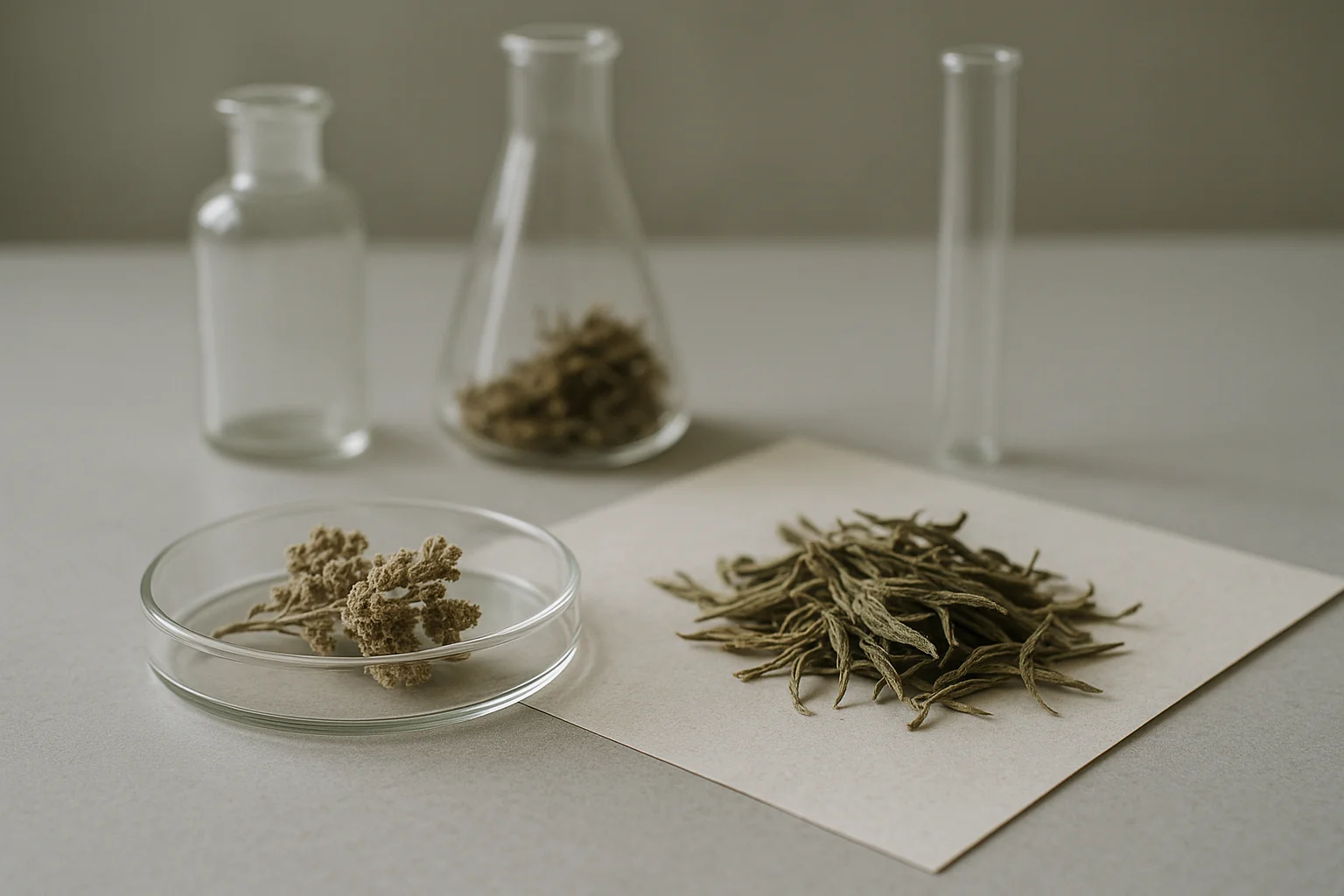

Pink Certz (Cannabis flos S-LAB): lineage from Grape Gasoline and nerolidol at the forefront
Pink Certz is an S-LAB hybrid with lineage from The Menthol and Grape Gasoline. One source describes the terpene profile, we provide the THC content as a range, and the sibling from Polish pharmacies counts three strains.
What is Pink Certz and where does it come from?
Pink Certz is a hybrid with a sativa dominance, created by crossing The Menthol with Grape Gasoline. The lineage is provided by the breeder's website, Compound Genetics, rather than a strain database collecting second-hand descriptions. In Polish pharmacies, the strain is available in two entries from a single manufacturer, which is S-LAB.
The breeder's website records the parents as The Menthol x Grape Gas. In this context, the second part has been brought to its full form, Grape Gasoline, because under the abbreviation and the full name, it refers to the same cultivar, and separating them would sever the connection with strains that share the same parent. The same lineage is repeated in the Polish commercial description of the S-LAB entry, so the record does not stand on a single sentence from one side.
The origin is established here, which is not a rule in this context: with twenty-five cultivars out of eighty-five, the breeder has not revealed the parents or the available descriptions contradict each other, and then we write it directly instead of guessing based on the name. However, the established origin does not say anything about what a specific batch of dried flower contains. The names of the parents describe the seed line, not the results of the analysis that the pharmacist has on the label. The composition visible in the listings pertains to the registration entry, not the crossing itself. The lineage serves a different purpose here: it connects strains that share a common parent and allows showing places where a similar name means nothing.
Which producers supply this strain to Polish pharmacies?
One. Pink Certz is supplied exclusively by S-LAB and does so in two registration entries that differ in declared THC content. The rest of the description is identical in both: the same genetics, the same set of terpenes, the same complete set of aroma descriptors. Both entries currently have a status of unavailable in the database.
| Producer | Registration position | THC content | How it differs from the other |
|---|---|---|---|
| S-LAB | Cannabis flos S-LAB, provided without a numerical component | 16,2-19,8% | lower declared value; the same set of terpenes and the same complete set of aroma descriptors |
| S-LAB | Cannabis flos S-LAB, provided without a numerical component | 19,8-24,2% | higher declared value; genetics described the same way, availability also marked as absent |
The registration name carries a number within it, as pharmacy entries are distinguished by their declared content. In the table, we provide this name without a numerical component, and the content itself separately, as a range. The reason is simple: manufacturers are allowed to deviate from the declared value by ten percent in either direction, so the number entered in the name describes the production target, not the analysis result of that specific batch. The range conveys the same information, just without the pretense of precision.
The status of both entries today indicates unavailability and this is not a description error, but a normal state of affairs. Dried flower is delivered to wholesalers in batches, and the permission for market circulation has its term and can be revoked. The statement that the strain can be purchased today would age faster than the rest of the text, which is why what can be realistically purchased is updated solely in the monthly review of what is on pharmacy shelves. We gather the list of other entries from this manufacturer separately, in a text about S-LAB.
Two meanings of the word dried flower can be easily confused. The pharmacy entry issued by a doctor's prescription is not the same as dried flower from the store's offer, which is not a medicine and is subject to different regulations.
What does Pink Certz smell and taste like?
The database describing this strain provides three aroma descriptors: diesel, licorice, and mint. This is a verbal description, not a measurement, and comes from the same single source as the profile composition. These listings do not describe the taste separately, so we repeat only what is stated in them.
The descriptors align with the names of the parents, which is interesting but proves nothing. The mint in the aroma description is adjacent to the name The Menthol, while the diesel note is associated with the name Grape Gasoline. Breeders name their hybrids in such a way that the name describes the scent, so the consistency of one with the other is more a consequence of naming than an independent confirmation.
Both pharmacy entries have the same set of three descriptors assigned, even though they differ in declared content. This is evident from what this description is attached to: the name of the strain, not the analysis of a specific batch. The scent of the dried flower changes with the conditions of cultivation, drying, and storage, and none of these factors are included in the database.
The same database lists four positions of the terpene profile: humulene, caryophyllene, limonene, and nerolidol, with the highest share attributed to nerolidol. We do not transcribe the shares next to the names, as for Pink Certz they sum up to sixty-seven percent instead of one hundred. The missing remainder is not written anywhere, and it is unclear whether it hides other compounds or is simply an incomplete measurement. The value placed next to the name of the compound, with an unknown denominator, reads like an analysis result, although it is not.
How long does it take for the strain to take effect and how long does the effect last?
The speed of onset depends on how the substance enters the body. No one has yet published concentration measurements for Pink Certz, so the ranges below refer to the method of administration itself. The terpene profile does not change anything here, as it describes the aroma and composition, not the absorption rate or the moment when the effect wears off.
The route of administration determines the course more than the variety itself. After vaporization, the substance passes from the lungs to the blood almost immediately, so the first sensations appear after a few minutes, the intensity increases for another ten to thirty minutes, and the whole effect lasts for two to four hours. After ingestion, the raw material first passes through the intestine and liver, so the first sensations are awaited from half an hour to two hours, and the episode can last six, sometimes eight hours. Hence the most common mistake with oral administration: anyone who thinks nothing is happening after thirty minutes and takes another dose will receive both doses at once. The above ranges describe the route of administration, not this variety; pharmacokinetic studies for a single cultivar have not been published.
The difference between the two S-LAB products concerns the declared content, not the duration: a stronger dried flower does not start working sooner nor does it end later. The method of administration is determined by the attending physician, as they write the prescription and know the patient's other medications.
What is known, and what is not known about the effects of this strain?
Nothing is known about the strain itself from studies, as there is no clinical or preclinical work that considers Pink Certz as a separate cultivar. However, something is known about nerolidol, the terpene that leads its profile in the database, and there are two studies on mice, none on humans.
The first was published in 2016 by Fonsêca DV, Salgado PR, de Carvalho FL, Salvadori MG, Penha AR, Leite FC, Borges CJ, Piuvezam MR, Pordeus LC, Sousa DP, Almeida RN in Fundamental & Clinical Pharmacology (PMID:26791997). Nerolidol (200-400 mg/kg) reduced the number of abdominal contractions induced by acetic acid in mice and lowered the levels of pro-inflammatory cytokines TNF-alpha and IL-1beta; the authors suggested the involvement of the GABAergic system in the analgesic effect, as opposed to the opioid mechanism and potassium channels.
The second is more recent. Hojjat SH, Rasouli F, Shakeri F described it in 2026 in the journal Arquivos de Neuro-Psiquiatria (PMID:42447923). Oral nerolidol (25-100 mg/kg) prolonged the latency to seizures induced by pentylene tetrazole (MCS and GTCS phases) in mice and reduced markers of oxidative stress in the brain.
Both studies administered the pure compound in doses calculated based on the animal's body weight, not a pair from dried flower. It has not been shown that nerolidol alleviates anxiety or insomnia in humans; both available studies concern rodents and describe analgesic, anticonvulsant, and antioxidant effects, not sleep or mood.
In addition, there is the manufacturer's material and patient reports. The database records one descriptor of possible effects for both products, described as balanced. This is a label from the product description, not a measurement result, and should not be read as a prediction of what a specific person will experience.
What side effects have been reported for this strain?
None specifically for this strain. In the Polish system, there is no compilation of symptoms assigned to the name of the cultivar, so it is impossible to write what has been reported after Pink Certz and what has not. This is a lack of data, not proof of safety, and the same situation applies to the other products in this compilation.
Reports of adverse effects are collected for medicinal products with a batch number, not for the strain name, so the following pertains to hemp dried flower as a group of raw materials. The most frequently reported symptoms are dry mouth, red eyes, and increased heart rate. Dizziness upon rapid standing, daytime drowsiness, and temporary worsening of short-term memory are less frequently described, as well as anxiety that increases with dosage. A separate issue is medications taken concurrently, especially sedatives and those affecting coagulation: their assessment requires knowledge of the entire list of preparations, not just the description of the plant. We do not provide the frequency of these symptoms numerically, as public compilations for hemp dried flower in Poland do not separate them by individual products.
The two S-LAB products differ in declared content, not in the list of possible symptoms: this list belongs to the raw material, not to a specific batch. Reports are directed to the attending physician or to the adverse event monitoring system, providing the batch number from the packaging, as it identifies the medicinal product.
How to vaporize this strain?
There is no specific setting for Pink Certz. Boiling temperatures describe pure compounds under laboratory conditions, not dried flower in the vaporizer chamber, so one number cannot be read from the tables for the strain. However, it is possible to show how far apart the entries in its profile are.
| Terpene from the profile | Source record | Pressure in the entry | Database from which the record originates |
|---|---|---|---|
| humulene | 99-100 °C | 3 mmHg | Human Metabolome Database |
| limonene | 352 °F, converted to 177.8 °C | 760 mmHg | CAMEO Chemicals |
| caryophyllene | 256-259 °C | 760 mmHg | JECFA |
| caryophyllene | 264-266 °F, converted to 130 °C | 14 mmHg | NTP, 1992 |
| nerolidol | 275-277 °C | not specified | JECFA |
Four entries from the profile of this strain have boiling temperatures measured under different conditions, and this alone excludes arranging them in a single line. Humulene has a reading taken at a pressure of three millimeters of mercury column, which means under conditions in which a vaporizer does not operate. Nerolidol has a reading without specified pressure, so it is even unclear what to compare it to. Caryophyllene appears in two readings at once, differing by more than a hundred degrees, and the difference arises solely from the measurement pressure.
The conclusion for the reader of such tables is clear: the number next to the compound name describes the measurement conditions, not the equipment setting. Additionally, the temperature displayed by the vaporizer pertains to the heater or chamber, not the dried flower itself, so even a well-read value does not directly translate to what evaporates from the plant. We elaborate on this separately, in a text about the evaporation of terpenes, in a text about discrepancies between the tables and in the text about. what the set number really pertains to.
Which strains are related to it?
Three, all available in Polish pharmacies. Grape Gasoline is on the side of the parent in both Gastro Pop and Modified Gas, while The Menthol is in Pave S1. This relationship is through one common parent, not both, so it is partial, and that is all that is known from the pedigree graph.
Gastro Pop dzieli z Pink Certz rodzica Grape Gasoline, a po drugiej stronie ma Apples and Bananas. Modified Gas dzieli tego samego rodzica, a drugim ma First Class Funk. Pavé S1 comes from the opposite branch: they are connected by The Menthol, and the other parent there is Paris OG. Each of these three strains has its own entries in Polish pharmacies, so the sibling relationship is not just a breeding curiosity.
The common element in the name of kinship does not prove anything, and this is evident in three examples from the same comparison. Pink Kush it carries the same first word, and its lineage remains undetermined, so it cannot be said whether anything connects them. Farm Gas has the same gas element in its name, and its parents are Sour Diesel and GMO. Wedding Pie derives from Grape Pie, meaning from a different cultivar than Grape Gasoline, despite the first common term.
Siblings through one parent do not predict a similar composition. The second parent contributes equally, and the growing conditions bring in the rest. The profiles of these three strains actually come from the same databases as the Pink Certz profile and have the same limitations, so comparing their compositions would be comparing descriptions, not analyses.
Frequently Asked Questions
Is Pink Certz available in Polish pharmacies?
Both entries from S-LAB have a status in the database we use indicating unavailability. This status changes with deliveries to wholesalers, so we maintain a list of what can actually be purchased in the strain comparison, not in the description of a single strain.
How many producers supply Pink Certz?
One. The strain is supplied exclusively by S-LAB, in two registration positions differing in declared THC content. The rest of the description is the same in both positions.
Which terpene leads the profile of Pink Certz?
Nerolidol. The base also mentions humulene, caryophyllene, and limonene in the profile, but the highest share is attributed to nerolidol. We do not transcribe the shares themselves, as their sum does not reach one hundred percent and the denominator remains unknown.
Are Pink Certz and Pink Kush related?
It is unknown and nothing indicates that. The lineage of Pink Kush remains undetermined, and the common first word in the name is not evidence of kinship in any direction.
Why is the THC content given as a range?
Because the number from the name of the position is a declared value, from which producers are allowed to deviate by ten percent in either direction. The range describes what can realistically end up in the jar, while a single number pretends to be the precision that does not exist.
Has the Pink Certz strain been clinically tested?
No. There is no clinical or preclinical work regarding this cultivar. Available studies concern a single terpene from its profile and were conducted on mice.
Dried flower is a pharmaceutical raw material dispensed by prescription in the Rpw category, and advertising of prescription medicinal products directed to the public is prohibited. The material is for informational purposes and does not replace the advice of the attending physician. Redakcja ubucha.pl