
CBD Crystal 99%: what it is, whether it's worth buying, and how to use it
CBD Crystal 99% — pure isolate. How does it differ from full-spectrum oil? Dosing, forms of use, pros and cons of CBD isolate. Is it worth choosing it over oil?
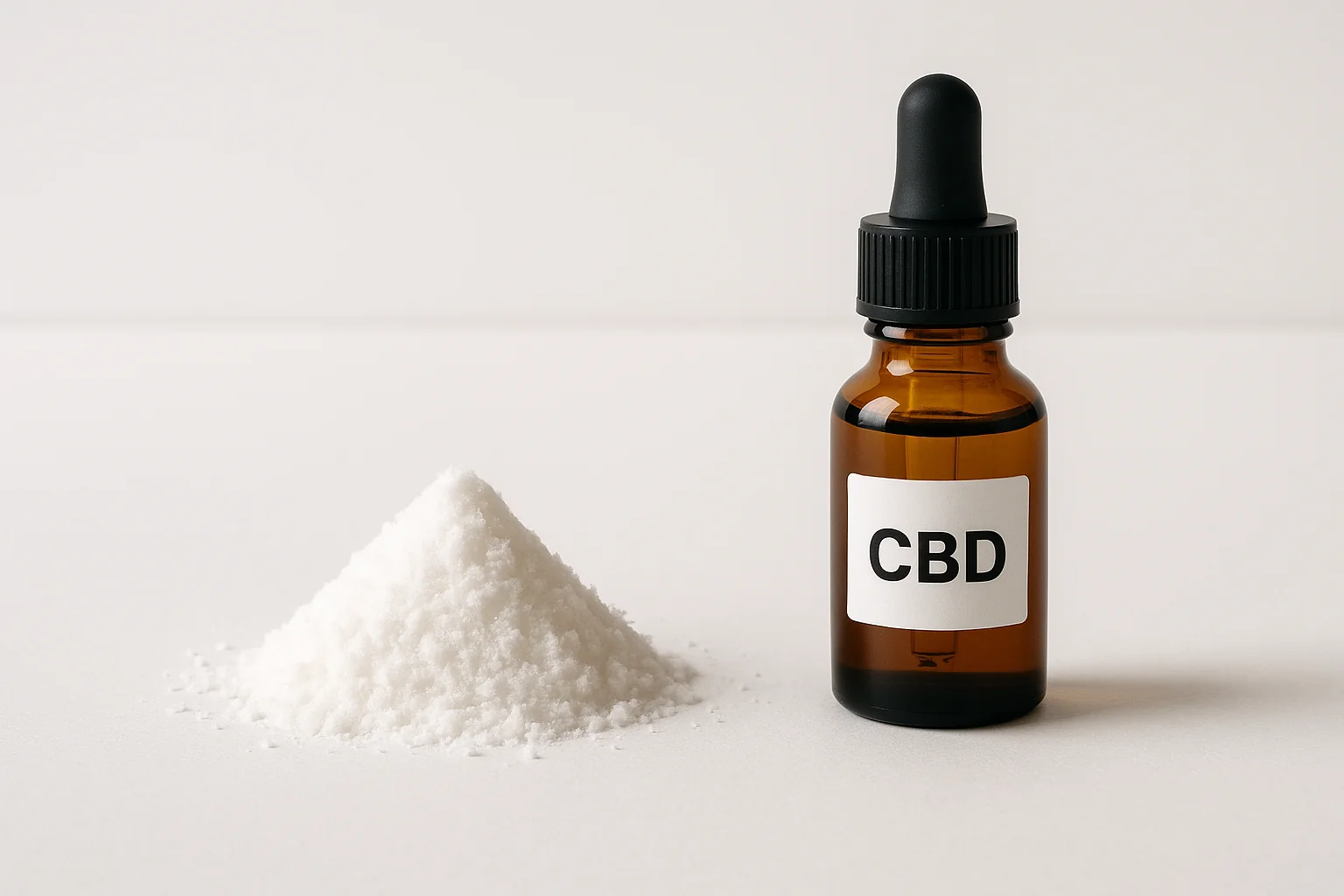
In the CBD market, alongside popular oils, a different type of product has emerged — CBD crystal 99%, also known as CBD isolate. This white, powdered substance containing over 99% pure cannabidiol piques the interest of advanced CBD users. Is it a better product than oil? Not always — it depends on the intended use. CBD crystal has specific advantages and equally specific limitations compared to full-spectrum and broad-spectrum oils. This article explains what it is, how it is made, how to use it, and when it is worth choosing CBD crystal over oil.
KEY INFORMATION
• CBD Crystal 99% is an isolate — pure cannabidiol devoid of all other cannabinoids, terpenes, and THC (resulting from the crystallization process of hemp extract).
• Lack of entourage effect: CBD isolate works less therapeutically than full-spectrum at the same CBD dose — this was shown in a study by Gallily et al. (Pharmacology & Pharmacy, 2015).
• Zero THC risk — ideal for individuals undergoing drug tests, athletes, and employees with sobriety requirements.
• CBD crystal allows for precise dosing down to the milligram — an advantage over oils, where dosing with drops has a margin of error.
• Methods of use: dissolving in carrier oil, sublingually, homemade capsules, vaporization (in the appropriate device).
How CBD Crystal 99% is Made — Production Process
CBD crystal is the result of the isolation and purification process of hemp extract. Here are the production stages:
Extraction: A raw extract is obtained from the flowers of the hemp plant — typically using supercritical CO₂ or ethanol methods. The raw extract contains CBD, other cannabinoids (THC, CBG, CBN, CBDa), terpenes, plant waxes, and chlorophyll.
Winterization: The extract is diluted in ethanol and cooled to -40°C or lower. Fats and waxes precipitate as sediment and are filtered out. The result: a pure extract without waxes.
Distillation: The extract undergoes short-path distillation or molecular spinning. Successive fractions are evaporated: first the solvent residues, then terpenes, and then low-molecular-weight cannabinoids. The result: a CBD fraction with a purity of 80–90%.
Crystallization: The CBD fraction is dissolved in pentane or hexane and slowly cooled — CBD crystallizes as white crystals. The crystals are filtered, washed, and dried. The final effect: a white powder or crystals with a purity of 99%+.
Every reputable producer of CBD crystal 99% provides a COA (Certificate of Analysis) from an independent laboratory, confirming purity and the absence of THC, pesticides, and heavy metals. Always check the COA before purchasing.
CBD Crystal vs Full-Spectrum Oil — Key Difference: Entourage Effect
The entourage effect is a term coined by Raphael Mechoulam describing the synergistic action of various cannabinoids and terpenes — where the whole is more effective than the sum of its parts. CBD isolate (crystal) is devoid of all other plant components — which eliminates the entourage effect.
Study Gallily et al. (Pharmacology & Pharmacy, 2015) compared full-spectrum extract with CBD isolate at the same dose of CBD in an inflammation model. Results: full-spectrum extract provided significantly higher anti-inflammatory effects than CBD isolate at the same amount of CBD — which is direct evidence of the entourage effect. The dose-response curve was also linear for full-spectrum (more CBD = more effect), while for the isolate it showed a bell-shaped curve (at too high doses of the isolate, the effect decreased).
Practical conclusion: if you want therapeutic effects of CBD (for pain, anxiety, inflammation), full-spectrum oil at the same dose of CBD will likely be more effective than the isolate crystal. The crystal has other advantages — but therapeutic strength is not one of them.
Who is CBD Crystal 99% a better choice for?
Despite the lack of entourage effect, CBD crystal has specific advantages in certain situations — and for these individuals, it is a better choice than full-spectrum oil.
Athletes and competitors: Sports organizations (WADA, Polish associations) use anti-doping tests that can detect THC. Although full-spectrum oils contain only trace amounts of THC (up to 0.3%), daily use of higher doses may lead to THC accumulation in fatty tissues and subsequent release into urine in detectable amounts. 99% CBD crystal eliminates this risk — zero THC, zero risk of disqualification.
Employees subject to drug testing: Professional drivers, pilots, industrial workers — similar situation as athletes. CBD crystal is the only safe form of cannabidiol when the risk of a positive drug test result is unacceptable.
Individuals making CBD products themselves: CBD crystal is an ideal starting point for DIY. It can be precisely weighed, dissolved in a carrier oil (MCT, olive oil), and prepared as a CBD oil with a precisely defined concentration. Homemade CBD oil 5% = 5 g of CBD crystal + 95 ml of MCT oil — and that's all the ingredients, without mysterious extracts.
Individuals sensitive to terpenes or cannabis odors: CBD crystal is odorless and tasteless. For users who cannot tolerate the herbal taste and smell of cannabis in oils — the crystal is a more pleasant form.
Our observations: Advanced CBD users often combine: full-spectrum oil as a daily base for the entourage effect, plus CBD crystal as a "dose supplement" when they need to precisely add, for example, 20 mg of CBD without adding another portion of THC. This is an unconventional but practical strategy for combining both forms.
How to use CBD crystal — forms of use
CBD crystal is very versatile in application. Here are the main forms:
Homemade CBD oil: Weigh the exact amount of crystal (e.g., 1 g = 1000 mg CBD), dissolve in 20 ml of MCT oil or olive oil — you will get 5% CBD oil. Mix in a warm water bath (~60°C) until fully dissolved. Store in a dark bottle. This is the best option for those who want to control the concentration without paying for ready-made oil.
Sublingual administration: Measure the appropriate amount of crystal (e.g., with a spatula or a small kitchen spoon — 1/8 teaspoon is about 50–100 mg). Place it under your tongue for 60–90 seconds, then swallow. The taste is neutral. Sublingual bioavailability is similar to that of oil (~30%), but without carrier oil, absorption is slightly improved.
Homemade capsules: Fill empty gelatin or HPMC (vegetarian) capsules with the measured amount of CBD crystal. One size 00 capsule can hold about 800 mg of material — you can fill it with up to ~100 mg of CBD (the rest of the space: MCT oil on a pipette or inert powder). Convenient like factory capsules, but fully controlled by you.
Vaporization: CBD crystal can be vaporized in vaporizers designed for concentrates (dab pen, vaporizer with an atomizer) at a temperature of 160–180°C. Bioavailability increases to ~50–60%. Important: temperature and type of device matter — not every vaporizer for cannabis flower is suitable for crystal. Vaporizing crystal is mainly an option for advanced users who care about quick action with low absorption. It is not a recommended method for individuals with respiratory issues.
Adding to food: The crystal can be added to a fatty meal (oil, full-fat yogurt, salad with olive oil). Bioavailability is similar to a capsule with a fatty meal. Do not add to hot drinks — CBD is sensitive to very high temperatures (>180°C it degrades, but in hot coffee at 70–80°C it is safe).
Dosing CBD crystal — how to measure?
Precision in dosing is one of the greatest advantages of CBD crystal — but also a logistical challenge if you don't have a laboratory scale. Here are practical methods:
Precision scale: A kitchen scale with an accuracy of 0.1 g is sufficient for doses of 100 mg+ (0.1 g = 100 mg). For doses below 50 mg, you need a precision scale of 0.01 g (available in laboratory stores and online for 30–80 PLN). This is the most accurate method.
Volumetric titration: If you make your own CBD oil (e.g., 1 g of crystal in 20 ml of MCT = concentration 5%), you can use a dropper just like with a ready-made oil. One drop = about 2.5 mg of CBD (at a concentration of 5%) or 5 mg (at 10%).
Approximate measurements: A pinch of crystal on the tip of a toothpick = about 10–15 mg. This is an imprecise method suitable only for estimating the order of magnitude — not for precise dosing. For repeatability — use a scale.
Start with 15–25 mg of CBD daily, which corresponds to exactly the same amount of substance when using pure isolate. Remember that due to the lack of entourage effect, you may need a slightly higher dose of crystal than full-spectrum oil to achieve a similar effect. You can find a comparison with oils in the article Which CBD concentration to choose.
CBD crystal and drug tests — can it be used safely?
One of the main reasons users choose CBD isolate over full-spectrum is the issue of drug testing. Tests for THC (tetrahydrocannabinol) — both from urine and saliva — are standard in many professions and sports disciplines. Are full-spectrum oils safe for testing? In theory, yes (THC below 0.3%), but in practice, with high doses and prolonged use, the risk of accumulating trace THC in fat tissues is real. The study Spindle et al. (Drug and Alcohol Dependence, 2020) showed that regular use of full-spectrum CBD products at doses of 15+ mg/day can lead to detectable levels of THC-COOH in urine in some individuals.
99% CBD crystal contains zero THC — and the COA certificate confirms this. When using pure isolate, the risk of a positive drug test for THC is zero. This is particularly important for: professional drivers subject to random testing, athletes controlled by anti-doping regulations, and employees in industries with specific safety requirements (energy, aviation, defense).
If drug tests are a part of your professional reality, CBD crystals or products with a „zero THC / non-detect” certification are the only safe choice in the world of CBD. You can read more about CBD and drug tests in the article. Does CBD show up on drug tests?.
How to store CBD crystal to maintain its quality?
CBD crystal is sensitive to the same factors as CBD oil: light, heat, and moisture. Proper storage will preserve its quality for 1–2 years from the production date.
Storage guidelines: airtight dark glass jar or hermetic metallic bag (mylar bag), at room temperature or lower (2–8°C in the fridge extends shelf life), away from heat sources and direct sunlight. Avoid frequent opening of the container — each opening exposes the crystal to moisture, which can cause clumping. If the crystal clumps into a hard mass — it is not a quality issue, just break it up before use. CBD does not lose its properties due to clumping.
The melting point of CBD is 66–67°C — under normal storage conditions, the crystal remains solid. At higher temperatures (in summer in a car or near a heater), it may soften and stick together — which does not change its properties but makes dosing more difficult.
Safety and legality of CBD crystal in Poland
99% CBD crystal is legal in Poland — it is a hemp product with THC content below the detection threshold (practically zero). CBD extract and its isolate are not covered by the drug prevention law as a psychotropic substance or drug, provided they come from industrial hemp and contain <0.3% THC. 99% CBD crystal meets both conditions.
The safety profiles of CBD isolate and CBD oil are identical — they contain the same active substance (CBD), differing only in the absence of accompanying phytochemicals. The WHO confirmed in its 2018 report that CBD poses no public health risk when used normally. The only significant caveat with the crystal: greater purity and ease of preparing high-concentration products — which increases the risk of accidentally taking too high a dose (sedation, discomfort). Always measure the dose accurately before use.
Frequently Asked Questions
What is 99% CBD crystal?
99% CBD crystal (CBD isolate) is pure CBD isolated from industrial hemp through extraction, dewaxing, and crystallization. The white powder or crystals contain 99% or more cannabidiol without THC, terpenes, or other cannabinoids. The COA certificate confirms the purity.
What is the difference between CBD crystal and CBD oil?
Crystal = pure CBD isolate, without the entourage effect, zero THC. Full-spectrum oil = CBD + other cannabinoids + terpenes + entourage effect. Gallily et al. (2015) demonstrated that full-spectrum is more therapeutically effective at the same dose of CBD. Crystal wins when there is a need for no THC and precise dosing.
How to use CBD crystal?
Best methods: (1) homemade CBD oil — crystal dissolved in MCT oil or olive oil; (2) sublingually — crystal directly under the tongue; (3) homemade capsules; (4) vaporization in a concentrate device. Always measure the dose — the crystal is highly concentrated.
Is CBD crystal better than full-spectrum oil?
It depends on the purpose. Better if: you need to avoid THC (drug tests, sports), you want precise dosing, you are creating your own CBD products. Full-spectrum is better if: you want the full therapeutic effect, you have no THC restrictions, and you prefer a ready-made product without preparations.
How much does CBD crystal cost and is it worth it?
In terms of mg of CBD, crystal is usually more expensive than ready-made oils in small quantities, but cheaper when purchased in bulk (5–10 g). It is worthwhile for advanced users who use high doses and want full control over the product. For standard supplementation of 15–30 mg/day — a ready-made oil is more convenient and comparably priced.
This article is for informational and educational purposes. It contains internal links to products available in the u Bucha store. Prices and specifications may change — please check the current data on the product page before purchasing.
Author: Michał Waluk · Published: 2026-05-04 · Updated: 2026-05-04