
Kolagen na stawy i skórę: który wybrać, jak dawkować i kiedy widać efekty (2026)
Kolagen na stawy i skórę: 7 preparatów z oferty u Bucha w tabeli, koszt 10 g kolagenu, dawki potwierdzone badaniami i realny czas na efekty.
Kolagen to najobficiej występujące białko w ludzkim ciele i główny materiał budulcowy skóry, chrząstki i kości. Jego zapas w skórze maleje z wiekiem, a u kobiet jest niższy w każdej grupie wiekowej (Shuster i wsp., British Journal of Dermatology, 1975). Stąd popularność suplementów i stąd kłopot: etykiety porównuje się fatalnie, bo jeden preparat podaje gramy proszku, drugi mililitry płynu, a trzeci samą liczbę porcji. Sprawdziliśmy więc, co naprawdę stoi na półce u Bucha, przeliczyliśmy każdy preparat na wspólny mianownik i zestawiliśmy to z dawkami z badań klinicznych. Dowiesz się, która forma kolagenu się wchłania, ile go potrzeba dziennie, ile kosztuje taka porcja i po jakim czasie ocena efektów ma sens.
KLUCZOWE INFORMACJE
• 2,5 g peptydów kolagenowych dziennie przez 8 tygodni istotnie poprawiło elastyczność skóry wobec placebo (Proksch i wsp., 2014).
• Wchłaniają się peptydy, nie kolagen natywny.
• U Bucha jest 7 preparatów kolagenowych, koszt 10 g kolagenu: od 3,97 zł do 45,02 zł.
• Skóra odpowiada po 8 tygodniach, staw po 3-6 miesiącach.
Czym jest kolagen i dlaczego jego zapas maleje z wiekiem?
Kolagen to rodzina białek włóknistych o potrójnej helisie, tworząca rusztowanie skóry i chrząstki. Shuster i wsp. (British Journal of Dermatology, 1975) zmierzyli kolagen w skórze przedramienia u dużej grupy zdrowych osób i wykazali, że spada z wiekiem, a u kobiet jest niższy w każdym przedziale wiekowym.
Typ I dominuje w skórze i kościach, typ II buduje chrząstkę stawową, a typ III towarzyszy typowi I w ścianach naczyń. Ta różnica liczy się przy wyborze preparatu, bo producenci deklarują typ na etykiecie.
Za syntezę odpowiadają fibroblasty w skórze i chondrocyty w chrząstce. Tempo ich pracy obniżają promieniowanie UV, palenie tytoniu i niedobór witaminy C. Ten ostatni czynnik bywa pomijany, choć bez niego nic nie zadziała: enzymy hydroksylujące prolinę i lizynę potrzebują witaminy C jako kofaktora. Bez niej powstają włókna o wadliwej strukturze, czego skrajnym obrazem jest szkorbut.
Zauważyliśmy w rozmowach z klientami, że prawie nikt o tym nie wie. Ludzie biorą proszek na czczo, popijają wodą i po dwóch miesiącach dziwią się brakowi efektu.
Hydrolizat czy kolagen natywny, co naprawdę się wchłania?
Wchłaniają się peptydy, nie całe białko. Kolagen natywny to cząsteczka rzędu 300 kDa, której jelito nie przepuszcza w całości, a enzymy trawienne rozkładają ją do zwykłych aminokwasów. Hydrolizat rozbito enzymatycznie już na etapie produkcji, do di- i tripeptydów o masie 500-2000 Da.
Iwai i wsp. (Journal of Agricultural and Food Chemistry, 2005) podali zdrowym ochotnikom hydrolizaty żelatyny na czczo i śledzili osocze. Peptydowa forma hydroksyproliny, przed podaniem praktycznie nieobecna, rosła do maksimum 20-60 nmol na mililitr po 1-2 godzinach, a po czterech godzinach spadała o połowę. Dominującym fragmentem był dipeptyd prolino-hydroksyprolina. To twardy dowód na to, że po hydrolizacie krążą we krwi całe peptydy, a nie wyłącznie rozłożone aminokwasy.
Praktyczny wniosek jest prosty. Na etykiecie szukaj słów „hydrolizat kolagenu” albo „peptydy kolagenowe”. Samo słowo „kolagen” bez tego dopisku nie mówi nic o formie i o tym, czy surowiec w ogóle przeszedł hydrolizę. Wyjątkiem jest niezdenaturowany kolagen typu II (UC-II), który działa zupełnie inną drogą i dlatego dawkuje się go w miligramach, nie w gramach.
Jaka dawka kolagenu ma potwierdzenie w badaniach?
Na skórę potwierdzenie ma 2,5 g dziennie. Proksch i wsp. (Skin Pharmacology and Physiology, 2014) w podwójnie zaślepionej próbie z placebo podali 69 kobietom w wieku 35-55 lat 2,5 g albo 5 g hydrolizatu przez 8 tygodni. Elastyczność skóry poprawiła się istotnie w obu grupach wobec placebo, a u starszych uczestniczek przewaga utrzymywała się jeszcze cztery tygodnie po odstawieniu.
Ten sam zespół sprawdził osobno zmarszczki. W drugiej próbie (Skin Pharmacology and Physiology, 2014) 114 kobiet w wieku 45-65 lat przyjmowało 2,5 g peptydów przez 8 tygodni. Objętość zmarszczek wokół oczu spadła o 20% wobec placebo, a w biopsjach skóry zawartość prokolagenu typu I wzrosła o 65%.
Na stawy dawki są wyższe, a dowody słabsze. Bello i Oesser (Current Medical Research and Opinion, 2006) zebrali cztery badania otwarte i trzy z podwójnym zaślepieniem, po czym podsumowali je ostrożnie: hydrolizat okazał się bezpieczny i poprawiał niektóre miary bólu oraz sprawności, ale część prac nie podawała nawet istotności statystycznej wyników. Osobną ścieżką jest UC-II w dawce 40 mg dziennie.
Które preparaty kolagenowe są dostępne u Bucha?
W katalogu jest dziś siedem preparatów kolagenowych: sześć rybich marki Aura Care i jeden bydlęcy od Divine Goods. Uszeregowaliśmy je według kosztu 10 g kolagenu, bo to jedyna wielkość porównywalna między proszkiem, płynem i kawą. Sama cena opakowania nic nie rozstrzyga, skoro porcja dzienna waha się od 0,73 g do 10 g.
| Miejsce | Preparat | Kolagen w porcji dziennej | Co wyróżnia | Cena | Koszt 10 g kolagenu |
|---|---|---|---|---|---|
| 1 | Boski Kolagen, Divine Goods by.herbs, 315 g | 10 000 mg | peptydy bydlęce typu I i III plus 500 mg ekstraktu z tremelli | 118,99 zł | 3,97 zł |
| 2 | Aura Care Collagen Moc Piękna 500 ml | 12 000 mg | płyn z kwasem hialuronowym i krzemem z bambusa | 139,00 zł | 5,79 zł |
| 3 | Aura Care Collagen Moc Młodości 500 ml | 11 000 mg | płyn z 1000 mg MSM i wyciągami roślinnymi | 139,00 zł | 6,32 zł |
| 4 | Aura Care Kolagen PREMIUM Aktywność 200 g | 5 500 mg | proszek z glukozaminą, chondroityną i MSM, profil stawowy | 129,00 zł | 7,82 zł |
| 5 | Aura Care Kolagen PREMIUM Piękno 200 g | 5 500 mg | proszek z krzemem organicznym i biotyną | 129,00 zł | 7,82 zł |
| 6 | Aura Care Kawa Kolagenowa Arabica 220 g | 2 000 mg | kolagen w kawie rozpuszczalnej, 36 porcji w opakowaniu | 99,00 zł | 13,75 zł |
| 7 | Aura Care Esencja Kolagenowa 50 ml | 733 mg | skoncentrowane krople z sześcioma witaminami z grupy B | 99,00 zł | 45,02 zł |
Ceny pochodzą ze sklepu, stan na 8 sierpnia 2026. Koszt 10 g policzyliśmy z deklarowanej zawartości kolagenu w porcji i z liczby porcji w opakowaniu. Cennik zmienia się szybciej niż artykuł, więc przed zakupem sprawdź kwotę w kategorii suplementy.
Ile kosztuje 10 g kolagenu w każdym z tych preparatów?
Rozpiętość jest jedenastokrotna. Najtańsze 10 g kolagenu kosztuje 3,97 zł, najdroższe 45,02 zł, a różnica nie bierze się z jakości surowca, tylko z formy podania i z tego, ile kolagenu producent zmieścił w jednej porcji.
Proszki wygrywają, bo nie trzeba w nich niczego konserwować. Płyny płacą za wodę i za butelkę, ale mają przewagę przy dawce: porcja Mocy Piękna to 12 g kolagenu, więcej niż daje którykolwiek proszek z tabeli. Kawa kolagenowa i krople to osobna kategoria. Ich porcja dostarcza 2 g i 0,73 g, więc jako samodzielne źródło kolagenu wypadają słabo, a sens mają jako wygodny dodatek.
Jeżeli celujesz w dawki z badań stawowych, licz koszt kwartału, nie cenę opakowania. Przy 10 g dziennie przez 12 tygodni najtańszy wariant z tabeli to około 333 zł, a Esencja Kolagenowa w tej samej roli kosztowałaby ponad 3 700 zł.
Kiedy widać efekty na skórze, a kiedy na stawach?
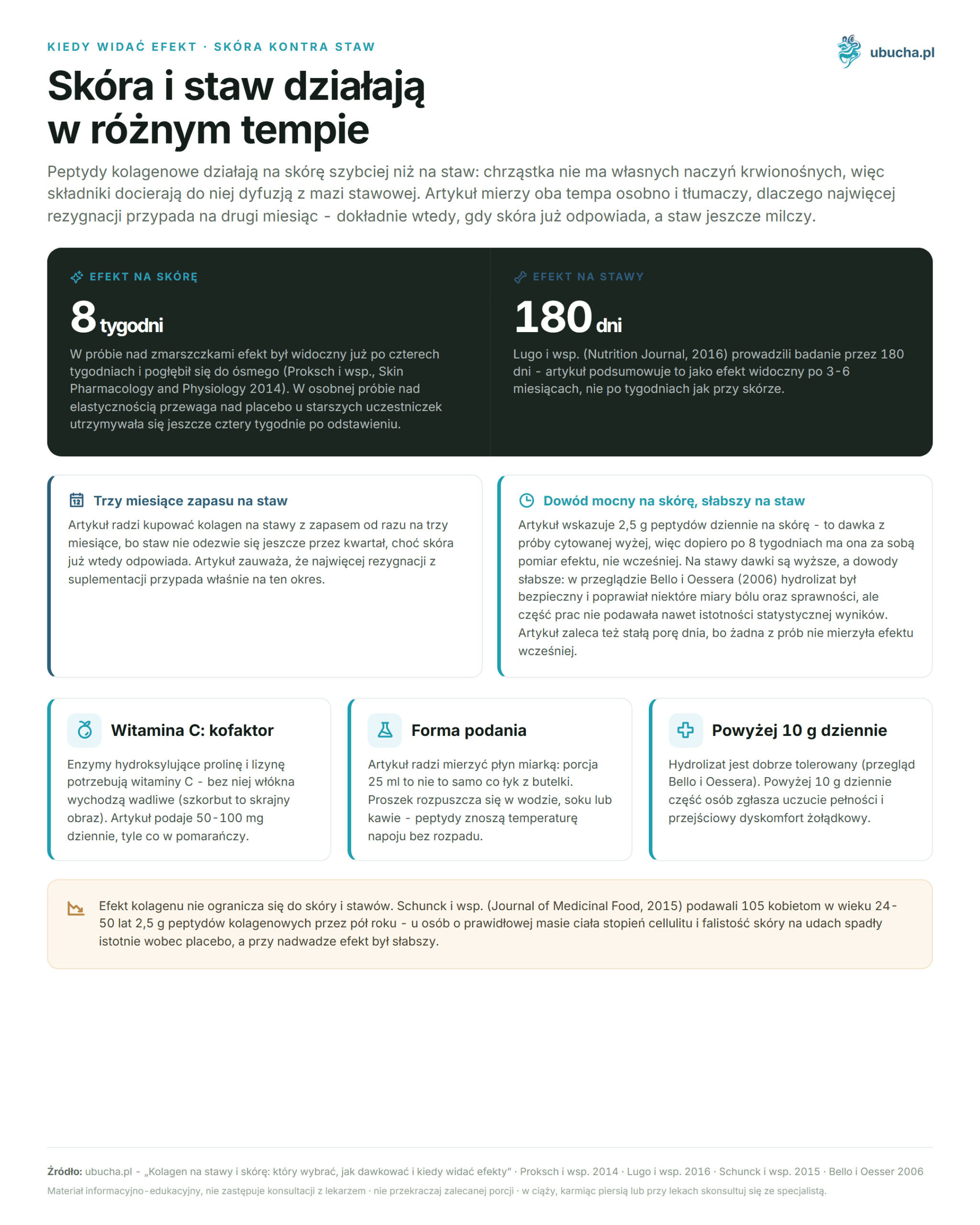
Skóra odpowiada szybciej. W próbie Prokscha i wsp. z 2014 roku pomiar po 8 tygodniach pokazał istotną poprawę elastyczności, a w drugiej pracy tego samego zespołu objętość zmarszczek zmalała już po czterech tygodniach i pogłębiła spadek do ósmego. Osiem tygodni to więc uczciwe minimum, po którym ocena ma sens.
Stawy wymagają cierpliwości, bo chrząstka nie ma własnych naczyń krwionośnych i składniki docierają do niej dyfuzją z mazi stawowej. Lugo i wsp. (Nutrition Journal, 2016) prowadzili badanie przez 180 dni. 191 osób z chorobą zwyrodnieniową kolana przydzielono do 40 mg UC-II, do glukozaminy z chondroityną albo do placebo. Po pół roku grupa UC-II miała istotnie niższy sumaryczny wynik WOMAC niż grupa placebo i niż grupa glukozaminowa.
Zauważyliśmy, że najwięcej rezygnacji przypada na drugi miesiąc, czyli wtedy, gdy skóra dopiero zaczyna odpowiadać, a staw nie odezwie się jeszcze przez kwartał. Kupując kolagen na stawy, planuj zapas na trzy miesiące od razu. Same typy porównaliśmy w tekście Kolagen typ I, II, III: czym się różnią.
Jak przyjmować kolagen i kto powinien uważać?
Regularność liczy się bardziej niż pora dnia. Wybierz stałą godzinę i trzymaj się jej przez minimum 8 tygodni, bo wszystkie cytowane wyżej próby mierzyły efekt dopiero po takim okresie. Proszek rozpuszcza się w wodzie, w soku albo w kawie, a peptydy znoszą temperaturę napoju bez rozpadu. Płyn odmierzaj miarką, bo porcja 25 ml to nie to samo co swobodny łyk prosto z butelki.
Do porcji dołóż witaminę C, jeżeli nie ma jej w składzie preparatu. Nie chodzi o megadawki. Dzienne 50-100 mg pokrywa zapotrzebowanie enzymów hydroksylujących, a tyle znajdziesz w jednej pomarańczy albo w połowie czerwonej papryki.
Hydrolizat kolagenu jest dobrze tolerowany, co potwierdził przegląd Bello i Oessera. Przy dawkach powyżej 10 g część osób zgłasza uczucie pełności i przejściowy dyskomfort żołądkowy. Trzy sytuacje wymagają ostrożności. Alergia na ryby wyklucza wszystkie preparaty rybie, czyli sześć z siedmiu pozycji w tabeli. Dieta wegańska wyklucza je wszystkie, bo kolagen jest białkiem zwierzęcym. Ciąża i karmienie piersią to obszar bez wystarczających danych klinicznych, więc decyzję zostaw lekarzowi.
Najczęściej zadawane pytania
Czy kolagen trzeba popijać witaminą C?
Witamina C jest kofaktorem hydroksylazy prolilowej i lizylowej, bez których łańcuchy kolagenu nie tworzą stabilnej helisy. Nie musisz brać jej w tej samej sekundzie co peptydy, ale dzienna podaż 50-100 mg powinna być stała. Oba proszki Aura Care PREMIUM mają w składzie ekstrakt z dzikiej róży.
Który typ kolagenu działa na stawy?
Chrząstkę stawową buduje kolagen typu II, ale badania kliniczne pokazują dwie działające drogi. Hydrolizat typu I i III w dawce kilku gramów oraz niezdenaturowany typ II (UC-II) w dawce 40 mg. Lugo i wsp. (Nutrition Journal, 2016) wykazali przewagę UC-II nad glukozaminą z chondroityną po 180 dniach stosowania.
Czy kolagen w płynie jest lepszy od proszku?
Nie ma dowodów na lepsze wchłanianie płynu. Różnica leży w wygodzie i w cenie za gram. W naszym zestawieniu porcja płynu dostarcza najwięcej kolagenu naraz, do 12 000 mg, ale 10 g kolagenu z płynu kosztuje 5,79 zł wobec 3,97 zł z proszku. Otwartą butelkę trzymaj w lodówce.
Czy kolagen pomaga na cellulit?
Schunck i wsp. (Journal of Medicinal Food, 2015) podawali 105 kobietom w wieku 24-50 lat 2,5 g peptydów kolagenowych przez pół roku. U kobiet o prawidłowej masie ciała stopień cellulitu i falistość skóry na udach spadły istotnie wobec placebo. Przy nadwadze efekt był słabszy.
Czy kolagen można łączyć z kwasami omega-3?
Tak, to częste połączenie przy dolegliwościach stawowych i nie ma między tymi składnikami znanej interakcji. Kolagen dostarcza materiału budulcowego, a kwasy omega-3 działają na stan zapalny w tkance. Dawkowanie samych kwasów tłuszczowych rozpisaliśmy we wpisie Omega-3: dawkowanie i co pokazały badania.
Czy kolagen zastępuje białko w diecie?
Nie. Kolagen nie zawiera tryptofanu i ma niedobór kilku innych aminokwasów egzogennych, więc jako jedyne źródło białka nie wystarczy. Porcja 10 g hydrolizatu wnosi około 10 g białka o niepełnym profilu. Zapotrzebowanie pokrywaj mięsem, nabiałem albo strączkami.
Wszystkie siedem preparatów z tego zestawienia znajdziesz w kategorii suplementy u Bucha.
Artykuł ma charakter informacyjno-edukacyjny i nie stanowi porady medycznej. Przed rozpoczęciem suplementacji skonsultuj się z lekarzem, zwłaszcza jeśli przyjmujesz leki na stałe, jesteś w ciąży lub karmisz piersią albo chorujesz przewlekle.
Autor: Michał Waluk · Opublikowano: 2026-06-15 · Aktualizacja: 2026-08-08