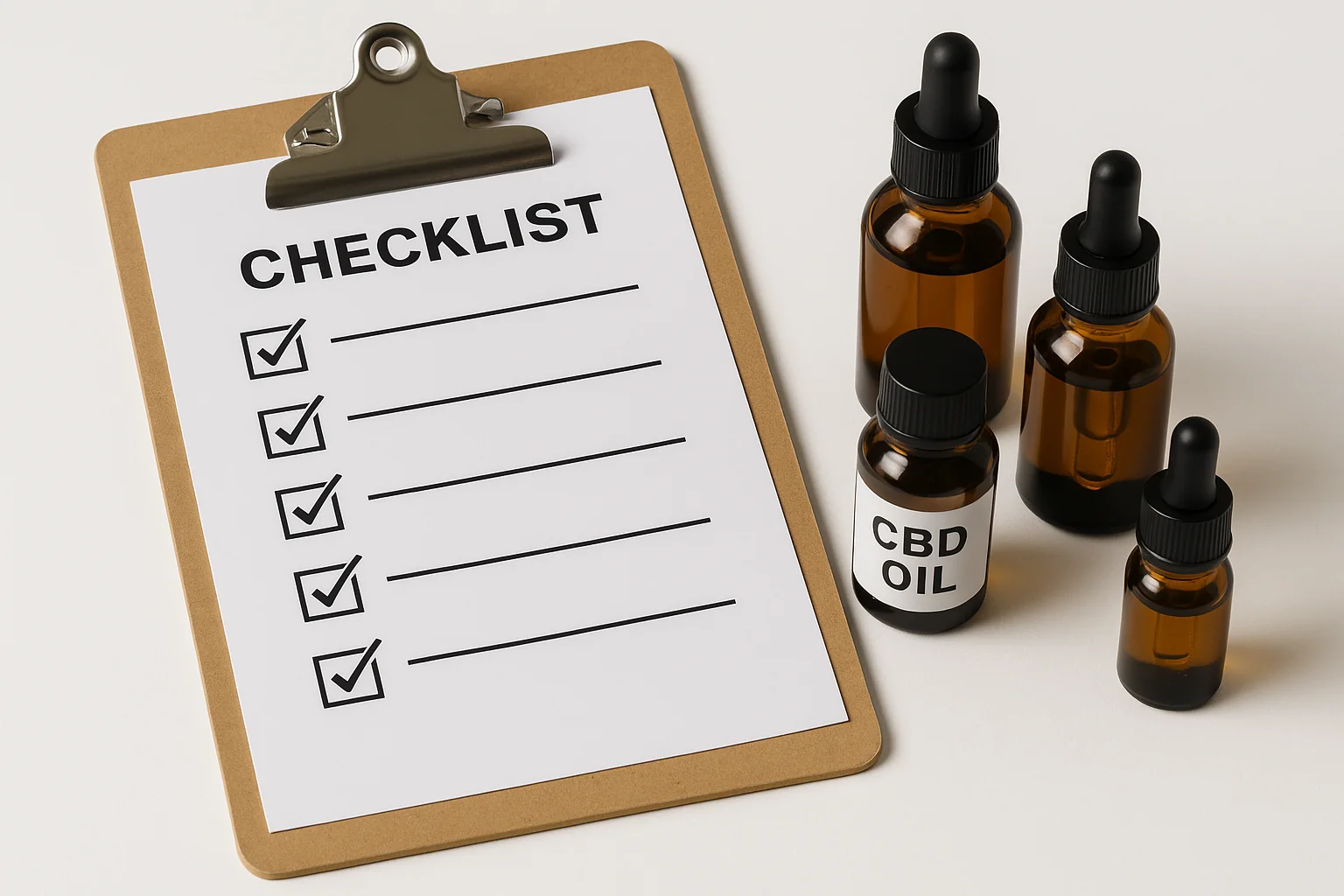

How to choose a CBD oil? A complete shopping checklist for new customers 2026
How to choose a good CBD oil? A complete checklist for new customers 2026: concentration, CO₂ extraction, COA certificates, full spectrum vs isolate, and what to avoid at all costs.
The CBD market in Poland is growing rapidly — in 2024, the value of the hemp supplement segment exceeded 120 million PLN, and the number of available products has increased several times over the last three years. This is good news, as there is plenty to choose from. The bad news: not every product labeled 'CBD' meets basic quality standards. Studies published by consumer organizations regularly show that some CBD oils contain less CBD than declared — or more THC than allowed. To avoid buying a pig in a poke, you need a list of specific questions for verification before purchase. You will find exactly that here.
KEY INFORMATION
• Up to 70% of CBD oils tested by ConsumerLab (2022) contained CBD levels differing from the declared amount by more than 10%.
• A COA certificate from an independent laboratory is the most important single guarantee of CBD quality.
• CO₂ extraction yields the purest extract without traces of solvents — the gold standard of the industry.
• Full spectrum works stronger due to the entourage effect, but carries the risk of trace THC; broad spectrum is a safe alternative.
• A concentration of 5% is a starting point; for doses > 20 mg/day, a 10% oil is more convenient.
Point 1 checklist: Does the product have a COA certificate?
COA (Certificate of Analysis) is a document issued by an independent laboratory that confirms the exact composition of the CBD product. This is the first and most important item on the checklist. Without a COA from an external laboratory, you have no guarantee that the oil contains as much CBD as the manufacturer claims, does not contain prohibited THC above 0.3%, is free from pesticides, heavy metals, and bacteria, and does not contain traces of solvents from the extraction process.
ConsumerLab study from 2022 analyzed 74 CBD supplements and found that nearly 70% contained an amount of CBD differing by more than 10% from what was declared — some had significantly less, some more. Products with well-documented COAs from reputable laboratories performed significantly better. The COA should be available on the product page (not just 'on request') and should be issued no less than every 6–12 months, as production batches vary.
What to check in the COA: date of testing (not older than 12 months), confirmation of CBD content in accordance with the label (tolerance ±10%), THC level below 0.3% (or 'ND' — not detected for zero THC), absence of pesticides (pesticide panel), absence of heavy metals (lead, mercury, arsenic, cadmium), and absence of pathogenic microorganisms. A product without a COA should be automatically rejected, regardless of price.
Point 2 checklist: CBD extraction method
Not every method of extracting CBD from the hemp plant is equal. The extraction method directly affects the purity of the product, the cannabinoid profile, and the presence of potential contaminants.
CO₂ extraction (supercritical carbon dioxide) — the gold standard of the industry. CO₂ under high pressure behaves like a solvent and extracts cannabinoids from the plant, and when the pressure is lowered, it returns to a gaseous state — leaving no traces in the product. This method allows precise control over which plant fractions are extracted (CBD or the entire spectrum can be selectively isolated). CO₂ extraction is more expensive but yields the purest product. Look for information about 'CO₂ extraction' or 'supercritical CO₂ extraction' on the manufacturer's website.
Ethanol extraction — an acceptable method where the plant is macerated in ethyl alcohol. It may yield a slightly broader ingredient profile (including chlorophyll, which can be an organoleptic drawback), but ethanol is a safe solvent and well-tolerated by regulators. Condition: the manufacturer must confirm that the final product contains no traces of ethanol (standard: below 0.1%).
Oil extraction (maceration) — a simple home method, low purity, unstable CBD content. Not suitable for high-quality commercial production.
Avoid: hexane, benzene, propanol, and other industrial organic solvents — traces of these substances in the product are harmful.
Point 3 checklist: Full spectrum, broad spectrum, or isolate?
The type of CBD extract is one of the most important purchasing decisions, as it determines both effectiveness and the risk associated with drug tests. The three main types:
Full spectrum CBD contains CBD plus all cannabinoids naturally present in the hemp plant (CBG, CBN, CBDA, CBC, and others), terpenes, flavonoids, and trace amounts of THC (up to 0.3%). Pamplona et al. (Frontiers in Plant Science, 2020) They demonstrated that full-spectrum extract was effective at a dose about 2× lower than CBD isolate due to the entourage effect — a synergistic enhancement through the interaction of all components. Drawback: traces of THC may yield a positive result on drug tests at higher doses. Indication: individuals not subject to drug testing who want maximum effectiveness.
Broad spectrum CBD — full spectrum of cannabinoids and terpenes, but with THC removed. Provides a greater entourage effect than isolate with zero risk of THC in testing. Best choice for: professional drivers, individuals regularly tested at work, parents, and anyone who wants the entourage effect without legal risk.
CBD Isolate — 99%+ pure CBD, no other cannabinoids or terpenes. The most predictable and neutral in taste, but without the entourage effect. At the same dose in mg — slightly less effective than full/broad spectrum. Indication: individuals sensitive to other cannabinoids, drug tests, precise dosing without variables.
Point 4 checklist: CBD concentration appropriate for the stage
Choosing the concentration is a matter of dosing convenience, not product quality — the same dose of mg CBD works the same regardless of whether it comes from a 5% or 20% oil. What matters is how much CBD you take in mg daily, not what percentage the bottle has. Nevertheless, concentration has significant practical importance as it determines the granularity of dosing.
For new customers, the only reasonable answer is 5%. Each drop is about 2.5 mg of CBD — allowing for precise starting doses of 5–10 mg/day (2–4 drops) and increasing by 2.5 mg at a time. At higher concentrations, the granularity is coarser — each drop of 20% is 10 mg, making precise titration and effect control at the start more difficult. After 4–8 weeks of using 5%, when you know your optimal dose, you can consider switching to 10% for convenience. A full guide to concentrations can be found in the article Which CBD concentration to choose.
Quick cheat sheet: 5% — new users, doses 5–20 mg/day; 10% — regular users, doses 15–30 mg/day; 15% — advanced, doses 30–50 mg/day; 20% — experienced, doses above 40 mg/day. With each change in concentration, recalculate the dose in mg, do not keep the same number of drops — this is one of the most common mistakes leading to unintended dose increases.
Point 5 checklist: Oil base and additional ingredients
CBD is a lipophilic substance — it must be "dissolved" in fat to be dosed in the form of oil. The choice of oil base affects the taste, stability, and bioavailability of the product.
MCT Oil (fractionated coconut oil) — the most commonly used base in quality CBD oils. Quickly absorbed, neutral taste, good oxidative stability. It is not a derivative of hemp — which is often overlooked by buyers looking for a "100% natural" hemp product. However, this does not affect quality.
Hemp Seed Oil — a popular base, especially among European producers. It has a natural, slightly bitter taste, contains beneficial unsaturated fatty acids omega-3 and omega-6, but is less stable than MCT (oxidizes faster). Refrigeration is important with this base.
Olive Oil — less commonly used base, characteristic taste, good bioavailability, but thick consistency and intense aroma. Acceptable in quality, but less convenient for precise dosing with a dropper.
Also check the composition for additives: natural flavors (mint, lemon) are permissible, but watch out for artificial colors, preservatives, and ethyl alcohol as a carrier — a good quality oil does not need any of these additives.
Point 6 checklist: Plant origin and cultivation certificates
Hemp is a bioaccumulator — it readily absorbs both nutrients and contaminants from the soil. Hemp grown in degraded soils can accumulate heavy metals and pesticides, which later end up in the CBD extract. Therefore, organic certifications have real value for CBD and are not just a marketing embellishment on the label.
Look for: organic cultivation certificate (EU organic, USDA organic, or equivalent), information about the country/region of cultivation (preferred: Austria, Poland, Netherlands, Czech Republic — EU with strict agricultural standards), genetic variety of hemp (strains certified in the EU — e.g., from the European Union Plant Variety Office registry). Producers who hide the source of hemp or do not provide the name of the raw material producer deserve distrust.
Our observations: Customers who buy CBD for the first time and focus solely on price often end up with products that simply do not work — because the actual CBD content is several times lower than declared. One bottle with a certified COA for 99 PLN provides more CBD and quality assurance than three bottles without certification for 35 PLN each. Verifying the COA takes 5 minutes and is one of the best investments when purchasing a supplement.
Point 7 checklist: Red flags – what to avoid?
List of warning signs when choosing CBD oil:
Unrealistic health claims. "Heals", "eliminates", "guarantees effects in 24 hours", "overcomes cancer" — these are not only legally prohibited claims for supplements (food safety law), but also a signal that the manufacturer treats the law flexibly. Reliable producers write "may support", "research suggests" and cite specific sources.
No COA or COA only "internal" (from the manufacturer's own laboratory). COA must be issued by an independent laboratory accredited by PCA or an equivalent body — not by a laboratory belonging to the producer. Check the COA: who issues the document, whether the laboratory is external, and whether there is an accreditation number.
Suspiciously low price. CBD oil 10%, 10 ml for 20–25 PLN is impossible while maintaining quality standards. The minimum costs of certified raw materials, CO₂ extraction, and laboratory analyses are real and reflect on the price. Don't overpay, but don't buy the cheapest without verification.
Lack of information about the producer. The label must include the name and address of the producer or distributor responsible for the product on the EU market. The absence of this information is a violation of food law and a signal that the product has not gone through normal import channels.
Practical CBD shopping checklist – summary
- COA certificate from an external laboratory — YES / exact content of CBD, THC < 0.3%, no pesticides and metals
- Extraction method — prefer CO₂, accept ethanol, reject hexane and other industrial solvents
- Type of extract — full spectrum (max effectiveness), broad spectrum (without THC), isolate (precision/neutrals)
- Concentration matched to the stage — 5% to start, 10%+ after establishing the dose
- Oil base — MCT or hemp oil, without artificial additives
- Organic certificate or documented source of cultivation in the EU
- No unrealistic health claims on the packaging and website
- Producer/distributor information on the label
How to assess quality after purchase – sensory test and home verification
Even after all the above steps, a few simple observations upon opening the bottle help assess the quality of CBD oil "on the spot".
Color: A good full-spectrum CBD oil has a color ranging from golden to dark green or brown — depending on the base and degree of purification. A watery, very light, or milky color may indicate a low cannabinoid content. An isolate in MCT may be nearly colorless — this is normal.
Taste and smell: A distinct, characteristic plant smell (terpenes, chlorophyll) is natural for full spectrum and broad spectrum. A complete lack of smell is a sign of isolates. A bitter, earthy, or slightly fruity taste (in flavored oils) is correct. A chemical, plastic, or sharp taste may indicate poor quality of the extract or residual solvents.
Consistency: The oil should flow smoothly from the dropper. Too watery or too greasy may indicate improper dilution. Natural separation (slight cloudiness after cooling or after a few weeks of opening) is normal — just gently turn the bottle before use.
Also read our article on the ranking of CBD oils to compare specific products available at u Bucha: CBD Oil Ranking 2026.
Point 8 checklist: Storage and shelf life after opening
Even a good CBD oil can lose quality due to improper storage. CBD degrades under the influence of three factors: light, heat, and oxygen. The bottle should be glass, dark (amber or green) — not transparent, which allows UV light to pass through. Plastic can react with the oil or release plasticizers with prolonged contact.
The optimal storage temperature is 5–15°C — the refrigerator is ideal, especially for hemp oil-based oils (which are less stable than MCT). MCT-based oils can be stored in a cool, dark place without refrigeration. Once opened, the shelf life typically lasts 6–12 months — check the expiration date on the label and adhere to it. Cloudiness in the refrigerator is normal — it’s a natural crystallization of fatty acids that disappears when warmed to room temperature.
Seal tightly after each use. Contact with air (oxygen) accelerates the oxidation of CBD, especially in products based on plant oils rich in unsaturated fatty acids. A few seconds is enough to transfer the pipette — but leaving the bottle uncapped for several minutes during repeated dosing shortens the product's lifespan.
How much does a good CBD oil cost – estimated price ranges 2026
The prices of CBD oils in Poland in 2026 range from several dozen to several hundred zlotys per bottle. How to navigate these ranges? The key parameter is the cost of 100 mg of CBD — it allows for comparison of products differing in volume and concentration on a common denominator. For quality products, the cost of 100 mg of CBD is 8–12 PLN for oils of 5–20% available in Poland.
Estimated ranges for the Polish market 2026: 5% oil, 10 ml — 45–75 PLN (approx. 9–15 PLN/100 mg); 10% oil, 10 ml — 85–130 PLN (approx. 8.5–13 PLN/100 mg); 15% oil, 10 ml — 125–180 PLN (approx. 8.3–12 PLN/100 mg); 20% oil, 10 ml — 160–220 PLN (approx. 8–11 PLN/100 mg). Products below the lower limit without COA — reject. Products above the upper limit without clear justification (organic certification, rare extract, special terpene profile) — should also be verified.
Our observations: The best test for a new product is to compare your subjective assessment of the effect at the same dose of mg over 2–3 weeks before deciding whether the product is worth its price. Quality differences between good products are smaller than between good and bad ones — and sometimes imperceptible to a specific person. A COA certificate ensures that you get what you pay for. The rest comes down to personal preferences regarding taste, form, and dosing convenience.
Frequently Asked Questions
What should you check when buying CBD oil?
Five key elements: COA certificate from an independent laboratory, extraction method (prefer CO₂), type of extract (full/broad spectrum/isolate), concentration matched to experience, and an oil base without artificial additives. The COA is absolutely the most important — without it, you have no assurance of what is in the bottle.
What is the difference between full spectrum and broad spectrum?
Full spectrum contains CBD, terpenes, cannabinoids, and up to 0.3% THC. Broad spectrum has the same components except for THC. Full spectrum provides a stronger entourage effect but carries minimal risk of THC traces in drug tests. Broad spectrum is the best choice for those subject to testing, professional drivers, and anyone who wants the entourage effect without legal risk.
What is the best method for extracting CBD?
CO₂ extraction (supercritical carbon dioxide) is the gold standard — it yields a pure extract without solvent residues. Ethanol extraction is acceptable if confirmed to be free of alcohol residues in the product. Avoid products extracted with hexane and other industrial solvents.
Is a cheaper CBD oil worse?
Not necessarily — but a price significantly below market value (below 30–35 PLN for 5%, 10 ml) should raise caution. The production costs of good CBD are real and reflect in the price. Always verify through COA, not by price — there are expensive, poor products, and cheaper ones with good certification.
What should you watch out for when buying CBD online?
Red flags: lack of COA, unrealistic health claims, lack of information about the extraction method, price significantly below market value, lack of manufacturer data, lack of Polish translation on the label. Buy from verified stores with direct contact options and Polish customer service.
This article is for informational and educational purposes. It contains internal links to products available in the u Bucha store. Prices and specifications may change — please check the current data on the product page before purchasing.
Author: Michał Waluk · Published: 2026-05-04 · Updated: 2026-05-04