
Cannabinoids in plants other than hemp - helichrysum and CBGA
Cannabinoids in plants other than cannabis — the mechanism of action explained simply, based on research. u Bucha.
Cannabis has a monopoly on cannabinoids only in imagination. The reality is more surprising: over 20 species of plants from various botanical families - from African herbs to European culinary spices - produce compounds that bind to CB1 and CB2 receptors or block enzymes that break down endocannabinoids. Scientific evidence for this has existed at least since 1986, when Mechoulam first described cannabinoid activity outside the genus. CannabisSo why do we still talk exclusively about cannabis? This is a question worth asking - especially since one of the plants, helichrysum, produces CBGA itself, the precursor "fuel" of all cannabis cannabinoids.
KEY INFORMATION
• Beta-caryophyllene from black pepper and cloves is a full agonist of CB2 with Ki ~155 nM (Gertsch et al., PNAS 2008) - it is the only dietary compound recognized as cannabinoids so far.
• Helichrysum umbraculigerum produces CBGA through a different biosynthetic pathway than cannabis, making it a unique tool for studying the evolution of the ECS.
• Alkamides from echinacea act on the CB2 receptor and inhibit FAAH, partially mimicking the action of PEA.
• Radula marginata (liverwort) contains perottetinen - a CB1-active analog of THC, the only known natural CB1 agonist outside the genus Cannabis.
Where do cannabinoids come from in plants that are not cannabis?
Plants produce cannabinoid-like molecules through various biosynthetic pathways, not just the cannabis polyketide pathway. Research from 2020 in the Journal of the American Chemical Society showed that cannabinoid synthesis has evolved independently at least three times in different plant lineages. This is convergent evolution - the independent invention of a similar chemical tool by organisms that do not share a close common ancestor.
The classic cannabis pathway begins with olivetolic acid combining with geranyldiphosphate in a reaction catalyzed by prenyltransferase. The result is CBGA. Meanwhile, helichrysum builds CBGA from a different side - through the floroglucinol acid pathway, which is characteristic of plants from the genus. Hypericum (St. John's wort). It's like two stores selling the same product but producing it from completely different raw materials.
Beta-caryophyllene, on the other hand, is a sesquiterpene - a compound from a completely different chemical class than classic cannabinoids. Its CB2-agonistic activity is a serendipitous effect of the molecule's shape, which fits the receptor like a key in a lock, even though it was not evolutionarily "designed" for the ECS. A similar story applies to echinacea alkamides.
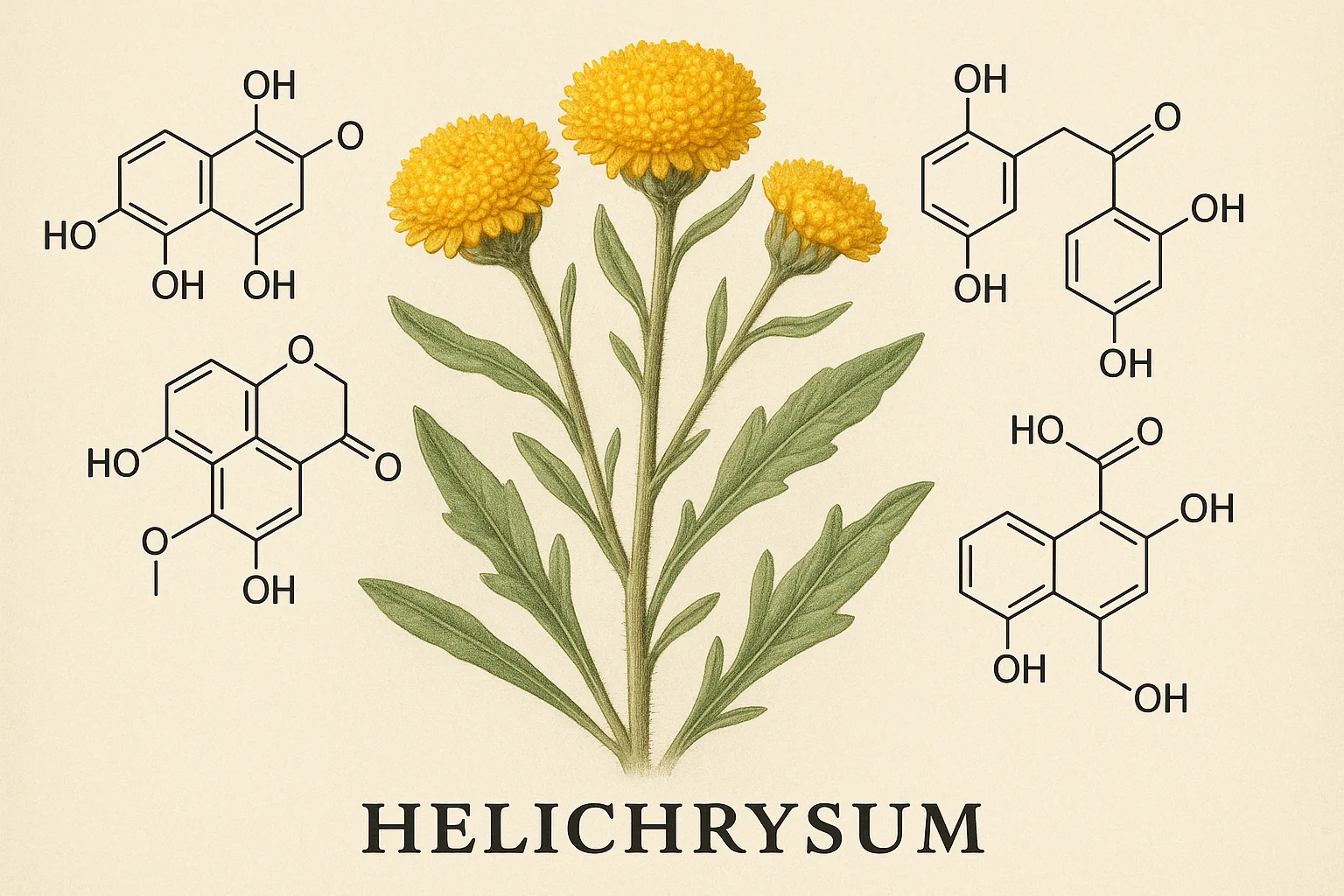
Helichrysum umbraculigerum - a plant that makes CBGA differently
Helichrysum umbraculigerum is a perennial plant from South Africa, known in traditional Zulu medicine as a psychoactive agent. In 1986, Bohlmann and Jakupovic first isolated cannabinoid compounds from it - amaronaldehyde and related monoterpeno-floglucinols. Analysis of a 2021 review in Frontiers in Pharmacology confirms that helichrysum produces CBGA, CBG, and CBT, although at concentrations significantly lower than cannabis.
The key difference lies in the biosynthetic pathway. In cannabis, OAC (olivetolyl CoA) reacts with GPP (geranyl diphosphate). In helichrysum, instead of olivetolic acid, the starting point is floroglucinic acid, which then undergoes methylation and condensation with isoprenyl units. The final result is a CBGA-like molecule with a slightly different substituent but retaining biological activity.
Our observations on cannabinoid metabolism in various plants indicate that helichrysum is a unique model for studying the evolution of the ECS system: since a plant that has never "talked" evolutionarily with cannabis independently developed CBGA synthesis, there must be strong selective pressure favoring the production of these molecules. They likely serve a protective function against pathogens or herbivores - the effect on the mammalian ECS is a "byproduct" of this defensive strategy.
What about pharmacological activity? Helichrysum extract in vitro showed inhibitory activity against MAO-B (monoamine oxidase B), which may explain its traditional use as a mood enhancer. The direct cannabinoid activity of CBGA from helichrysum - CB1/CB2 agonism - is weak and requires further research in vivo.
Beta-caryophyllene - a dietary cannabinoid from pepper and cloves
Beta-caryophyllene (BCP) is probably the most practical of all "non-cannabis" cannabinoids, as you consume it daily with food. Gertsch and colleagues in a groundbreaking study published in PNAS in 2008 demonstrated that BCP binds to the CB2 receptor with Ki ~155 nM and exhibits full agonistic activity - not partial, not modulatory, but full. This was the first documentation of cannabinoid activity in a dietary component.
CB2 agonism of BCP has clinical implications: CB2 is an immune receptor, primarily present on immune cells and in peripheral tissues, and not (unlike CB1) in the CNS. This means that BCP can act anti-inflammatorily without psychoactive effects. In vitro and rodent studies indicate neuroprotective, antioxidant, and analgesic effects (through the NF-κB and ERK pathways).
How much BCP is in the daily diet? Black pepper contains ~9-15% BCP in its essential oil. Cloves - up to 22%. Lavender, rosemary, cinnamon - a few percent. The suggested "therapeutic dose" from rodent studies is 5-10 mg/kg, which in a 70 kg human corresponds to 350-700 mg of pure BCP - more than a normal diet provides (estimates: 0.5-2 mg/day from food). However, with high doses of pepper oil supplements, it is possible to achieve real concentrations.
Radula marginata - liverwort with active CB1
Radula marginata is a type of liverwort (moss) growing in New Zealand, which contains perottetinen - a bibenzyl compound with structural similarity to THC. The study by Chicca et al. published in Science Advances in 2018 confirmed that perottetinen binds to CB1 with a Ki of ~2.2 µM and exhibits psychomimetic activity in rodent models. It is the only confirmed natural CB1 agonist outside the genus. Cannabis.
Perottetinen differs from THC in the type of ring: instead of a monoterpenoid carbocyclic system, it has a dibenzofuran system. Despite this difference, the three-dimensional shape makes it fit into the CB1 binding pocket - a demonstration of how convergent evolution can lead to similar pharmacological solutions.
Importantly - the psychoactive activity of perottetinen is significantly weaker than that of THC. In rodent studies, it induced tetrad effects (four classic indicators of CB1 intoxication) only at higher doses and with a shorter duration of effect. Is Radula marginata an "alternative" to cannabis? Absolutely not - lack of clinical safety, lack of standardization, lack of pharmacokinetic data in humans.
Alkamidy z echinacei - naturalni modulatorzy CB2 i FAAH
Echinacea purpurea and related species contain alkamides - fatty acid amides with unsaturated carbon chains, structurally similar to anandamide. Raduner and colleagues in the Journal of Biological Chemistry (2006) identified 12 alkamides from echinacea and demonstrated their CB2-agonistic activity (Ki in the range of 0.2-75 µM). Additionally, they inhibit FAAH - the enzyme that breaks down anandamide - which indirectly raises the level of endogenous cannabinoids.
This mechanism is similar to that of PEA (palmitoylethanolamide): instead of directly activating CB1/CB2 receptors, alkamides prolong the lifespan of anandamide. Clinically, the effect is modulation of the immune system - which explains the popularity of echinacea in upper respiratory infections. The meta-analysis by Karsch-Völk et al. in Cochrane Database (2015) confirms the moderate effectiveness of echinacea in shortening the duration of colds (by ~10-20%), although the cannabinoid mechanism was not directly studied there.
Do these "non-cannabis" cannabinoids have a therapeutic future?
The outlook is promising, but a realistic assessment requires distinguishing several levels of evidence. Beta-caryophyllene is the furthest along in this race - it has solid mechanistic studies, is widely available in diet and supplements, and its safety profile is excellent. The review by Gonçalves et al. in Frontiers in Pharmacology (2021) catalogs over 50 studies on rodents and several in vitro studies, showing activity in models of neuropathic pain, neuroprotection, and anxiety states.
Helichrysum remains primarily a tool for biochemical research - too little is known about the bioavailability of its CBGA to consider supplementation. Radula marginata is mainly of academic significance (and possibly forensic - it helps understand which compounds can cause false positive THC test results). Echinacea alkamides have some clinical applications, but more through the lens of immunology than cannabinoidology.
We noticed an interesting pattern in the literature: plants producing cannabinoid-like compounds disproportionately often belong to ecologically "stressed" niches - tropical forests, dry African plains, extreme microenvironments. This suggests that cannabinoid biosynthesis may be an evolutionary response to biotic and abiotic stress, and their action on the mammalian ECS is a secondary property, not a primary adaptive function.
Comparison of "non-cannabis" cannabinoids - table
| Compound | Plant | Receptor | Strength of evidence | Clinical status |
|---|---|---|---|---|
| Beta-caryophyllene | Pepper, cloves | CB2 (full agonist) | High (in vitro + animal) | Diets/supplements |
| CBGA from helichrysum | Helichrysum umbraculigerum | Weak CB1/CB2; MAO-B | Low (in vitro) | Exploratory studies |
| Perottetinen | Radula marginata | CB1 (agonist) | Moderate (animal) | Academic |
| Echinacea Alkamides | Echinacea purpurea | CB2 + FAAH inhibition | Moderate (in vitro + 1 RCT) | Immunological supplementation |
| Kiwi (amides) | Actinidia chinensis | Weak CB1 | Very low | Scientific curiosity |
Frequently Asked Questions
Does cacao contain cannabinoids?
Cacao contains N-acylethanolamines, including OEA and PEA, which inhibit FAAH and indirectly modulate CB2 activity. Direct CB1 activity has not been demonstrated. Study by di Tomaso et al. in Nature (1996) This phenomenon was described, but later analyses showed that the concentrations are too low to have a physiological effect after consuming chocolate.
Does black cumin (Nigella sativa) have cannabinoid activity?
Thymoquinone from black cumin exhibits weak CB2 agonism in vitro and inhibits enzymes that break down endocannabinoids. Review from Frontiers in Pharmacology (2022) suggests anti-inflammatory action through ECS pathways, but there is a lack of clinical studies directly confirming cannabinoid activity in vivo.
Can these plants complement the action of CBD from hemp?
Theoretically yes - beta-caryophyllene from pepper and echinacea alkamides act on CB2, while CBD modulates CB1 indirectly through FAAH. The receptor specificity profile is complementary. However, there are no clinical studies confirming the synergistic effect in humans, so this remains a pharmacological hypothesis for now.
How does beta-caryophyllene get into the brain?
CB2 is a peripheral receptor - in a healthy brain, its expression is low, so BCP mainly acts on the peripheral nervous system and immune tissues. In inflammatory CNS conditions (multiple sclerosis, stroke), CB2 expression in microglia increases, which may open a "therapeutic window" for BCP in neurology.
Can eating cloves "unlock" the ECS?
The amounts of BCP from a normal culinary dose of cloves (0.5-1 g) are 10-20 mg of essential oil, which yields 2-4 mg of BCP. This is too little for a noticeable physiological effect - therapeutic studies use doses of 5-100 mg of pure BCP. However, regular consumption of spicy foods may have a cumulative modulatory effect on CB2, although there is no direct data for this.
This article is for informational and educational purposes and does not replace consultation with a doctor. If you are pregnant, breastfeeding, taking medications, or have chronic conditions, consult the use of supplements or herbs with a specialist.
Author: Michał Waluk · Published: 2026-05-04 · Updated: 2026-05-04