
Endocannabinoids - PEA, OEA, and related compounds besides anandamide and 2-AG
Endokannabinoidom — mechanizm dzialania wyjasniony prosto, w oparciu o badania. u Bucha.
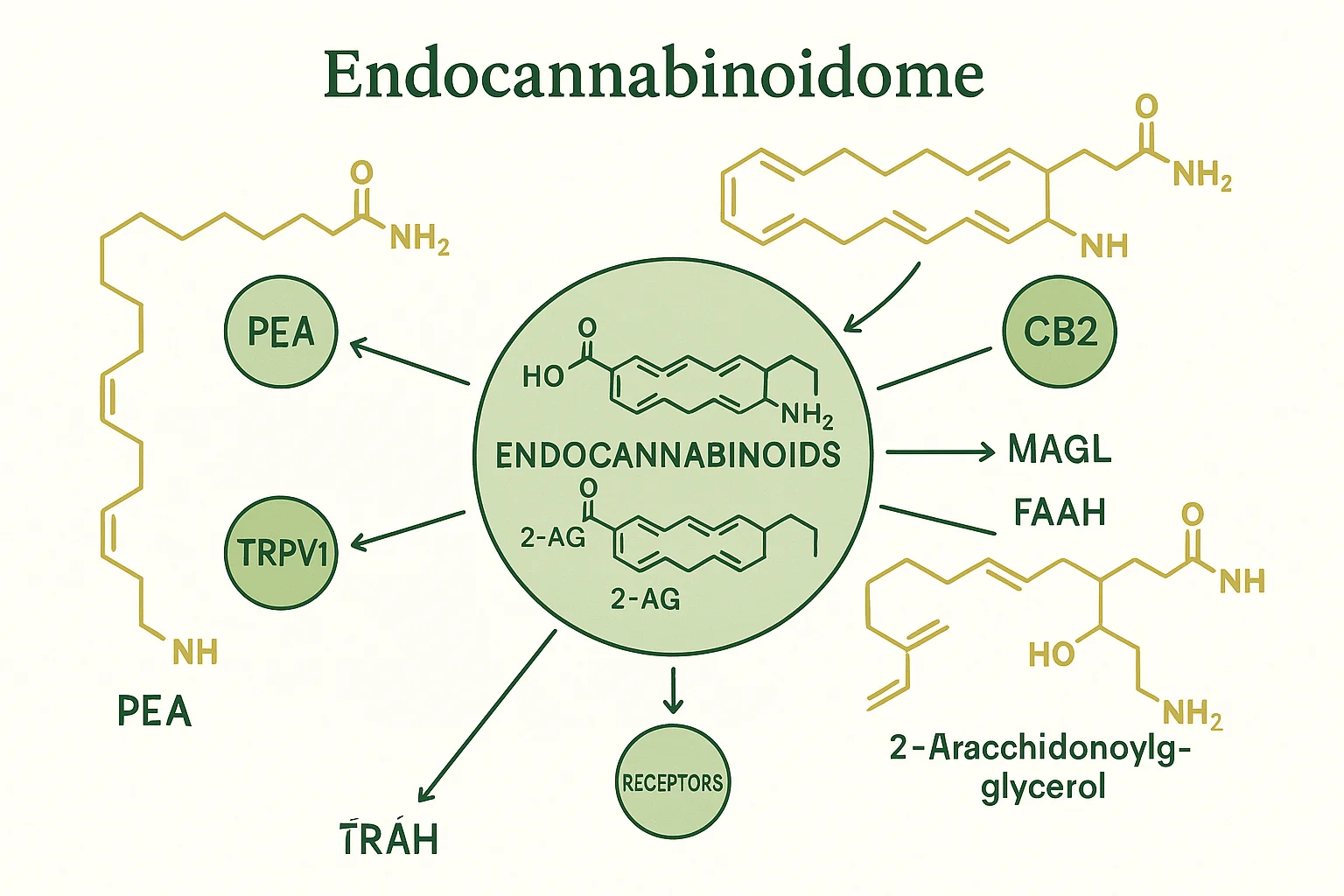
The endocannabinoid system is not just anandamide and 2-AG. Over the past two decades, scientists have discovered a whole family of related signaling lipids - N-acylethanolamines (NAE) - that act on nuclear receptors, orphan receptors, and together with classical endocannabinoids form a more extensive network termed by Raphael Mechoulam as the "endocannabinoidome". Mechoulam, the discoverer of THC and anandamide, proposed this term around 2012 to emphasize that the biological response to cannabinoid-like lipids is much broader than two receptors and two molecules (Russo, British Journal of Pharmacology, 2011). This article presents the most important "relatives" of anandamide: PEA, OEA, DHEA, and SEA - and explains how CBD affects this expanded network.
KEY INFORMATION
• Endocannabinoidome is an expanded network of signaling lipids including NAE (N-acylethanolamines), such as PEA, OEA, DHEA, SEA - beyond classical anandamide and 2-AG (Russo, British Journal of Pharmacology, 2011).
• PEA acts through the nuclear receptor PPAR-alpha and exhibits anti-inflammatory effects independent of CB1/CB2 - confirmed by clinical studies in neuropathic pain.
• OEA regulates satiety after a fatty meal through the GPR119 receptor and PPAR-alpha - it is an endogenous satiety signal from the intestines.
• CBD, by inhibiting FAAH and NAAA enzymes, indirectly raises the levels of PEA and OEA in tissues.
What are N-acylethanolamines (NAE) and where do they come from?
N-acylethanolamines (NAE) are a family of bioactive lipids composed of an ethanolamine group linked to a fatty acid of varying length and saturation. Anandamide (N-arachidonoylethanolamine) is the most well-known because it binds to CB1 and CB2 receptors. However, it coexists in tissues with several other NAE that do not have such affinity for CB1/CB2 but act through their own receptors.
NAE are synthesized from membrane phospholipids "on demand" - under the influence of cellular stress, inflammation, or neuronal activation. The enzyme calcium-sensitive N-acyltransferase (Ca-NAT) converts the N-acylated phospholipid to N-acyl-phosphatidylethanolamine (NAPE), which is then hydrolyzed by phospholipase D to free NAE. Synthesis is therefore a rapid response to stimuli - like anandamide, NAE are not stored but produced on the fly.
The breakdown of NAE is catalyzed by the same enzymes as anandamide: mainly FAAH (fatty acid amide hydrolase) and NAAA (N-acylethanolamine acid amidase, particularly for PEA). This is crucial: FAAH inhibitors developed as ECS modulators simultaneously raise the levels of PEA, OEA, and other NAE - not just anandamide.
PEA - palmitoiloetanoloamina: „endogenny ibuprofen”
PEA (palmitoylethanolamide, C16:0 NAE) is the most abundantly represented NAE in human tissues. Its concentrations in the brain, heart, and intestines exceed those of anandamide. PEA acts mainly through the nuclear receptor PPAR-alpha (similar to CBD through PPAR-gamma, though on a different isoform) and the GPR55 receptor. Activation of PPAR-alpha by PEA inhibits the NF-kB pathway and reduces the expression of inflammatory genes - this mechanism is similar to the action of corticosteroids, but without their side effects.
We have noticed that PEA is often described as "endogenous CBD" or "endogenous ibuprofen" in popular science articles - which is an oversimplification, but illustrates its clinical potential. Paladini and colleagues conducted a review of clinical studies on PEA in neuropathic pain (over 1000 patients in total) and demonstrated a reduction in pain intensity of 30-50% compared to placebo (Paladini et al., Pain Physician, 2016). This level of evidence is significantly higher than for many supplements - although still lower than for registered drugs.
PEA also exhibits "entourage" properties towards anandamide: it inhibits FAAH and competitively reduces the breakdown of anandamide, raising its levels. This is one of the mechanisms of the entourage effect in full-spectrum extracts - not only CBD and THC, but also endogenous NAE mutually modulate their levels through shared degradative enzymes.
| Compound | Fatty acid | Main receptor | Main action |
|---|---|---|---|
| Anandamide (AEA) | Arachidonic (C20:4) | CB1, CB2, TRPV1 | Psychoactivity, pain, mood |
| PEA | Palmitic (C16:0) | PPAR-alpha, GPR55 | Inflammation, neuropathic pain |
| OEA | Oleic (C18:1) | PPAR-alpha, GPR119 | Satiety, lipid metabolism |
| DHEA | Docosahexaenoic (C22:6) | CB1, CB2 (weakly) | Neuroprotection, antioxidation |
| SEA | Stearic (C18:0) | PPAR-alpha (weakly) | Modulation of CB1 activity |
OEA - oleoylethanolamide: a satiety signal from the intestines
OEA (oleoylethanolamide, C18:1 NAE) is primarily synthesized in enterocytes - the epithelial cells of the intestines - after consuming a meal rich in oleic acid (olive oil, avocado). OEA activates the PPAR-alpha receptor in enterocytes and the GPR119 receptor on L cells in the intestine. GPR119 stimulates the release of incretins (GLP-1, GIP) responsible for the feeling of fullness and insulin modulation.
Activation of PPAR-alpha by OEA in the intestines sends a signal through the vagus nerve to the nucleus of the solitary tract (NTS) in the brainstem, and from there to the hypothalamus - inhibiting the hunger center. This is an endogenous mechanism for suppressing appetite after a fatty meal. Fascinatingly, olive oil acts on this pathway precisely through OEA: oleic acid is a substrate for its synthesis.
OEA does not bind to CB1/CB2 receptors - it is an "endocannabinoid outside the cannabinoid system" in the strict sense. However, FAAH breaks down OEA as efficiently as anandamide. FAAH inhibitors (including CBD) raise OEA levels in the intestines and brain, which may explain the appetite-reducing effect observed by some CBD users at low doses.
How does CBD affect the endocannabinoid system?
CBD has several entry points into the endocannabinoid system. Firstly, FAAH inhibition: CBD inhibits this enzyme, slowing down the breakdown of anandamide, PEA, and OEA. This raises the levels of all three molecules. Secondly, CBD inhibits NAAA - an enzyme particularly important for the degradation of PEA (FAAH prefers anandamide, NAAA prefers PEA). Inhibition of NAAA by CBD may selectively raise PEA levels in inflammatory tissues.
Our observations suggest that the concept of the endocannabinoid system is groundbreaking for understanding why full-spectrum hemp extract may act differently than isolated CBD. A full-spectrum product contains not only CBD and trace cannabinoids but also fatty acids (omega-3, omega-6, oleic acid) that are precursors to endogenous NAE. Consumption of these acids may serve as a substrate for the production of PEA and OEA in the intestines and nerves - which expands the "dawn effect" to the level of endogenous lipid biochemistry.
Thirdly, CBD, by activating PPAR-alpha and PPAR-gamma, can mimic some of the actions of PEA and OEA at the receptor level - acting "in parallel" to endogenous NAE, rather than solely by raising their levels. This means that CBD is active even when levels of endogenous NAE are reduced by stress or illness.
DHEA and SEA - lesser-known members of the NAE family.
Beyond PEA and OEA, the NAE family also includes DHEA (docosahexaenoil ethanolamide, C22:6 NAE) and SEA (stearoylethanolamide, C18:0 NAE), whose biology is less studied but increasingly interesting. DHEA is a derivative of DHA (omega-3) and shows weak affinity for CB1 and CB2 receptors - higher than other NAE besides anandamide. It also acts through the GPR110 receptor and exhibits neuroprotective effects in cell models, potentially important in the context of omega-3 supplementation in neurodegeneration.
SEA (C18:0) is a structurally simple NAE with saturated stearic acid. For many years, it was considered an inactive metabolite. However, newer studies suggest that SEA may modulate CB1 activity in an allosteric manner - changing its conformation and reducing anandamide's affinity for this receptor. If true, SEA would act as an endogenous "brake" on the endocannabinoid system - a natural limitation on AEA activity through CB1, preventing excessive stimulation. This is a fascinating regulatory hypothesis within the endocannabinoid system itself.
SEA concentrations in tissues are generally higher than those of anandamide - making this allosteric regulation potentially physiologically significant. However, data remains fragmentary and mainly comes from in vitro studies. A complete picture of SEA's role in regulating endocannabinoid tone in humans awaits systematic investigation.
Endocannabinoid system as a target for a new generation of cannabinoid drugs
The classical pharmacological approach focused on directly modulating CB1 and CB2. The endocannabinoid system opens new targets: NAAA inhibitors (for selectively raising PEA), GPR119 agonists (for modulating GLP-1 and satiety through OEA), PPAR-alpha modulators (through PEA), and PPAR-gamma (through CBD). Each of these targets can provide therapeutic effects without engaging CB1 - eliminating the risk of psychoactivity and tolerance through CB1 internalization.
NAAA inhibitors (the enzyme that degrades PEA) are actively being researched as pain-relieving and anti-inflammatory drugs. Compounds like ARN077 have shown anti-inflammatory effects in animal models comparable to ibuprofen, without gastrointestinal side effects. The mechanism: selective elevation of endogenous PEA by blocking its degradation. This is a pharmacologically elegant approach - instead of administering exogenous PEA (like supplements), it inhibits its breakdown and enhances natural signaling.
The perspective of the entire endocannabinoid system also changes the approach to cannabinoid supplementation. Full-spectrum hemp extract provides not only CBD and trace cannabinoids but also fatty acids - substrates for the synthesis of endogenous NAE. A diet rich in omega-3 and olive oil supports the production of DHEA and OEA. CBD inhibits FAAH and NAAA. This is a three-tiered system: diet provides substrates, CBD inhibits degradation, endogenous NAE exert effects through their own receptors. The endocannabinoid system allows us to see this complexity as a coherent whole.
Frequently Asked Questions
What is the endocannabinoid system?
The endocannabinoid system is an expanded signaling network of bioactive lipids that includes not only anandamide and 2-AG but also the entire family of N-acylethanolamines (PEA, OEA, DHEA, SEA), nuclear receptors (PPAR-alpha, PPAR-gamma), and orphan receptors (GPR55, GPR119, GPR18). The term was introduced by Raphael Mechoulam, the discoverer of THC and anandamide, highlighting the breadth of endogenous cannabinoid-like biochemistry (Russo, British Journal of Pharmacology, 2011).
How does PEA (palmitoylethanolamide) work?
PEA primarily acts through the nuclear receptor PPAR-alpha and the GPR55 receptor. It exhibits anti-inflammatory and analgesic effects independent of CB1/CB2 receptors. Clinical studies on PEA in neuropathic pain have shown a pain reduction of 30-50% compared to placebo in over 1000 patients (Paladini et al., Pain Physician, 2016).
What is the role of OEA in regulating appetite?
OEA is synthesized in enterocytes after fat consumption and activates the PPAR-alpha and GPR119 receptors. GPR119 stimulates the release of GLP-1 and sends satiety signals through the vagus nerve to the hypothalamus. This is an endogenous mechanism for suppressing hunger after a meal rich in oleic acid - among others, after consuming olive oil.
Does CBD affect the levels of PEA and OEA?
Yes, indirectly. CBD inhibits the enzymes FAAH and NAAA, which break down both anandamide and NAE such as PEA and OEA. By inhibiting these enzymes, CBD raises the levels of PEA and OEA in tissues - which is one of the mechanisms of its anti-inflammatory action and appetite modulation independent of direct activation of CB1/CB2.
What distinguishes the endocannabinoid system from the classical ECS?
The classical ECS consists of anandamide + 2-AG + CB1/CB2 receptors + FAAH/MAGL enzymes. The endocannabinoid system expands this picture to include the entire family of NAE, nuclear receptors (PPAR-alpha/gamma), and orphan receptors (GPR55, GPR119). It is a signaling network of bioactive lipids that is significantly broader and encompasses metabolism, inflammation, satiety, and neuroprotection - not just mood and pain modulation.
This article is for informational and educational purposes and does not replace consultation with a doctor. If you are pregnant, breastfeeding, taking medications, or have chronic conditions, consult the use of supplements or herbs with a specialist.
Author: Michał Waluk · Published: 2026-05-04 · Updated: 2026-05-04