
Microdosing vs. placebo - what controlled studies really say
Mikrodawkowanie a placebo: rzetelne odpowiedzi oparte na badaniach. Edukacja u Bucha.
Microdosing psychedelics has gained enormous popularity in technology and wellness communities in recent years. Hundreds of thousands of people worldwide regularly take fractional doses of psilocybin or LSD, claiming that it improves concentration, mood, and creativity. It sounds convincing - but what does controlled science say about it? The answer is less clear-cut than the media and online forums suggest. In this article, we analyze available studies with control groups, explain the issues of unblinding and the placebo effect, and answer the questions that actually matter: does microdosing work beyond the expectancy effect?
KEY INFORMATION
• The largest controlled microdosing study (Szigeti et al., eLife, 2021, n=191) showed effects comparable to placebo - both groups improved evenly (Szigeti et al., eLife, 2021).
• The unblinding problem: participants recognize the active substance from subtle sensations - which 'unblinds' the studies and inflates the results.
• Some studies have shown a paradoxical increase in neuroticism and anxiety with microdoses of psilocybin.
• Ongoing RCTs (Imperial College, Maastricht) are expected to resolve the issue of effectiveness within 2-3 years.
What is microdosing and where did it come from?
The term microdosing was popularized by James Fadiman, a psychologist from San Francisco, who in 2011 described informal protocols for taking sub-threshold doses of LSD by employees in Silicon Valley. Fadiman collected hundreds of self-reports from volunteers - but without control groups, blinding, or randomization. This is a key limitation of his data, often overlooked in popular media.
A typical microdosing protocol: 0.1-0.3 g of psilocybin dried material (or 1-3 mg of pure psilocybin) or 5-15 µg of LSD, taken every third day (one day 'on', two days 'off'), for 4-8 weeks. The doses are sub-threshold - they do not produce full psychedelic effects, do not disrupt perception or the ability to work. Communities report improvements in mood, energy, creativity, and concentration.
The problem is that anecdotal reports and studies based on self-assessment questionnaires are susceptible to the placebo effect and expectancy effect. Individuals actively seeking microdosing and purchasing it themselves have strong positive expectations - which in itself may trigger the observed improvement, regardless of the substance.
The Szigeti study and the 'self-blinding' problem - what did it really show?
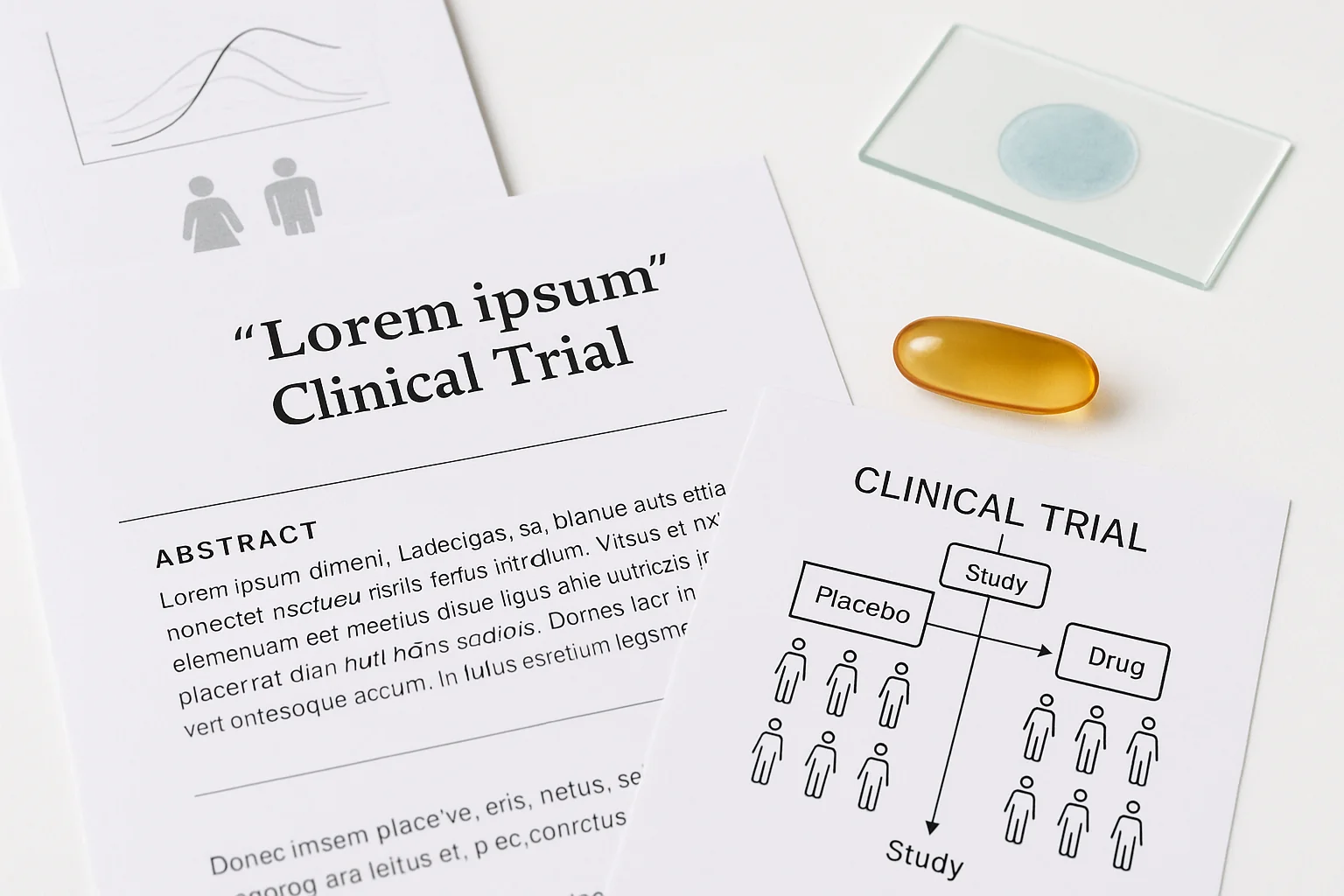
The most important and best-designed study in this field remains the work of Szigeti and colleagues published in eLife (2021), conducted on 191 participants using their own microdoses (Szigeti et al., eLife, 2021). The study employed a self-blinding methodology: participants coded their own capsules (active substance vs. placebo) and did not know in which order they were taking them.
The results were surprising for microdosing enthusiasts. Both groups - those taking the active substance and those taking placebo - showed improvement in measures of mood, energy, and mindfulness. The difference between the groups was minimal and statistically insignificant for most measured variables. The only significant difference: the active substance group reported paradoxically more episodes of anxiety and neuroticism. This is not confirmation of effectiveness - it is confirmation of the strength of the placebo effect in this practice.
| Study | Design | Outcome | Limitations |
|---|---|---|---|
| Szigeti et al., eLife 2021 (n=191) | Self-blinding RCT | No advantage over placebo; increased neuroticism in the active group | Participant coded the capsules themselves; unblinding possible |
| Anderson et al., Psychopharmacology 2019 (n=278) | Observational (no placebo group) | Improvement in mood and concentration; increased neuroticism in some | No control group; strong expectation effect |
| Szigeti et al., Neuropsychopharmacology 2023 | Additional data analysis eLife | The effect of unblinding correlates with mood improvement more strongly than the substance | Secondary analysis, not primary RCT |
| Polito & Stevenson, PLOS ONE 2019 (n=98) | Prospective observational | Improved concentration, reduced depression; variable impact on mindfulness | No blind trial; self-selection bias |
Why is unblinding such a big problem in microdosing research?
The classic double-blind protocol assumes that neither the participant nor the researcher knows who is receiving the active substance. In microdosing studies, we encounter a specific problem: even with sub-threshold doses, some participants experience subtle physiological signals - slight tingling, changes in the perception of time, altered body sensations - which allow them to identify the 'active' capsule with high accuracy.
The Szigeti study showed that participants who accurately guessed whether they had taken the active substance or a placebo ("unblinded") reported greater mood improvement—regardless of what they actually took. In other words, it was the belief in having taken the active substance, not the substance itself, that predicted improvement. This is a classic expectation effect and a significant methodological challenge for this entire line of research (Szigeti et al., eLife, 2021).
We have noticed that the issue of unblinding is not unique to psychedelic research—it also appears in studies on caffeine, cannabidiol, and other biologically active substances. However, in the case of psychedelic microdosing, the expectation effect is particularly strong due to the cultural context: microdosing is surrounded by a narrative of "transformation," creating a particularly fertile ground for the placebo effect.
What do ongoing studies say and what results can we expect?
The current state of knowledge is definitely insufficient for formulating clinical recommendations. However, the first truly rigorously designed RCTs are underway. Imperial College London is conducting a study on psilocybin microdoses in patients with ADHD—with random randomization, an active control group, and blinded outcome assessment. Maastricht University is investigating the effects of LSD in microdoses on concentration and mood in laboratory conditions, where unblinding is strictly monitored.
The results of these studies are expected between 2026 and 2028. Only then will they be able to determine whether the effects of microdosing go beyond the placebo effect in populations with specific diagnoses. Until then, the honest answer to the question "does microdosing work?" is: we don’t know—observational data is positive, but the only controlled study shows a strong placebo effect without a significant advantage of the active substance.
From our editorial observations, it appears that discussions about microdosing in Polish internet forums rarely refer to current scientific data, and very often to anecdotes and self-reported community experiences. This creates a risk of confusing correlation (I feel better after a microdose) with causation (the microdose caused the improvement). In medicine, this difference is fundamental—and that is precisely why studies are conducted with a control group.
Frequently Asked Questions
What is psychedelic microdosing?
Microdosing involves taking very small amounts of a psychedelic substance—5-10% of the dose that produces full effects—every 2-4 days, without causing perceptual changes. A typical microdose of psilocybin is 0.1-0.3 g of dried material or 1-3 mg of pure substance. Practitioners report improvements in mood, concentration, and creativity, although controlled studies do not unequivocally confirm these effects.
Do controlled studies confirm the effectiveness of microdosing?
The evidence is mixed. The largest controlled study (Szigeti et al., eLife, 2021, n=191) found that the improvement reported by participants was comparable to the placebo effect. Observational studies report benefits but suffer from a lack of blind trials and a strong expectation effect. Ongoing RCTs (Imperial College, Maastricht) are expected to provide stronger data (Szigeti et al., eLife, 2021).
Why is it so difficult to study microdosing using a double-blind method?
Even sub-threshold doses can cause subtle sensations that the participant recognizes as the active substance—"unblinding" the study. The Szigeti study found that participants who accurately guessed the type of capsule reported greater improvement—regardless of what they actually took. This indicates the expectation effect as a major factor (Szigeti et al., eLife, 2021).
What is the placebo effect in the context of microdosing?
The placebo effect in microdosing is strong because expectations regarding this practice are very positive. When researchers measure mood improvement, it is difficult to separate pharmacology from expectations. The Szigeti study showed that mere knowledge of having taken a microdose—even with a placebo—improved participants' well-being to a degree comparable to the active substance.
Does microdosing have proven negative effects?
Yes—some controlled studies have shown that psilocybin microdosing can paradoxically increase neuroticism and anxiety (Anderson et al., Psychopharmacology, 2019). Regular use of controlled substances is also associated with the risk of tolerance and interactions. The lack of long-term safety data is a significant gap in the literature.
What studies on microdosing are currently being conducted?
In 2025-2026, RCTs are being conducted: Imperial College London (psilocybin microdose vs placebo in individuals with ADHD) and Maastricht University (LSD microdose, concentration, and mood). The results have the potential to resolve the debate about effectiveness beyond the placebo effect. Until their publication, the current state of knowledge does not allow for clinical recommendations.
What are the legal and practical consequences of microdosing in Poland?
Psilocybin and LSD—the substances most commonly used in microdosing—are controlled substances in Poland listed on Schedule I-N of the Act on Counteracting Drug Addiction (Journal of Laws of 2023). Their possession, even in small amounts, is illegal and may result in criminal liability. This legal reality is often overlooked in popular discussions about microdosing, which have focused on effects and protocols rather than the legal risks for the user.
The lack of legality also has practical consequences for safety: substances available on the illegal market do not undergo purity and concentration testing. Drug-checking studies show that samples sold as psilocybin or LSD contain other substances or have extremely variable active ingredient content—making precise dosing impossible and creating unpredictable risks. This is a fundamental difference compared to clinical protocols, where pharmaceutical-grade substances with certified purity and content are used.
Is there a legal alternative to microdosing? In Poland, in 2026, the only legal option with a mechanism similar to cognitive effects (though through entirely different pathways) are adaptogens and nootropics—such as ashwagandha, lion’s mane (Hericium erinaceus), or rhodiola. They do not replace psychedelic effects but are legally available, clinically studied, and safe when used appropriately.
This article is for informational and educational purposes and does not replace consultation with a doctor. If you are pregnant, breastfeeding, taking medications, or have chronic conditions, consult the use of supplements or herbs with a specialist.
Author: Michał Waluk · Published: 2026-05-04 · Updated: 2026-05-04