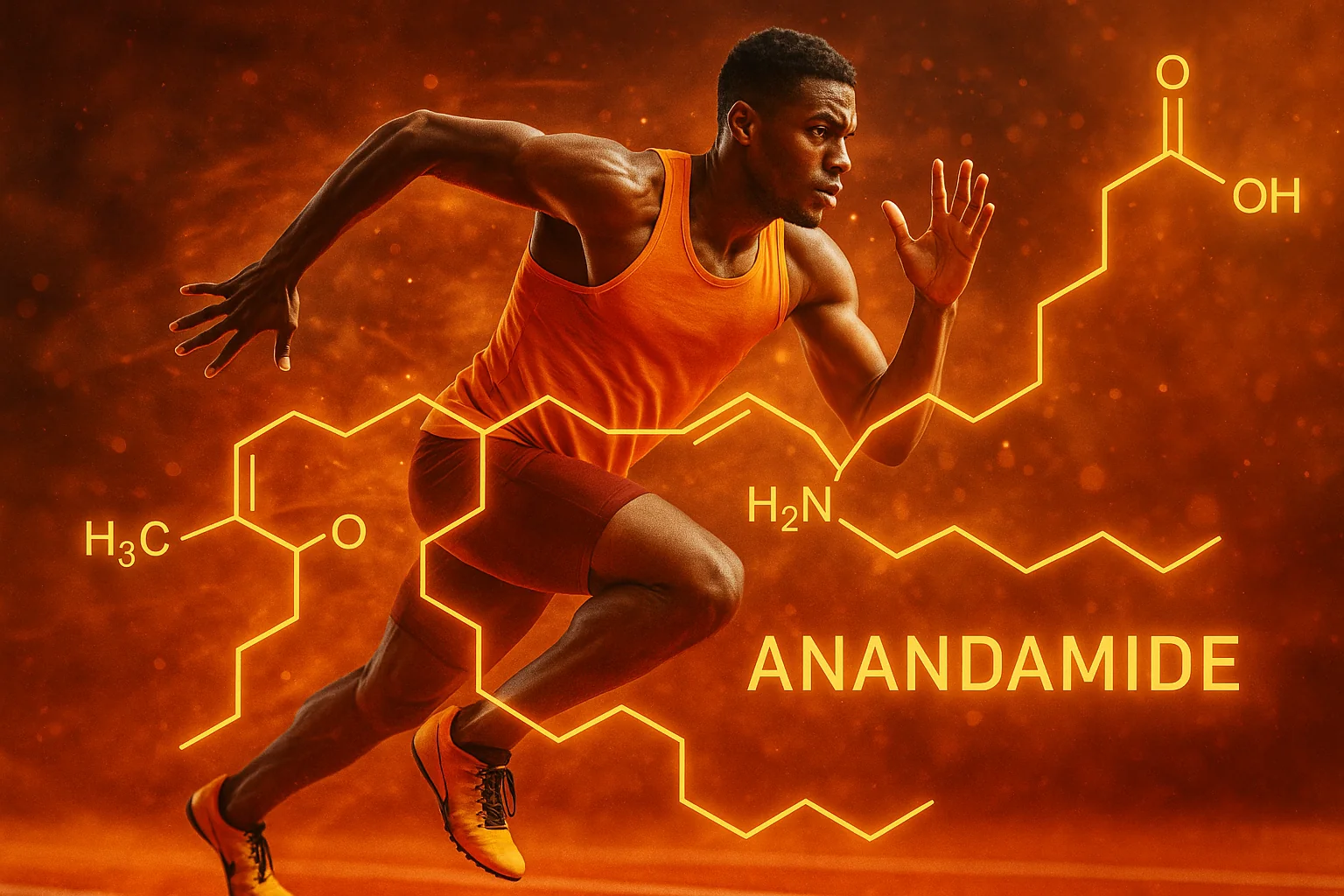

The endocannabinoid system adapts to exercise - anandamide, PEA, and oleamide
The endocannabinoid system adapts to exercise — the mechanism explained simply, based on research. u Bucha.
For decades, "runner's high" was attributed solely to endorphins. In 2015, a study by Fuss and colleagues debunked this myth: blocking CB1 receptors (not opioid receptors) in mice eliminated the euphoric effect after exercise, indicating the endocannabinoid system as the main mediator of this phenomenon (Fuss et al., PNAS, 2015). Since then, research on ECS and physical exertion has been rapidly evolving. It turns out that anandamide, PEA, and oleamide — three structurally related molecules — play complementary roles in the body's adaptation to training, recovery, and post-exercise sleep. This article explains these mechanisms step by step.
KEY INFORMATION
• Blocking CB1 receptors, not opioid receptors, eliminates runner's high in mice (Fuss et al., PNAS, 2015).
• 30-60 minutes of aerobic exercise raises blood levels of anandamide 2-3 times (Heyman et al., 2012).
• PEA and oleamide are "relatives" of anandamide - produced during exercise and involved in recovery.
• The ECS regulates both exercise-induced pain and the transition to restorative sleep after physical exhaustion.
• CBD inhibits FAAH - the enzyme that breaks down anandamide - which may prolong its effects after training.
Anandamide and exercise - what do studies say?
Anandamide (AEA, N-arachidonoylethanolamide) is the best-known endocannabinoid. Produced "on demand" in neurons and peripheral tissues, it acts briefly - it is quickly broken down by the FAAH enzyme. The study by Heyman and colleagues in 2012 was one of the first to precisely measure the kinetics of anandamide during exercise in humans.
In the study, 11 trained runners performed a 30-minute run on a treadmill at an intensity of 70-80% VO2max. Blood levels of anandamide increased 2-3 times compared to resting levels after just 20 minutes of running and remained elevated for 15-30 minutes after the exercise. Importantly, low-intensity exercise (walking) and maximal effort (sprinting) yielded a significantly weaker anandamide response. The aerobic zone - about 65-75% VO2max - proved optimal for anandamide release (Heyman et al., Psychoneuroendocrinology, 2012).
The mechanism of this release is multifaceted: an increase in body temperature stimulates the synthesis of anandamide by membrane phospholipases; activation of TRPV1 receptors by heat and metabolic acidosis triggers retrograde release of anandamide; mechanical stress on muscles activates local synthesis of AEA in muscle tissue.
Dlaczego anandamid, nie endorfiny, jest mediatorem runner’s high?
The endorphin hypothesis was unquestioned for years. Endorphins - opioid peptides produced by the brain - increase during exertion and bind to opioid receptors, which could explain the euphoria. The problem: endorphins do not cross the blood-brain barrier. They are too large and hydrophilic to penetrate the central nervous system from the blood - which makes their role in central euphoria always speculative.
Anandamide does not have this limitation. It is lipophilic and easily crosses the blood-brain barrier, reaching CB1 receptors in the reward system, prefrontal cortex, and cerebellum. Fuss and colleagues confirmed in 2015 that administering a CB1 antagonist (receptor blocker) to mice - but not an opioid antagonist - eliminated the euphoric effects of exertion. This is mechanistic evidence that anandamide acting through CB1 - not endorphins through opioid receptors - is responsible for runner's high (Fuss et al., PNAS, 2015).
Citation capsule (Fuss et al., PNAS, 2015): Mice lacking CB1 receptors did not exhibit typical behaviors indicating euphoria after exertion (reduced anxiety, analgesia), even though endorphin levels were normal. The authors state that "the endocannabinoid system, not the opioid system, is responsible for the acute euphoric effect of aerobic exercise" (Fuss et al., PNAS, 2015).
PEA and oleamide - "siblings" of anandamide in the context of sports
PEA (palmitoylethanolamide) and oleamide are fatty acid amides - molecules structurally related to anandamide, although acting through different receptors. PEA mainly acts through the PPAR-alpha receptor and GPR55 and GPR119 receptors, not through CB1. It does not cause euphoria but exhibits strong anti-inflammatory and analgesic effects. In the context of physical exertion, PEA is released by macrophages and mast cells in tissues affected by micro-injuries - serving as a local modulator of the inflammatory state (Lo Verme et al., Journal of Pharmacology and Experimental Therapeutics, 2005).
Oleamide (cis-9,10-octadecenamide) has a completely different functional niche. Discovered in 1995 by Cravatta and colleagues, oleamide accumulates in the blood and cerebrospinal fluid during sleep deprivation and physical exhaustion. It acts on GABA-A receptors and serotonin 5-HT2 receptors, promoting the transition to slow-wave sleep (N3) - the most restorative phase of sleep (Cravatt et al., Science, 1995). After intense training, when the body needs recovery, oleamide serves as a "signal for sleep."
Three molecules - anandamide, PEA, and oleamide - together form an adaptive system: anandamide manages euphoria and analgesia during exertion, PEA suppresses inflammation after micro-injuries, and oleamide initiates restorative sleep. This is an elegant biological system that remained undiscovered for many years precisely because the focus was solely on anandamide.
ECS and training adaptation - why do regular exercises change the endocannabinoid system?
The ECS not only responds to exertion - it adapts to regular training. Studies on trained athletes have shown that they have higher baseline levels of anandamide and 2-AG at rest than inactive individuals. This means that regular exercise 'sensitizes' the system to endocannabinoid signals and increases the availability of these molecules even outside of training.
The review by Silvestri and Di Marzo from 2013, published in Cell Metabolism, argues that the ECS is a central regulator of energy balance - and that its activation through exertion may explain some of the long-term effects of exercise: improved mood, better sleep, reduced appetite for highly processed food, and overall improved stress tolerance (Silvestri & Di Marzo, Cell Metabolism, 2013).
We have noticed that athletes asking about CBD after training often imagine its effect as 'an extra boost of anandamide'. This is not an accurate metaphor. CBD does not provide anandamide - it inhibits its breakdown by inhibiting FAAH. It's more like a 'prolongation of the action' of endogenous anandamide rather than its replacement. The difference is subtle but important: it means that CBD without prior exertion generating anandamide has less potential for post-exercise effects.
How does lack of physical activity affect the ECS?
If exertion strengthens the ECS, a logical question is: what does a sedentary lifestyle do? Epidemiological studies indicate that physically inactive individuals have lower baseline levels of anandamide and higher FAAH activity - the enzyme that breaks down anandamide. This means that endocannabinoids are degraded more quickly and have a shorter duration of action. The authors of the 2013 review by Silvestri and Di Marzo referred to this trend as 'endocannabinoid deficiency' as a potential mediating mechanism between a sedentary lifestyle and a higher risk of depression, anxiety disorders, and chronic pain (Silvestri & Di Marzo, Cell Metabolism, 2013).
The clinical endocannabinoid deficiency hypothesis, developed by Ethan Russo in 2004 and updated in 2016, posits that chronic conditions such as fibromyalgia, migraine, and irritable bowel syndrome may be partially related to chronic endocannabinoid signaling deficiency. Regular physical activity, by raising levels of anandamide and 2-AG, would in this model not only improve fitness but correct a physiological deficit.
For CBD users, this perspective has specific implications: CBD used as a supplement to regular physical exertion works in an environment rich in endocannabinoids and may synergistically prolong their action by inhibiting FAAH. CBD without physical exertion - in an environment poor in anandamide - has a weaker starting point. This is not an argument against CBD for inactive individuals, but an argument for combining supplementation with regular aerobic movement.
It is also worth remembering that physical exertion itself increases the sensitivity of CB1 receptors in brain areas associated with mood and reward. Therefore, after a few weeks of regular exercise, the same dose of CBD may have a more pronounced effect than at the beginning - not because CBD 'works better', but because the ECS is in better condition.
Frequently Asked Questions
Co to jest runner’s high i jaka jest rola ECS?
Runner's high is a state of euphoria and reduced pain perception during prolonged exertion. A study by Fuss and colleagues showed that blocking CB1 receptors - not opioid receptors - eliminated this effect in mice. Anandamide is now recognized as the main mediator of runner's high (Fuss et al., PNAS, 2015).
How does physical effort affect anandamide levels?
Moderate-intensity aerobic exercise (65-75% VO2max) for 30-60 minutes increases blood levels of anandamide 2-3 times compared to resting levels. The effect appears after about 20-30 minutes and lasts for 15-30 minutes after exercise (Heyman et al., Psychoneuroendocrinology, 2012).
What are PEA and oleamide in the context of exercise?
PEA increases during exercise and acts anti-inflammatory through the PPAR-alpha receptor in tissues with micro-injuries. Oleamide accumulates during physical exhaustion and regulates the transition to restorative sleep through GABA-A receptors. Both complement the role of anandamide in adapting to exercise (Cravatt et al., Science, 1995).
Can CBD enhance the effects of endocannabinoids after training?
Theoretically yes - CBD inhibits FAAH, the enzyme that breaks down anandamide, which may prolong its effects after exertion. However, there are few direct clinical studies in this context. Using CBD after training is safe, but its impact on specific recovery parameters requires further clinical research.
What types of exercise most activate the ECS?
Moderate-intensity aerobic exercise (running, cycling, swimming at 65-75% VO2max) most strongly raises anandamide levels. Anaerobic exertion activates 2-AG more. Too low intensity (walking) and too high (maximum sprint) yield a weaker endocannabinoid response (Heyman et al., Psychoneuroendocrinology, 2012).
This article is for informational and educational purposes and does not replace consultation with a doctor. If you are pregnant, breastfeeding, taking medications, or have chronic conditions, consult the use of supplements or herbs with a specialist.
Author: Michał Waluk · Published: 2026-05-04 · Updated: 2026-05-04