
CBD as an antipsychotic compound - raising anandamide instead of blocking dopamine
CBD as an antipsychotic compound — mechanism explained simply, based on studies. u Bucha.
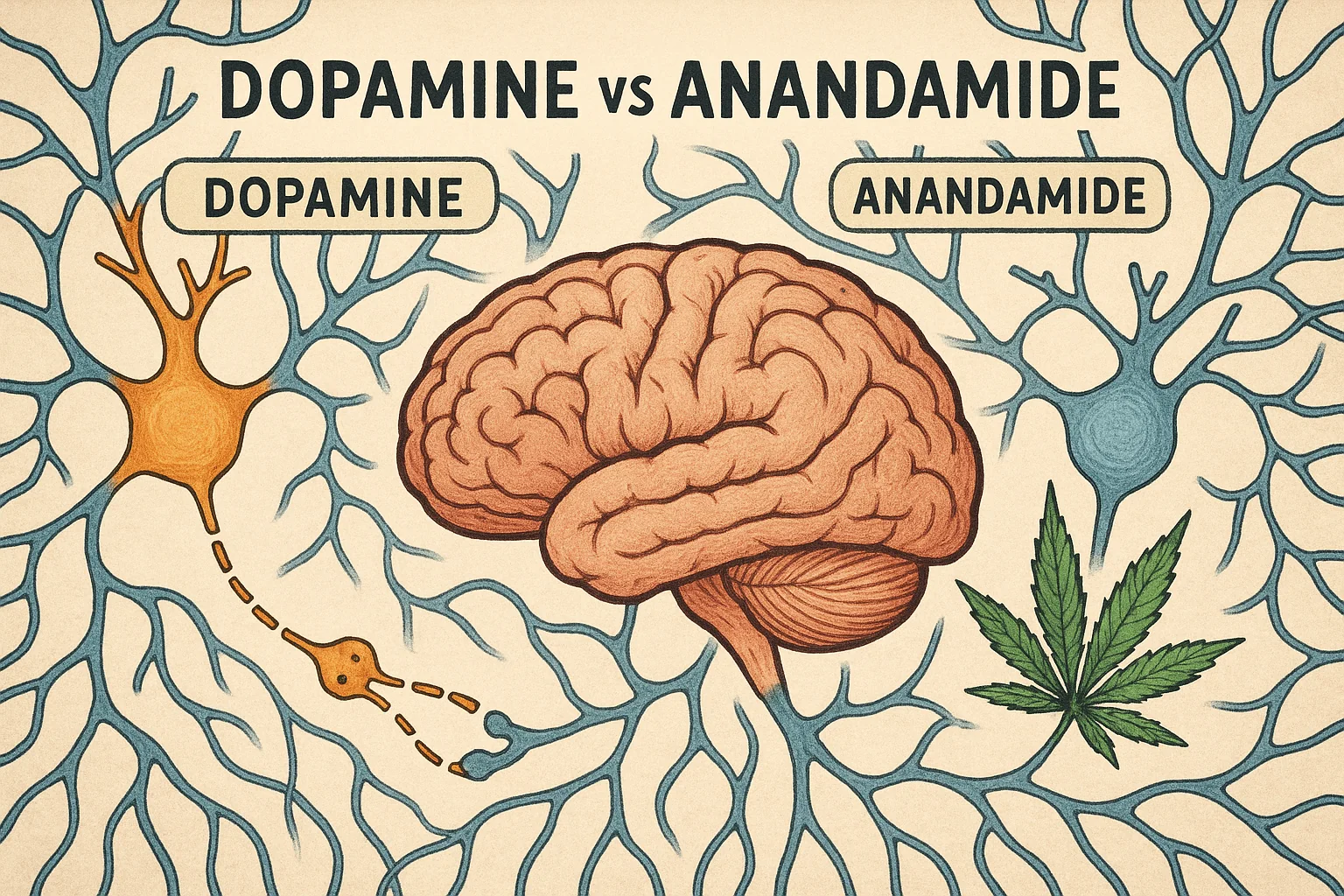
Classic antipsychotic medications block D2 dopamine receptors - effectively suppressing hallucinations, but at the cost of serious side effects: tardive dyskinesia, weight gain, metabolic disorders. CBD proposes a different mechanism: instead of blocking dopamine, it raises endogenous anandamide levels by inhibiting the FAAH enzyme. A clinical study by Leweke et al. from 2012 showed that CBD administered to patients with schizophrenia raised anandamide levels in cerebrospinal fluid and reduced psychotic symptoms comparably to amisulpride - with a significantly better tolerance profile (Translational Psychiatry, 2012). How does it work and what do subsequent studies say?
KEY INFORMATION
• CBD exhibits antipsychotic effects by raising anandamide (inhibiting FAAH) - not by blocking D2 dopamine receptors like classic medications (Leweke et al., TP, 2012).
• In the RCT, Leweke CBD was comparable to amisulpride in reducing psychotic symptoms with a better tolerance profile.
• Anandamide in CSF is reduced in individuals with acute psychosis - CBD corrects this deficit.
• The study by McGuire et al. (AJP, 2018) confirmed the efficacy of CBD as an adjunctive therapy in schizophrenia in an RCT with 88 patients.
• CBD is not an approved psychiatric medication and does not replace pharmacotherapy prescribed by a psychiatrist.
How do classic antipsychotic medications work and why are they problematic?
The neurobiological basis of schizophrenia is the hyperactivity of the mesolimbic dopaminergic pathway - "too much dopamine" in the nucleus accumbens generates positive symptoms (hallucinations, delusions). First-generation medications (haloperidol, chlorpromazine) and atypical ones (risperidone, olanzapine) block the D2 receptor, reducing this hyperactivity. Efficacy in positive symptoms has been confirmed by decades of research (Leucht et al., Lancet, 2013).
The problem is that D2 blockade is not selective for the mesolimbic pathway. The D2 receptor is also in the nigrostriatal pathway (where blockade causes tardive dyskinesia and drug-induced parkinsonism) and the mesocortical pathway (where it may exacerbate negative symptoms of schizophrenia - social withdrawal, anhedonia). Atypical medications reduce but do not eliminate these problems. Dropout due to side effects is a major cause of relapses in schizophrenia.
The anandamide hypothesis of schizophrenia - what do the data say?
Leweke et al. in a groundbreaking study from 2012 measured anandamide (AEA) levels in cerebrospinal fluid (CSF) in three groups: healthy controls, untreated patients with acute schizophrenia, and patients treated with typical antipsychotic medications. The results were clear: untreated patients with recent psychosis had significantly lower AEA levels in CSF than healthy individuals. Moreover, the lower the anandamide level, the stronger the psychotic symptoms on the PANSS scale (Leweke et al., Translational Psychiatry, 2012).
This led to the hypothesis: anandamide may act as an endogenous protective factor against psychosis - a kind of "buffer" modulating dopaminergic activity. When AEA levels are low (due to FAAH hyperactivity), the inhibition of excessive dopamine is weakened, which promotes psychosis. CBD - by inhibiting FAAH - corrects this endogenous deficit.
| Mechanism | Classic antipsychotic medications | CBD |
|---|---|---|
| Target receptor | Dopamine D2 (blockade) | FAAH (inhibition) → increase in anandamide |
| Impact on positive symptoms | Strong | Moderate (confirmed by RCT) |
| Impact on negative symptoms | Weak or worsening | Promising (McGuire et al., 2018) |
| Late dyskinesias | High risk | No reports |
| Impact on weight/metabolism | Often negative (olanzapine) | Neutral or positive |
| Registration status | Approved medications | No psychiatric approval |
Badanie Leweke 2012 - CBD vs amisulpryd
The key study by Leweke et al. had an active control design: 42 patients with schizophrenia were randomly assigned to CBD (150-600 mg/day for 4 weeks) or amisulpride (200-800 mg/day). Both arms showed similar reductions in symptoms on the PANSS (Positive and Negative Syndrome Scale) after 4 weeks of treatment. However, CBD performed better in terms of tolerance profile: fewer extrapyramidal side effects, less weight gain, and lower prolactin levels in the blood (Leweke et al., TP, 2012).
Importantly: patients receiving CBD had higher anandamide levels in CSF after 4 weeks than before treatment, and this increase negatively correlated with the severity of psychotic symptoms. This is direct evidence that the FAAH-anandamide mechanism is not just a hypothesis - it is measurably activated by CBD in vivo in humans.
McGuire Study 2018 - CBD as an adjunct therapy
Another important step was the study by McGuire et al. published in American Journal of Psychiatry (2018). This time, CBD (150-300 mg twice daily) was added to existing antipsychotic treatment in 88 patients with schizophrenia - instead of replacing medications, it was checked whether CBD works additively. Result: the CBD group showed greater reduction in positive and general symptoms, a higher percentage of patients with "minimal symptom severity" assessed by psychiatrists, and better cognitive function compared to placebo (McGuire et al., AJP, 2018).
It is worth noting that the doses of CBD used in the McGuire study (up to 600 mg/day) are several times higher than typical supplemental doses used by consumers (10-50 mg/day). This means that the antipsychotic effect should not be expected at doses available in OTC CBD oils - this is a different order of magnitude, similar to therapeutic doses used in epilepsy (Epidiolex). Supplementation of CBD in individuals without psychosis at these doses is qualitatively different.
CBD and the risk of psychosis in healthy individuals
Paradoxically, THC - the second main cannabinoid of cannabis - is a risk factor for psychosis, especially in young people with genetic predispositions. CBD shows the opposite effect: the Morgan et al. study found that individuals using cannabis with higher CBD content had lower severity of psychosis-like symptoms than those using cannabis with only THC (Morgan et al., Psychological Medicine, 2012). This is consistent with the mechanism: CBD inhibits excessive dopaminergic activity induced by THC through the increase of anandamide.
This does not mean that CBD is a preventive medication for psychosis in the general population - there is no evidence for that. But it suggests that the ratio of CBD to THC in cannabis products has biological significance for the profile of mental safety.
Co z tego wynika - gdzie stoimy?
CBD as a compound with antipsychotic potential is one of the better-studied mechanisms of CBD in psychiatry - we have RCTs, biological mechanisms, and biomarker data (AEA levels in CSF). This distinguishes this area from many other applications of CBD, where clinical data is significantly weaker.
From our experience, the topic of CBD and schizophrenia evokes strong emotions in both directions: some claim that CBD "cures schizophrenia," while others argue that it is dangerous misinformation. The truth lies in the middle: there is promising RCT with CBD in schizophrenia, but there is not enough data to recommend CBD as a treatment instead of approved medications. As an adjunct therapy - with knowledge and psychiatric supervision - the topic is scientifically open.
Further research directions - what will the decade 2025-2035 bring?
Following the Leweke and McGuire studies, the next step is a phase 3 study with CBD in schizophrenia - large enough to provide registration data. So far, no such study has been completed. Several phase 2 trials are ongoing in Europe and Australia, testing CBD both as a monotherapy in the first psychotic episode and as an adjunct to clozapine in treatment-resistant patients. Results are expected between 2026 and 2028. Importantly, in previous CBD trials, it did not worsen symptoms in any patient - which in the context of psychiatry is an important piece of information regarding the safety profile.
At the same time, researchers are looking for predictive biomarkers: not all patients with schizophrenia have reduced anandamide in CSF. Those who do seem to respond better to CBD. If this pattern is confirmed, it would mean that CBD could be effective in a biologically defined subgroup - not in all patients. This is precision psychiatry in a cannabinoid version - and one of the most exciting directions in the entire neuropsychopharmacology of this decade.
Frequently Asked Questions
How do classic antipsychotic medications work?
They block the D2 dopamine receptor in the mesolimbic and mesocortical pathways, reducing excessive dopaminergic activity responsible for positive symptoms. Efficacy is confirmed, but D2 blockade also causes side effects: tardive dyskinesia, metabolic disorders, and exacerbation of negative symptoms (Leucht et al., Lancet, 2013).
Does CBD act like an antipsychotic medication?
CBD shows antipsychotic effects in clinical studies (Leweke 2012, McGuire 2018), but through a different mechanism than medications - it raises anandamide by inhibiting FAAH, it does not block D2. It is not an approved psychiatric medication and does not replace prescribed medications. As an adjunct therapy, it requires psychiatric supervision.
What is the anandamide hypothesis of schizophrenia?
It posits that reduced anandamide levels in CSF are a component of the pathophysiology of schizophrenia. Leweke et al. demonstrated lower AEA levels in patients with acute psychosis compared to healthy individuals, and the correlation with the severity of PANSS symptoms suggests that anandamide acts as an endogenous protective factor against psychosis (TP, 2012). Importantly, AEA levels increased during CBD treatment and this increase correlated with clinical improvement - this is one of the few biological biomarkers of response to CBD confirmed in RCT.
Can CBD be used together with antipsychotic medications?
Cautiously and only under psychiatric supervision. CBD inhibits CYP3A4 and CYP2D6, which can raise the levels of certain medications (clozapine, olanzapine, haloperidol) in the blood to toxic levels. Any addition of CBD to psychiatric therapy requires monitoring of drug levels and medical assessment.
What is the most important clinical study of CBD in psychosis?
The McGuire et al. study (AJP, 2018) - 88 patients, double-blind RCT design, CBD as an adjunct to existing treatment. It showed a reduction in positive symptoms, improvement in cognitive functions, and better overall assessment by psychiatrists in the CBD group vs. placebo (AJP, 2018).
This article is for informational and educational purposes and does not replace consultation with a doctor. If you are pregnant, breastfeeding, taking medications, or have chronic conditions, consult the use of supplements or herbs with a specialist.
Author: Michał Waluk · Published: 2026-05-04 · Updated: 2026-05-04