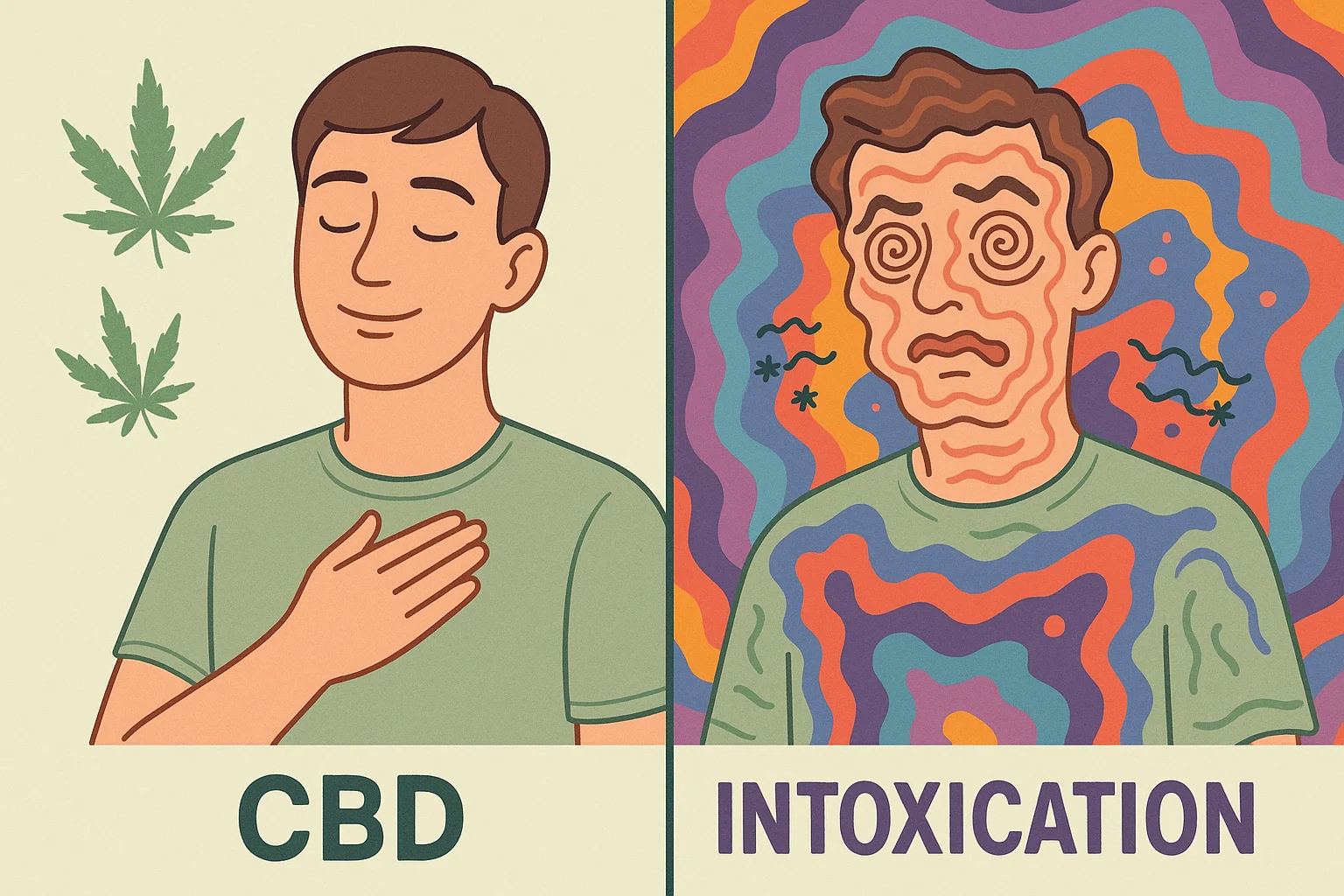

Is CBD non-psychoactive - the difference between psychoactive and intoxicating
Czy CBD jest niepsychoaktywne: odpowiedzi oparte na badaniach naukowych. u Bucha.
‘CBD is non-psychoactive’ - this statement appears on almost every CBD oil label and in every marketing text. The problem is that it is technically false. CBD exhibits psychoactive effects: clinical randomized studies have confirmed that it reduces anxiety, improves mood, and modulates pain perception (Blessing et al., Neurotherapeutics, 2015). The question that is really worth asking is: is CBD intoxicating? And here the answer is clear - no. This article explains why the distinction between 'psychoactive' and 'intoxicating' is crucial for understanding CBD, and what this difference means in practice.
KEY INFORMATION
• CBD is psychoactive in a scientific sense - it affects mood, anxiety, and pain perception (Blessing et al., Neurotherapeutics, 2015).
• CBD is not intoxicating - it does not cause euphoria, does not distort perception, and does not impair motor abilities.
• THC is both psychoactive and intoxicating; CBD is psychoactive but not intoxicating.
• A 2021 meta-analysis found no evidence of impaired driving ability at typical doses of CBD.
• The term 'non-psychoactive' is a marketing simplification, not a precise scientific term.
Co znaczy „psychoaktywny” - definicja naukowa
Psychoactive is an adjective meaning 'affecting mental processes' - on perception, mood, emotions, or cognitive functions. This definition encompasses a very broad category of substances: caffeine is psychoactive (improves alertness and concentration), L-theanine is psychoactive (induces calm), alcohol is psychoactive. All of these substances affect the brain and mental processes - and this is what defines psychoactivity.
THC is psychoactive - and it is also intoxicating (intoxicating). THC strongly activates the CB1 receptor in the reward system and prefrontal cortex, causing euphoria, changes in the perception of time and space, short-term memory disturbances, and potentially anxiety or paranoia at higher doses. This is a combination of psychoactivity with intoxication.
CBD, on the other hand, is psychoactive - but it is not intoxicating. It affects mental processes through several mechanisms: it acts on the 5-HT1A serotonin receptor (reducing anxiety), inhibits FAAH (raising levels of endogenous anandamide), and acts on the TRPV1 receptor (modulating pain perception). None of these mechanisms cause euphoria or perceptual disturbances (Blessing et al., Neurotherapeutics, 2015).
Table: psychoactive vs intoxicating vs CBD
| Feature | THC | CBD | Caffeine |
|---|---|---|---|
| Effect on mood | Yes (euphoria) | Yes (anxiety reduction) | Yes (stimulation) |
| Perceptual disturbance | Yes | No | No |
| Motor impairment | Yes | No | No |
| Risk of addiction | Yes (moderate) | No (according to WHO 2018) | LOW |
| WHO Classification | Controlled substance | Does not require control | Not regulated |
| Psychoactive (scientific definition) | Yes | Yes | Yes |
| Intoxicating (intoxicating) | Yes | No | No |
What do studies say about the psychological effects of CBD?
Clinical evidence for the psychoactive effects of CBD is well documented - and it is this evidence that forms the basis for its therapeutic applications. A meta-analysis by Blessing and colleagues from 2015, covering 34 preclinical studies and 11 human studies, found strong evidence for the anxiolytic effects of CBD in generalized anxiety disorders, PTSD, and SAD (Blessing et al., Neurotherapeutics, 2015). To psychologiczny efekt - skuteczny i powtarzalny.
The study by Crippy and colleagues from 2011, which was randomized and double-blind, showed that a dose of 300 mg of CBD significantly reduced anxiety induced by public speaking situations - measured both by subjective scales and objective measures of blood pressure and skin conductance (Crippa et al., Neuropsychopharmacology, 2011). The effect was clear and statistically significant. This is a psychoactive action - without any intoxication.
Citation capsule (Blessing et al., Neurotherapeutics, 2015): A meta-analysis of 45 studies on CBD provided strong evidence for its anxiolytic effects in generalized anxiety disorders, PTSD, and social phobia. The authors indicate that CBD exerts clear psychological effects through 5-HT1A mechanisms and modulation of the amygdala - making it a psychoactive substance in a scientific sense, though non-intoxicating (Blessing et al., Neurotherapeutics, 2015).
Does CBD impair driving ability?
This question has practical significance - and the answer is reassuring. A meta-analysis by Arkell and colleagues from 2021, published in Neuroscience and Biobehavioral Reviews, reviewed 19 studies involving humans assessing the impact of CBD on motor and cognitive abilities. The conclusion: no evidence was found for impairment of these abilities at doses of CBD up to 1500 mg - values that far exceed typical supplemental doses (10-50 mg daily) (Arkell et al., Neuroscience and Biobehavioral Reviews, 2021).
In comparison: THC clearly and consistently impairs driving ability - affecting both reaction time and the ability to judge distance and speed. This is another axis on which CBD and THC are fundamentally different, even though both belong to cannabinoids.
We have noticed that the controversy surrounding the term "non-psychoactive" rarely harms CBD users, but often causes unnecessary confusion in conversations with doctors and employers. A more accurate formulation - "CBD is not intoxicating or intoxicating, but it affects mood and anxiety levels" - is longer, but gives the interlocutor the right picture. Linguistic precision in this context is worth a few extra words.
Why has "non-psychoactive" become an industry standard?
The term "non-psychoactive" gained popularity in the CBD market as a contrast to negative associations with THC and "intoxication". It was a communication choice - understandable and effective from a marketing perspective. The WHO report from 2018, which stated that CBD "does not exhibit addictive potential and does not cause euphoria", was partly responsible for the spread of this narrative (WHO ECDD, 2018).
Scientists - including Cristino, Bisogno, and Di Marzo, authors of the textbook on endocannabinoids - emphasize that a more precise term is "non-intoxicating", not "non-psychoactive". This distinction is important not only semantically: the mistaken belief that CBD "does not affect the brain" can lead to it being overlooked in pre-operative interviews or with new medications - which carries real risks.
Practical implications of this difference - drug tests and law
The distinction between "psychoactive" and "intoxicating" has real consequences beyond academic semantics. Drug tests used in workplaces, by road police, or in professional sports do not detect CBD - they detect THC or its metabolite THC-COOH. Pure CBD isolate will not yield a positive result. However, full-spectrum products containing trace amounts of THC (up to 0.2% in Poland) may - at very high doses or with prolonged use - give a positive result in sensitive drug tests.
From the perspective of Polish law, CBD is not a psychotropic substance or a narcotic. The 2005 Drug Prevention Act (with later amendments) does not list cannabidiol among controlled substances. However, the police drug test measures the presence of THC in saliva or THC-COOH in urine - and if the CBD product used contained undeclared THC (which the JAMA study confirmed for 21% of products), there is a real risk of a positive result. This is another argument for choosing products with a CoA certificate confirming THC content below the detection threshold.
Frequently Asked Questions
Is CBD psychoactive?
In a strict scientific sense - yes. CBD affects mental processes: it reduces anxiety, improves mood, and modulates pain perception. However, it is not intoxicating - it does not cause euphoria or disrupt the perception of reality. This is a key difference that the popular term "non-psychoactive" does not accurately convey (Blessing et al., Neurotherapeutics, 2015).
What is the difference between psychoactive and intoxicating?
Psychoactive means "affecting mental processes" - a category that includes caffeine, theanine, and CBD. Intoxicating means causing intoxication, perceptual disturbances, and impaired functioning. THC is both psychoactive and intoxicating. CBD is psychoactive but not intoxicating.
Does CBD affect driving ability?
A meta-analysis of 19 studies found no impairment of motor or cognitive abilities at doses of CBD up to 1500 mg - values that are many times higher than typical supplemental doses (Arkell et al., Neuroscience and Biobehavioral Reviews, 2021). In comparison - THC clearly impairs driving ability.
Why is CBD marketed as non-psychoactive?
The term "non-psychoactive" was created as a contrast to THC and recreational cannabis, to show that CBD does not cause a "high". In common understanding, this communication is clear, but scientists point out that a more precise term is "non-intoxicating" - not intoxicating, rather than "non-psychoactive".
Can CBD change mood or perception?
Yes - and this is where its therapeutic application lies. Clinical studies have confirmed that CBD reduces anxiety and improves mood by acting on the 5-HT1A receptor and inhibiting FAAH. These effects are subtle and do not cause perceptual disturbances, but they exceed the placebo threshold (Crippa et al., Neuropsychopharmacology, 2011).
This article is informational and educational in nature. It contains internal links to products available in the u Bucha store. Prices and specifications may change - please check the current data on the product page before purchasing.
Author: Michał Waluk · Published: 2026-05-04 · Updated: 2026-05-04