
Preemptive nausea - why cannabis works where serotonin antagonists fail
Anticipatory nausea — mechanism explained simply, based on studies. u Bucha.
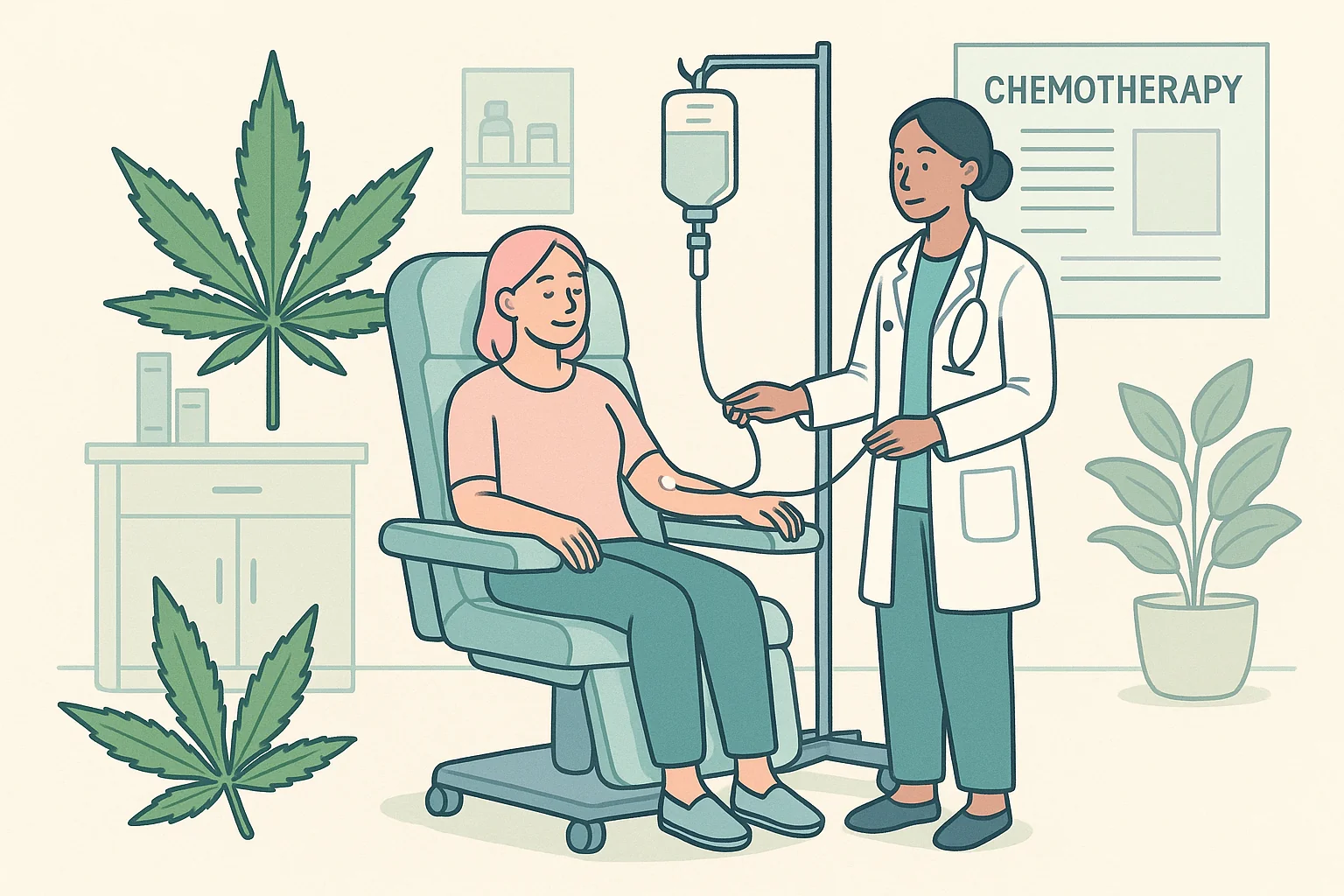
Anticipatory nausea is one of the most frustrating problems in oncology: the patient starts vomiting even before chemotherapy is administered - at the mere sight of the hospital, the smell of the ward, or even the thought of the visit. It affects about 25-30% of patients undergoing multi-cycle treatment (Morrow et al., Support Care Cancer, 2002). Setrons - the most effective class of antiemetic drugs used in chemotherapy - completely fail here. The reason is mechanistic: anticipatory nausea is learned through classical conditioning and generated by the limbic system, not by serotonin receptors. Cannabinoids - both CB1 and the 5-HT1A mechanism of CBD - target exactly there. This article explains the biology of this phenomenon step by step.
KEY INFORMATION
• Anticipatory nausea (ANV) affects about 25-30% of patients after multi-cycle chemotherapy - it is a learned conditioned response, not a drug effect (Morrow et al., 2002).
• Setrons block 5-HT3 in the intestines and brainstem - effective against nausea after chemotherapy, powerless against ANV from the limbic system.
• CB1 receptors in limbic structures and the brainstem control anxiety conditioning and the vomiting reflex - this is the target of cannabinoids.
• In animal models, CBD and THC reduced ANV through CB1, while ondansetron was ineffective (Parker et al., BJP, 2011).
• CBD also acts through the 5-HT1A receptor - a second antiemetic mechanism independent of CB1.
What is anticipatory nausea and how does it occur?
Anticipatory nausea and vomiting (ANV) is a classic example of Pavlovian conditioning in medicine. During subsequent cycles of chemotherapy, the patient's brain associates previously neutral stimuli - the color of the syringe, the smell of disinfectant, the sound of the intercom at the clinic - with severe nausea after drug administration. After several repetitions, these stimuli alone are enough to trigger a full vomiting response before any drug reaches the stomach.
Risk factors for ANV are well described. Stronger nausea after chemotherapy increases the risk of developing ANV in subsequent cycles. Higher levels of pre-treatment anxiety, age under 50, susceptibility to motion sickness, and previous experience of pregnancy-related nausea - all of these are predictors. Studies show that once conditioned, ANV is extremely difficult to reverse: cognitive-behavioral therapy is the only psychological approach with proven effectiveness (Roila et al., Annals of Oncology, 2016).
Why do setrons fail in ANV?
Setrons (ondansetron, granisetron, palonosetron) block the serotonin receptor 5-HT3 in enterochromaffin cells of the small intestine and the chemoreceptor zone of the brainstem. This mechanism is effective for nausea directly induced by the cytotoxic effects of chemotherapeutics on enterocytes - which release serotonin stimulating the vagus nerve and triggering the vomiting reflex.
However, ANV involves a completely different neural pathway. Conditioned stimuli are processed by the amygdala and hippocampus - limbic structures responsible for associative learning and emotional memory. The signal from the amygdala reaches the nucleus of the solitary tract (NTS) and the area postrema (AP) in the brainstem, triggering the vomiting reflex via a non-serotonergic pathway. Blocking 5-HT3 does not affect this pathway - hence the ineffectiveness of setrons against ANV. The study by Roila et al. clearly indicates that no 5-HT3 antagonist has shown efficacy in randomized trials controlling for ANV (Annals of Oncology, 2016).
| Type of nausea | Mechanism | Effectiveness of setrons | Effectiveness of cannabinoids |
|---|---|---|---|
| Ostre (po chemo, 0-24h) | 5-HT3 in the intestines and AP | High | Moderate (additive) |
| Delayed (24-120h) | Substance P, NK1 | Niska | Moderate |
| Anticipatory (ANV) | Limbic conditioning (CB1) | None | Promising (preclinical data) |
How do CB1 receptors suppress conditioned nausea?
CB1 receptors are densely expressed precisely in structures key to ANV: in the amygdala, hippocampus, NTS, and AP. Parker et al. from the University of Guelph conducted a series of experiments on rats with a conditioned nausea model (measured by the delay response), which showed that activation of CB1 by THC or synthetic CB1 agonists effectively blocked the learned vomiting response. Crucially, the CB1 antagonist (SR141716A) completely abolished this effect, confirming that it is a strictly CB1-dependent mechanism (Parker et al., British Journal of Pharmacology, 2011).
Biologically, it makes sense: the endocannabinoid system modulates synaptic plasticity underlying associative learning. Activation of CB1 'extinguishes' learned associations of fear and disgust - this is the same mechanism through which cannabinoids are studied in PTSD (extinguishing traumatic memories). ANV is simply trauma at a lower threshold - learned disgust without a traumatic narrative. The mechanism is common.
Rola CBD - mechanizm przez 5-HT1A
CBD does not strongly bind to CB1, so its action in ANV follows a different pathway. The key is the serotonin receptor 5-HT1A - an agonist through which CBD exerts anxiolytic and antiemetic effects. Parker et al. demonstrated that CBD administered to rats before exposure to a conditioned stimulus reduced ANV expression, and the 5-HT1A antagonist (WAY100635) blocked this effect - evidence that this is a 5-HT1A-dependent mechanism, not CB1 (Parker et al., BJP, 2011).
This is an interesting mechanistic observation: CBD and THC act on ANV through different receptors (5-HT1A vs CB1), suggesting that the combination of both may work additively or synergistically. The entourage effect - the synergy between cannabis phytochemicals - may have practical clinical significance here. Full-spectrum products with naturally occurring ratios of CBD and THC may be more beneficial than CBD isolate in this specific application.
Approved cannabinoid medications and clinical practice
Dronabinol (Marinol) and nabilone (Cesamet) - synthetic cannabinoids - have been approved by the FDA since the 1980s for the treatment of chemotherapy-induced nausea and vomiting resistant to conventional medications. Their efficacy in ANV has been demonstrated in several clinical studies, although the design of these trials often did not allow for a pure isolation of the effect in ANV vs. acute nausea. In Canada and several European countries, they are used in oncology practice as second or third-line medications.
In Poland, dronabinol is available by prescription as a medication imported under a targeted import procedure. This is not a routine solution and requires clinical justification. CBD as a standalone antiemetic does not have an approved indication in Poland or the EU - although mechanistic studies and preliminary clinical data are promising.
What does this mean for patients and caregivers?
ANV is discussed too rarely in oncology offices - patients are embarrassed to talk about "head" nausea and often do not know that it is a recognized clinical phenomenon with described mechanisms. The first steps are to inform the attending oncologist about the growing problem, assess the risk, and consider behavioral therapy (relaxation techniques, systematic desensitization) as a first line.
There is also a practical preventive dimension. Effective control of nausea in the first cycles of chemotherapy - before conditioning occurs - is the most effective strategy for preventing ANV. The MASCC/ESMO and ASCO guidelines emphasize that inadequately treated acute and delayed nausea is the strongest predictor of ANV occurrence in later cycles. For this reason, aggressive, preventive control of nausea from the first cycle - including consideration of dronabinol in high-risk patients - has greater clinical value than treating already conditioned ANV. Cannabinoids thus fit not only as a therapeutic intervention but potentially as a component of ANV prevention by reducing the severity of primary nausea.
From our experience, oncology patients and their families ask about CBD in the context of nausea relatively often. An honest answer is: the mechanism is clear (CB1 and 5-HT1A vs. limbic conditioning), preclinical data is strong, clinical data for CBD alone is limited, and for the combination of CBD+THC - more promising. Any decision about supplementation during chemotherapy requires consultation with an oncologist due to possible interactions with cytostatics via CYP enzymes. It is also worth remembering that ANV has a strong anxiety component - and the anxiolytic properties of CBD through the 5-HT1A receptor may reduce the overall level of anxiety before a visit, which in itself lowers the readiness for a conditioned vomiting response.
Frequently Asked Questions
What are anticipatory nausea and who does it affect?
Anticipatory nausea and vomiting (ANV) is learned, conditioned nausea that occurs before the next cycle of chemotherapy at the sight or smell of stimuli associated with treatment. It affects about 25-30% of patients undergoing multi-cycle chemotherapy, especially those with severe nausea in previous cycles (Morrow et al., Support Care Cancer, 2002).
Why do setrons not work for anticipatory nausea?
Serotonin 5-HT3 receptor antagonists block the 5-HT3 receptor in the intestines and brainstem - effective for nausea directly induced by chemotherapeutics. ANV has a conditioned basis involving the amygdala and hippocampus, where there are no 5-HT3 receptors. The limbic mechanism is independent of serotonin, so serotonin antagonists have no target (Roila et al., Ann Oncol, 2016).
How do cannabinoids affect anticipatory nausea?
CB1 receptors are densely distributed in the amygdala and hippocampus - structures that generate conditioned ANV. Activation of CB1 extinguishes learned disgust associations. CBD additionally acts through 5-HT1A. In animal models, both mechanisms reduced ANV in the absence of ondansetron's effect (Parker et al., BJP, 2011).
Is there an approved cannabinoid medication for chemotherapy-induced nausea?
Yes - dronabinol and nabilone (synthetic cannabinoids) are approved by the FDA for the treatment of chemotherapy-induced nausea resistant to conventional medications. In Poland, they are available by prescription under a targeted import procedure. CBD as a standalone antiemetic does not have an approved indication in the EU or Poland.
Does CBD without THC help with anticipatory nausea?
In animal models, CBD reduced ANV through the 5-HT1A receptor, but the effect was weaker than that of THC. Clinical data on CBD alone in ANV is limited. The combination of CBD+THC (full-spectrum extract) shows a stronger effect through additive action on CB1 and 5-HT1A. Any decision during chemotherapy requires consultation with an oncologist.
This article is for informational and educational purposes and does not replace consultation with a doctor. If you are pregnant, breastfeeding, taking medications, or have chronic conditions, consult the use of supplements or herbs with a specialist.
Author: Michał Waluk · Published: 2026-05-04 · Updated: 2026-05-04