


Diabetic cardiomyopathy - how CBD limits oxidative stress and heart fibrosis
Kardiomiopatia cukrzycowa — mechanizm wyjasniony prosto, w oparciu o badania. u Bucha.
Diabetes damages not only the kidneys and retina - it also directly affects the heart muscle. Diabetic cardiomyopathy affects about 12% of diabetic patients and is one of the leading causes of mortality in this group, regardless of the presence of coronary artery disease or hypertension (Jia et al., Circulation Research, 2018). The key mechanisms of damage are oxidative stress and progressive heart fibrosis. In this article, we explain what preclinical studies say about the role of CBD in protecting the heart muscle - through which receptors it acts, what biochemical markers it changes, and where the boundary lies between mechanistic promise and proven clinical efficacy.
KEY INFORMATION
• Diabetic cardiomyopathy affects about 12% of diabetes patients and leads to heart failure regardless of coronary diseases (Jia et al., Circulation Research, 2018).
• The key mechanisms of damage are oxidative stress (overproduction of ROS) and fibrosis (collagen deposition by activated fibroblasts).
• CBD reduces markers of oxidative stress (MDA), activates the Nrf2 pathway, and inhibits the TGF-β/Smad pathway responsible for fibrosis.
• CBD partially antagonizes pro-inflammatory CB1 and activates cardioprotective CB2 in the heart exposed to hyperglycemia.
• Results are at the preclinical stage - large clinical studies with CBD in diabetic cardiomyopathy have not been conducted.
What is diabetic cardiomyopathy and where does it come from?
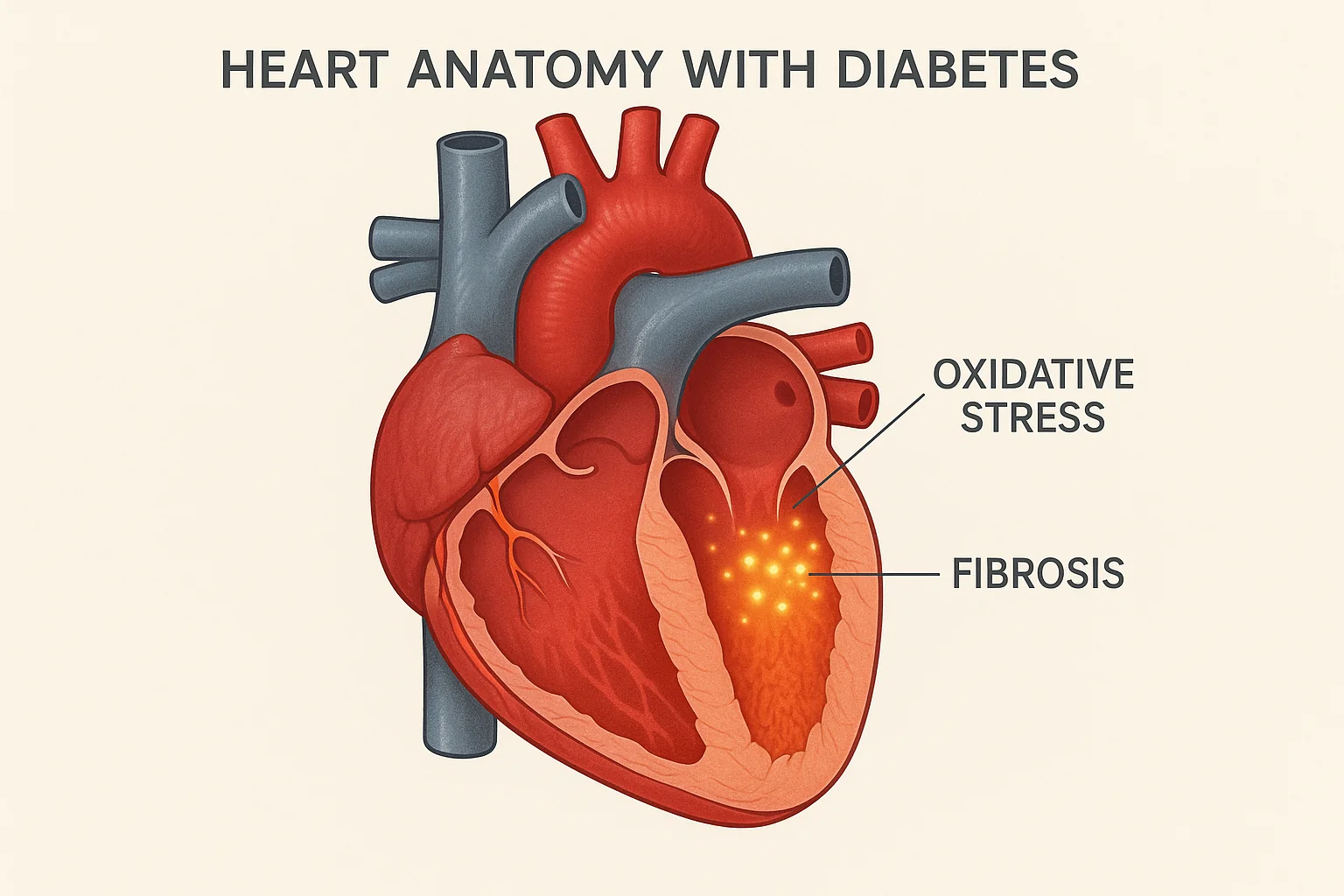
Diabetic cardiomyopathy (DC) is a specific damage to the heart muscle directly resulting from chronic hyperglycemia, hyperinsulinemia, and insulin resistance - not from coronary artery atherosclerosis. It is distinguished by two stages: early diastolic dysfunction (left ventricular relaxation disorders) and late systolic dysfunction leading to overt heart failure. Patients in the early stage often have no symptoms - the disease is detected only in echocardiography.
The pathophysiology of DC involves several overlapping pathways. Chronic hyperglycemia generates advanced glycation end products (AGEs), which cross-link collagen and stiffen the heart wall. Overproduction of reactive oxygen species (ROS) by mitochondria damages cardiomyocytes and activates pro-inflammatory signaling pathways. Concurrently, activated cardiac fibroblasts deposit collagen I and III, replacing elastic muscle tissue with rigid scar tissue. The result is an organ that cannot properly relax or fill with blood (Jia et al., Circulation Research, 2018).
Stres oksydacyjny w sercu cukrzycowym - jak CBD reaguje?
Oxidative stress in diabetic heart is primarily driven by overactivated mitochondrial respiratory chain and NADPH oxidase enzyme. CBD exhibits antioxidant effects on two levels: it directly neutralizes free radicals (it has phenolic groups with ROS scavenging properties) and activates the Nrf2 pathway - the transcriptional "master regulator" of antioxidant enzymes.
A fundamental study by Rajesh et al. published in Journal of the American College of Cardiology in 2010 examined the effect of CBD on the hearts of mice with streptozotocin-induced diabetes. CBD administered orally reduced levels of malondialdehyde (MDA - a marker of lipid peroxidation), increased superoxide dismutase (SOD) and catalase activity, and lowered the expression of pro-inflammatory cytokines in cardiac tissue (Rajesh et al., JACC, 2010). This is a comprehensive antioxidant profile, not just one parameter.
| Biochemical marker | In diabetes without CBD | After CBD (mouse model) |
|---|---|---|
| MDA (lipid peroxidation) | Elevated | Reduced |
| SOD (superoxide dismutase) | Reduced activity | Restored activity |
| Catalase | Reduced | Increased |
| TNF-α, IL-1β (cytokines) | Elevated | Decreased |
| Collagen I/III (fibrosis) | Increased deposition | Decreased deposition |
Heart fibrosis - how does CBD inhibit the TGF-β pathway?
Cardiac muscle fibrosis (fibrosis) is a process in which cardiac fibroblasts differentiate into myofibroblasts and synthesize excess extracellular matrix proteins - mainly collagen I and III. A key mediator of this process is TGF-β1 (transforming growth factor beta 1), which activates the Smad2/3 signaling pathway. In diabetes, hyperglycemia stimulates the secretion of TGF-β1 by cardiomyocytes and endothelial cells, driving heart remodeling.
CBD inhibits the TGF-β/Smad pathway at the transcription level - reducing the expression of TGF-β1 itself and the phosphorylation of Smad2/3 in cardiac fibroblasts. In the study by Rajesh et al., hearts of diabetic mice treated with CBD showed histologically less deposited collagen and better left ventricular wall elasticity in echocardiographic measurements (Rajesh et al., JACC, 2010). This translated into better diastolic parameters - the heart relaxed better.
We noticed an interesting issue in the literature: SGLT2 inhibitors (gliflozins) - a modern class of antidiabetic drugs with proven cardioprotective effects in humans - also reduce TGF-β1 and fibrosis markers. This is not a coincidental mechanistic overlap with CBD. This means that the TGF-β/fibrosis pathway is a biologically validated therapeutic target in diabetic cardiomyopathy (DC), which adds contextual value to CBD research.
CB1 and CB2 receptors in the heart - an imbalance in diabetes
In a healthy heart, cannabinoid receptors CB1 and CB2 are present in relatively low concentrations. Under conditions of hyperglycemia and chronic inflammation, CB1 is upregulated in cardiomyocytes, which paradoxically exacerbates damage: activation of CB1 by endogenously produced endocannabinoids (2-AG, anandamide) in this context accelerates oxidative stress, mitochondrial dysfunction, and cardiomyocyte death. The study by Timar et al. showed that CB1 activation in diabetic mice exacerbated cardiac dysfunction, while its blockade had a protective effect (Timar et al., PMC/PLOS ONE, 2013).
CB2 acts in the opposite way: its activation in the diabetic heart reduces inflammation and apoptosis of cardiomyocytes. CBD, as a partial antagonist of CB1 and an agonist of CB2, exhibits the right profile in this context: it limits the pro-inflammatory action of overactive CB1 while simultaneously promoting protective CB2 signaling. This is a rare example of a compound that modifies the balance between two receptors of the same system in a cardioprotective manner.
Are there clinical data in humans?
There is a lack of direct clinical studies on CBD in diabetic cardiomyopathy in humans - this is a significant gap in the literature. We know from observational studies that CBD users report improvements in overall well-being and sleep quality, and data from the Realm of Caring registry indicate a reduction in medications taken by some users (Garcia-Romeu et al., Frontiers in Pharmacology, 2022). But these are observational studies, not randomized - they lack a control group or the ability to isolate the effect on the heart.
Some indirect clinical data exist for Epidiolex (approved CBD preparation) in epilepsy - where ECG monitoring did not show pro-arrhythmic effects of CBD at doses up to 20 mg/kg/day. This is safety data, not efficacy in DC. A full phase 3 clinical trial in diabetic cardiomyopathy is needed to translate mechanistic data into clinical recommendations. However, the cardiac safety profile of CBD in available data is encouraging: no proarrhythmic effects were observed, no significant impact on resting blood pressure, or clinically significant changes in ECG in observational studies at supplemental doses - which is an important starting point for future clinical trials in the cardiology population.
What does this mean in practice?
Diabetic cardiomyopathy is a serious complication of diabetes, and its biochemical mechanisms - oxidative stress and fibrosis via the TGF-β pathway - are biologically similar to those that CBD affects in preclinical models. This is not a coincidental overlap.
An additional perspective is provided by studies on other compounds acting on the Nrf2 and TGF-β pathways - e.g., resveratrol or quercetin - which, with similar preclinical mechanisms, have encountered difficulties in translating effects to human populations due to low bioavailability and high effective doses. CBD has one advantage over them: it is recorded in adipose tissue and maintains tissue concentration longer, which theoretically may favor chronic protection against oxidative stress. However, without pharmacokinetic data from cardiac tissue in diabetic patients, this advantage remains speculative. Researchers and diabetologists agree that the priority is to maintain normoglycemia - the basis for DC prevention - and CBD, if ever indicated, would be a supportive intervention, not a substitute.
From our experience, people with diabetes asking about CBD are primarily interested in its effects on sleep, stress, and neuropathic pain - less often directly about the heart. Information about the cardiac mechanism often surprises them, as it is associated with advanced pharmacology, not supplementation. An honest answer is: the mechanism is described, but clinically unapproved - the decision to supplement requires a conversation with a diabetologist and cardiologist, especially when taking heart medications.
Frequently Asked Questions
What is diabetic cardiomyopathy?
Diabetic cardiomyopathy is a specific damage to the heart muscle resulting from chronic hyperglycemia - independent of coronary artery disease or hypertension. It leads to diastolic dysfunction and, in advanced stages, to overt heart failure. It affects about 12% of patients with diabetes (Jia et al., Circulation Research, 2018).
How does CBD reduce oxidative stress in the heart?
CBD acts as a direct scavenger of free radicals and activates the transcriptional regulator Nrf2, which increases the expression of antioxidant enzymes (SOD, catalase). In a diabetic mouse model, it reduced MDA levels (a marker of ROS damage) and restored catalase activity (Rajesh et al., JACC, 2010).
How does CBD affect heart fibrosis in diabetes?
CBD inhibits the TGF-β/Smad2/3 pathway, which is the main mediator of the activation of cardiac fibroblasts into myofibroblasts and collagen deposition. In diabetic mouse models, CBD reduced histological signs of cardiac fibrosis and improved left ventricular diastolic parameters (Rajesh et al., JACC, 2010).
Can CBD replace diabetes or heart medications?
No. CBD is not approved as a cardiology or anti-diabetic medication. Mechanistic data from animal models are promising, but there are no large phase 3 clinical trials in diabetic cardiomyopathy. CBD does not replace metformin, SGLT2 inhibitors, beta-blockers, or other medications prescribed by a cardiologist or diabetologist.
What is the relationship between CB1/CB2 receptors and the heart in diabetes?
In diabetic hearts, there is upregulation of CB1, whose overactivation increases oxidative stress and cardiomyocyte death. CB2 acts protectively - reducing inflammation. CBD, as a partial antagonist of CB1 and agonist of CB2, corrects this pathological imbalance towards cardioprotection (Timar et al., PLOS ONE, 2013).
This article is for informational and educational purposes and does not replace consultation with a doctor. If you are pregnant, breastfeeding, taking medications, or have chronic conditions, consult the use of supplements or herbs with a specialist.
Author: Michał Waluk · Published: 2026-05-04 · Updated: 2026-05-04