
CBD Oil: Reviews and Effectiveness - What Do Studies Say
CBD oil in user reviews and data from scientific surveys: why people reach for it, how long they wait for effects, and what EFSA says about safe dosing.
The opinions in this text come from two surveys, with 2409 and 387 respondents, and not from forum threads, and we show this difference below with numbers. The phrase "CBD oil reviews" is searched more often today than the name of any single manufacturer. The problem is that most of the circulating numbers come from sales materials, not from research. Percentages like "78% of customers choose" or "62% report improvement" look like data, but upon checking, lead to the homepage of a magazine or to nothing. We decided to check how many of these opinions can be confirmed in scientific publications and cut out everything that cannot be verified. Three large datasets on individuals using cannabidiol remain, one pharmacokinetic review, and one fresh EFSA opinion. This guide shows what they imply for someone considering their first bottle, where knowledge ends, and marketing begins.
KEY INFORMATION
• In a survey of 2409 people, 62% turned to CBD due to a specific ailment, most commonly pain, anxiety, and depression (Corroon and Phillips, Cannabis and Cannabinoid Research, 2018).
• EFSA established a provisional safe dose of 0.0275 mg per kilogram of body weight per day in 2026, which is about 2 mg for a person weighing 70 kg.
• The absolute bioavailability of CBD was measured in humans only after smoking and was found to be 31%; no one has measured it for oral or sublingual routes.
• The 0.3% THC threshold in Polish law is calculated as the sum of delta-9-THC and THCA, not just delta-9-THC alone.
What is CBD oil and where did its popularity come from?
CBD oil is an extract from industrial hemp Cannabis sativa L. dissolved in a carrier oil, most often MCT, hemp, or olive oil. The leading substance is cannabidiol, a compound with no intoxicating effects. Its popularity stems from a simple comparison: the product does not intoxicate, yet it has a drug registration for a serious neurological indication.
In June 2018, the American FDA approved Epidiolex, the first cannabidiol-based drug, for the treatment of rare and severe forms of epilepsy (VanDolah i wsp., Mayo Clinic Proceedings, 2019). This event shifted CBD from a novelty category to a substance worth investigating. The rest of the market followed this signal much faster than regulations could keep up.
Why doesn't CBD cause intoxication? Because it does not stimulate the CB1 receptor like THC does. Laprairie et al. demonstrated in cells with the CB1 receptor that cannabidiol acts as a non-competitive negative allosteric modulator: it decreases the efficacy and potency of CB1 agonists instead of activating the receptor itself (British Journal of Pharmacology, 2015). This is where the profile comes from, where the effect is felt as subtle rather than intoxicating.
This subtlety is also the source of half of the negative reviews. A person expecting effects comparable to a sleeping pill will find the product ineffective after the first evening. A person who waits a month and records observations will evaluate it quite differently. The difference lies in expectations, not in the bottle.
What do CBD oil users say in large surveys?
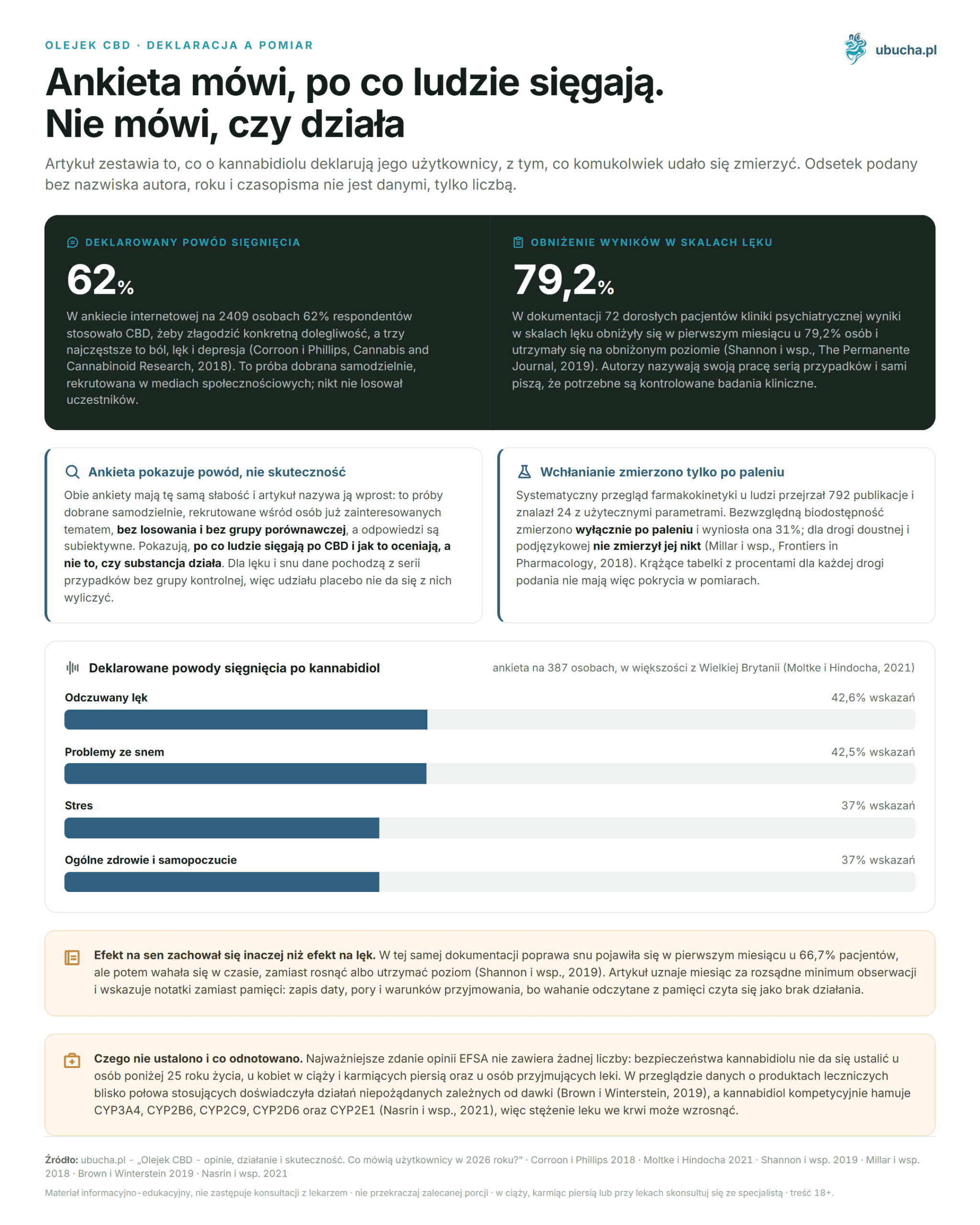
The broadest published collection of reviews comes from an online survey of 2409 people. Almost 62% of respondents used CBD to alleviate a specific ailment, with the three most common being pain, anxiety, and depression. Nearly 36% rated CBD as handling their problem "very well," while only 4.3% chose the response "not very well" (Corroon i Phillips, Cannabis and Cannabinoid Research, 2018).
The second survey, conducted on 387 people mostly from the UK, provides a very similar picture of the reasons. The four most common reasons for using cannabidiol are perceived anxiety (42.6%), sleep problems (42.5%), stress (37%), and general health and well-being (37%). The authors also noted how low the actual doses are: 54% of respondents took below 50 mg daily, and 72.6% used the sublingual route (Moltke i Hindocha, Journal of Cannabis Research, 2021).
One observation from the first survey goes beyond the list of ailments and speaks to the buyer profile itself. The likelihood that someone uses CBD for therapeutic purposes was 1.44 times higher among non-regular cannabis users than among regular users (confidence interval 95%: from 1.16 to 1.79). In other words, a person who has nothing to do with cannabis on a daily basis is more likely to reach for cannabidiol. This is the opposite of the image suggested by most marketing communications in this category.
Both surveys share the same weakness, and it must be named directly. These are self-selected samples, recruited from social media among people already interested in the topic. No one randomized participants, no one controlled a comparison group, and the responses are subjective. They show why people reach for CBD and how they evaluate it, not whether the substance works.
It is worth comparing them with one clinical measurement to see the scale of the difference between declaration and measurement. We return to this in the section on the duration of effects. If you are looking for practical criteria for evaluating the product itself, a separate comparison can be found in the entry how to distinguish a good CBD oil from a poor one.
How do forum opinions differ from survey results?
By the selection of individuals who express their opinions. On forums, those who write have a reason: either very good or very bad experiences. In a survey, the entire sample responds, including individuals for whom nothing happened, and it is this group that disappears from threads, even though it may be the largest.
The outcome is predictable and visible in the numbers. Threads provide extremes and individual stories, while surveys provide percentages with a given denominator. Therefore, a description like "everyone says it works" is not a result, but a reflection of who had the motivation to write.
The second difference concerns what no one on the forum controls: dosage, concentration, duration of use, and whether the product actually contained the declared amount of cannabidiol. The survey does not measure this perfectly either, but at least it asks everyone the same way.
Practical conclusion: read a forum thread like a conversation, not like data, and look for product descriptions and batch certificates, not ratings on a scale from one to ten.
How is CBD oil made and what does the certificate of analysis reveal?
The journey from field to bottle has four stages, and each leaves a mark on the final composition. The first is the selection of a variety from the EU register of industrial hemp and soil testing, as hemp is a bioaccumulator and absorbs heavy metals along with nutrients.
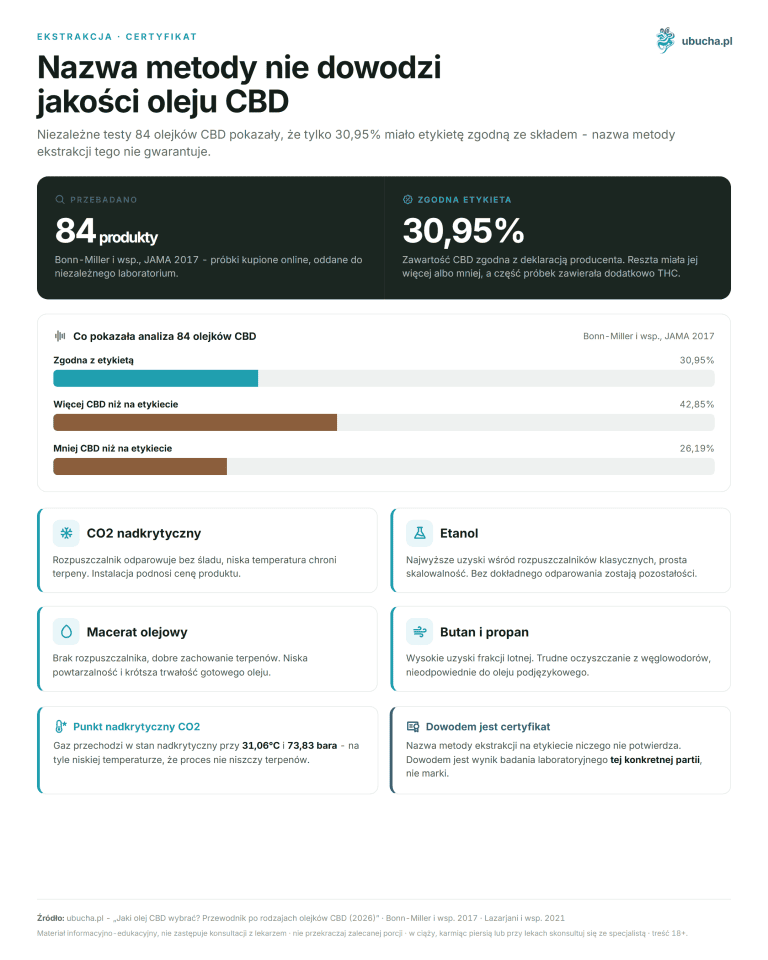
The second stage is extraction. Supercritical carbon dioxide extraction is considered the standard, as it leaves no solvent residues. The cheaper ethanol alternative requires careful evaporation, and any shortcomings at this step are later visible in tests for solvent residues.
The third stage is decarboxylation. In the living plant, cannabinoids exist in acidic forms, as CBDA and THCA. Only heating detaches the carboxyl group, resulting in the form we know from labels. A producer who intentionally retains some cannabinoids in their acidic form ends up with a product of a different profile; the difference between both versions is discussed more broadly in the entry about olejkach RAW i dekarboksylowanych.
The fourth stage is formulation and batch testing. An analysis certificate from an independent laboratory is the only document that allows checking whether the content matches the label declaration. It should provide cannabinoid profile, terpene profile, and results of tests for pesticides, heavy metals, microbiology, and solvent residues. The absence of such a document is not a trivial matter: a review for clinicians in Mayo Clinic Proceedings directly warns that the market is poorly regulated, and studies have shown discrepancies between declared amounts of CBD and THC and actual content (VanDolah et al., 2019).
What else is in the bottle besides cannabidiol?
Full-spectrum hemp extract is a mixture in which cannabidiol is just the most numerous component. Alongside it are minority cannabinoids and terpenes, all dissolved in a carrier oil that brings its own fatty acids. This complexity is the basis of a hypothesis known as the entourage effect.
The author of the most frequently cited work on this topic is Ethan Russo, and his name is often associated with Mechoulam in this one work. The 2011 review has a single author. Russo discusses eight cannabis terpenoids and notes that they are compounds strong enough to influence the behavior of animals and humans even at serum concentrations of single nanograms per milliliter, inhaled from the surrounding air (British Journal of Pharmacology, 2011).
- Limonene, myrcene, alpha-pinene, and linalool, which are terpenoids that give cannabis its characteristic scent.
- Beta-caryophyllene and caryophyllene oxide, nerolidol, and phytol, described in the same study.
- All share a common precursor with phytocannabinoids, so they come from the same branch of the plant's biosynthesis.
- All of them are simultaneously flavoring and aromatic ingredients common in the diet, recognized by the American Food and Drug Administration as safe for this role.
Russo also posits a hypothesis that never appears in sales materials because it does not sell a product: some non-cannabinoid components of the plant may act as an antidote to the intoxicating effects of THC, thereby increasing its therapeutic index. This shows that the entourage effect in its original formulation also includes the attenuation of effects, not just enhancement.
The way Russo formulates the conclusion is more significant than the list of compounds itself. The cannabinoid-terpene synergy is conditionally presented in this work as a hypothesis to be proven, and a significant portion of the text is devoted to proposing methods for its study. This is not an announcement of a discovery. Subsequent reviews of the same literature repeat this cautious tone.
The practical conclusion for the reader is simple. A richer extract profile is a sensible reason to choose a more complete product than an isolate, but it is not a clinically proven reason. A seller who speaks of the entourage effect as a fact is ahead of science by a few steps.
How to choose a specific product and where to start, we break down in przewodniku po wyborze olejku CBD.
What are the differences between full spectrum, broad spectrum, and isolate?
Three extract formats correspond to three different compromises between the fullness of composition and the absence of THC. Full spectrum retains the entire natural profile of the plant along with trace amounts of tetrahydrocannabinol. Broad spectrum retains the rest of the components, but THC is removed from it. Isolate is a single compound with a purity above 99%, devoid of both terpenes and minor cannabinoids.
| Format | THC | Composition beyond CBD | For whom |
|---|---|---|---|
| Full spectrum | trace, within legal limits | full profile of cannabinoids, terpenes, and flavonoids | people without THC tests |
| Broad spectrum | removed during processing | minor cannabinoids and terpenes | professional drivers and athletes |
| Isolate | none | none, pure cannabidiol above 99% | people allergic to other cannabis components |
The label provides the percentage concentration, which translates directly into milligrams. A 5% oil contains 500 mg of cannabidiol in 10 ml, 10% contains 1000 mg, and 20% contains 2000 mg. A standard drop from a pipette is about 0.05 ml, so in 5% oil, it carries approximately 2.5 mg. This arithmetic allows for comparing two products with different prices and concentrations before looking at anything else.
A separate mistake is confusing CBD oil with hemp seed oil. These are two products made from different raw materials and for different purposes; the distinction is detailed in the entry. olej z konopi kontra olejek CBD. Olej z nasion trafia do kuchni, olejek CBD do suplementacji.
How much CBD does the body absorb and why is this a difficult question?
Tables with bioavailability percentages for each route of administration circulate across the internet and most do not have backing from measurements. A systematic review of the pharmacokinetics of cannabidiol in humans reviewed 792 publications and found 24 with useful parameters. The conclusion is surprisingly modest: absolute bioavailability was measured only after smoking and was found to be 31%. No such measurement has been made for any other route of administration, even though intravenous preparations, necessary for such measurement, are available (Millar et al., Frontiers in Pharmacology, 2018).
What did the review actually establish? The half-life of cannabidiol ranges from 1.4 to 10.9 hours after sublingual spray, from 2 to 5 days with chronic oral administration, 24 hours after intravenous administration, and 31 hours after smoking. Maximum concentration increases after a meal and with lipid formulations, and the time to reach it is between zero and four hours after intake.
This finding has direct implications for the advice read in stores. The recommendation to hold the oil under the tongue is reasonable and convenient, but it cannot be said today how much it increases absorption, as this value has not been measured. It is worth remembering this when reading guides promising to double the effect; practical differences between methods of intake are covered in the entry. how to use CBD oil.
What is certain, however, is that a meal changes the picture. If you compare your feelings from two weeks, take the oil under similar conditions, otherwise you are comparing two different pharmacokinetics, not two doses.
How long should you use the oil before assessing the effect?
Here, user opinions diverge most from clinical data, so it is worth starting with measurement. In a psychiatric clinic, the documentation of 72 adult patients was analyzed, in whom cannabidiol was added to standard treatment. Among 47 individuals reporting anxiety and 25 individuals with sleep problems, anxiety scores decreased in the first month for 79.2% of patients and remained at a reduced level throughout the observation period (Shannon et al., The Permanente Journal, 2019).
Results regarding sleep behaved differently, and this is the most interesting part of this work. Improvement appeared in the first month for 66.7% of patients, but then fluctuated over time instead of increasing or maintaining a level. The authors call their study a case series and state that controlled clinical trials are needed.
What conclusions can be drawn from this for someone who has just bought their first bottle? A month is a reasonable minimum for observation, as changes were visible in the cited documentation during this period. At the same time, the effect on sleep can be unstable, so one bad week does not negate the product, and one good week does not confirm it.
The practical consequence is inconvenient for sellers and buyers alike. A reliable assessment requires notes, not memory. Record the date, time, conditions, and one sentence about your well-being; after four weeks, you will have material that can be read, rather than an impression that can be interpreted in any way.
What do studies confirm, and what remains a hypothesis?
The division is sharper than most sales materials suggest. On the confirmed side, there is one indication: the registration of a cannabidiol-based drug for rare, severe forms of epilepsy, granted by the FDA in June 2018 (VanDolah et al., Mayo Clinic Proceedings, 2019). This is proof that the substance has pharmacological effects, not that it will help with everything.
On the side of promising but unconfirmed signals are anxiety and sleep. Shannon's case series shows changes in clinical scales, but without a control group and without randomization. A review for clinicians notes a growing body of preclinical and clinical evidence for chronic pain, describing CBD as a possible additional option, not as an established therapy.
On the side of hypotheses stands the entourage effect. Neither Russo's 2011 review nor subsequent review papers present it as a proven fact; they describe it as a concept requiring research. Marketing this difference usually does not highlight it.
From our observations while organizing this text, one more thing emerges that goes beyond individual indications. A large portion of the numbers repeated in the Polish internet about CBD, especially the percentages describing users, does not lead to any publication. When all of them are cut off, there is less material left, but what remains can be verified in two minutes.
How much cannabidiol is safe according to EFSA?
Since 2026, there is a number to refer to, and it differs from what was previously repeated by several orders of magnitude. The European Food Safety Authority derived a provisional safe dose of 0.0275 mg per kilogram of body weight per day using the benchmark dose method, with an uncertainty factor of 400. For a person weighing 70 kg, this amounts to about 2 mg daily (EFSA Journal, 2026).
The range of this value is narrow and must be provided along with the number. It applies only to supplements with a cannabidiol purity of at least 98%, without nanoparticles, produced through a process deemed safe and excluding genotoxicity. The panel based it on sub-chronic studies compliant with good laboratory practice.
The most important sentence from this opinion does not contain any numbers. The safety of cannabidiol cannot be established in individuals under 25 years of age, in pregnant and breastfeeding women, and in those taking medications. If you belong to any of these groups, this information is more important than any dosage provided in the guide.
EFSA also lists where data is still incomplete: liver, gastrointestinal tract, nervous, hormonal, and reproductive systems. Animal studies have shown consistent liver toxicity, and human study data indicate a potential hepatotoxicity, especially when medications are used simultaneously. An older safety review described cannabidiol as well-tolerated but noted inhibition of hepatic drug metabolism among documented effects (Bergamaschi i wsp., Current Drug Safety, 2011).
What do we still not know about the safety of cannabidiol?
The same EFSA opinion is simultaneously the most honest list of gaps that exists regarding CBD, and it is worth reading alongside the number 2 mg. The panel reviewed studies on animals and humans published until June 2024 and found that earlier data gaps persist because many new works have methodological limitations: non-standardized protocols, short duration, and concurrent pharmacological treatment of participants.
The strongest signal concerns the liver. Animal studies have shown consistent liver toxicity, with organ mass and histopathological changes being the most sensitive endpoints. Human studies indicate a potential hepatotoxicity, especially when cannabidiol is used together with medications. Higher doses have also reported gastrointestinal symptoms.
Three areas remain open, each concerning a different group of readers. Data on neurological and psychiatric safety is insufficient. Animal studies have reinforced concerns about reproductive toxicity, and after prenatal exposure, long-term and offspring sex-dependent neurodevelopmental effects have been observed. Hormonal disorders, including changes in thyroid hormone levels and histopathological changes in the adrenal glands, have also been noted. No one has yet investigated immunotoxicity, even though cannabidiol interacts with immune pathways.
For balance, it is worth noting what was not found in the older safety review, as the list is long. Cannabidiol was not found to be toxic to non-transformed cells, did not change food intake, did not induce catalepsy, did not affect heart rate, blood pressure, or body temperature, did not alter gastrointestinal transit, and did not disrupt psychomotor or mental functions. On the side of documented effects, however, there was inhibition of hepatic drug metabolism, reduced fertility, and decreased activity of P-glycoprotein and other drug transporters (Bergamaschi et al., 2011).
Does CBD interact with medications?
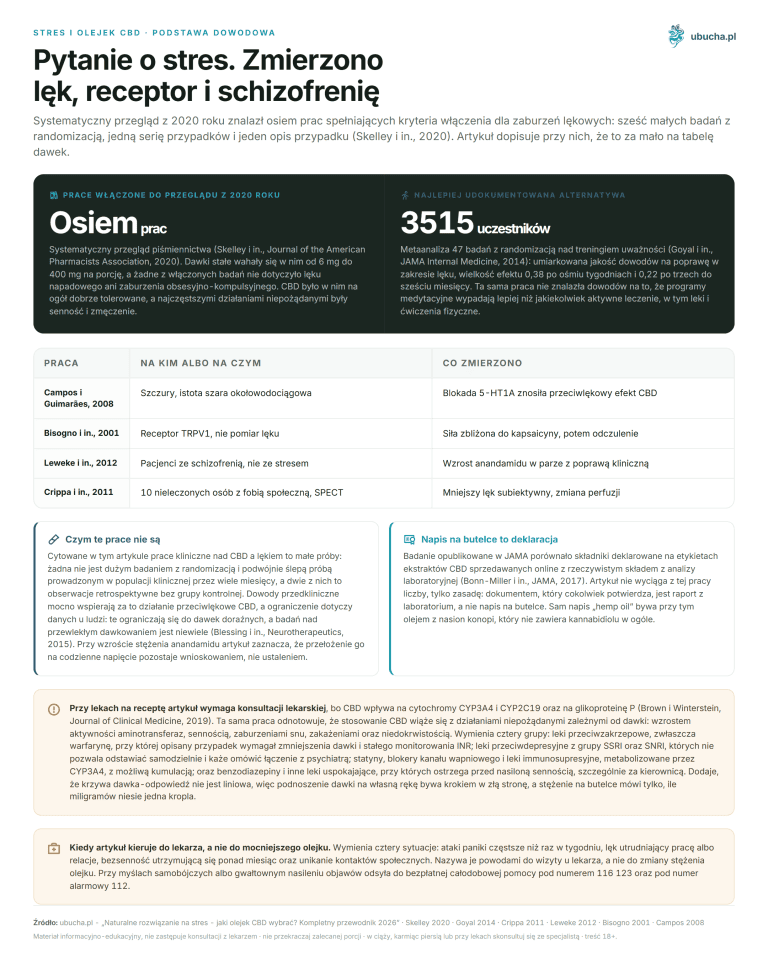
Yes, and this is the best-documented safety issue of cannabidiol. A review of data from medicinal product information containing CBD showed that nearly half of users experienced adverse effects, with a general dose-dependent relationship. The most common include increased aminotransferase activity, sedation, sleep disturbances, infections, and anemia (Brown and Winterstein, Journal of Clinical Medicine, 2019).
The mechanism of interaction lies in drug-metabolizing enzymes and transporters. The authors of this review point to the effect of cannabidiol on cytochrome P450, mentioning CYP3A4 and CYP2C19, as well as P-glycoprotein responsible for excretion. A laboratory study examining cannabinoids and their metabolites on microsomes with overexpression of individual isoforms showed that cannabidiol competitively inhibits CYP3A4, CYP2B6, CYP2C9, CYP2D6, and CYP2E1 (Nasrin i wsp., Drug Metabolism and Disposition, 2021).
What does this mean at the kitchen table, rather than in the lab? If you are taking a medication metabolized by any of these pathways, its concentration in the blood may increase. This applies to drugs with a narrow therapeutic window, where a small change in concentration alters the effect. Talking to a doctor or pharmacist is not just a formality added at the end of the article, but a condition for the sensible use of the product.
Caution also applies in the other direction, with medications taken on an as-needed basis. The mere fact that something is available over the counter says nothing about how it will behave in the presence of cannabidiol.
Is CBD oil legal in Poland?
Yes, provided the condition regarding the content of tetrahydrocannabinol in the raw material is met. Industrial hemp, according to Polish law, refers to plants of the species Cannabis sativa L., in which the sum of delta-9-THC and tetrahydrocannabinolic acid in flowering or fruiting tops does not exceed 0.3% when calculated on a dry weight basis. The basis is Article 4 point 5 of the Act of July 29, 2005 on Counteracting Drug Addiction, as amended by the Act of March 24, 2022, Journal of Laws 2022 item 763.
Three details of this regulation are often misrepresented on the internet, and each of them alters the outcome of laboratory testing. First, the threshold is calculated as the sum of delta-9-THC and THCA, not just delta-9-THC; the sum is rounded to one decimal place. Second, the value of 0.3% has been in effect since May 7, 2022, whereas it was previously 0.20%, so older guides provide a different number according to the then-current legal status.
Third, the Polish threshold does not stem from EU regulations, although it has the same value. Regulation (EU) 2021/2115 of the European Parliament and of the Council, applicable from January 1, 2023, establishes a threshold of 0.3% for hemp cultivated under the Common Agricultural Policy. This is a separate regulation with the same numerical value, not the source of the Polish threshold. The earlier regulation 1307/2013, to which some texts still refer, established a threshold of 0.2% and was repealed as of January 1, 2023.
Separately, it is worth noting hexahydrocannabinol, or HHC, which is sometimes marketed as a legal alternative. HHC is a controlled substance in Poland, and nothing has changed in this regard.
What mistakes most often spoil the assessment of the effectiveness of the oil?
Most negative reviews can be reduced to five recurring situations, each of which has a counterpart in the data cited above. We have gathered them in one place so that they can be checked off before writing your own review.
- Too short observation period. In clinical documentation, changes in anxiety scales appeared in the first month, not after the first evening (Shannon et al., 2019).
- A lower dose than expected. In a survey of 387 people, 54% took less than 50 mg daily, so comparing your own feelings with descriptions from forums can be comparing different things (Moltke and Hindocha, 2021).
- Product without a certificate of analysis. A review for clinicians notes the discrepancy between declared amounts of CBD and THC and the actual content as a documented market problem (VanDolah et al., 2019).
- Variable conditions of intake. Maximum concentration increases after a meal and in lipid formulations, so oil taken once on an empty stomach and once after lunch gives two different courses (Millar et al., 2018).
- Assessment from memory instead of from notes. The effect on sleep in the cited case series varied over time, and variation without a record reads as a lack of effect.
The sixth mistake is of a higher order and concerns the reading of opinions themselves. A percentage given without the author's name, year, and journal is not data, just a number. In organizing this text, we rejected several such percentages, including alleged market shares and alleged results of consumer surveys, as none of them led to a publication that could be opened.
Where to buy CBD oil to ensure quality?
What matters is not the sales channel, but whether the seller provides a certificate of analysis for a specific batch and whether the batch number on the document matches the number on the bottle. A review for clinicians describes the CBD market as poorly regulated and recommends directing patients only to products with verifiable quality (VanDolah et al., Mayo Clinic Proceedings, 2019).
Four things to check before purchasing, regardless of where you buy. Whether the certificate comes from an independent laboratory and is no older than one year. Whether it provides a cannabinoid profile along with THC content, not just CBD. Whether it includes testing for pesticides, heavy metals, and solvent residues. Whether the manufacturer provides the extraction method and the composition of the carrier.
What to avoid? Offers without a specified manufacturer, sales through social media accounts without registered business activity, and products where the answer to the question about the certificate is descriptive rather than a file. The price difference rarely compensates for the risk that the contents of the bottle differ from what is on the label.
The price alone carries limited information and does not replace documentation. The cheapest product per milligram may be the cheapest because it contains fewer milligrams than the packaging claims, which is exactly the defect described in the Mayo Clinic Proceedings review.
Frequently Asked Questions
Does CBD oil really work, or is it a placebo?
Cannabidiol has documented pharmacological effects: in June 2018, the FDA approved the drug Epidiolex for rare, severe forms of epilepsy (VanDolah et al., Mayo Clinic Proceedings, 2019). This does not mean it will help with every ailment. For anxiety and sleep, the data comes from case series without a control group, so the placebo effect cannot be calculated from them.
What do people who use CBD most often say about it?
In a survey of 2409 people, 62% turned to CBD for a specific ailment, most often pain, anxiety, and depression, and nearly 36% rated its effects as very good (Corroon and Phillips, 2018). A second survey, involving 387 people, yielded a similar list of reasons: anxiety 42.6%, sleep 42.5%, stress 37% (Moltke and Hindocha, 2021).
How long does it take to see the effects of CBD oil?
In documentation from 72 patients at a psychiatric clinic, anxiety scale results decreased in the first month for 79.2% of individuals, and sleep improvement occurred in 66.7%, but varied over time (Shannon et al., 2019). A month of regular use is therefore a reasonable minimum for observation before forming your own opinion.
Is CBD oil legal in Poland?
Yes, if the raw material is industrial hemp in which the sum of delta-9-THC and THCA does not exceed 0.3% when converted to dry mass. The basis is Article 4 point 5 of the Act on counteracting drug addiction as amended by Dz.U. 2022 poz. 763. The threshold is counted as the sum of both compounds, not just delta-9-THC.
What concentration of CBD oil should I choose to start?
A lower concentration allows for finer dosing, making observation easier. A 5% oil contains 500 mg of cannabidiol in 10 ml, and a standard drop is about 2.5 mg. At 10%, the same drop carries twice as much. Decide on the dosage size with your doctor, especially if you are taking any medications.
Does CBD interact with medications?
Yes. Cannabidiol competitively inhibits CYP3A4, CYP2B6, CYP2C9, CYP2D6, and CYP2E1 (Nasrin et al., Drug Metabolism and Disposition, 2021), and a review of safety data additionally indicates P-glycoprotein (Brown and Winterstein, 2019). The concentration of the drug in the blood may increase, so the combination should be discussed with a doctor.
What does broad spectrum mean on the label?
Broad spectrum is an extract from which tetrahydrocannabinol has been removed, retaining minor cannabinoids and terpenes. It is chosen by those subject to THC testing, including professional drivers and athletes. The retention of other components is an argument based on the hypothesis of the entourage effect, not on clinical evidence.
What side effects do CBD users report?
In a review of data from medicinal product information, nearly half of users experienced dose-dependent side effects: increased aminotransferase activity, sedation, sleep disturbances, infections, and anemia (Brown and Winterstein, 2019). In a consumer survey, one in three reported a mild adverse effect (Corroon and Phillips, 2018).
If after reading you want to compare available formats and concentrations, the full offer has been gathered in the category hemp oils.
This article is for informational and educational purposes only and does not constitute medical advice. Before starting to use hemp or CBD for therapeutic purposes, consult your doctor, especially if you are taking other medications, are pregnant, or breastfeeding.
Author: Michał Waluk · Opublikowano: 2026-05-11 · Aktualizacja: 2026-08-24