
Cranberry for urinary tract - dosage and does it work (table)
Cranberry for urinary tract: dosage table, how much to take, when and how to start. Practical guide from u Bucha.
Cranberry is one of the few natural supplements for which there is actual scientific evidence supporting its effectiveness in preventing urinary tract infections. The problem is that most people buy the wrong form or incorrect dosage. A meta-analysis by Chen et al. published in Medicine showed that cranberry significantly reduces the risk of recurrent urinary tract infections (UTI) in women, catheter users, and individuals with recurrent infections - provided proper standardization to proanthocyanidins (PAC) (Chen et al., Medicine, 2012). This article explains the mechanism, dosage, and when cranberry truly helps and when it does not.
KEY INFORMATION
• Cranberry reduces the risk of recurrent UTIs - an effect confirmed by a meta-analysis (Chen et al., Medicine 2012), but it acts preventively, not therapeutically.
• Active ingredients are proanthocyanidins (PAC) - an effective dose is 36-72 mg PAC daily.
• Pure cranberry juice requires 240-480 ml daily to provide an effective dose of PAC.
• Cranberry may interact with warfarin - medical consultation is mandatory when using anticoagulants.
• In the case of active bladder inflammation, cranberry does not replace antibiotic therapy.
How does cranberry work for the urinary tract?
For years, it was believed that cranberry acidifies urine, making it unfriendly to bacteria. This is a misconception - the amounts of organic acids in cranberry are too small to significantly change urine pH. The true mechanism of action was discovered only in the late 90s: type A proanthocyanidins (PAC-A), present in cranberry, block the ability of E. coli bacteria to adhere to the urinary tract epithelium.
E. coli is responsible for about 80-90% of UTI cases. These bacteria have fimbriae (projections) with lectins that bind to receptors on bladder epithelial cells. PAC-A alters the structure of these fimbriae or blocks the receptors - as a result, bacteria cannot adhere, are flushed out with urine, and do not multiply. This is an anti-adhesive mechanism, not antibacterial. Hence the key conclusion: cranberry works preventively, before an infection develops - it does not treat an active infection.
Cranberry dosage table - how much and in what form?
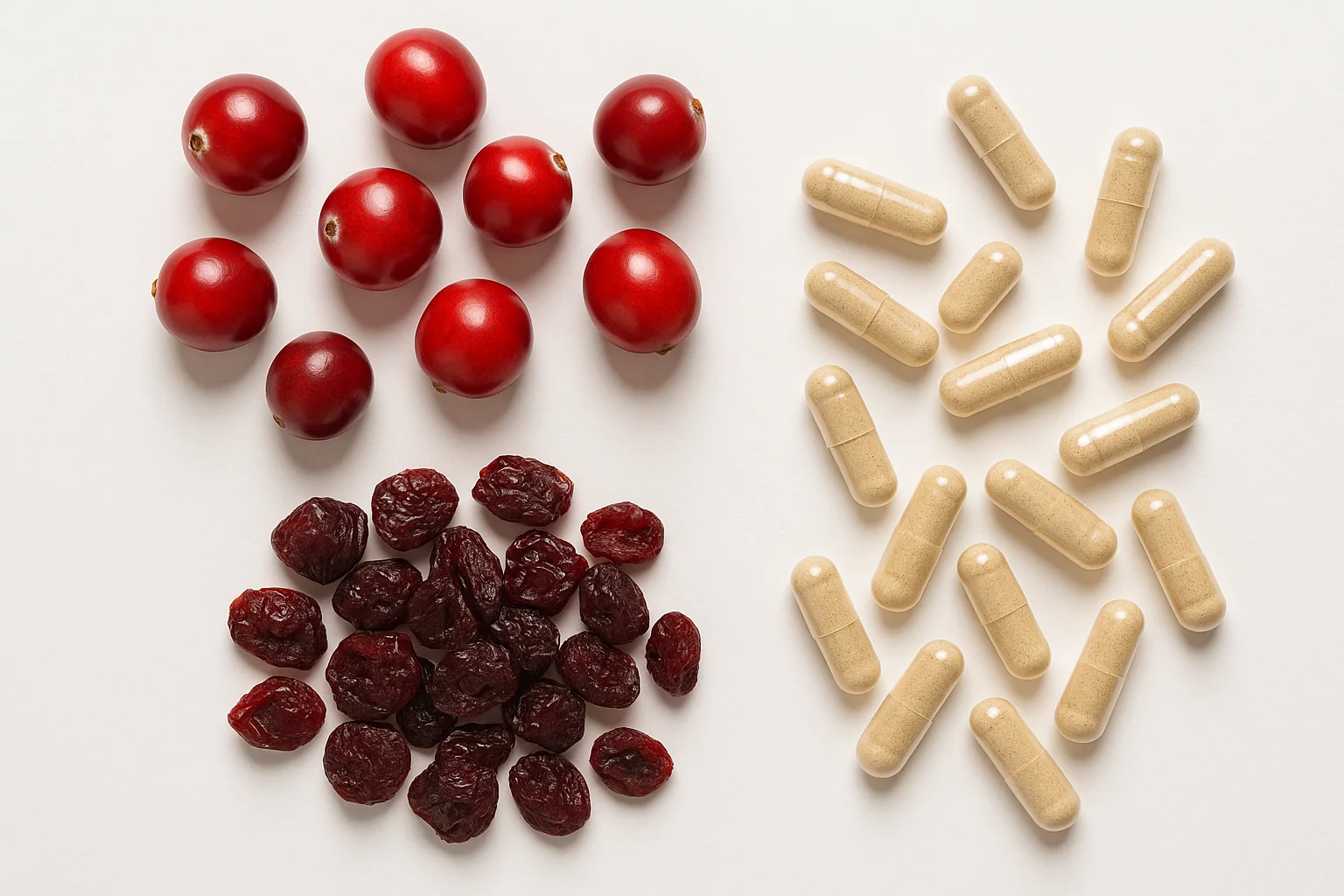
The effectiveness of cranberry directly depends on the PAC content in the product. The table below compares the forms and doses used in clinical studies with typical daily consumption.
| Form | PAC content / serving | Daily dose | Notes |
|---|---|---|---|
| Standardized extract (capsules) | 36-72 mg PAC / capsule | 1-2 capsules | The most convenient form, check standardization on the label |
| 100% cranberry juice (unsweetened) | ~7 mg PAC / 100 ml | 240-480 ml | High acidity, many calories for the required volume |
| Dried cranberry | ~2-3 mg PAC / 30 g | Insufficient in practical doses | High sugar content, low PAC content - not recommended as a supplement |
| Lyophilized powder | Variable - check the label | According to the manufacturer's declaration | Better form than juice, but standardization on PAC is required |
Who is cranberry particularly recommended for?
Cranberry has the strongest scientific justification in the prevention of recurrent urinary tract infections in women - a group that accounts for about 80% of all UTI cases. According to NIH data, about 50% of women experience at least one episode of UTI in their lifetime, and about 25% have regular recurrences (NIDDK, NIH). For this group, systematic supplementation with cranberry extract (36-72 mg PAC daily) is justified and well tolerated.
The second group includes individuals using urinary catheters (e.g., after surgeries, during immobilization), where the risk of UTI is significantly higher. The third group consists of older women after menopause - the decline in estrogen reduces vaginal acidity and alters the bacterial flora, increasing susceptibility to UTI. A study by Stothers showed that women drinking 300 ml of cranberry juice daily had a 58% lower risk of UTI over the year compared to the placebo group (Stothers, Canadian Journal of Urology, 2002).
Citation capsule (Stothers, 2002): In a randomized study, women consuming cranberry (300 ml of juice or capsules with extract) for 12 months had a 58% lower risk of recurrent UTI compared to placebo. The effect was statistically significant and included both a reduction in the number of episodes and a decrease in antibiotic use.
When does cranberry not help?
Cranberry does not work in several key situations that are worth knowing before purchasing. First of all: in the case of active bladder inflammation. If you already have symptoms - burning, frequent urination, pain above the pubis - cranberry will not eliminate the infection. This requires medical consultation and usually antibiotic therapy. Delaying treatment by using only supplements can lead to complications (pyelonephritis).
Secondly: in infections caused by bacteria other than E. coli (e.g., Klebsiella, Proteus, Enterococcus). The PAC mechanism is specific to E. coli fimbriae - other bacteria may lack these structures. Thirdly: when using non-standardized preparations. Cranberry juice with added sugar, cranberry nectars with 20-30% juice content, or dried cranberries do not contain sufficient amounts of PAC to achieve a preventive effect.
We have noticed that many women buy cranberry "for bladder cold" and are disappointed by the lack of effect - because they use it reactively during an infection, rather than preventively between episodes. This is a classic misunderstanding of the supplement's mechanism of action.
Interactions and safety of cranberry
Cranberry is generally very safe. The most important interaction concerns warfarin - cranberry may enhance its effect, increasing the risk of bleeding. The mechanism likely involves the inhibition of CYP2C9, an enzyme that metabolizes warfarin. Individuals taking warfarin or other anticoagulants (acenocoumarol, dabigatran) should absolutely consult their doctor about supplementation and regularly monitor INR.
In cases of kidney stones with oxalates (hyperoxaluria), cranberry may increase the excretion of oxalates in urine - which increases the risk of stone formation. Individuals with a history of oxalate stones should consult a urologist before using cranberry. With these exceptions - for healthy adults, long-term use of cranberry extract in standard doses is safe.
Cranberry and antibiotics - can they be used together?
Cranberry does not replace antibiotics and does not have significant clinical interactions with them - they can be used simultaneously without fear of mutual weakening of effects. However, the hierarchy of action is important: in the case of an active urinary tract infection with symptoms (burning, urgency, fever), medical consultation and antibiotic therapy are a priority. Cranberry should not delay a doctor's visit or replace a prescribed antibiotic.
The role of cranberry during UTI antibiotic therapy is twofold. First: it may reduce the adhesion of residual E. coli bacteria that survived the antibiotic course and could cause a recurrence. Second: in the case of recurrent UTIs, using cranberry extract between episodes (after completing antibiotic therapy) reduces the frequency of subsequent recurrences. This is a well-documented scheme in studies: antibiotic for treating active infection, cranberry for prevention between episodes.
There is one important exception: individuals taking warfarin should consult their doctor before using cranberry (both juice and supplements) due to the potential enhancement of anticoagulant effects. This interaction is confirmed in clinical literature and requires monitoring of INR.
UTI prevention - what else helps besides cranberry?
Cranberry is one element of a broader preventive strategy. Several other methods have scientific documentation for recurrent urinary tract infections. Hydration: consuming at least 1.5-2 liters of fluids daily dilutes urine and mechanically flushes bacteria from the urinary tract. A study by Hooton et al. showed that women with recurrent UTIs who increased their water intake by 1.5 liters daily had 48% fewer recurrences over the year (Hooton et al., JAMA Internal Medicine, 2018).
D-mannose is another supplement with a growing evidence base. Like cranberry, it acts anti-adhesively against E. coli - bacteria bind to mannose-binding proteins on the surface of the urothelium, and D-mannose as a free sugar "competes" with these receptors. A study by Kranjcec et al. showed that D-mannose (2 g daily) was as effective as the antibiotic nitrofurantoin in preventing recurrent UTIs, with a significantly better safety profile (Kranjcec et al., World Journal of Urology, 2014).
Probiotics with Lactobacillus rhamnosus GR-1 and Lactobacillus reuteri RC-14 may support vaginal flora, reducing the reservoir of E. coli that leads to ascending infections. The combination of cranberry with D-mannose and probiotics is a protocol used by some urologists in the prevention of recurrent UTIs in women.
We have noticed that women with recurrent UTIs often look for "one miracle supplement" - meanwhile, the most effective strategy is multi-faceted: hydration, hygiene after intercourse, D-mannose or cranberry preventively, vaginal probiotics, and regular urological consultations. No single supplement can replace a comprehensive approach. It is also worth knowing that cranberry and D-mannose have different, complementary anti-adhesive mechanisms - PAC from cranberry block the P-type fimbriae of E. coli, while D-mannose acts on type 1 fimbriae. The combination of both preparations may provide a broader range of protection than using only one of them. Several small studies have suggested an additive effect of this combination, although large randomized studies using it are still needed.
Frequently Asked Questions
Does cranberry cure bladder inflammation?
No - cranberry works preventively, not therapeutically. Its proanthocyanidins (PAC) block the adhesion of E. coli bacteria to the urinary tract epithelium, but do not destroy already present bacteria. In the case of active bladder inflammation, medical consultation is necessary and usually antibiotic therapy.
How many mg of cranberry extract should be taken daily?
The effective dose is 36-72 mg of proanthocyanidins (PAC) daily or 500-1500 mg of extract standardized for PAC. Always check if the supplement provides the PAC content per capsule - this is the only measure of the actual effectiveness of the preparation, not the total mass of the extract.
How long should cranberry be taken preventively?
In clinical studies, supplementation was used for 6-12 months. For recurrent UTIs (≥2 episodes per year), continuous supplementation throughout the year or seasonally during months of increased risk is justified. There is no established upper time limit for the safe use of standard doses of cranberry extract in healthy adults.
Cranberry and warfarin - can they be combined?
Cranberry may enhance the effects of warfarin by inhibiting CYP2C9. Individuals taking warfarin or other anticoagulants should definitely consult their doctor before using cranberry and regularly monitor INR. This is one of the few real drug interactions with cranberry.
Does cranberry juice work the same as a supplement?
100% unsweetened juice may be effective when consumed at 240-480 ml daily, but this means a high intake of acids and calories. A supplement with an extract standardized for PAC is more convenient and safer for individuals with diabetes, reflux, or kidney stones (Stothers, Canadian Journal of Urology, 2002).
This article is for informational and educational purposes and does not replace consultation with a doctor. If you are pregnant, breastfeeding, taking medications, or have chronic conditions, consult the use of supplements or herbs with a specialist.
Author: Michał Waluk · Published: 2026-05-04 · Updated: 2026-05-04