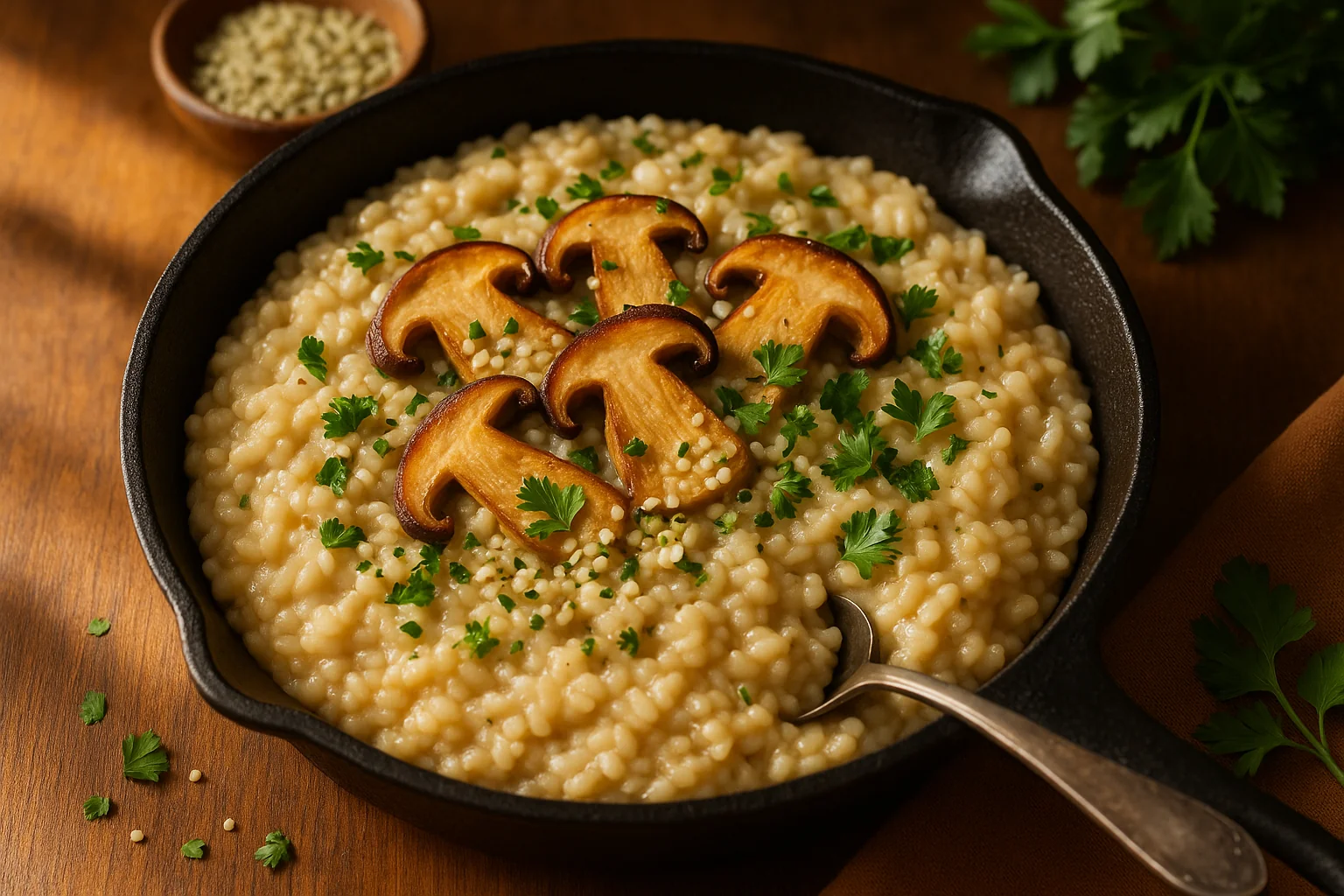

Risotto with hemp seeds and wild mushrooms
Creamy risotto with hulled hemp seeds and dried mushrooms, without butter and without cream. The technique of mantecatura, broth proportions, and protein calculation.
Creamy risotto without butter and cream sounds like a compromise, but it doesn't have to be. Shelled hemp seeds added after removing the pot from the heat and vigorously mixed into the hot rice release the fat that binds with the starch from arborio into a thick, velvety emulsion. This is the same mechanism as with butter, just with a different fat: seeds contain 48.8 g per 100 g (USDA FoodData Central, record 170148). Additionally, a broth made from dried mushrooms replaces more than half of the broth, the nutty flavor of the seeds, and forty minutes of work for two servings. Below you will find the proportions, the order of operations, and one clarification about what hemp really does to the protein in this dish, as there is a claim circulating that is the opposite of the truth.
KEY INFORMATION
• Shelled hemp seeds contain 48.8 g of fat and 31.6 g of protein per 100 g, with 38.1 g of that fat being polyunsaturated (USDA FoodData Central, record 170148).
• The omega-6 to omega-3 ratio in hemp seed oil typically ranges between 2:1 and 3:1 (Callaway, Euphytica, 2004).
• Add the seeds after removing the pot from the heat, never to boiling broth.
• Hemp does not fix lysine in rice: it is lysine itself that is the limiting amino acid in the seeds (House et al., Journal of Agricultural and Food Chemistry, 2010).
What does adding hemp seeds to risotto provide?
Creaminess without dairy. Classic risotto ends with mantecatura: cold butter mixed into hot rice creates an emulsion with the released starch. Shelled hemp seeds do the same with their own fat, which they have 48.8 g per 100 g (USDA FoodData Central, record 170148), roughly the same as butter when calculated per gram of product.
The difference lies in the type of fat. Of those 48.8 g, as much as 38.1 g is polyunsaturated fatty acids, which is about 78% of the total, while butter predominantly contains saturated fats. Callaway states that for hemp seed oil alone, over 80% is polyunsaturated, and the omega-6 to omega-3 ratio is usually between 2:1 and 3:1 (Euphytica, 2004). He calls this ratio optimal for human health, but this is his own assessment from a review, not a recommendation from WHO or FAO, and it should be read as such.
Polyunsaturated fatty acids do have a practical drawback: they are the most sensitive to heating. Hence the entire rule of this recipe. The seeds go into the pot after removing it from the heat, when the rice is hot but no longer boiling, and you mix them vigorously for a minute. The emulsion forms from movement and residual temperature, not from boiling.
Do hemp seeds improve protein in risotto?
They add quite a bit, but they do not fix what is weakest in rice, and here we need to clarify a claim circulating in recipes. Rice is low in lysine, but hemp does not save it: House et al. found that lysine is the first limiting amino acid in all studied hemp products (Journal of Agricultural and Food Chemistry, 2010).
Mattila et al. measured the same thing by a different method. In nine plant protein sources marked by one method, hemp seeds had the least lysine of all, 3.30 g per 16 g of nitrogen (Plant Foods for Human Nutrition, 2018). If you want to truly supplement this dish, add legumes: in the same set, broad beans had almost twice as much lysine as hemp.
Quantitatively, the calculation looks like this. The recipe is for two servings and contains 40 g of hemp seeds, which is 20 g per plate, and this, with 31.6 g of protein per 100 g, gives about 6 g. Rice adds about 5 g, as there are 80 g of dry arborio per serving with 6.5 g of protein per 100 g (USDA FoodData Central, records 170148 and 168931). Together, it amounts to about 11 g per plate. This is decent for a one-pot dish without meat and dairy, but it is not a portion comparable to a cutlet.
If you are looking for something thicker and more filling in the same style, check out our recipe for casserole with pumpkin and hemp seeds, where the grain is treated the same way as rice.
What ingredients do you need?
Proportions for 2 servings. Preparation takes 10 minutes, cooking 30, including soaking the mushrooms. The rice must be short-grain and starchy, as the entire effect depends on the starch that the grain releases into the broth.
- 160 g of arborio or carnaroli rice
- 20 g of dried forest mushrooms, porcini or bay boletes
- 150 g of fresh mushrooms or oyster mushrooms, optional
- 40 g of shelled hemp seeds, plus a teaspoon for decoration
- 1 medium onion and 2 cloves of garlic
- 50 ml of dry white wine or juice from half a lemon
- 2 tablespoons olive oil
- about 700 ml of vegetable broth, including the mushroom broth
- salt, white pepper, a pinch of nutmeg
- fresh parsley for serving
- optional 2 tablespoons of nutritional yeast or grated parmesan
Long-grain rice won't work here because it releases too little starch, leaving the risotto watery. Choose dried mushrooms by their aroma, not their appearance: they carry the flavor of the entire dish, as their broth replaces more than half of the stock. Do not substitute hemp seeds with ground ones, as they will dissolve in the sauce and you will lose the texture.
How to cook risotto step by step?
The technique boils down to three things: hot broth added in portions, constant contact with the pot for 18-20 minutes, and adding the hemp seeds only at the end, after removing from the heat.
- Soak 20 g of dried mushrooms in 400 ml of warm water and let sit for 20-25 minutes. Strain through a fine sieve or cheesecloth, retaining all the broth, and chop coarsely.
- Supplement the mushroom broth with vegetable broth to about 700 ml. Heat and keep hot throughout the cooking process, as cold broth lowers the temperature of the rice.
- In a wide pot, heat 2 tablespoons of olive oil and sauté finely chopped onion for 5-6 minutes until it softens and becomes translucent without browning. Add garlic and sauté for another minute.
- Add the rice and sauté for 2 minutes, stirring constantly until the grains become slightly translucent. Add the chopped mushrooms, pour in wine or lemon juice, and wait about a minute for it to evaporate.
- Add hot broth with a ladle, about 80 ml at a time, stirring every 30 seconds and waiting for the rice to absorb almost all of the previous portion. Repeat for 18-20 minutes until the grain is al dente.
- Remove the pot from the heat, add 40 g of hulled hemp seeds, and mix vigorously for a minute. Season with salt, white pepper, and a pinch of nutmeg, and on the plate, sprinkle with parsley and a teaspoon of seeds.
How to modify the recipe to suit your needs?
Risotto is a technique, not a set of ingredients, so you can substitute almost everything except for the rice and the method of adding the broth. The principle of adding hemp seeds at the very end remains unchanged in every variant.
The spring version can be made with asparagus blanched for two minutes and sugar snap peas instead of mushrooms. The flavor becomes lighter, and it's worth making the broth entirely vegetable-based, as there is no mushroom broth to deepen it.
Diced hokkaido pumpkin, 200 g, goes into the pot with the rice for the first five minutes. It breaks down, colors the dish orange, and adds sweetness that nicely counters the earthiness of the mushrooms.
If you want creaminess without rice at all, the same trick with hemp seeds works in soups: we described it in the recipe for krem z kalafiora z nasionami konopi.
The biggest mistake is using too little broth. Arborio rice needs about three times its volume in liquid, and with scant broth, the center of the grain remains hard, even though it looks ready on the outside. The second mistake is adding hemp seeds to a boiling pot.
Frequently Asked Questions
Why do hemp seeds make risotto creamy?
Because they contain 48.8 g of fat per 100 g (USDA FoodData Central, record 170148), and when vigorously mixed into hot rice, they release it to the starch freed from the arborio grains. An emulsion of fat with water and starch is created, which is exactly what butter provides in classic risotto.
Do hemp seeds complement the amino acids of rice?
Not those that lack rice the most. Lysine is the first limiting amino acid in all hemp products (House et al., Journal of Agricultural and Food Chemistry, 2010), and Mattila et al. measured 3.30 g in seeds per 16 g of nitrogen, the least among nine raw materials. Legumes add lysine.
What mushrooms pair best with hemp risotto?
Dried porcini and bay boletes, as their intense umami flavor balances the nutty taste of hemp seeds. Fresh mushrooms and oyster mushrooms provide a milder effect and require separate sautéing. A mixture of 20 g of dried and 150 g of fresh is a compromise between intensity and price.
How much protein is in a serving of risotto with hemp seeds?
About 11 g. Of this, approximately 6 g comes from hemp seeds, as there are 20 g per serving with 31.6 g of protein per 100 g, and about 5 g from rice, as 80 g of dry arborio contains 6.5 g per 100 g (USDA FoodData Central, records 170148 and 168931).
Can hemp seed risotto be frozen?
Better not. Arborio loses its creaminess after thawing, which is why it is cooked. If you want to prepare the dish in advance, cook the rice to about 80% and store it in the refrigerator for up to two days, adding the broth and hemp seeds just before serving.
We do not carry hulled hemp seeds at the u Bucha store. The hemp food products we have gathered are in the category hemp food.
The article is informational and educational in nature and does not replace consultation with a doctor. If you are pregnant, breastfeeding, taking medications, or have chronic conditions, consult the use of supplements or herbs with a specialist.
Author: Michał Waluk · Opublikowano: 2026-05-29 · Aktualizacja: 2026-08-16