
Fisetin and quercetin - senolytics for longevity (table)
Fisetin and quercetin: comparison, differences, and what to realistically choose. Table and tips from u Bucha.
Fisetin and quercetin are two flavonoids that have transitioned from the category of "nutraceutical curiosity" to the center of longevity research in recent years. A 2019 clinical study from Mayo Clinic showed that a senolytic protocol involving quercetin significantly reduced aging biomarkers in humans - in just 11 days (Kirkland and Tchkonia, PMC 2019). Fisetin, on the other hand, demonstrated a more effective removal of senescent cells than 10 other flavonoids tested simultaneously. But how exactly do they differ, which to choose, and how to dose - these are the questions this article answers with a table and specific data.
KEY INFORMATION
• Fisetin showed the strongest senolytic activity among the 10 tested flavonoids in the Mayo Clinic study (Yousefzadeh et al., PMC 2018).
• Quercetin better stabilizes mast cells and inhibits histamine - stronger effects on allergies.
• Fisetin penetrates the blood-brain barrier better than quercetin - more favorable neuroprotection.
• Both compounds are safe for short-term use; long-term data is limited.
• In senolytic protocols, fisetin and quercetin are used intermittently, not daily.
What are senolytics and why are these two flavonoids in the spotlight?
Senolytics are compounds that selectively eliminate senescent cells - aging cells that have stopped dividing, do not die naturally, and secrete pro-inflammatory cytokines (the so-called SASP: senescence-associated secretory phenotype). Their accumulation in tissues is associated with accelerated aging, cardiovascular diseases, type 2 diabetes, and neurodegeneration (Kirkland and Tchkonia, 2019).
Fisetin (3,3′,4′,7-tetrahydroxyflavonol) and quercetin (3,5,7,3′,4′-pentahydroxyflavonol) act as senolytics through different molecular pathways. Fisetin activates the Bcl-2/Bcl-xL pathway, forcing senescent cells into apoptosis. Quercetin blocks the PI3K/Akt/mTOR pathway and inhibits survival activators specific to senescent cells. The mechanisms complement each other, making the combination of both potentially stronger than either alone.
Why these two? Among dozens of studied flavonoids, only fisetin and quercetin demonstrated the strongest senolytic effects with an acceptable safety profile. Dasatinib (an oncology drug) is stronger but is associated with serious side effects. Flavonoids are candidates for supplements, not drugs - hence the interest from the longevity community.
What is cellular senescence and why do cells age?
To understand why it is necessary to remove senescent cells, one must know where they come from. Most body cells have a limited number of divisions - this is the so-called Hayflick limit, associated with telomere shortening with each division. When telomeres become too short, or when a cell suffers severe DNA damage or oncogenic stress, it enters a state of senescence: it permanently stops dividing but does not die. This is a protective mechanism - it halts the reproduction of damaged cells that could become cancerous.
The problem is that with age, senescent cells accumulate because the immune system increasingly fails to remove them. They secrete a cocktail of pro-inflammatory proteins (SASP), which "infects" neighboring cells and drives a chronic, low-grade inflammatory state known as inflammaging. The most important aspect from the perspective of senolytics is that senescent cells defend themselves against apoptosis using special survival pathways (SCAPs). Fisetin and quercetin work precisely because they block these pathways, removing the "shield" from the senescent cell and allowing it to die (Kirkland and Tchkonia, PMC 2019).
Comparative table: fisetin vs quercetin
Both substances belong to flavonoids, but they differ in their action profile, bioavailability, and practical indications. A study by Yousefzadeh and colleagues (Mayo Clinic, 2018) showed that fisetin reduced the level of senescent cells in the adipose tissue of mice by 25-50%, while quercetin achieved about 30% lower results in the same model (Yousefzadeh et al., PMC 2018).
| Feature | Fisetin | Kwercetyna |
|---|---|---|
| Chemical class | Flavanol (flavonol) | Flavonol (flavonol) |
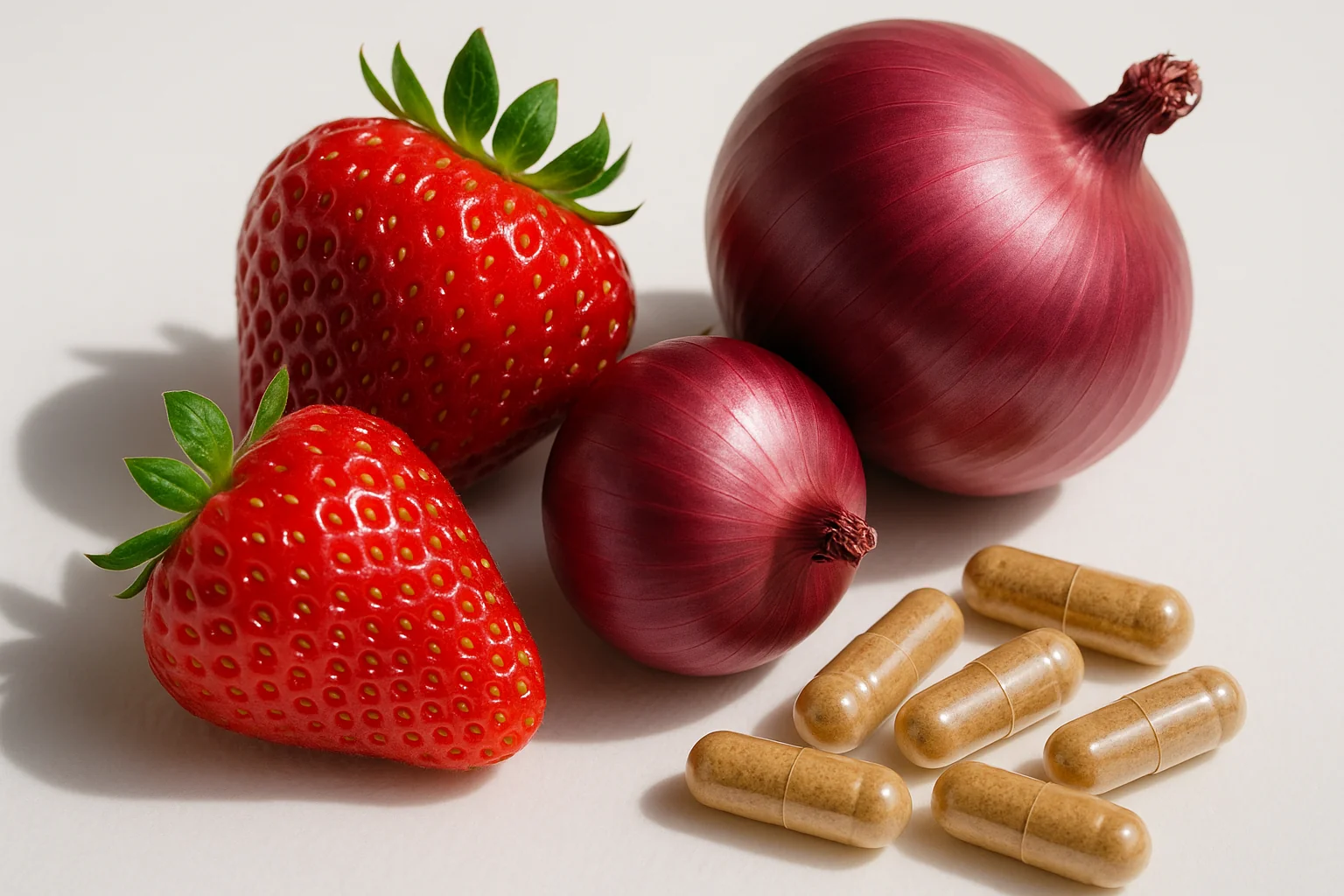
| Natural sources (top) | Strawberries, apples, persimmons | Red onion, capers, kale |
| Senolytic action | Stronger - the best among flavonoids | Umiarkowane - zwykle stosowana z dasatynibem |
| Neuroprotection / BBB penetration | Strong - well penetrates the blood-brain barrier | Weaker - poorer BBB penetration |
| Antihistaminic action | Weaker | Strong - stabilizuje mastocyty |
| Action on allergies / immunity | Moderate | Well documented |
| Antioxidant Activity | Strong | Strong |
| Oral bioavailability | Low (~5-10%), improved by piperine or phytosomes | Low (~1-10%), improved by phytosomes/piperine |
| Typical daily dose | 100-500 mg (continuous) or impulse protocol | 500-1000 mg (continuous) or impulse protocol |
| Clinical studies in humans | Limited (a few phase I/II trials) | More - allergies, heart, osteoporosis |
| Price (relative) | Higher | Lower |
How to dose fisetin - impulse protocol and continuous doses
Fisetin is being studied in two separate protocols. The first is continuous use in small doses (100-500 mg daily) aimed at neuroprotective, antioxidant, and anti-inflammatory effects. The second is the senolytic impulse protocol: high doses for 2 consecutive days, repeated every 1-3 months.
The pulse protocol comes from clinical studies at the Mayo Clinic. In the study EXploring Effects of Fisetin on Inflammation, Frailty, and Resilience (AFFIRM-LITE, NCT03430037), 20 mg of fisetin per kilogram of body weight was used for two consecutive days (ClinicalTrials.gov, 2022). For a person weighing 70 kg, that is 1400 mg daily for two days. The study results showed a reduction in SASP markers (pro-inflammatory proteins secreted by senescent cells) in the blood serum.
| Protocol | Dose | Duration | Purpose | Notes |
|---|---|---|---|---|
| Continuous (neuroprotection) | 100-500 mg/day | Long-term | Antioxidation, BDNF, neuron protection | With piperine or phytosomes for bioavailability |
| Pulse senolytic | 20 mg/kg for 2 days | 2 days every 1-3 months | Removal of senescent cells | Protocol from Mayo Clinic studies |
| Combined (fisetin + quercetin) | 500 mg fis. + 500-1000 mg kw. | 2-3 days every month | Complementary senolytic pathways | Popular in longevity circles - no RCT |
The bioavailability of fisetin is low - estimates suggest 5-10% after oral administration. Two strategies help improve it: piperine (an alkaloid from pepper, 5-20 mg) inhibits intestinal enzymes that degrade flavonoids and can increase bioavailability by 3-5 times. The phytosomal form (fisetin bound to soy lecithin) improves absorption through lipid membranes. In an impulse protocol, these two treatments are particularly justified, as the dose is high and costly.
How to dose quercetin - continuous doses and indications
Quercetin is better studied clinically than fisetin, although the data is still of moderate quality. A meta-analysis of 17 randomized controlled trials showed that quercetin at doses of 500-1000 mg daily significantly reduced levels of CRP and IL-6 (inflammatory markers) compared to placebo (Serban et al., PMC 2021). The effect was more pronounced with a duration of use exceeding 8 weeks.
For seasonal allergies, quercetin works by stabilizing mast cells - cells that release histamine during an allergic reaction. In vitro studies and several small clinical trials indicate effectiveness at doses of 500 mg twice daily, taken 2-4 weeks before the pollen season. The effect is preventive, not immediate - start taking it earlier, not when symptoms have already appeared.
Our observations show that individuals using quercetin with vitamin C (1000 mg) achieve better antihistamine effects than with quercetin alone. Vitamin C is a natural antihistamine in its own right and synergistically supports the bioavailability of flavonoids.
Safety, interactions, and who should avoid it
Both fisetin and quercetin are classified as safe for short-term use at standard doses. The European Food Safety Authority (EFSA) assessed quercetin as safe up to 500 mg daily for adults in a 2011 evaluation (EFSA, 2011). Data regarding fisetin at high doses in an intermittent protocol are more limited.
Drug interactions mainly concern medications metabolized by CYP3A4 and CYP2C9 (warfarin, statins, some immunosuppressive drugs). Quercetin inhibits these enzymes, which may raise blood levels of medications. With an intermittent protocol using high doses of fisetin, the risk of interactions increases. Both substances may enhance the effects of anticoagulants. Pregnant and breastfeeding women should avoid high doses of flavonoids due to limited safety data.
Fisetin or quercetin - which to choose in practice?
It depends on the main goal of supplementation. For those interested in longevity protocols and the removal of senescent cells - fisetin is the first choice as a stronger senolytic. For those seeking support for allergies, inflammation, and immunity - quercetin has more clinical studies and a lower price. Both substances can be used simultaneously, as they act through different molecular pathways and complement each other without known interactions.
If the priority is neuroprotection and protection of cognitive functions with age - fisetin wins, as it better crosses the blood-brain barrier and supports BDNF (brain-derived neurotrophic factor). If the priority is the cardiovascular system and lowering CRP - studies better document quercetin in this indication. Both flavonoids can be part of a broader longevity supplementation alongside resveratrol and NMN, but neither can replace a diet rich in polyphenols and physical activity.
What do studies in humans really show?
Here, honesty is needed, as there has been a lot of marketing enthusiasm around senolytics. The strongest data comes from studies in mice, where the removal of senescent cells extended healthy lifespan and improved fitness. In humans, we are at a very early stage. A pilot study with a combination of dasatinib + quercetin in patients with idiopathic pulmonary fibrosis (14 people) showed improvement in physical fitness (Justice et al., EBioMedicine, 2019), and another small study in people with diabetic kidney disease confirmed a real reduction in the number of senescent cells in adipose tissue and skin (Hickson et al., EBioMedicine, 2019).
These are promising signals, but they need to be read cautiously. These were trials involving a dozen or so people, measuring biomarkers and performance parameters - not lifespan. No study has proven that flavonoids extend human life. Changing the SASP marker in the blood is not the same as a confirmed clinical benefit. Therefore, fisetin and quercetin remain experimental compounds in the context of longevity, and dietary supplements are not a registered senolytic therapy. If you are considering an impulse protocol with high doses, this is a topic for discussion with a doctor, not a self-experiment.
How do fisetin and quercetin fit into a broader longevity strategy?
Senolytics are just one lever among many, and probably not the most important. Lifestyle interventions have much stronger evidence than any single supplement: regular exercise triggers autophagy and improves mitochondrial function, adequate sleep supports nightly tissue cleaning, and moderate calorie restriction is among the best-documented methods for slowing aging processes in animal models. In this context, flavonoids are an addition, not a foundation.
In longevity circles, fisetin and quercetin are sometimes compared with other studied compounds - NAD precursors (NMN, NR), resveratrol, spermidine, or metformin. However, it should be remembered that such "stacks" rarely have confirmation in randomized studies in humans and are mainly based on mechanistic reasoning. A sensible order is the opposite of popular belief: first a diet rich in polyphenols, sleep, exercise, and weight control, and only then possible experimentation with senolytics as a supplement. Resveratrol is often combined with flavonoids in this context due to their common action on the SIRT1 pathway.
Frequently Asked Questions
What are senolytics and why are fisetin and quercetin in this group?
Senolytics are compounds that selectively remove aging (senescent) cells that do not die naturally and secrete pro-inflammatory molecules (SASP). Fisetin and quercetin show senolytic activity in preclinical studies and preliminary human studies - they initiate apoptosis of senescent cells through various molecular pathways (Kirkland and Tchkonia, PMC 2019).
How much fisetin should be taken daily and for how long?
In the impulse protocol (senolytic), 20 mg/kg body weight is used for 2 consecutive days, every 1-3 months - for a 70 kg person, this is about 1400 mg over 2 days. Daily doses of 100-500 mg are being studied for neuroprotection and antioxidant effects. Always consult higher doses with a doctor.
Quercetin or fisetin - which to choose for immunity and allergies?
For allergies and immune support, quercetin is better. It stabilizes mast cells and inhibits histamine release - an effect clinically confirmed at 500-1000 mg daily (Serban et al., 2021). Fisetin has weaker antihistamine effects but stronger neuroprotection.
Can fisetin and quercetin be taken together?
Yes. Both belong to flavonoids and do not show known negative interactions. They act through different molecular pathways - quercetin as a daily antioxidant, fisetin in the impulse protocol once a month - making them complementary supplements in longevity strategies.
What are the natural sources of fisetin and quercetin?
Fisetin is most abundant in strawberries (160 mcg/g), apples, and persimmons. Quercetin - in red onions, capers, and kale. Concentrations in food are, however, several hundred times lower than in supplements used in clinical studies. Diet can complement supplementation, but it cannot replace it for therapeutic purposes.
Do senolytics really extend life in humans?
No clinical study has yet shown an extension of life in humans after senolytics. Data on extending healthy life mainly comes from studies on mice. Trials in humans are small and early - measuring biomarkers and physical fitness, not lifespan. Therefore, fisetin and quercetin should be treated as experimental compounds, not proven anti-aging therapies.
Can fisetin be taken daily, or only in pulses?
Both approaches are used. Continuous low doses (100-500 mg) are being studied for their antioxidant and neuroprotective effects. The impulse protocol - a high dose for 2 days every 1-3 months - is a senolytic scheme from clinical studies, limiting cost and exposure. Higher doses should be consulted with a doctor, especially when taking medications metabolized by the liver.
This article is for informational and educational purposes and does not replace consultation with a doctor. If you are pregnant, breastfeeding, taking medications, or have chronic conditions, consult the use of supplements or herbs with a specialist.
Author: Michał Waluk · Published: 2026-05-04 · Updated: 2026-05-04