
Energy balls with hemp protein and dates – power balls
Energy balls with hemp protein and dates – a recipe for power balls ready in 20 minutes. No baking, no sugar, packed with protein and healthy fats.
Do you need a snack ready in 20 minutes, without an oven and without drawing attention on your desk? Energy balls with hemp protein and dates fit this role perfectly. One ball contains about 90–100 kcal, 3–4 g of protein, and natural sweetness without added sugar. Hemp protein contains about 50% edestin and 33% albumins – fractions that are well absorbed, especially after physical activity. The recipe is simple: blender, fridge, done. I will show you how to adjust the proportions and avoid the most common mistake that causes the balls to crumble.
KEY INFORMATION
• Hemp protein contains about 50% edestin and 33% albumins – fractions that are well absorbed after physical exertion (Schuler et al., Nutrients, 2023).
• A serving of 30 g of hemp protein powder provides 15–18 g of protein and 5–7 g of fiber (USDA FoodData Central, 2023).
• The digestibility of hemp protein (PDCAAS about 0.63–0.66) is higher than that of pea protein (Tang et al., Journal of Food Science, 2010).
• You can store the balls in the fridge for up to 2 weeks or in the freezer for up to 3 months – ready for the whole week from one session.
What does hemp protein provide in energy balls?
Most recipes for energy balls are based on oats, nut butters, and dates – a great carbohydrate base, but low in protein. Adding 3 tablespoons of hemp protein powder changes the balance: a serving of 2 balls starts to provide 6–8 g of protein instead of 2–3 g. Schuler et al. (Nutrients, 2023) indicate that hemp protein contains about 50% edestin – a globulin with a structure similar to human globin, which is particularly well absorbed after exercise when muscle tissues actively take up amino acids.
The taste of hemp protein is distinctly nutty-earthy, stronger than whey or rice protein. Combined with dates and cocoa, this flavor becomes an asset rather than a drawback – creating a deep, dark chocolate flavor profile. The only rule: don’t overdo it. More than 4 tablespoons for 12 balls makes the bitterness of the protein dominate over the sweetness of the dates. An optimal 2–3 tablespoons provide balance.
We noticed in tests that hemp protein with a higher fat content (darker color, stronger flavor) creates a denser ball than defatted protein (lighter, milder). The fat in the protein helps the mixture bind together like peanut butter. If your balls are crumbling, check the protein label – defatted requires an extra tablespoon of butter or coconut oil.
Nutritional values – what does a serving of 2 balls provide?
Two balls (about 56 g) provide about 185–200 kcal, 6–8 g of protein, 8 g of fat, and 22 g of carbohydrates (of which most are natural sugars from dates). The fiber from hemp protein and oats is about 3 g per serving. Medjool dates contribute iron, potassium, and magnesium. Almond butter adds vitamin E and monounsaturated fatty acids.
Ingredients – what do you need?
Proportions for 12–14 balls (about 340 g of mass). Active preparation time: 20 minutes + 30 minutes cooling.
- 200 g of Medjool dates, pitted (approx. 10–12 pieces)
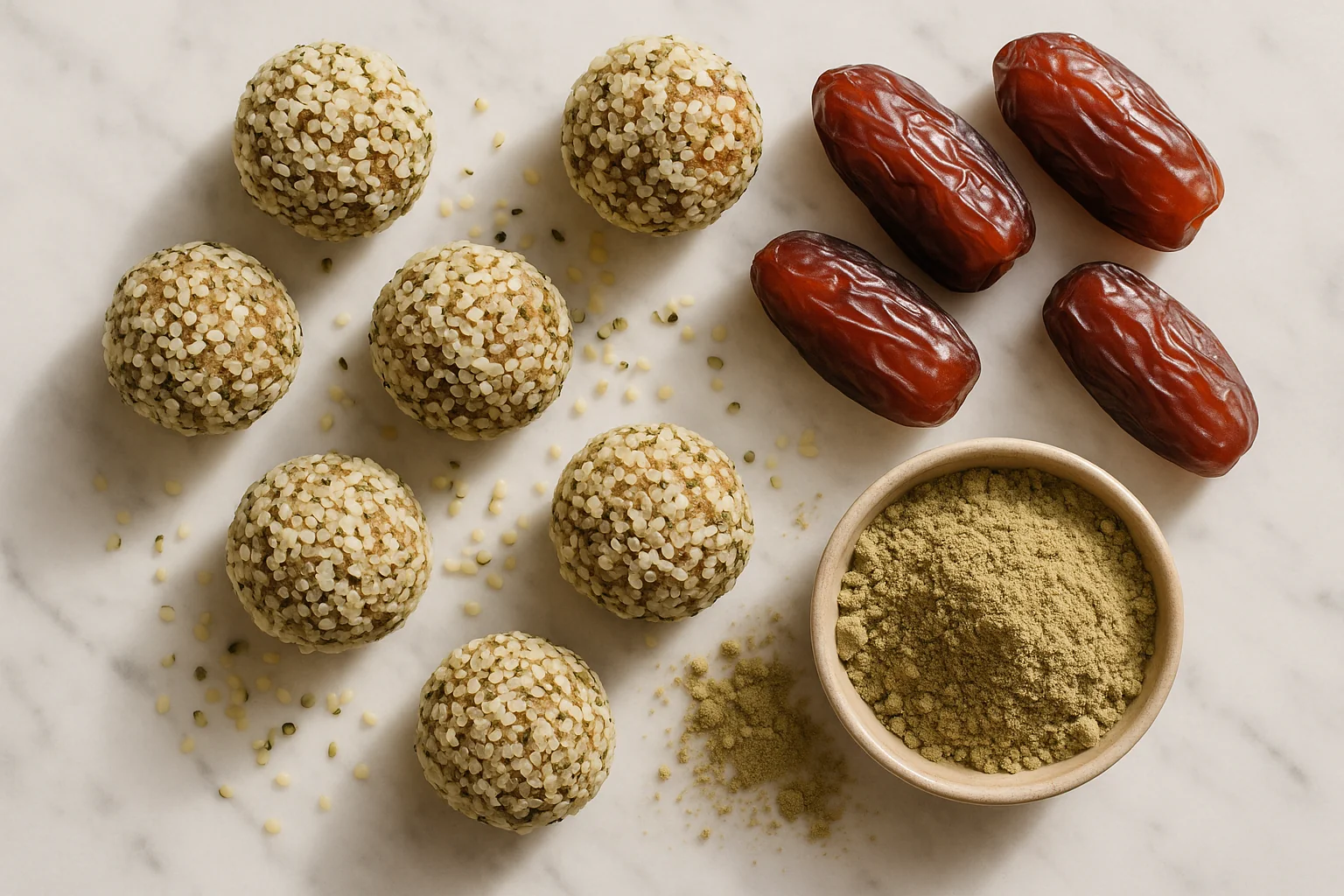
- 3 tablespoons (about 25 g) of BIO hemp protein powder
- 4 tablespoons of almond or nut butter (without sugar)
- 1 tablespoon of unrefined coconut oil
- 2 tablespoons raw cacao
- 2 tablespoons of rolled oats
- a pinch of sea salt
- optional: 1 teaspoon of vanilla extract, a pinch of cinnamon
- for coating: 3 tablespoons of hulled hemp seeds or coconut flakes
How to prepare energy balls with hemp protein – step by step?
The recipe does not require an oven or a stove. You need a food processor or a powerful blender. The total active time is about 20 minutes, the rest is done by the fridge.
Step 1. Soak the dates. Place pitted dates in a bowl, cover with warm water for 5–10 minutes. Soaking makes them blend into a smoother mass and gives the balls a creamy texture. If the dates are fresh and already soft, skip this step. Drain the water, keeping 2 tablespoons.
Step 2. Blend the base. Transfer the drained dates to the food processor. Add almond butter, coconut oil, and salt. Blend for about 60 seconds until uniform – the mixture should be sticky and pull away from the sides. With a strong blender, 40 seconds is sufficient.
Step 3. Add protein, cocoa, and flakes. To the date mixture, add hemp protein, cocoa, and oats. Blend briefly – 20–30 seconds in pulses. The mixture should be thick, slightly grainy from the flakes. Don’t overdo the blending – excessive breakdown of the flakes changes the texture to too smooth.
Step 4. Check the consistency. Take a spoonful of the mixture and try to form a ball in your hands. A well-stuck mixture does not stick to your hands and holds its shape. Too dry? Add a tablespoon of soaking water. Too wet? Add a tablespoon of hemp protein. This is the most important step – a bad consistency at this stage can be corrected without re-blending.
Step 5. Form the balls. Moisten your hands with cold water. Tear off portions of the mixture of about 25–30 g (the size of a large tablespoon). Quickly roll in your hands in a circular motion to form a uniform ball. Place on a baking sheet lined with paper. Wet hands prevent the mixture from sticking – repeat moistening every 3–4 balls.
Step 6. Coat and chill. Prepare a bowl with hulled hemp seeds or coconut flakes. Coat each ball thoroughly. Place on a baking sheet and refrigerate for at least 30 minutes. Chilled balls are firmer and better withstand transport to work or training.
Tips and variations
Energy balls with hemp protein are the base for many variations. Here are some tried-and-true modifications:
Matcha version. Replace cocoa with 2 teaspoons of ceremonial matcha. The mixture changes color to deep green, and the taste becomes slightly herbal. Add 1 teaspoon of honey or maple syrup, as matcha is more bitter than cocoa. Coat in coconut flakes – the white background highlights the green color. Also, check out our recipe for energy balls with matcha and hemp seeds.
Nut version. Add 30 g of walnuts or pecans to blend with the dates. Nuts bring additional fat and deeper flavor. Reduce almond butter by a tablespoon so the mixture isn’t too fatty.
Citrus version. Add the zest of 1 orange or lime to the mixture. The citrus accent perfectly breaks the earthiness of hemp protein and the bitterness of cocoa. Decorate with coconut-coated balls topped with fruit zest.
Nut-free version (allergy). Replace almond butter with sunflower seed butter or pumpkin seed paste. The taste is less sweet, more pronounced. Pumpkin seed butter colors the mixture a greenish hue – an optically interesting effect.
Frequently Asked Questions
How much protein do energy balls with hemp protein have?
One ball (approx. 28 g) provides about 3–4 g of protein. A 30 g serving of hemp protein powder contains 15–18 g of protein (USDA FoodData Central, 2023). Two balls make for a solid post-workout snack with 6–8 g of protein and natural energy from dates.
Do energy balls with hemp protein need to be baked?
No – this is a no-bake snack. Dates act as a natural binder. All you need is a blender and 20 minutes of work. The lack of heat treatment preserves the omega-3 fatty acids from hemp protein, which have a ratio of omega-3 to omega-6 of about 3:1 (Callaway, Euphytica, 2004).
How long can energy balls be stored?
In the fridge in an airtight container for up to 2 weeks. In the freezer for up to 3 months – take them out 15 minutes before eating. Hemp protein contains about 50% edestin (Schuler et al., Nutrients, 2023), whose nutritional properties do not change during cold storage.
How to determine the amount of hemp protein in energy balls?
Optimal is 2–3 tablespoons (approx. 20–25 g) per batch of 12 balls. More than 4 tablespoons results in a noticeable bitterness. The digestibility of hemp protein (PDCAAS approx. 0.63–0.66) is good even in small portions (Tang et al., Journal of Food Science, 2010).
What can replace dates in energy balls?
Medjool dates are the best due to their creamy texture. Alternatives: dried plums (less sweet), dried apricots (tart), dried figs. Each requires 5 minutes of soaking. All serve as a natural sweetener without refined sugar.
This article is for informational and educational purposes and does not replace consultation with a doctor. If you are pregnant, breastfeeding, taking medications, or have chronic conditions, consult the use of supplements or herbs with a specialist.
Author: Michał Waluk · Published: 2026-05-04 · Updated: 2026-05-04