
Sodium butyrate for the intestines - dosage and for whom (table)
Sodium butyrate for the intestines: dosage table, how much to take, when and how to start. A practical guide from u Bucha.
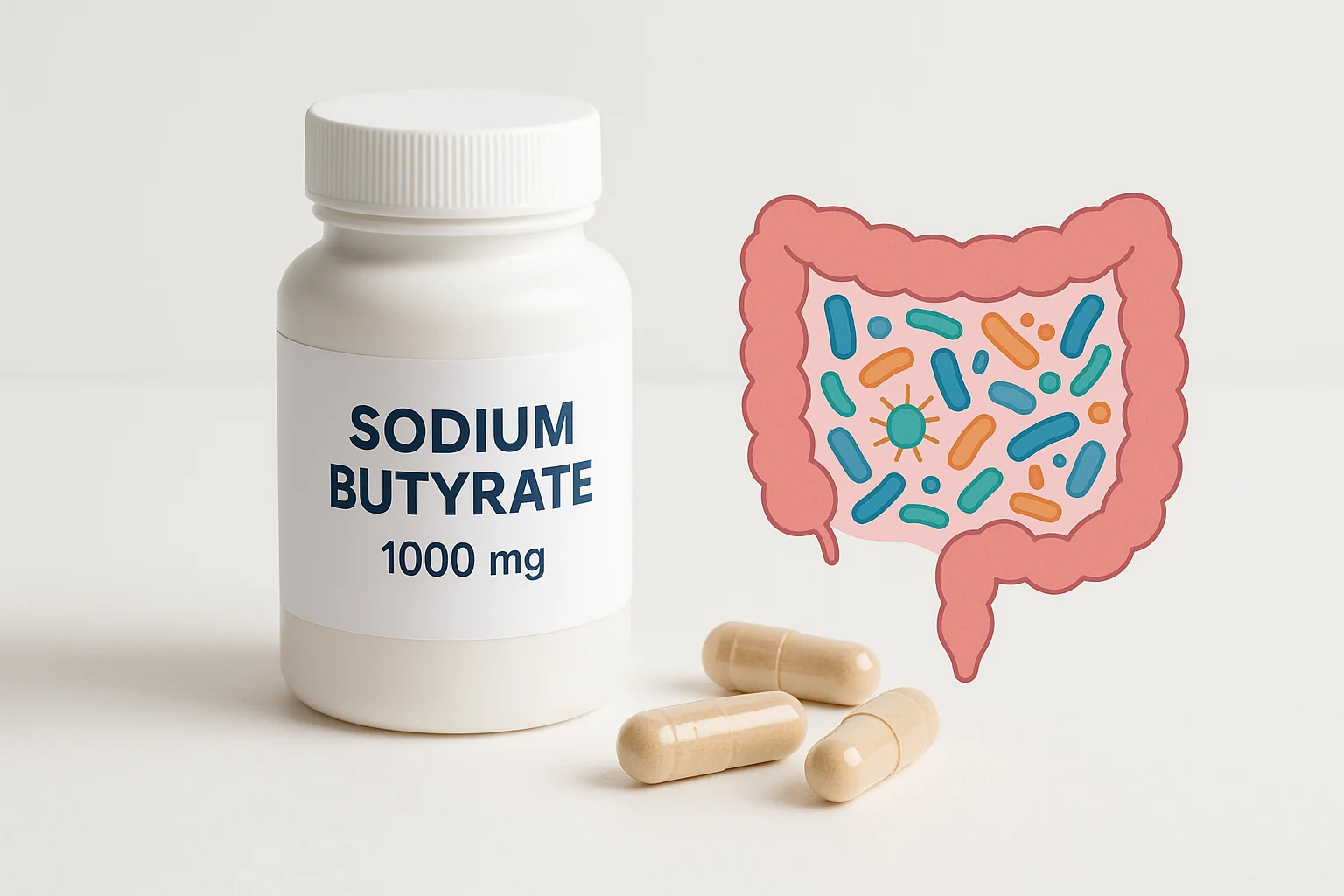
Sodium butyrate is a supplement that has transitioned from a niche product for gastroenterologists to one of the most sought-after supplements for the intestines in recent years. Not without reason: butyric acid is literally fuel for the epithelial cells of the colon. A study by Hamer et al. published in Alimentary Pharmacology & Therapeutics It has been shown that butyrate provides about 60-70% of the energy for colonocytes and is crucial for maintaining the integrity of the intestinal barrier (Hamer et al., Alimentary Pharmacology & Therapeutics, 2008). This article explains for whom sodium butyrate makes sense, how to dose it, and what to pay attention to when choosing a product.
KEY INFORMATION
• Butyric acid provides about 60-70% of the energy for colonocytes - it is a key fuel for the epithelial cells of the large intestine (Hamer et al., Alimentary Pharmacology 2008).
• Sodium butyrate is particularly indicated for IBS, leaky gut, dysbiosis, and after antibiotic therapy.
• Standard dose: 150-600 mg of butyric acid per day in enteric form or delayed release.
• The preparation must have an enteric coating - without it, butyric acid is degraded in the stomach before reaching the large intestine.
• Butyric acid is naturally produced by gut bacteria from fiber - a high-fiber diet is essential for its production.
How does sodium butyrate work in the intestines?
Butyric acid (butyrate) is a short-chain fatty acid (SCFA) produced by gut bacteria during the fermentation of indigestible fiber - mainly by Firmicutes, including Faecalibacterium prausnitzii i Roseburia. It is the main source of energy for the epithelial cells of the large intestine. But that's not all - butyrate also plays a role as an epigenetic regulator: it inhibits histone deacetylases (HDAC), which affects the expression of genes related to inflammation, cell proliferation, and apoptosis.
With a disrupted microbiome (dysbiosis, after antibiotic therapy, with a low-fiber diet), the production of endogenous butyrate decreases. Colonocytes then become malnourished, tight junctions (the connections between epithelial cells) loosen - leading to a phenomenon known as "leaky gut." Supplementation with sodium butyrate allows for the direct delivery of butyric acid, bypassing dependence on the state of the microbiome.
Sodium butyrate dosage table - how much, when, and in what form?
A key parameter when choosing a product is the release form. Butyric acid without protection is absorbed in the small intestine and does not reach the colon, where it is needed. The product must have an enteric coating or a delayed-release system.
| Indication | Daily dose (butyric acid) | When to take | Duration |
|---|---|---|---|
| Prevention and overall gut health | 150-300 mg | Once daily with a meal | Minimum 8-12 tygodni |
| IBS (Irritable Bowel Syndrome) | 300-600 mg | Divided into 2 doses with meals | 12 weeks according to studies |
| After antibiotic therapy (rebuilding) | 300-400 mg | With meals, throughout the treatment | 4-8 tygodni po antybiotyku |
| Leaky gut | 300-600 mg | In the evening with a meal | 3-6 months |
| Ulcerative colitis (supplementary) | Up to 1200 mg (under medical supervision) | According to the gastroenterologist's indications | According to the doctor's indications |
Who is sodium butyrate particularly recommended for?
Sodium butyrate has the best justification in several specific groups. First: people with IBS (Irritable Bowel Syndrome). The study by Urbansky et al. showed that supplementation with sodium butyrate in enteric-coated capsules for 12 weeks significantly reduced abdominal pain and improved stool regularity in patients with IBS-D (Urbansky et al., Journal of Clinical Gastroenterology, 2014). The effect is consistent with other studies - butyrate reduces visceral hypersensitivity, which is one of the main mechanisms of pain in IBS.
The second group: individuals after antibiotic therapy. Antibiotics destroy butyrate producers - bacteria of the genus Faecalibacterium i Roseburia are particularly sensitive to many broad-spectrum antibiotics. Supplementation with sodium butyrate for 4-8 weeks after antibiotic treatment may support the regeneration of the intestinal barrier before the microbiome returns to normal.
The third group: individuals on a low-fiber diet. The Western diet based on processed foods drastically limits the substrate for butyrate production by gut bacteria. Estimates indicate that the average Pole consumes about 15 g of fiber daily, while the recommended minimum is 25-30 g (NCEZ/PZH). With chronic fiber deficiency, the production of endogenous butyrate is significantly limited.
Citation capsule (Hamer et al., 2008): Butyric acid accounts for about 60-70% of the energy needs of colonocytes and is a key regulator of the integrity of the intestinal barrier. A deficiency of butyrate is associated with the loosening of tight junctions, increased intestinal permeability, and exacerbation of inflammatory states in the large intestine (Hamer et al., Alimentary Pharmacology & Therapeutics, 2008).
Diet and butyrate - the foundation without supplementation
Before you buy sodium butyrate, it's worth asking yourself: how much fiber do I consume daily? Products rich in so-called fermentable fiber - resistant starch, inulin, fructooligosaccharides (FOS) - are the best "food" for butyrate-producing bacteria. Main sources of resistant starch: cooked and cooled potatoes, green bananas, cooked and cooled rice. Inulins and FOS: Jerusalem artichoke, onion, garlic, leek, chicory, bananas.
Supplementation with sodium butyrate does not replace a high-fiber diet - it complements it in situations where the microbiome is disrupted or when the diet is temporarily low. The most effective protocol is a combination: increasing the intake of fermentable fiber + sodium butyrate for the first month + probiotics containing butyrate-producing strains (e.g. Lactobacillus reuteri, Bifidobacterium longum).
We have noticed that individuals using sodium butyrate without simultaneously changing their diet have worse long-term outcomes - the supplement acts "symptomatically" when the microbiome is unable to produce its own butyrate, but does not address the root cause of the deficiency.
Sodium butyrate and the microbiome - how to combine them for the best effects?
Sodium butyrate and probiotics act at different levels of the gut axis, which is why their combination is often used in gut health support protocols. Probiotics (strains Lactobacillus i Bifidobacterium) colonize the small intestine and interact with immune cells of the mucosal membrane. Sodium butyrate reaches the large intestine and nourishes colonocytes, strengthening the mucosal barrier. These are complementary mechanisms, not interchangeable.
Combination protocol: probiotics in the morning on an empty stomach (or 30 minutes before breakfast) - at this time, the stomach pH is higher after the overnight break, which improves the survival of the strains. Sodium butyrate in the evening with a meal or at noon - the enteric-coated preparation does not require a specific timing relative to meals, but the presence of fat in the meal may support peristalsis, which transports the capsule to the large intestine. Prebiotics (inulin, FOS, resistant starch) should be consumed regularly in the diet - they are "food" for bacteria producing their own butyrate.
In the case of IBS-D (diarrheal form), the combination of sodium butyrate with probiotics containing Lactobacillus rhamnosus GG or Bifidobacterium infantis shows better results in studies than each of these ingredients separately. Synergistic effects include reducing intestinal permeability and normalizing motility.
Sodium butyrate and inflammatory bowel diseases - what is known?
Ulcerative colitis (UC) is a disease in which the epithelial lining of the large intestine is subject to chronic inflammation. Inflamed colonocytes have impaired ability to oxidize butyrate - which paradoxically deepens the energy deficiency in the cells and exacerbates inflammation. This vicious cycle makes sodium butyrate supplementation biologically justified in UC as an adjunctive treatment.
The study by Scheppach et al. showed that sodium butyrate enemas improved mucosal inflammation parameters in patients with ulcerative colitis - the effect was similar to enemas with mesalazine (the standard treatment) in distal form (Scheppach et al., Gastroenterology, 1992). Oral supplements in enteric-coated form potentially have a weaker effect on distal sections of the intestine than enemas, but are easier to use.
Important: for ulcerative colitis, Crohn's disease, and other non-specific inflammatory bowel diseases, sodium butyrate supplementation should be consulted with a gastroenterologist and treated as a complement, not an alternative to prescribed pharmacological treatment. Self-changing the treatment protocol may lead to disease exacerbation. Sodium butyrate is, however, a safe and justified supplement for common and mild conditions such as occasional bloating, discomfort after meals rich in fermentable carbohydrates (FODMAP), and transient bowel rhythm disturbances. In such cases, it does not require medical consultation - a dose of 150-300 mg of butyric acid daily for 4-8 weeks is safe for adults without diagnosed bowel diseases. Just remember to choose a preparation with an enteric coating or microencapsulated form of butyric acid, as without it the active substance will not reach the large intestine.
Frequently Asked Questions
What is sodium butyrate and where does it come from?
Sodium butyrate is the sodium salt of butyric acid - a short-chain fatty acid produced by gut bacteria during fiber fermentation. It is the main fuel for colonocytes (cells of the colonic epithelium) and a key regulator of intestinal barrier integrity (Hamer et al., Alimentary Pharmacology & Therapeutics, 2008).
How much sodium butyrate should I take daily?
Standard doses are 150-600 mg of butyric acid daily. For IBS and inflammatory bowel conditions, 300-600 mg is used. The preparation must have an enteric coating or a delayed-release system - without it, butyric acid is degraded in the stomach before reaching the large intestine.
What is sodium butyrate good for?
Sodium butyrate has effects in the areas of: strengthening the intestinal barrier, reducing inflammation in the colon, alleviating IBS symptoms, and supporting the restoration of the microbiome after antibiotic therapy. A study by Urbansky et al. showed a significant reduction in abdominal pain and improvement in stool with IBS-D (Journal of Clinical Gastroenterology, 2014).
Can sodium butyrate be taken for IBS?
Yes - several randomized studies have shown improvement in IBS symptoms, particularly in the diarrhea-predominant form (IBS-D), with sodium butyrate supplementation in enteric form over 12 weeks. IBS, however, requires an individual approach and gastroenterological diagnosis, as symptoms can have various causes requiring different management.
Does sodium butyrate smell?
Butyric acid in its pure form has an unpleasant odor. Preparations contain sodium or calcium butyrate in enteric-coated capsules or coated forms, which eliminates contact with the substance during swallowing. A good quality preparation should not be perceptible in smell. If the capsules have a strong odor - it is a sign of poor quality packaging or form.
How to assess whether sodium butyrate is effective?
The effects of sodium butyrate supplementation are easiest to measure in IBS and food discomfort: reduced bloating, better stool regularity, and reduced abdominal pain. The first effects usually appear after 3-4 weeks of regular use, and a full assessment requires at least 8-12 weeks. If after 12 weeks at a dose of 300-600 mg daily there is no improvement in digestive symptoms, it is worth consulting a gastroenterologist - the cause of the discomfort may be an issue beyond butyrate deficiency.
This article is for informational and educational purposes and does not replace consultation with a doctor. If you are pregnant, breastfeeding, taking medications, or have chronic conditions, consult the use of supplements or herbs with a specialist.
Author: Michał Waluk · Published: 2026-05-04 · Updated: 2026-05-04