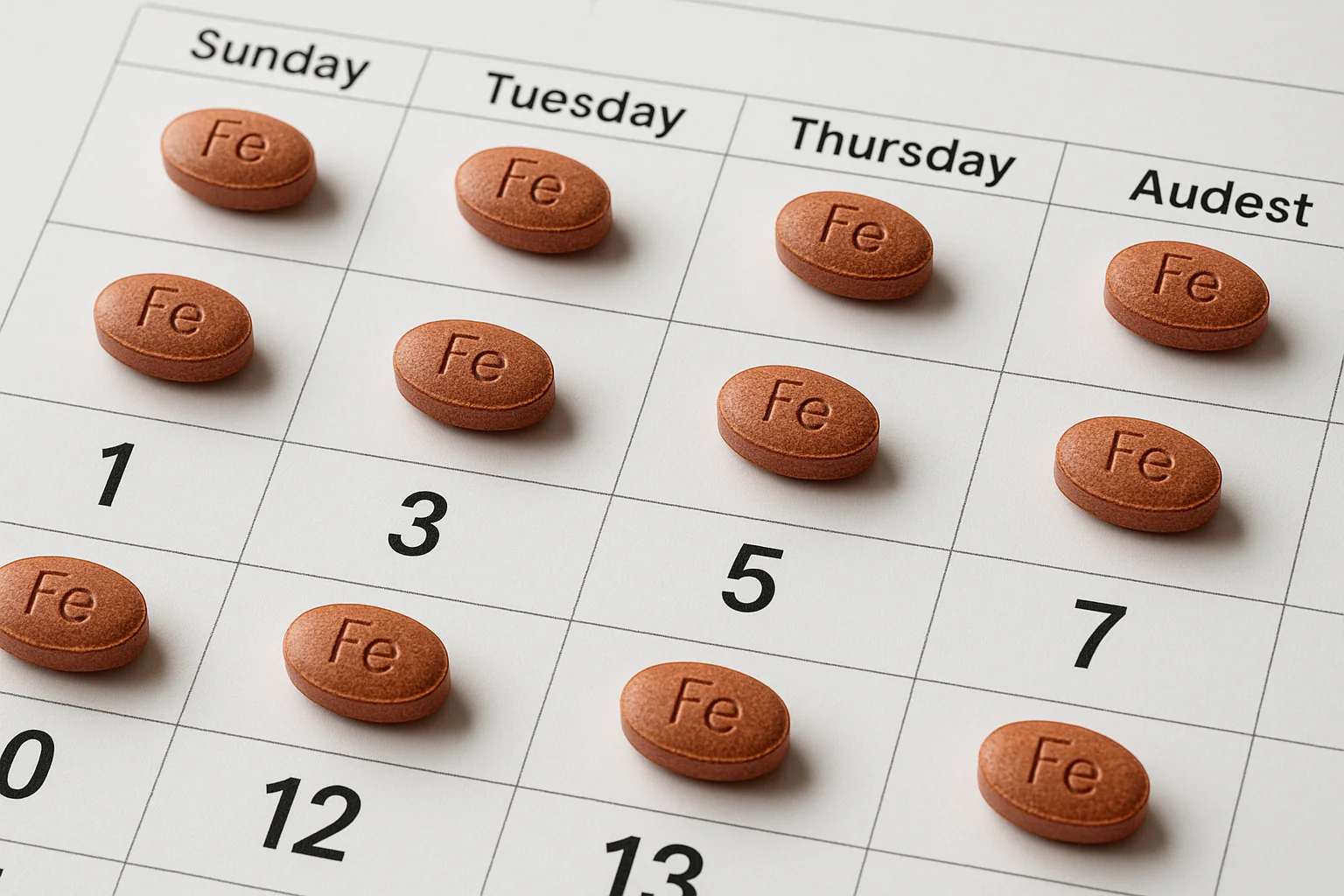

Iron every other day instead of daily - what studies on hepcidin have revealed
Iron every other day instead of daily: answers based on scientific research. u Bucha.
For decades, doctors have recommended iron twice a day or daily. It turns out that this regimen may be less effective than supplementation every other day. A study published in the prestigious Lancet Haematology in 2015 showed that fractional iron absorption is higher with alternating dosing than with daily dosing - due to a hormone called hepcidin (Moretti et al., Lancet Haematol, 2015). This discovery changed the clinical approach to iron supplementation - it's worth knowing what lies behind this change.
KEY INFORMATION
• Iron supplementation every other day provides higher fractional absorption than daily - Lancet Haematology, 2015.
• Mechanism: hepcidin blocks absorption for 24 hours after a dose; a one-day break 'resets' it.
• The every-other-day regimen may result in fewer gastrointestinal side effects.
• In cases of severe anemia, a doctor may decide on daily dosing despite lower fractional absorption.
• Vitamin C taken with iron increases absorption - tea and coffee block it.
What is hepcidin and how does it regulate iron in the intestines?
Hepcidin is a 25-amino acid hormonal peptide, primarily produced by liver hepatocytes. It is the main regulator of systemic iron metabolism - acting as a 'gatekeeper.' When iron stores in the body are high, the liver produces more hepcidin. When they are low (as in deficiency), hepcidin drops, opening the intestines for absorption (Ganz, Physiol Rev, 2013).
The molecular mechanism is elegant. Hepcidin binds to ferroportin - the only exporter of iron from intestinal cells to the bloodstream. After binding with hepcidin, ferroportin is internalized and degraded. Without ferroportin, iron absorbed by enterocytes gets 'trapped' in the cell and excreted along with it when the enterocyte dies after a few days. The effect: iron ends up in the stool, not in the blood.
A key finding of the Moretti study is that the iron dose itself - even oral, in deficiency - sufficiently raises hepcidin to block absorption for the next 24 hours. It's a closed loop: the more iron you give daily, the more you block its absorption the next day. A one-day break allows hepcidin to return to baseline, and the next dose hits 'open doors'.
What was the key study about?
The study by Moretti et al. included young women with iron deficiency (without anemia or with mild anemia). Participants received iron labeled with stable isotopes in various regimens: daily, twice a day, or every other day. Absorption was measured using the isotopic method - precise and objective (Moretti et al., Lancet Haematol, 2015).
The results were surprising. Women taking iron every other day absorbed significantly more fractional iron than those taking it daily. Moreover, the twice-a-day regimen was worse than once a day, as the afternoon dose hit the hepcidin induced by the morning dose. 'More times' equated to 'less effectively.'
The total amount of iron absorbed was comparable or higher with the alternating regimen, while simultaneously reducing the gastrointestinal exposure to unbound iron. This explains the clinically observed phenomenon: patients taking iron daily often report constipation, nausea, and a metallic taste - while those on the every-other-day regimen report these symptoms less frequently.
We noticed that this mechanism has practical consequences that many patients are unaware of: if you drink coffee or tea in the morning, and the iron tablet is for the same morning - that coffee will block part of the absorption. But will you take another tablet in the afternoon? Then you hit the hepcidin from the morning dose. A one-day break elegantly avoids both problems.
Practical tips: how to optimize iron absorption?
The every-other-day regimen is not the only variable. Several dietary factors significantly affect absorption regardless of dosing timing. Vitamin C (ascorbic acid) reduces iron Fe³⁺ to the more absorbable Fe²⁺ and forms soluble chelates with it - studies show even a 3-fold increase in absorption when taken simultaneously with 200 mg of vitamin C (Camaschella, NEJM, 2015).
Tea, coffee, and red wine contain polyphenols and tannins that bind iron into insoluble complexes. Tea can reduce iron absorption by 60-90% when taken within an hour of the tablet. Dairy products (calcium) and whole grains (phytates) also block absorption - which is why the classic recommendation is: iron on an empty stomach, washed down with water or orange juice.
Amino acids, especially from meat, form 'meat' chelates with iron that improve absorption. This is one reason why heme iron from meat is absorbed better than non-heme from tablets and plants. For vegetarians, this is important information: the absorption of iron from supplements in a plant-based diet may be lower than indicated on the label, precisely due to phytates and polyphenols from whole grains.
When does a doctor recommend daily dosing after all?
The every-other-day regimen is optimal for individuals with iron deficiency without severe anemia - a typical preventive scenario or mild hypochromic anemia. However, in cases of severe anemia (hemoglobin below 8 g/dL) or rapidly increasing demand (pregnancy, intensive oncological treatment), the doctor may decide on daily supplementation despite lower absorption fraction. In such situations, the total amount of iron delivered is more important than the absorption fraction.
A similar situation applies to intravenous iron treatment (i.v.) - used for IBD, chronic kidney disease, or after major surgeries. Iron administered directly into the bloodstream completely bypasses hepcidin, so the discussion about alternating schemes does not pertain to this route of administration.
Hepcidin and inflammation - why does infection block iron?
Hepcidin does not respond solely to iron levels. A strong stimulator of its production is inflammation - particularly interleukin-6 (IL-6). During infection, sepsis, or chronic inflammation (IBD, rheumatoid arthritis), IL-6 causes a sharp increase in hepcidin, which blocks the release of iron from stores and inhibits its intestinal absorption (Ganz, Physiol Rev, 2013). The result is "anemia of chronic disease" - iron is in the body but trapped.
This makes evolutionary sense: bacteria and pathogens need iron to grow. The body deliberately hides it, making it difficult for pathogens to access. The problem is that such "inflammation blocks iron" makes oral iron supplementation ineffective during active inflammation - iron will not be absorbed. Therefore, morphology and ferritin tests conducted during infection may give a false picture of deficiency.
Practical consequence: before starting iron supplementation, get tested in a healthy state, not during an infection or exacerbation of a chronic disease. Ferritin measured during active inflammation is elevated (acute phase protein) and does not reflect actual stores. A full assessment also requires an inflammatory marker - CRP - to correctly interpret ferritin.
For individuals with IBD (Crohn's disease, ulcerative colitis), the implication is even more important: oral iron supplementation may not only be ineffective due to hepcidin, but unreduced iron in the intestine actively exacerbates inflammation of the mucosa. Therefore, the standard in IBD with iron deficiency is intravenous iron, which bypasses both hepcidin and the irritating effect of iron on the diseased intestine.
Frequently Asked Questions
Does iron every other day absorb better than daily?
Tak - badanie Moretti et al. opublikowane w Lancet Haematology (2015) showed higher fractional absorption of iron with alternating dosing. The mechanism: hepcidin triggered by the morning dose blocks absorption for about 24 hours. A one-day break allows it to drop, and the next dose reaches receptive intestines (Lancet Haematol, 2015).
What is hepcidin and how does it regulate iron absorption?
Hepcidin is a peptide hormone produced by the liver that binds to ferroportin - the only exporter of iron from enterocytes - and causes its degradation. Without ferroportin, iron remains trapped in intestinal cells and is excreted. High hepcidin = closed "doors" for iron. Iron deficiency and inflammation act on hepcidin in opposite directions (Ganz, 2013).
How long does hepcidin remain elevated after an iron dose?
After an oral iron dose, hepcidin levels rise within 6-8 hours and remain elevated for about 24 hours. This means that taking iron twice a day does not double absorption - the second dose coincides with the peak of hepcidin. A one-day break allows the hormone to return to baseline before the next dose (Moretti et al., 2015).
What dose of iron should be used with an every-other-day schedule?
Studies used 60 mg of elemental iron every other day. Typical supplemental preparations contain 80-200 mg of iron salts, corresponding to 25-65 mg of elemental iron. The content of elemental iron depends on the salt: ferrous sulfate (20%), gluconate (12%), fumarate (33%). The specific dose and duration of treatment are determined by the doctor based on morphology and ferritin results.
Is every-other-day supplementation equally effective in replenishing deficiency?
Yes - studies show comparable or higher increases in ferritin with an alternating scheme, with better food tolerance. In cases of severe anemia (Hb <8 g/dL), the doctor may still recommend daily supplementation, where the priority is rapid replenishment rather than optimal absorption fraction (Moretti et al., 2015).
This article is for informational and educational purposes and does not replace consultation with a doctor. If you are pregnant, breastfeeding, taking medications, or have chronic conditions, consult the use of supplements or herbs with a specialist.
Author: Michał Waluk · Published: 2026-05-04 · Updated: 2026-05-04