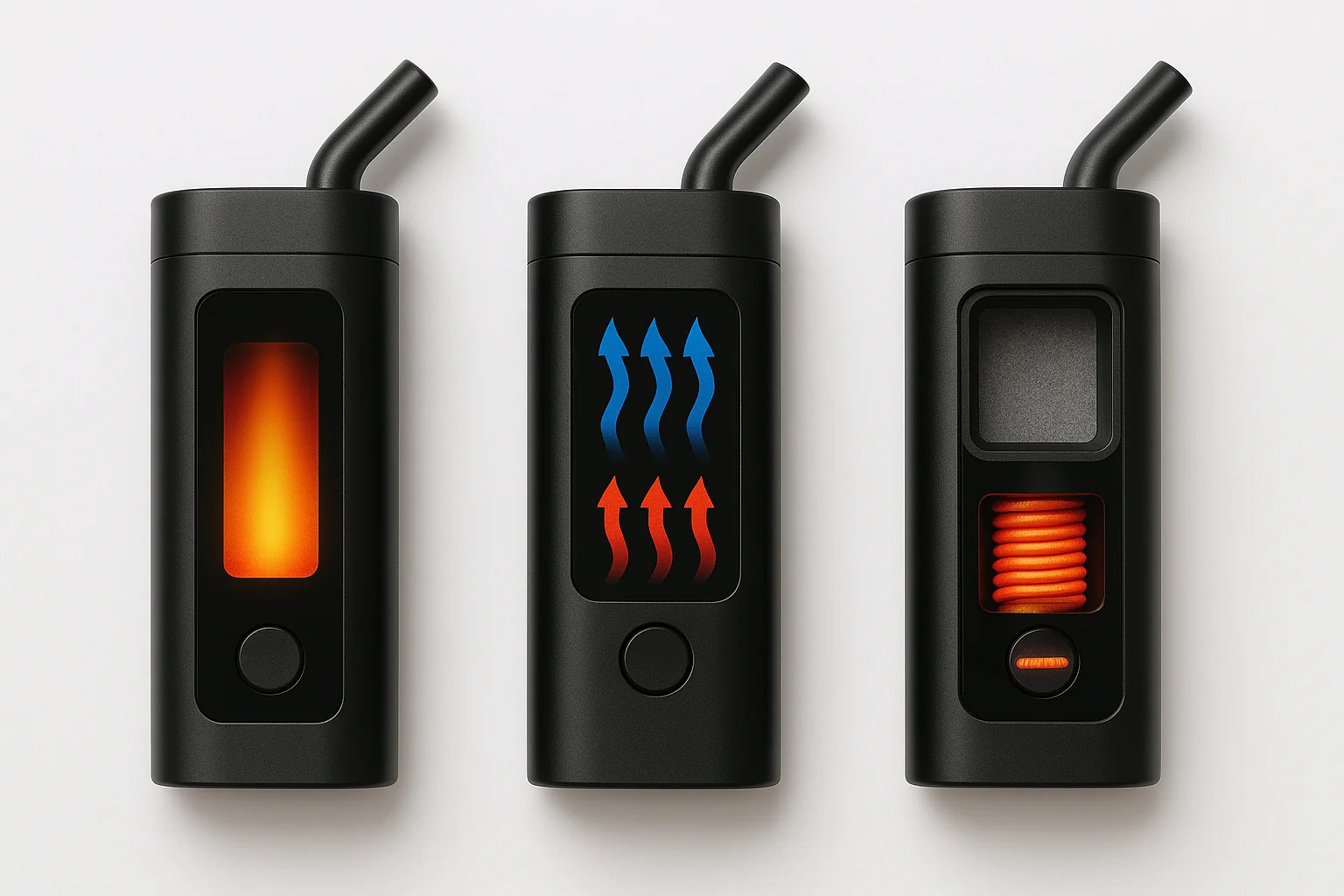

Convection vs conduction vs hybrid vaporizer - how they work (table)
Convection vs conduction vs hybrid vaporizer: comparison, differences, and what to choose. Table from u Bucha.
Choosing a heating method is one of the most important parameters when purchasing a vaporizer, and also one of the least understood. The difference between convection and conduction heating is not just a matter of terminology - it determines vapor quality, heating speed, material efficiency, and device price. Comparative studies published in Journal of Analytical Toxicology confirmed that the heating method significantly influences the profile of volatile compounds released during vaporization (Pomahacova et al., Journal of Analytical Toxicology, 2009). This article explains how each of the three systems works, where the practical differences lie, and which type suits which style of use.
KEY INFORMATION
• Convection - hot air flows through the material; pure vapor, even heating, higher price.
• Conduction - material sits on a hot surface; quick heating, cheaper devices, risk of uneven extraction.
• Hybrid - combines both mechanisms; a good compromise of efficiency and user comfort.
• Optimal vaporization temperature for herbs: 170-210°C (combustion above about 230°C).
• Vaporizers replace combustion and eliminate products of incomplete combustion, as confirmed by EMCDDA (EMCDDA, 2023).
How does convection heating work in a vaporizer?
Convection heating involves the heating element warming the air, which then flows through the material placed in the chamber. The material never comes into direct contact with the heating element - heat is transferred by the airflow. The mechanism is analogous to a forced air furnace: the air temperature is precisely controlled, and heat reaches every particle of material evenly.
The practical effect is the precise extraction of volatile compounds from the entire volume of the load. The material does not get burnt from the bottom nor remains raw from the top. The released vapor is pure because there is no overheating of the material in one spot. Convection vaporizers usually require slow, long inhales - the airflow must be sufficient to effectively transfer heat through the load.
The downside of the convection system is the higher production cost. It is necessary to use a precise heating element capable of quickly heating the flowing air to a high temperature while maintaining a stable temperature with varying inhale intensity. This requires advanced electronics and high-temperature materials - ceramics or surgical steel. Therefore, a good convection vaporizer costs more than a comparable conduction one.
How does conduction heating work in a vaporizer?
Conduction heating works differently: the material placed in the chamber comes into direct contact with the heated surface or the walls of the chamber. Heat penetrates the material through direct contact - just like on a hot frying pan or ceramic tile. The mechanism is simpler and known from older models of vaporizers, but still common in budget and mid-range devices.
The main advantage is speed. The conduction chamber heats up in 15-30 seconds because there is no need to heat the airflow - it is enough to heat the chamber itself. The device is ready to use almost immediately. This is an important advantage in the context of mobile use, where waiting for a minute can be uncomfortable.
The weakness of the conduction system is the risk of uneven extraction. The material in contact with the chamber walls heats up faster than the material in the center of the load. The effect is so-called hot spots - areas of excessive heating - which can lead to local overheating and even microscopic burning at very high temperatures. Regularly mixing the material during the session partially solves this problem but requires user involvement.
Convection vaporizer vs conduction vs hybrid - comparison table
The table below compares the three heating systems based on parameters important for choosing a device. Quality ratings (low/medium/high) refer to comparisons within the category of dry herb vaporizers, not to combustion products.
| Feature | Convection | Conduction | Hybrid |
|---|---|---|---|
| Heating mechanism | Hot air through the material | Direct contact with the heating element | Combination of both methods |
| Heating time | 30-90 s | 15-30 s | 20-60 s |
| Quality and purity of vapor | High | Medium | High |
| Uniformity of extraction | Very good | Moderate | Good |
| Material efficiency | High | Medium | High |
| Temperature control | Very precise | Good | Precise |
| Device price | Higher (300-800 PLN+) | Lower (150-400 PLN) | Medium (250-600 PLN) |
| Ease of use | Requires skill | Simple | Easy to medium |
| Battery life (session) | Shorter (heats air continuously) | Longer | Medium |
| Recommended for | Experienced, quality is a priority | Beginner, budget | Versatile use |
Waporyzator hybrydowy - najlepszy kompromis?
The hybrid vaporizer combines both mechanisms in one heating chamber. A typical solution is a ceramic chamber, whose walls transfer heat through conduction while simultaneously heating the inhaled air through convection. The effect: the material starts to heat up immediately after being placed in the chamber (conduction provides a quick start), and the flowing air evenly completes the extraction until the end of the load (convection finishes the session).
In practice, a hybrid eliminates the main drawbacks of both systems. You don't have to wait as long as with pure convection. There is also no risk of hot spots typical for budget conduction devices, where the chamber walls may be unevenly heated. Mid-range and premium vaporizer manufacturers increasingly use the hybrid system as standard - the X-MAX V3 Pro is an example of a device where the ceramic chamber and airflow are designed to complement each other.
However, the hybrid does not replace top-end convection for extremely precise extraction. Vaporization enthusiasts who program temperature profiles and expect 100% convection without any contact of the material with the heated surface reach for stationary devices like classic balloon and whip models. But for 90% of mobile users, the hybrid is the most sensible choice.
Vaporization temperature - how to choose it?
Temperature is a parameter independent of the heating system but closely related to it - the convection system usually offers greater precision of control. The vaporization temperature of herbs directly affects the profile of released compounds. Pharmacokinetic studies indicate that the most important terpenes begin to evaporate at around 150°C, while other active ingredients require higher temperatures, up to 220°C (Hazekamp et al., Journal of Ethnopharmacology, 2006).
Practical tip: start at 170-180°C - you will achieve a lighter, terpene-rich vapor with a delicate taste. If you want to extract more from the material, switch to 190-205°C. Above 210°C, the vapor becomes denser but also sharper in taste. Avoid temperatures above 230°C - this is the threshold at which organic material begins to undergo thermal decomposition, i.e., burning, rather than vaporization.
Digital vaporizers with a step of 1°C or 0.1°C allow for precise experimentation with the extraction profile. Devices with simple three-level temperature switches (low/medium/high) are more convenient for those who do not want to delve into details - but limit the possibilities for session customization.
Heating chamber materials - ceramic, steel, or titanium?
Regardless of the heating system, the material of the chamber affects the taste and safety of the vapor. Ceramic is the premium standard - it is chemically inert at vaporization temperatures, does not emit any compounds, and provides a neutral taste. Stainless steel (surgical 316L) is cheaper, mechanically more durable, and also safe, but some users experience a slight metallic aftertaste with new devices. Grade 2 titanium is a material used in dabbing devices - very durable and safe, rarer in portable dry herb vaporizers.
What to avoid: plastic parts in the vapor stream, aluminum chambers without anodized coating, and low-quality silicone seals near the heating chamber. At high temperatures, cheap plastics can emit plasticizers into the inhaled air. Reputable manufacturers provide the material composition of the chamber in product documentation or on the website - the absence of this information should raise doubts.
How to clean and maintain the heating chamber?
Cleaning the heating chamber is mandatory regardless of the type of heating system - in convection, conduction, and hybrid vaporizers alike. Residual organic material left after a session oxidizes at high temperatures and over time affects the taste of the vapor and can reduce the heating element's efficiency. The recommended cleaning frequency is after every 5-10 sessions, with deeper cleaning monthly.
To clean the conduction chamber, a soft brush (usually included in the set) and cotton swabs soaked in isopropanol (90%+) are sufficient. The convection chamber also requires cleaning of the air channels - thin pipe cleaners are helpful here. Mesh screens near the chamber should be replaced every 2-4 weeks, as they clog with dust and reduce airflow.
The mouthpiece is the part that requires the most frequent cleaning, as it comes into direct contact with the user's mouth. Remove it, soak it in isopropanol for 15-30 minutes, then rinse with warm water and dry thoroughly before reuse. Moisture in the mouthpiece promotes the growth of bacteria and fungi, especially with intensive use by multiple people.
Desktop vaporizer vs portable - where lies the difference?
The division into convection/conduction/hybrid intersects with another important division: desktop vaporizers vs portable ones. Desktop vaporizers are connected to the electrical network, allowing for a constant, precise temperature without battery limitations. Classic desktop models based on pure convection - with a pump blowing hot air - provide the highest quality extraction available in the consumer segment.
Portable vaporizers run on batteries, which inevitably involves compromises. The battery discharges, the heating element must be lighter and smaller, and the heating time is a critical parameter for user convenience. Therefore, hybrids and conduction dominate the portable segment - they are more energy-efficient and faster to heat than full convection realized by an air pump.
Individuals for whom the absolute quality of vapor is a priority and have constant access to an electrical outlet should consider a desktop vaporizer with convection. Active individuals, travelers, or those who value discretion will choose a portable hybrid or conduction vaporizer. Both segments have their place - there is no one 'better' solution.
Vaporization vs combustion - what does science say?
Vaporizers were developed as an alternative to combustion, eliminating the products of incomplete combustion: carbon monoxide, benzopyrene, and other polycyclic aromatic hydrocarbons (PAHs). The European Monitoring Centre for Drugs and Drug Addiction (EMCDDA) indicates that vaporization at controlled temperatures significantly reduces exposure to harmful substances produced during combustion (EMCDDA, 2023).
Clinical study published in Clinical Pharmacology & Therapeutics It has been shown that individuals using a vaporizer instead of a cigarette inhale significantly lower amounts of carbon monoxide and smoke with comparable extraction of active ingredients (Abrams et al., Clinical Pharmacology & Therapeutics, 2007). The choice of heating system (convection vs conduction) affects the extraction profile, but both systems - when used correctly below the combustion threshold - maintain this key advantage over combustion.
What to pay attention to when buying - checklist
When choosing a vaporizer, it is worth checking several elements before making a decision. First: the heating system - convection, conduction, or hybrid - and whether it fits your usage style. Second: temperature range and precision of control. A device with regulation every 1°C offers significantly more possibilities than a three-level switch. Third: the material of the heating chamber - ceramic or stainless steel is the minimum quality standard.
Other elements: battery capacity (mAh) and charging time, size and weight (important for mobile use), compatibility with a water adapter (if you want to use a bong as a filter), as well as the availability of spare parts - screens, seals, mouthpieces. Vaporizers from reputable manufacturers have available parts in Poland, which extends the device's lifespan and protects your investment.
The last, often overlooked element: warranty and service. Reputable manufacturers offer a warranty of 1 to 3 years on the device. A short warranty or lack thereof is a warning sign when purchasing heating electronics of this class. A vaporizer is a device for everyday use - a failure of the heating element after a few months without the possibility of a complaint generates unnecessary costs.
Frequently Asked Questions
What is the difference between a convection and conduction vaporizer?
In a convection vaporizer, hot air flows through the material and releases vapor - the material does not come into direct contact with the heating element. In a conduction vaporizer, the material sits on a hot plate or in a heating chamber and is heated by direct contact. Convection provides cleaner, more even vaporization, while conduction heats up faster and is cheaper to produce.
Which type of vaporizer is best for beginners?
For those starting their journey with vaporization, a conduction or hybrid vaporizer usually works better - they heat up faster, are cheaper, and easier to operate. Convection vaporizers require longer inhales and a bit of practice to properly utilize the airflow, but they provide higher vapor quality and temperature precision.
Is a hybrid vaporizer better than a convection one?
A hybrid vaporizer combines both systems - it heats the material through direct contact (conduction) and hot air (convection). The result is quick heating with good vapor quality and uniformity. It is not always better, but it represents a good compromise for those who value both convenience and quality.
What is the best temperature for vaporizing herbs?
The optimal temperature range is 170-210°C, depending on the purpose. Lower temperatures (170-185°C) extract more delicate terpenes and produce lighter vapor. Higher temperatures (190-210°C) release more active ingredients with thicker vapor. Above 230°C, material combustion begins, negating the advantages of vaporization.
How long does it take for a convection vaporizer to heat up?
Most convection vaporizers heat up in 30-90 seconds, while conduction ones often reach working temperature in 15-30 seconds. Hybrid vaporizers typically fall in the middle - about 20-60 seconds. Heating time also depends on the specific model and quality of the heating element.
This article is for informational and educational purposes and does not replace consultation with a doctor. If you are pregnant, breastfeeding, taking medications, or have chronic conditions, consult the use of supplements or herbs with a specialist.
Author: Michał Waluk · Published: 2026-05-04 · Updated: 2026-05-04