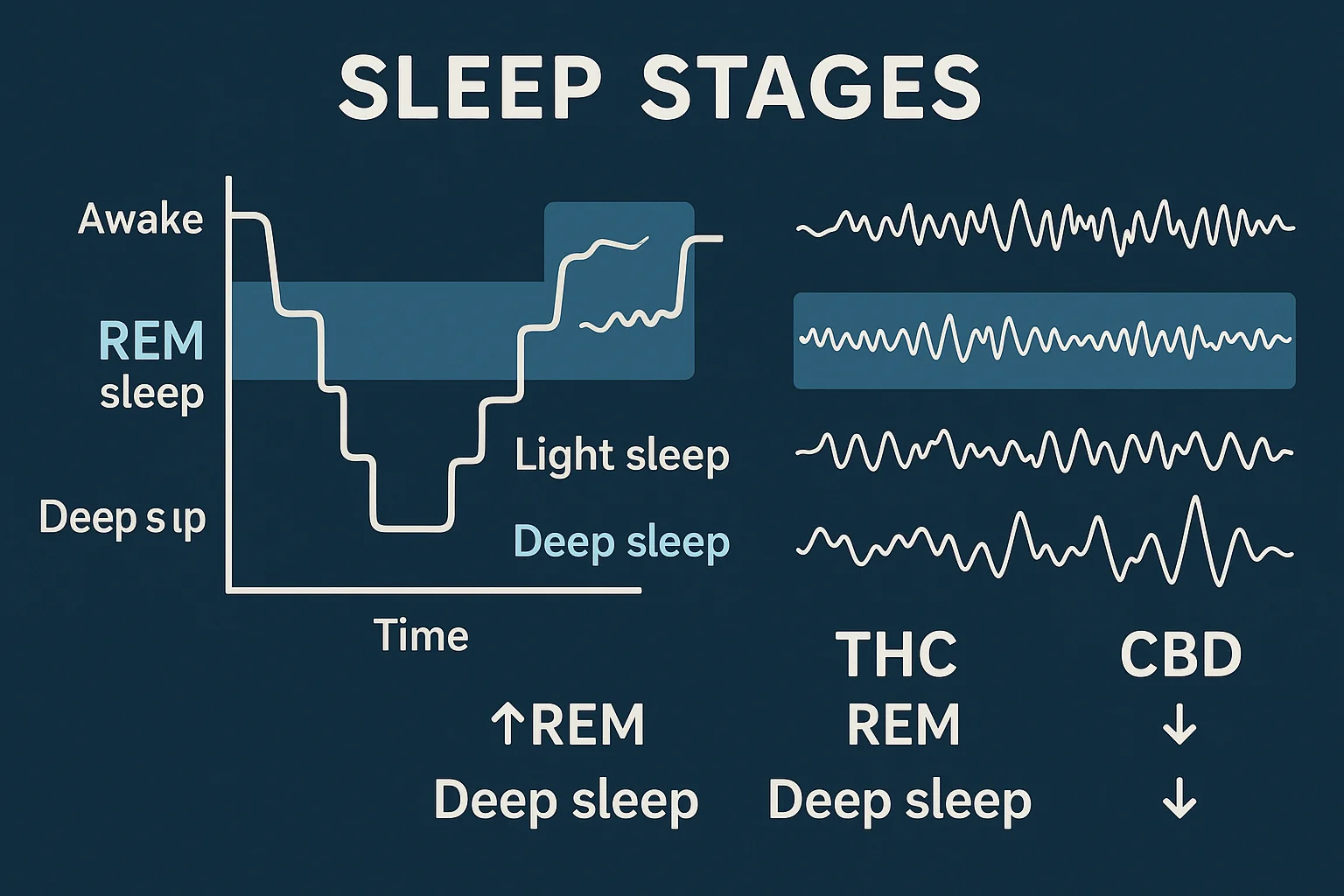

Why does THC disrupt sleep architecture in the long run, while CBD does not?
Why THC disrupts sleep architecture in the long term, while CBD does not: comparison and what studies really show. Table from u Bucha.
Many cannabis users report that marijuana helps them fall asleep - and that's true, at least at first. But a meta-analysis by Bhatt et al. published in Sleep Medicine Reviews showed that regular THC users have a REM phase shortened by 20-30% compared to non-users (Sleep Medicine Reviews, 2020). Meanwhile, CBD does not suppress REM and may improve it in cases of sleep issues caused by anxiety. The difference lies in which receptors both molecules target.
KEY INFORMATION
• THC shortens the REM phase by 20-30% in regular users through direct activation of CB1 receptors in centers regulating REM.
• CBD does not inhibit the REM phase - it works through 5-HT1A and FAAH inhibition, not through direct activation of CB1.
• After discontinuing THC, REM rebound occurs - 2-4 weeks of intense dreaming during the restoration of sleep architecture.
• A study by Shannon et al. (2019): 66.7% of patients reported improved sleep after one month of using 25 mg of CBD.
• THC may shorten sleep latency in the short term, but it destroys its structure in the long term.
What is sleep architecture and why is the REM phase crucial?
Sleep is not a uniform state - it is a cyclical process composed of several phases repeating every 90 minutes. Healthy sleep architecture includes three NREM (Non-REM) phases: N1 (falling asleep), N2 (light sleep), and N3 (slow-wave sleep, SWS - the deepest, restorative), followed by the REM (Rapid Eye Movement) phase. A typical adult spends about 20-25% of their sleep time in the REM phase, and its share increases in subsequent cycles - the last cycle of the night has proportionally more REM.
The REM phase is critical for cognitive and emotional processes. During REM, the brain consolidates procedural and emotional memory, processes stressful experiences, and "resets" emotional reactivity. Studies on selective REM deprivation have shown that even with the total sleep time maintained, lack of REM leads to memory deterioration, increased irritability, concentration disorders, and heightened anxiety (Nature Reviews Neuroscience, 2010). This is why chronic suppression of REM by THC has serious cognitive consequences.
The N3 phase (slow-wave sleep) is crucial for physical regeneration: it is during this phase that growth hormone is released, tissues regenerate, and declarative memory is consolidated. THC has a less clear effect on N3 - studies show both an extension of N3 in the short term (which may explain the subjective feeling of "deeper sleep"), as well as normalization or shortening with longer use.
Mechanism: why does THC suppress the REM phase?
THC is a strong, full agonist of the cannabinoid receptor CB1. CB1 receptors are particularly densely distributed in brain areas regulating the sleep-wake cycle and the initiation of the REM phase: in the ventral tegmental area (VTA), locus coeruleus, basal forebrain, and brainstem structures. Activation of CB1 in these areas by THC inhibits the release of acetylcholine - a neurotransmitter essential for initiating and maintaining the REM phase.
The neurobiology of REM is closely dependent on the interaction between cholinergic neurons (activating REM) and aminergic neurons (inhibiting REM, releasing serotonin and norepinephrine). THC, through CB1, enhances aminergic activity and suppresses cholinergic activity - the result is reduced amplitude and frequency of the REM phase. With occasional use, the effect is reversible within one night without THC. With regular use, there are lasting receptor adaptations: CB1 receptors in these areas undergo desensitization and internalization, leading to chronic suppression of REM even without THC use (Bhatt et al., Sleep Medicine Reviews, 2020).
The paradox of THC and sleep is that short-term, THC may shorten sleep latency (time to fall asleep) and subjectively improve the sense of sleep depth - but at the cost of REM. This makes the short-term subsidy effect and long-term harm difficult to distinguish without polysomnography. Users feel "well-rested" in terms of N3 depth, unaware of the REM deficit that accumulates over weeks.
THC vs CBD - comparison of effects on sleep architecture
CBD affects sleep through entirely different mechanisms than THC. The main pathways are: activation of the 5-HT1A receptor (serotonin), inhibition of the FAAH enzyme (which raises the level of endogenous anandamide), and modulation of the A2A adenosine receptor. None of these pathways directly inhibit cholinergic acetylcholine or lead to REM suppression. A review by Babson and colleagues in Current Psychiatry Reports (2017) concludes that CBD likely does not disrupt sleep architecture at therapeutic doses and may support it by reducing anxiety and tension that hinder natural phase cycling (Current Psychiatry Reports, 2017).
| Sleep parameter | THC (short-term) | THC (long-term) | CBD |
|---|---|---|---|
| Sleep latency (time to fall asleep) | Reduction | Tolerance - the effect weakens | Moderate reduction with anxiety |
| REM phase | Supresja 20-30% | Sustained suppression, CB1 adaptation | No suppression; possible slight extension |
| N3 phase (SWS) | Possible extension | Normalization or reduction | No changes or moderate extension |
| Total sleep time | Extension | Normalization, tolerance | No significant changes or slight extension |
| Subjective sleep quality | Improvement | Deterioration below baseline | Improvement (especially with anxiety) |
| REM rebound after withdrawal | None (single use) | Strong (2-4 weeks of intense dreams) | None |
| Risk of substance dependence with sleep | LOW | Moderate (cannabis use disorder) | None (WHO 2018: no potential for addiction) |
Clinical evidence: CBD and sleep quality in humans
The most cited clinical study on CBD and sleep is the work by Shannon and colleagues published in The Permanente Journal (2019). In this retrospective study of 72 adult patients with anxiety and sleep disorders, CBD administered at a dose of 25-175 mg orally resulted in 79.2% of patients reporting reduced anxiety and 66.7% reporting improved sleep quality after the first month. Sleep improvement persisted throughout the 3-month observation period, although it was somewhat less consistent than anxiety improvement (Permanente Journal, 2019). An important caveat: the study did not have a placebo control group, which limits causal conclusions.
The mechanism of action of CBD on sleep is not directly sedative - CBD does not cause drowsiness like benzodiazepines or antihistamines. It works indirectly: by reducing anxiety and excessive stimulation of the nervous system, which are common causes of insomnia. Individuals whose insomnia results from rumination, anxiety, or sympathetic nervous system overactivity may experience a clear benefit. Those with insomnia due to circadian rhythm disorders, sleep apnea, or primary insomnia may feel less effect.
REM rebound - what to expect after discontinuing THC
Individuals who regularly used THC for sleep and decide to discontinue experience the phenomenon of REM rebound - a sharp increase in the REM phase above normal values as compensation for the accumulated deficit. This manifests as intense, vivid dreams, often nightmares, and may disrupt sleep for 2-4 weeks after discontinuation (Bhatt et al., Sleep Medicine Reviews, 2020).
Many users interpret REM rebound as evidence that "without THC they cannot sleep normally" - and return to use. This is a vicious cycle. REM rebound is temporary and is a sign of recovery, not dysfunction. Full normalization of sleep architecture may require 4-8 weeks of abstinence. During this time, CBD may play a bridging role: reducing anxiety associated with withdrawal and not blocking the restoration of the REM phase.
Customers at u Bucha who transition from THC to CBD as sleep support often describe the first 2-3 weeks as more challenging than they expected - intense dreams and subjectively worse sleep than with THC. This is typical REM rebound. Advance information about this mechanism significantly improves compliance and reduces the rate of returns to THC during this difficult window.
Inne substancje a architektura snu - jak CBD wypada na tle alkoholu i benzodiazepin?
The comparative context is important because many people turn to various substances to fall asleep. Alcohol - like THC - shortens sleep latency and increases slow-wave sleep in the first half of the night, but in the second half drastically disrupts architecture: REM is suppressed, and sleep quality drops sharply. A review by Ebrahim et al. found that even moderate alcohol consumption before sleep reduces REM in the first half of the night and causes "rebound arousal" - increased activity and worse sleep in the second half (Alcoholism: Clinical and Experimental Research, 2013). In this regard, alcohol and THC act similarly: short-term gain in latency, long-term loss in quality.
Benzodiazepines (e.g., diazepam, temazepam) and Z-drugs (zolpidem) suppress both REM and deep N3 sleep. They are effective in shortening sleep latency, but with regular use, they destroy sleep architecture more completely than THC - suppressing both REM (emotional and memory consolidation) and SWS (physical regeneration). After discontinuing benzodiazepines, the rebound is even stronger than after THC and can last for weeks.
CBD stands out positively against this background: it does not cause REM or N3 suppression, does not build pharmacokinetic tolerance leading to the need for dose escalation, and does not cause rebound after discontinuation. It is not as effective as benzodiazepines for severe primary insomnia - but for those with insomnia caused by anxiety or stress, it offers support without destroying sleep architecture. This is a fundamental difference that simple comparisons of "works vs does not work" do not capture.
Can CBD be used together with melatonin for sleep?
Melatonin and CBD work through completely different mechanisms and do not enter known pharmacokinetic interactions. Melatonin is a chronobiotic - it synchronizes the biological clock and signals the body that it is time to sleep, but it does not deepen sleep or change its architecture. CBD reduces anxiety and tension that hinder falling asleep, acting through 5-HT1A and anandamide. The combination may be synergistic in individuals where both circadian rhythm dysregulation and anxiety are factors in insomnia.
A key caveat: CBD inhibits CYP3A4 enzymes that metabolize melatonin in the liver. When CBD and melatonin are administered together, the concentration of melatonin in the blood may be higher than with melatonin alone - which theoretically may increase drowsiness the next day with high doses of melatonin. In practice, with typical supplemental doses of melatonin (0.5-1 mg), this effect is unlikely to be clinically significant, but it is advisable to start with low doses of both substances and monitor the response.
The key conclusion from the comparison of THC, CBD, alcohol, and benzodiazepines is clear: substances that shorten the time to fall asleep are not equivalent to substances that improve sleep quality. THC, alcohol, and benzodiazepines help you fall asleep at the expense of sleep architecture - they buy latency while destroying structure. CBD does not shorten latency as drastically, but it does not destroy REM or N3, does not build tolerance requiring dose escalation, and does not cause destructive rebound after discontinuation. For those whose insomnia results from anxiety or excessive stimulation, this is a significant advantage over seemingly faster alternatives.
Frequently Asked Questions
Why does THC shorten REM sleep phase?
THC activates CB1 receptors densely distributed in brain centers regulating REM - including in the locus coeruleus and ventral tegmental area. Activation of CB1 inhibits acetylcholine, a neurotransmitter essential for initiating REM. A meta-analysis by Bhatt et al. showed a 20-30% suppression of REM in regular users (Sleep Medicine Reviews, 2020). With regular use, there are lasting receptor adaptations that maintain suppression.
How does CBD affect REM sleep and sleep architecture?
CBD does not activate CB1 in a way that would inhibit acetylcholine and REM. It works through the 5-HT1A receptor and FAAH inhibition, raising anandamide levels. A review by Babson et al. (2017) concludes that CBD does not disrupt sleep architecture at therapeutic doses - it may support it by reducing anxiety that hinders natural phase cycling (Current Psychiatry Reports, 2017).
Can REM sleep be restored after stopping THC?
Yes - sleep architecture normalizes after discontinuing THC, but for 2-4 weeks, REM rebound occurs: a sharp increase in the REM phase above normal with intense dreams and nightmares. Full normalization in long-term users may take 4-8 weeks (Bhatt et al., Sleep Medicine Reviews, 2020). REM rebound is temporary and is a sign of recovery, not dysfunction.
Does CBD help with falling asleep?
CBD helps with sleep indirectly - not through direct calming effects, but by reducing anxiety and tension that hinder falling asleep. A study by Shannon et al. showed that 66.7% of patients reported improved sleep after one month of using 25 mg of CBD (Permanente Journal, 2019). It works best for anxiety-induced insomnia, less so for primary insomnia or insomnia resulting from sleep apnea.
How long should CBD be used to improve sleep quality?
In the study by Shannon et al. (2019), sleep improvement was noticeable after the first month of regular use of 25-75 mg of CBD in the evening. With oral administration, blood concentration stabilization takes 2 weeks. Changing the dose more frequently than every 5-7 days makes it difficult to assess effectiveness. The effect of CBD on sleep is cumulative - it is not a substance to be used 'as needed' like a sleeping pill.
This article is for informational and educational purposes and does not replace consultation with a doctor. If you are pregnant, breastfeeding, taking medications, or have chronic conditions, consult the use of supplements or herbs with a specialist.
Author: Michał Waluk · Published: 2026-05-04 · Updated: 2026-05-04