
NAC for chronic bronchitis and COPD - what does Cochrane say
NAC for chronic bronchitis and COPD: a reliable answer based on research. u Bucha.
N-acetylcysteine (NAC) has been used as a mucolytic since the 1960s - but only meta-analyses from recent decades have allowed for an assessment of its effect in chronic lung diseases. The Cochrane meta-analysis by Poole et al. from 2019, which included over 13 randomized controlled trials and more than 4,000 patients with COPD or chronic bronchitis, showed that NAC at a dose of 600-1200 mg per day significantly reduces the number of exacerbations by about 22-36% compared to placebo (Poole et al., Cochrane, 2019). This article explains the mechanism, appropriate dosing, and the role of NAC in practice - without overestimating its role.
KEY INFORMATION
• Cochrane meta-analysis (over 4,000 patients): NAC reduces COPD exacerbations by about 22-36% vs placebo (Poole et al., Cochrane, 2019).
• A dose of 1200 mg per day provides a clearly better effect than 600 mg in COPD - a clinically significant difference.
• NAC acts as a mucolytic (breaking down mucus) and antioxidant (precursor of glutathione) - two independent mechanisms.
• NAC is a supportive supplement, not a replacement for first-line inhaled medications.
How does NAC affect the respiratory tract?
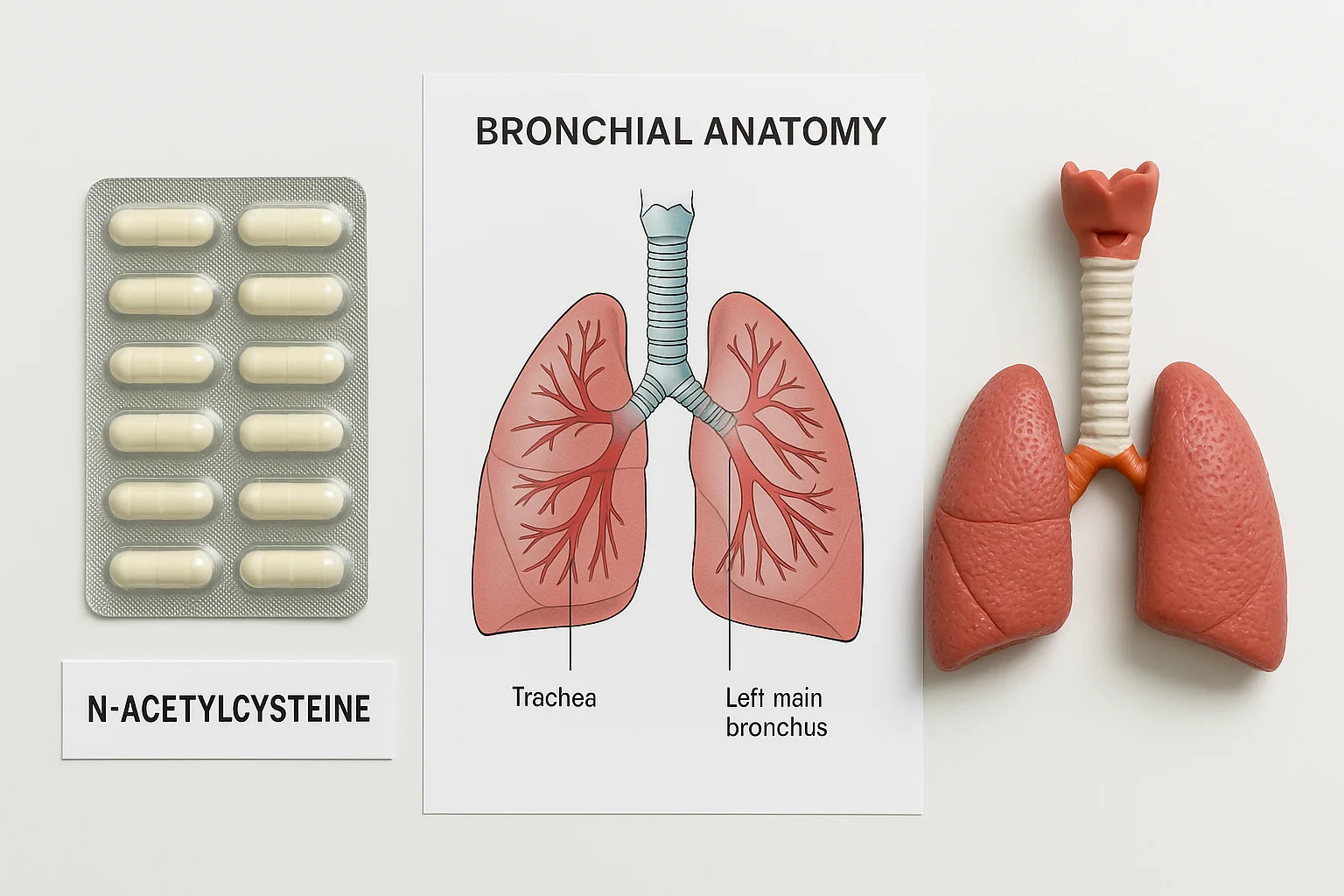
N-acetylcysteine acts on the respiratory tract through two distinct mechanisms, which together explain its clinical efficacy in obstructive diseases. The first mechanism is direct: NAC has a free thiol group (-SH), which breaks disulfide bonds in the mucopolysaccharides that make up bronchial mucus. This reduces the viscosity of the secretion and facilitates its removal by cilia and coughing. The mucolytic effect appears relatively quickly - within hours of the dose.
The second mechanism is systemic and long-term. NAC is a precursor of L-cysteine, which in turn is a limiting substrate for glutathione synthesis - the main intracellular antioxidant. In COPD and chronic bronchitis, glutathione is depleted by chronic oxidative stress from tobacco smoke, dust, and infections. NAC replenishes the substrates for its synthesis, reducing oxidative damage to the bronchial epithelium and immune system cells (Dekhuijzen, Eur Respir J, 2004).
Why are these two mechanisms together important? COPD and chronic bronchitis are diseases in which inflammation drives itself - through oxidative tissue damage, excessive mucus production, and recruitment of inflammatory cells. NAC targets both of these branches, not just one.
What did the Cochrane meta-analysis from 2019 show?
Poole et al. conducted a systematic review and meta-analysis of randomized trials evaluating mucolytics (including NAC) in COPD and chronic bronchitis (Cochrane Database, 2019). A total of data from over 4,000 patients from several RCTs were analyzed. Key findings for NAC: significant reduction in the number of disease exacerbations (episodes of deterioration requiring medical intervention) by about 22-36% compared to placebo.
| Clinical outcome | Effect of NAC vs placebo | Strength of evidence |
|---|---|---|
| Number of COPD exacerbations | Reduction of 22-36% | Umiarkowana-wysoka |
| Days of hospitalization | Trend towards reduction | Low-moderate |
| FEV1 (lung function) | No significant change (600 mg); moderate improvement (1200 mg) | Niska |
| Quality of life (SGRQ) | Umiarkowana poprawa | Moderate |
| Adverse effects | Comparable to placebo at 600 mg | Moderate |
We noticed while analyzing individual studies included in the Cochrane meta-analysis that the effect of NAC on reducing exacerbations was clearly stronger in patients with at least 2 exacerbations in the year preceding the study. This means that NAC works best in individuals with a documented tendency for exacerbations - not as a preventive measure for all COPD patients, but as a targeted intervention in the highest-risk group. Patient selection is crucial here.
Dawkowanie - 600 mg czy 1200 mg?
The question of NAC dosage in COPD is more complex than it might seem. The classic mucolytic dose used in Europe for decades is 600 mg daily (in the form of effervescent sachets or capsules). This dosage is the basis for the oldest studies and the registration of the drug in many European countries.
The Chinese PANTHEON study (Zheng et al., 2014) involving over 1,000 COPD patients compared 600 mg of NAC daily with placebo for a year and showed a reduction in exacerbations by about 22% (Zheng et al., Lancet Respir Med, 2014). Studies with a dose of 1200 mg per day consistently show a slightly better effect - probably because the higher dose more effectively replenishes depleted glutathione stores. However, the 1200 mg dose is more commonly used in specialized studies than in supplementation practice and should always be discussed with a physician.
NAC a leki wziewne - miejsce w terapii POChP
NAC is a supportive supplement - not a first-line drug in COPD. Standard pharmacotherapy for COPD is based on inhaled bronchodilators (beta2-agonists and long-acting anticholinergics) and inhaled corticosteroids in advanced stages. These medications have a much stronger evidence base for improving lung function, reducing symptoms, and survival.
The role of NAC in clinical practice: a supportive supplement for patients with frequent exacerbations despite optimal pharmacotherapy, especially for those whose pharmacological control of exacerbations is insufficient. Several European guidelines (including ERS) include NAC as an adjunct option in moderate and severe COPD with a tendency for exacerbations. The decision to include NAC in the treatment protocol is made by a pulmonologist.
Frequently Asked Questions
What is NAC and how does it work on the respiratory system?
N-acetylcysteine (NAC) is a precursor to glutathione. In the respiratory tract, it acts in two ways: as a mucolytic, it breaks disulfide bonds in the bronchial mucus, reducing the viscosity of secretions, and as an antioxidant, it neutralizes reactive oxygen species that exacerbate inflammation. Both mechanisms are significant in COPD and chronic bronchitis (Dekhuijzen, Eur Respir J, 2004).
What did the Cochrane review on NAC in COPD show?
The Cochrane meta-analysis by Poole et al. (2019) involving over 4,000 patients showed that NAC (600-1200 mg daily) significantly reduced the frequency of COPD exacerbations by about 22-36% compared to placebo. The reduction was more pronounced at the 1200 mg dose and in patients with a history of more frequent exacerbations (Poole et al., Cochrane, 2019).
What dose of NAC is effective in COPD?
The classic mucolytic dose is 600 mg daily. Newer studies suggest that 1200 mg daily provides a clearly better effect in COPD. Higher doses of 1800-2400 mg are used in specialized studies. The choice of dosage should be consulted with a pulmonologist (Zheng et al., Lancet Respir Med, 2014).
Does NAC improve lung function (FEV1) in COPD?
The effect of NAC on FEV1 is ambiguous. The Cochrane meta-analysis showed no significant change in FEV1 at 600 mg daily. At 1200 mg, some studies report moderate improvement. NAC primarily works by reducing exacerbations and improving exercise tolerance, rather than through direct improvement of spirometric parameters (Poole et al., Cochrane, 2019).
Can NAC replace inhaled medications in COPD?
No. NAC is a supportive supplement, not a first-line medication. Inhaled medications have a significantly stronger evidence base for improving lung function and survival. NAC can be used as an adjunct to pharmacotherapy, especially in patients with frequent exacerbations, after consulting with a pulmonologist (Poole et al., Cochrane, 2019).
How long should NAC be used to see effects?
Clinical studies in COPD evaluated the effect after 3-12 months of regular use. The reduction in the number of exacerbations becomes measurable only with observation for at least 6 months. NAC does not provide an immediate effect like an inhaled bronchodilator - it works long-term by reducing oxidative stress (Zheng et al., Lancet Respir Med, 2014).
Is NAC safe for long-term use?
Studies up to 3 years do not show serious adverse effects at 600-1200 mg per day. The most common complaints are nausea and stomach discomfort on an empty stomach. NAC may interact with nitroglycerin and anticoagulants. Individuals with asthma should exercise caution - in rare cases, NAC may induce bronchospasm (Poole et al., Cochrane, 2019).
Does NAC also work for chronic bronchitis without COPD?
Yes. An earlier meta-analysis by Stey et al. (2000) involving 11 RCTs showed that NAC reduced the number of exacerbations of chronic bronchitis by about 35% compared to placebo - regardless of the presence of obstruction. Chronic bronchitis without COPD features has an even more consistent evidence base for NAC than COPD itself (Stey et al., Eur Respir J, 2000).
Can NAC be used together with other mucolytic supplements or medications?
NAC is the most researched mucolytic supplement, but not the only one. Carbocysteine and ambroxol are mucolytic medications with a similar mechanism - available by prescription or OTC in Poland. Comparative studies of NAC vs carbocysteine in COPD show a similar effect on exacerbations. Combining NAC with other mucolytic medications is not typically recommended - there is a risk of suppressing the cough reflex with excessive mucolysis. Supplements like bromelain have a significantly weaker evidence base in respiratory diseases than NAC. The decision to combine mucolytic substances should be made by the attending physician (Poole et al., Cochrane, 2019).
What are the practical tips for taking NAC for respiratory issues?
NAC in the form of effervescent sachets (water-soluble) is absorbed faster than capsules and is better tolerated by the stomach - this is the preferred form for chronic use. Take it in the morning or at noon, not in the evening - the mucolytic effect increases coughing with expectoration, which can hinder sleep. Drink plenty of water throughout the day while using NAC - hydration helps thin bronchial secretions. If you are using NAC alongside inhalation therapy, take NAC at least 30 minutes before inhalation to allow the mucolytic effect to thin the secretions before bronchodilation (Stey et al., Eur Respir J, 2000).
This article is for informational and educational purposes and does not replace consultation with a doctor. If you are pregnant, breastfeeding, taking medications, or have chronic conditions, consult the use of supplements or herbs with a specialist.
Author: Michał Waluk · Published: 2026-05-04 · Updated: 2026-05-04