
Hemp vs Indian vs Ruderalis: how to distinguish them (table)
Hemp, Indian, and ruderalis in one table: growth habit, leaf, flowering, and autoflowering. What genetics says and what legal hemp flower is made from.
Three names, one type, and a lot of misunderstandings. Cannabis sativa, Cannabis indica, and Cannabis ruderalis describe plants with different growth habits and different ways of transitioning to flowering. However, botany and genomics do not speak with one voice here. Sequencing of 110 hemp lines from around the world indicated a single gene pool from the early Neolithic in East Asia, from which today's fiber and intoxicating varieties are derived (Ren i wsp., Science Advances, 2021). The label "indica" or "sativa" on a product says less than its sound suggests. Below you will find a table of morphological characteristics and an answer to the question of what legal hemp flower available in Poland is really made from. The prices listed in the article come from the store API as of August 8, 2026.
KEY INFORMATION
• Sequencing of 110 hemp lines indicates a single gene pool in East Asia (Ren et al., Science Advances, 2021).
• Cannabis ruderalis contributes autoflowering: it flowers based on the age of the plant, not the length of the day.
• O proporcji CBD do THC decyduje pojedynczy locus, nie nazwa gatunkowa (de Meijer i wsp., Genetics, 2003).
• The 0.3% THC threshold in the EU results from regulation 2021/2115, not from the repealed 1307/2013.
What are hemp plants and what distinguishes them?
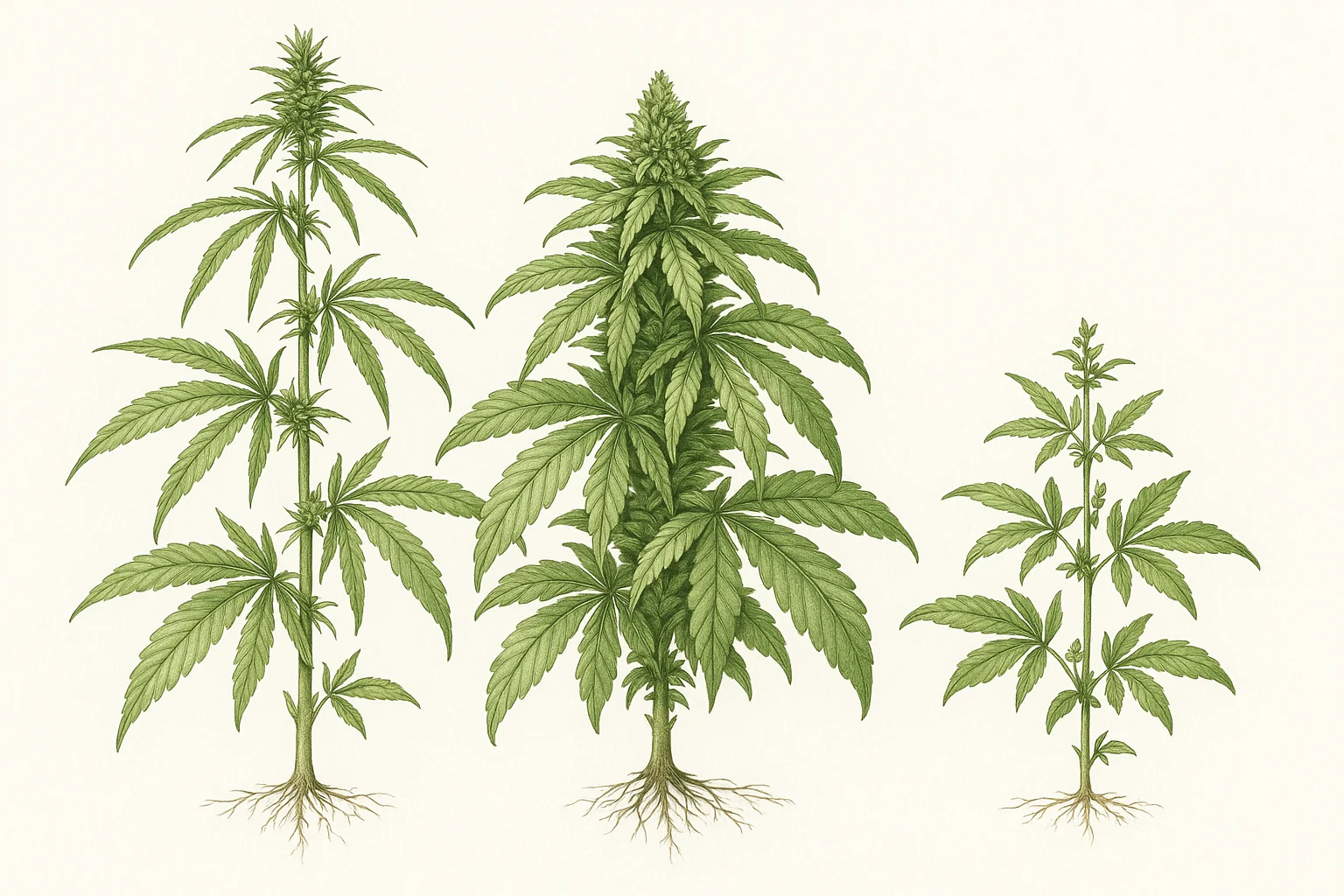
Konopie siewne to Cannabis sativa L., gatunek opisany przez Karola Linneusza w 1753 roku w dziele Species Plantarum. The plant grows tall, from 1 to 5 meters, has narrow leaf segments and a light color. It only begins to flower when the day shortens. All varieties allowed for cultivation in the European Union come from this species.
The analysis of the genomes of 110 lines from around the world placed the first domestication in the early Neolithic in East Asia and showed that today's fiber and psychoactive varieties derive from a single gene pool, currently represented by wild plants and landrace in China (Ren i wsp., Science Advances, 2021). The common image of two independent developmental lines is difficult to reconcile with this.
The cultivation cycle here is the longest of the three discussed forms. Photoperiodic varieties need 10 to 16 weeks of flowering after the day is shortened to below 12 hours, which can be a problem in the Polish climate: the plant may not finish before the frost. Fiber and oil varieties manage well here because their harvest occurs earlier.
Seeds of this species are a separate product category. A review of the nutritional value of industrial hemp seeds describes them as a source of plant protein and unsaturated fatty acids, and the distinction between industrial and psychoactive hemp is reduced to the THC threshold in dry mass (Farinon i wsp., Nutrients, 2020).
What are cannabis indica and where do their characteristics come from?
Cannabis indica is Cannabis indica Lam., described by Jean-Baptiste Lamarck in 1785 based on material brought from India. The plant is short, from 0.5 to 2 meters, bushy, with wide leaf segments. These characteristics are associated with its mountainous origin from the Hindu Kush region, where the growing season is short and sunlight is strong.
The most striking difference is the density of glandular hairs, or trichomes. It is in these that the biosynthesis and accumulation of phytocannabinoids occurs, so a thicker layer of resin simply means more space where these compounds are produced (Xie i wsp., Horticulture Research, 2023). Hence the traditional use of this form as a raw material for hashish production in Afghanistan, Morocco, and Nepal.
Flowering lasts shorter than in hemp plants, usually from 8 to 9 weeks, and also depends on the length of the day. The popular division into the calming effects of indica and the stimulating effects of sativa comes from the practice of breeders, not from research on the plant. We return to this in the section on taxonomy, as this division most often appears on product labels.
How has ruderalis changed cannabis cultivation?
Cannabis ruderalis is a wild-growing form from Central Asia and Eastern Europe, described by Dmitrij Janischewsky in 1924. It grows to 30 to 60 centimeters, has a thin stem, and produces little resin. Its value lies elsewhere: it flowers after a certain number of days from germination, regardless of the length of the day.
This feature is called autoflowering. The plant usually begins to flower 3 or 4 weeks after germination, as waiting for a light signal would be risky in a zone with a short and unpredictable season. Crossing ruderalis with a photoperiodic form transfers this trait to the offspring, allowing the entire cultivation cycle to close in 8 to 10 weeks without light control.
The genetic basis of this trait is still not fully understood. A review of studies on the flowering time in Cannabis sativa states that the loci responsible for phenology are less well described than the biosynthetic pathways of phytocannabinoids, and the lack of a coherent reference genome has long hindered the comparison of results between teams (Steel i wsp., Frontiers in Plant Science, 2023). Autoflowering is therefore a trait practically tamed by breeders, but not fully explained by genetics.
How to distinguish the three cannabis taxa in the field?
The simplest indicators are height, width of leaf segments, and what triggers flowering. The table below compares them side by side. A caveat is important: the boundaries are fluid, and most cultivated plants are hybrids drawing from at least two forms, so morphologically pure specimens are mainly found among landrace.
| Feature | Cannabis sativa | Cannabis indica | Cannabis ruderalis |
|---|---|---|---|
| Height | 1-5 m | 0,5-2 m | 0,3-0,6 m |
| Leaf segments | Narrow, long | Wide, short | Drobne, nieliczne |
| Bodziec kwitnienia | Shortening of the day | Shortening of the day | Age of the plant |
| Flowering time | 10-16 tygodni | 8-9 tygodni | 8-10 weeks from germination |
| Layer of trichomes | Moderate | Obfita | Sparse |
| Origin | East Asia, now cosmopolitan | Hindukusz | Central Asia, Eastern Europe |
| Rola w hodowli | Fiber, oil, and flower varieties | Resinous raw material | Dawca cechy autoflowering |
In practice, the first thing to look at is the proportions: the ratio of the height of the bush to its width and the width of a single leaf segment. The number of segments alone says little, as it changes with the age of the plant. With ruderalis, the decisive factor is often the flowering time, as the shape of a young specimen can easily be mistaken for an undernourished indica.
Czy konopie to jeden gatunek, czy trzy?
There is no universally accepted answer among botanists, and the debate has been ongoing for half a century. In short: the difference lies in whether you consider morphological traits as a species boundary or merely as a variation within a single variable population. Three positions exist in circulation, each with different practical consequences.
- One species. Ernest Small and Arthur Cronquist proposed in 1976 a classification in which all cannabis belongs to Cannabis sativa L. with two subspecies, and ruderalis is a variant within this system.
- Three species. Loran Anderson and some taxonomists treated sativa, indica, and ruderalis as separate species. This perspective has become entrenched in the jargon of breeders.
- Chemical classification. Instead of asking about the species, one asks about the cannabinoid and terpene profile of a specific strain.
The third position currently has the strongest support among researchers. Ethan Russo called the division into sativa and indica useless and urged the scientific community and the public to abandon this nomenclature in favor of reliable biochemical designations of cannabinoid and terpene profiles (Piomelli i Russo, Cannabis and Cannabinoid Research, 2016). The argument is simple: morphology does not predict chemical composition.
We have noticed that our own catalog has already gone in this direction. In the names of 34 items in the flower category, the word "indica" or "sativa" does not appear even once. Instead, there are strain names: Santhica, Northwest, Midwest, Heaven. This is precisely the direction that Russo advocates.
What determines the content of CBD and THC if not the species?
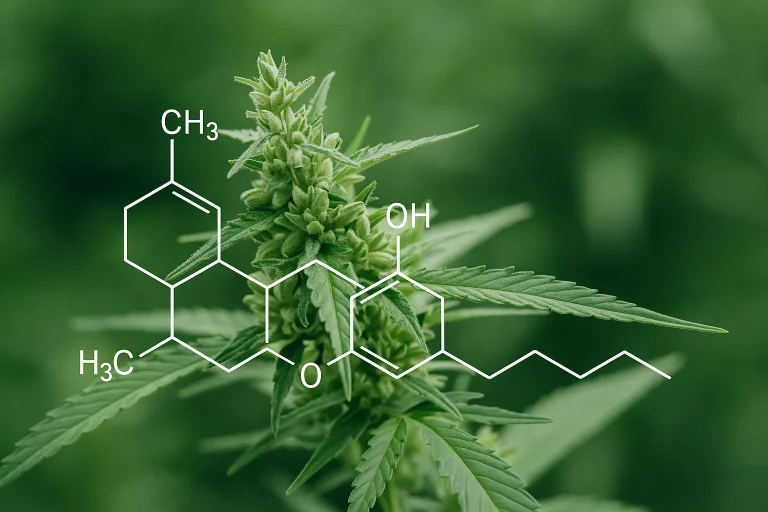
A single location in the genome determines it. Crossbreeding plants with a pure CBD profile with plants with a pure THC profile always produced an F1 generation with a mixed profile, and in the F2 generation, the three profiles separated in a ratio of 1:2:1 (de Meijer i wsp., Genetics, 2003). This distribution indicates one locus with two co-dominant alleles.
The practical conclusion is that the ratio of CBD to THC is inherited independently of the plant's shape. A tall, slender sativa can have a lot of THC or almost none, while a short indica can be a CBD-dominant strain. The species name does not carry this information, as it pertains to a completely different characteristic.
This is confirmed by genotyping 81 intoxicating strains and 43 fiber strains across 14,031 single nucleotide polymorphisms. The authors found a moderate correlation between the genetic structure of the strains and the declared origin from sativa or indica, but also explicitly stated that strain names often do not correspond to any meaningful genetic identity (Sawler i wsp., PLOS ONE, 2015). Therefore, the label on the jar is a weak indicator, while the results of batch testing are strong.
Co to znaczy dla legalnego suszu konopnego w Polsce?
Legal flower comes entirely from hemp. The Polish law on combating drug addiction defines fiber hemp as Cannabis sativa L. plants in which the sum of delta-9-tetrahydrocannabinol and tetrahydrocannabinolic acid in the flowering tops does not exceed 0.3% when calculated on a dry weight basis (Dz.U. 2023 poz. 1939).
The same threshold applies in EU law, although it was reached indirectly. Regulation 1307/2013 allowed for subsidies for hemp with a THC content of up to 0.2%. Since 2023, it has been replaced by regulation 2021/2115, which raises the limit to 0.3% in Article 4 (EUR-Lex 32021R2115). The older value still circulates on the internet, so the date with such a number is more important than the number itself.
Cultivation requires registration with the Agency for Restructuring and Modernization of Agriculture and certified seed material from the variety catalog. Hemp has a long tradition in Poland: since the 16th century, fiber from domestic crops was shipped through Gdańsk for ship ropes and canvas, and the decline only came with cheap synthetic fibers in the 20th century. Neither indica nor ruderalis are listed in the EU variety catalog, so the question "what species is this flower" has only one legal answer.
Ile kosztuje gram legalnego suszu konopnego?
In the flower category in the u Bucha store, there are 34 available items, and the price range per gram exceeds four and a half times. The following table shows six items from different price ranges, with a conversion to 1 gram, which is the only comparable measure here. Prices come from the store's API and describe the state as of August 8, 2026.
| Product | What distinguishes | Price | Koszt 1 g |
|---|---|---|---|
| Madness had CBD 10G Grandma Marysia MIX Trim | Shredded material, not whole flower clusters | 75.00 PLN | 7.50 PLN |
| Grandma Marysia's Specials Hemp Flower Northwest 10G | Female flower clusters, doypack with humidity regulator | 140.00 PLN | 14.00 PLN |
| Grandma Marysia's Specials Hemp Flower Santhica CBG 5G | Santhica strain, the leading phytocannabinoid is cannabigerol | 75.00 PLN | 15.00 PLN |
| Rollmops Special of Mopsa (CBD Heaven) 5g | Heaven strain, the dominant terpene is D-limonene | 99.00 PLN | 19.80 PLN |
| Grandma Marysia CBD Midwest 2G | Odmiana Midwest, uprawa szklarniowa w Polsce | 45.00 zł | 22,50 zł |
| Grandma Marysia CBD Northwest 1G | Odmiana Northwest, najmniejsze opakowanie | 35.00 zł | 35.00 zł |
Our observations indicate that this price range is determined neither by species nor by the declared profile. It is determined by the size of the package and whether you are buying whole flower clusters or shredded material. The cheapest gram is a trim from a 10 g pouch, while the most expensive is a single gram of flower clusters in a jar. If you are just checking the aroma of a specific strain, paying extra for a small format can be justified.
Frequently Asked Questions
What are hemp seeds and what are they used for?
Hemp is Cannabis sativa L., a species described by Carl Linnaeus in 1753. The plant grows to several meters, has narrow leaf segments, and flowers after the day is shortened. It is cultivated for fiber, seeds, and flower clusters. All strains permitted in the European Union belong to this species (EUR-Lex 32021R2115).
How do Indian hemp and hemp seeds differ?
Cannabis indica Lam. grows low, from 0.5 to 2 meters, is bushy, and has wide leaf segments. It flowers for a shorter period, from 8 to 9 weeks, and produces a denser layer of glandular hairs. It is in these that phytocannabinoids are produced, so a richer resin translates into the traditional use of this form (Xie i wsp., Horticulture Research, 2023).
What is autoflowering and where did it come from?
Autoflowering is the transition to flowering after a certain number of days from germination, usually after 3 or 4 weeks, regardless of day length. This trait comes from Cannabis ruderalis, adapted to a short growing season. Photoperiodic varieties will only flower when the day shortens to below 12 hours.
Does the division into indica and sativa have a basis in genetics?
Only partially. Genotyping 81 intoxicating strains and 43 fiber strains showed a moderate correlation between genetic structure and declared origin, and strain names often do not correspond to their genetic identity (Sawler i wsp., PLOS ONE, 2015). The division itself does not accurately describe what is in the plant.
How much THC can legal hemp flower contain in Poland?
The Act on Counteracting Drug Addiction defines hemp as Cannabis sativa L., in which the sum of delta-9-tetrahydrocannabinol and tetrahydrocannabinolic acid in the flowering tops does not exceed 0.3% dry weight (Dz.U. 2023 poz. 1939). The same threshold applies in the EU regulation 2021/2115.
Z jakiego gatunku pochodzi legalny susz konopny w sklepach?
Hemp seeds, or Cannabis sativa L. Varieties listed in the EU catalog and legally cultivated in Poland belong to this species, and product cards provide the name of the variety, not the affiliation to indica or ruderalis. The composition of a specific batch is confirmed by an analysis certificate from an independent laboratory.
You can find the full offer of flower buds and trim from certified varieties of hemp in the category drought.
This article is for informational and educational purposes. It contains internal links to product categories available in the u Bucha store. Prices and specifications may change: check the current data on the product page before purchasing.
Author: Michał Waluk · Opublikowano: 2026-06-27 · Aktualizacja: 2026-08-08