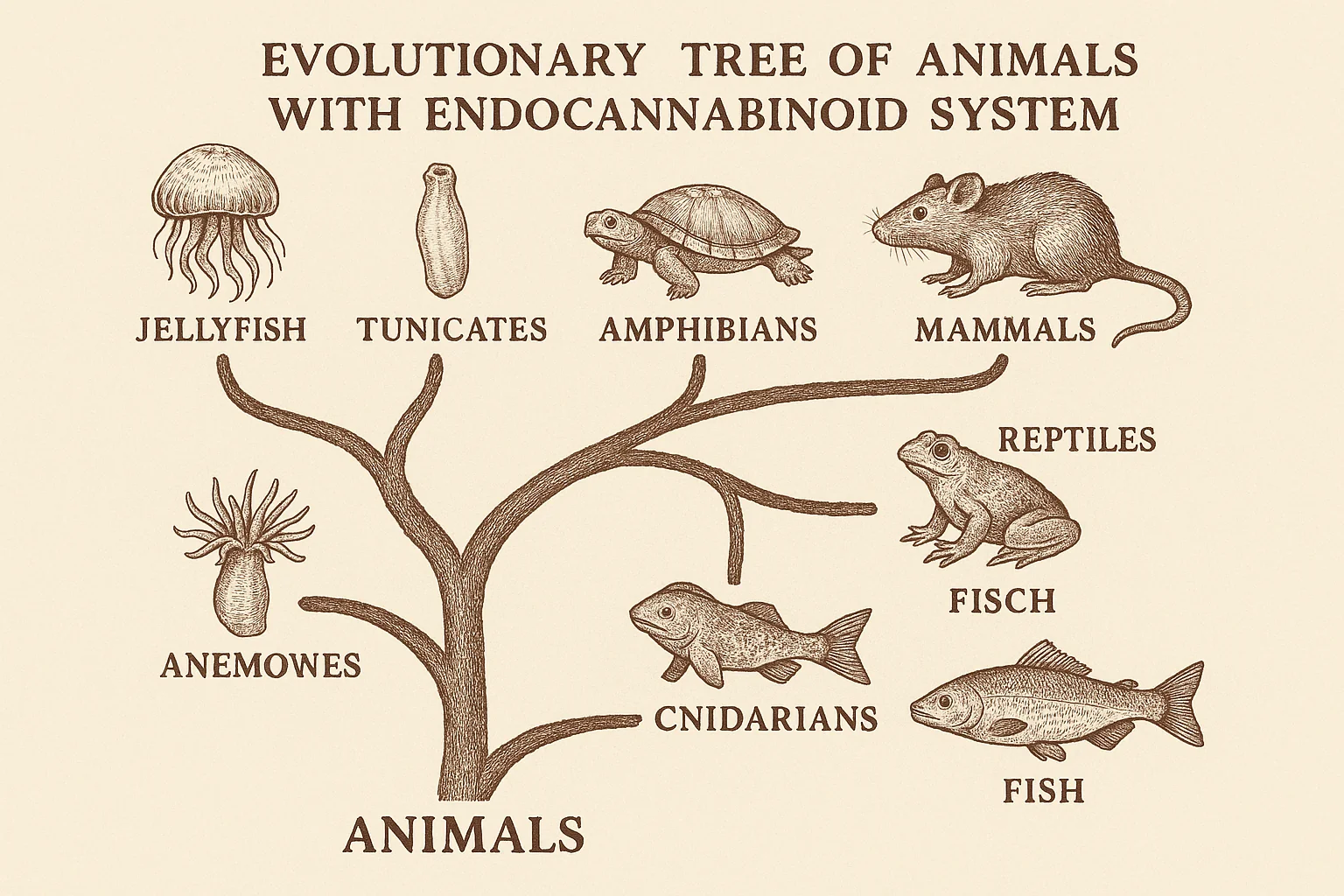

The evolution of the endocannabinoid system - which animals have it and which do not
The evolution of the endocannabinoid system - a mechanism explained simply, based on research. u Bucha.
The endocannabinoid system (ECS) is often described as "one of the most important regulatory systems in mammalian biology." But that is not the whole picture. The ECS is older than mammals, older than vertebrates, and may even be older than the first animals with a nervous system. Cannabinoid-like receptors have been found in creatures living over 600 million years ago. This places THC, CBD, and the entire cannabis market in a completely different perspective: cannabis did not "invent" the ECS - it encountered a system that had been waiting for it for hundreds of millions of years of evolution.
KEY INFORMATION
• The CB1 receptor appeared in vertebrates at least 500 million years ago - CB1 ortholog has been identified in lampreys (Petromyzon marinus), the oldest living jawless vertebrates (Elphick et al., BMC Evolutionary Biology 2004).
• The ECS regulates the same functions in most animals as it does in mammals: appetite, pain, reproduction, stress response, and energy homeostasis.
• Insects do not have a CB1 ortholog - this is an exception among taxonomic groups of invertebrates, suggesting a selective loss of the gene.
• Dogs have 4-5 times more CB1 receptors in the cerebellum than humans, which explains their drastically higher sensitivity to THC.
Where does the ECS come from - how many millions of years does it have?
The most conservative evolutionary estimates date the ECS in protostome invertebrates to at least 550-600 million years ago, but evidence goes back even further. Elphick and colleagues in BMC Evolutionary Biology (2004) They demonstrated the presence of a CB1-like receptor in lampreys (Petromyzon marinus) - jawless fish that diverged from the mammalian evolutionary line over 500 million years ago. This receptor binds anandamide and 2-AG with a similar affinity to mammalian CB1.
Even deeper in the evolutionary tree are studies on cnidarians (Cnidaria). McPartland and colleagues in Gene (2006) They searched the genome of Hydra vulgaris and identified sequences coding for a GPCR receptor with a structure similar to CB1. Hydra lacks a brain or nervous system in the vertebrate sense, but has a primitive diffuse nervous system (nerve net) - and at this level, the ECS already regulates feeding and responses to chemical stimuli.
Did the ECS exist even earlier, in protozoa or fungi? The genomes of yeasts and the simplest fungi do not contain CB1/CB2 orthologs. However, fungi produce lipids similar to N-acylethanolamines - possibly precursors of the ECS. A detailed review of genomic databases from 2020 (Elphick, Barker, Open Biology) did not reveal homologs of CB receptors in plants or fungi, suggesting that the ECS is exclusively an animal invention.
Vertebrates - CB1 and CB2 in their classical form
In all vertebrates - from cartilaginous fish (sharks, rays) to mammals - both CB1 and CB2 have been found with high sequence conservation. Elphick and Egertova in Pharmacological Reviews (2001) They described that the amino acid sequence of CB1 in fish is ~70% identical to mammalian CB1 - indicating that the receptor has hardly changed over 400 million years of evolution. This is a strong selective pressure for functional conservation.
In birds, the situation is interesting: they have CB1 and CB2, but the expression of CB1 in the brain is significantly lower than in mammals. Kempf and colleagues in Brain Research (2000) They demonstrated that CB1 in birds is mainly concentrated in the forebrain and cerebellum, but with a lower density than in mice or humans. Birds may therefore be less sensitive to phytocannabinoids than mammals - although there is a lack of large comparative studies.
Amphibians and reptiles have a functional ECS. In frogs, CB1 regulates thermogenesis and motor activity. In the house gecko (Gekko gecko), it has been shown that 2-AG modulates the response to stress and aggression - suggesting that the neuromodulatory role of the ECS has been conserved throughout reptilian evolution.
Invertebrates - where ECS disappears or changes form
Among invertebrates, the picture is heterogeneous. Echinoderms (Echinodermata - sea urchins, starfish) have a CB1-like receptor that regulates ciliary epithelial movement and feeding behaviors. Mollusks (snails, clams, octopuses) have a partial ECS - receptors resembling CB2, but not CB1, and degradation enzymes for AEA. Salzet and Stefano in Brain Research Reviews (2002) They described the effect of anandamide on the movement of clam larvae - suggesting that AEA as a movement signaling molecule existed before the development of a complex nervous system.
The case of insects is the most intriguing. The fruit fly (Drosophila melanogaster) - a model for genetic research - lacks a CB1 ortholog. Its GPCR receptor CG9753 has a similar architecture to CB2, but the homologous sequence is low (~25%). Pharmacological studies have shown that Drosophila does not respond to AEA or 2-AG through this receptor in a manner comparable to mammalian CB2. This is an evolutionary "puzzle" - did insects lose CB1 during evolution, or did they never acquire it? Genome analysis suggests rather a loss, as echinoderms (evolutionarily closer to vertebrates than insects) have a CB1-like receptor present.
Our observations of this literature indicate an intriguing pattern: "social" animals (bees, ants, termites) losing CB1 may have gained an evolutionary advantage by eliminating individual neuromodulation of appetite and reward - facilitating the emergence of eusocial colonies, where the individual "does not care for itself". This is speculation, but it raises questions about the role of the ECS in the evolution of sociality.
Psy i koty - dlaczego THC jest dla nich niebezpieczne
Veterinarians are alarmed: THC poisoning in dogs from cannabis products (especially edibles) is becoming increasingly common. Understanding this through the lens of the ECS is crucial. Meola and colleagues in the Journal of Veterinary Emergency and Critical Care (2012) They described a series of cases of dog poisoning and showed that toxic doses start at ~3 mg/kg body weight, while in humans the doses required to cause severe intoxication are 10-20× higher (about 20-30 mg/kg in animal models).
Why such a difference? Dogs have an exceptionally high density of CB1 receptors in the cerebellum - the area responsible for motor coordination. When THC floods these receptors, symptoms in dogs include: ataxia (lack of coordination), nystagmus, bradycardia, hypotonia, and drowsiness. In severe cases - coma. In cats, sensitivity is somewhat lower, but the mechanism is the same.
CBD is significantly safer for dogs than THC - clinical studies on dogs with joint pain have shown safety at doses of 2-8 mg/kg daily. However, any CBD product for dogs should contain THC below 0.3% (and preferably below 0.1%) to avoid the risk of intoxication even at higher doses.
What does the evolution of the ECS tell us about cannabis and humans?
The fact that the ECS is a 500-million-year-old biological system says something important: it is not a "nature experiment" specific to mammals. It is a fundamental regulatory mechanism of animal biology. Therefore, hemp - producing phytocannabinoids tailored to CB1 and CB2 - has hit a system that existed long before their evolution. It is a pharmacological "bullseye" that nature has refined over hundreds of millions of years.
For understanding the safety of phytocannabinoids in different species, it is important that CB1 expression in key areas of the brain varies significantly between species. Humans have a relatively low density of CB1 in the brainstem (the area responsible for controlling breathing and heart rhythm), which explains why there are no documented cases of death from THC overdose in healthy adults. Dogs, rodents, and cats have a much higher density of CB1 both in the brainstem and in the cerebellum - hence the clearly higher toxicity of THC for these species compared to humans.
Frequently Asked Questions
Do fish have an endocannabinoid system?
Yes, fish have both CB1 and CB2 receptors. Studies on zebrafish (Danio rerio) have shown the presence of orthologs of both receptors as well as enzymes for the synthesis and degradation of endocannabinoids. ECS in fish (Elphick et al., 2004) It regulates appetite, reproduction, and response to stress - functions convergent with mammals, confirming the deep evolutionary conservation of the system.
What is the oldest animal with an endocannabinoid system?
Cannabinoid-like receptors have been identified in Hydra vulgaris (a freshwater polyp, ~600 million years old) and in some marine sponges. Hydra possesses a cannabinoid receptor regulating feeding, although it is evolutionarily distant from mammalian CB1/CB2. The ECS is older than 600 million years and predates the emergence of a complex nervous system.
Do insects have an ECS?
Insects do not possess CB1 orthologs in the classical sense. Drosophila melanogaster has a GPCR receptor similar to CB2, but not CB1. This suggests that CB1 and CB2 evolved as distinct receptors in vertebrates or their close ancestors, or that insects lost CB1 during evolution — possibly as an adaptation to eusociality.
Why are dogs more sensitive to THC than humans?
Dogs have a higher density of CB1 receptors in the cerebellum and brainstem than humans. THC toxicity in dogs starts at ~3 mg/kg, while in humans, the symptoms of poisoning are significantly milder at similar doses relative to body weight. Dog owners should keep all THC products out of their reach.
Is the ECS important for bees?
Bees do not have CB1. However, they do have GPCR receptors similar to CB2 and enzymes for the metabolism of N-acylethanolamines. Research by Elphick and Egertova (2001) suggests that in bees, the ECS (or its precursor) may regulate swarming and foraging behaviors, but the mechanism differs fundamentally from that of mammals.
This article is for informational and educational purposes and does not replace consultation with a doctor. If you are pregnant, breastfeeding, taking medications, or have chronic conditions, consult the use of supplements or herbs with a specialist.
Author: Michał Waluk · Published: 2026-05-04 · Updated: 2026-05-04