


Immune supplements for children: which are safe and when it’s really worth giving them
Which immunity supplements for children have studies, and which do not. Vitamin D, C, zinc, probiotics, elderberry, and echinacea in light of pediatric data.
A preschooler can go through infection after infection from October to March, and the pharmacy shelf suggests that it can be bought. The problem is that a significant portion of "immunity" preparations for children is based on studies conducted on adults, and the doses have been calculated from a person weighing seventy kilograms. This text separates two things: what has actually been tested on children and on how many of them, and what is sold on faith. We read for this purpose Cochrane reviews covering ingredients from the top shelf of the pharmacy, current Polish guidelines for vitamin D dosing, and descriptions of poisonings in small children. You will see how many infections per year fall within the developmental norm, when recurring infections are a signal for immunological diagnostics, and why excess vitamin can be more dangerous for a child than its deficiency.
KEY INFORMATION
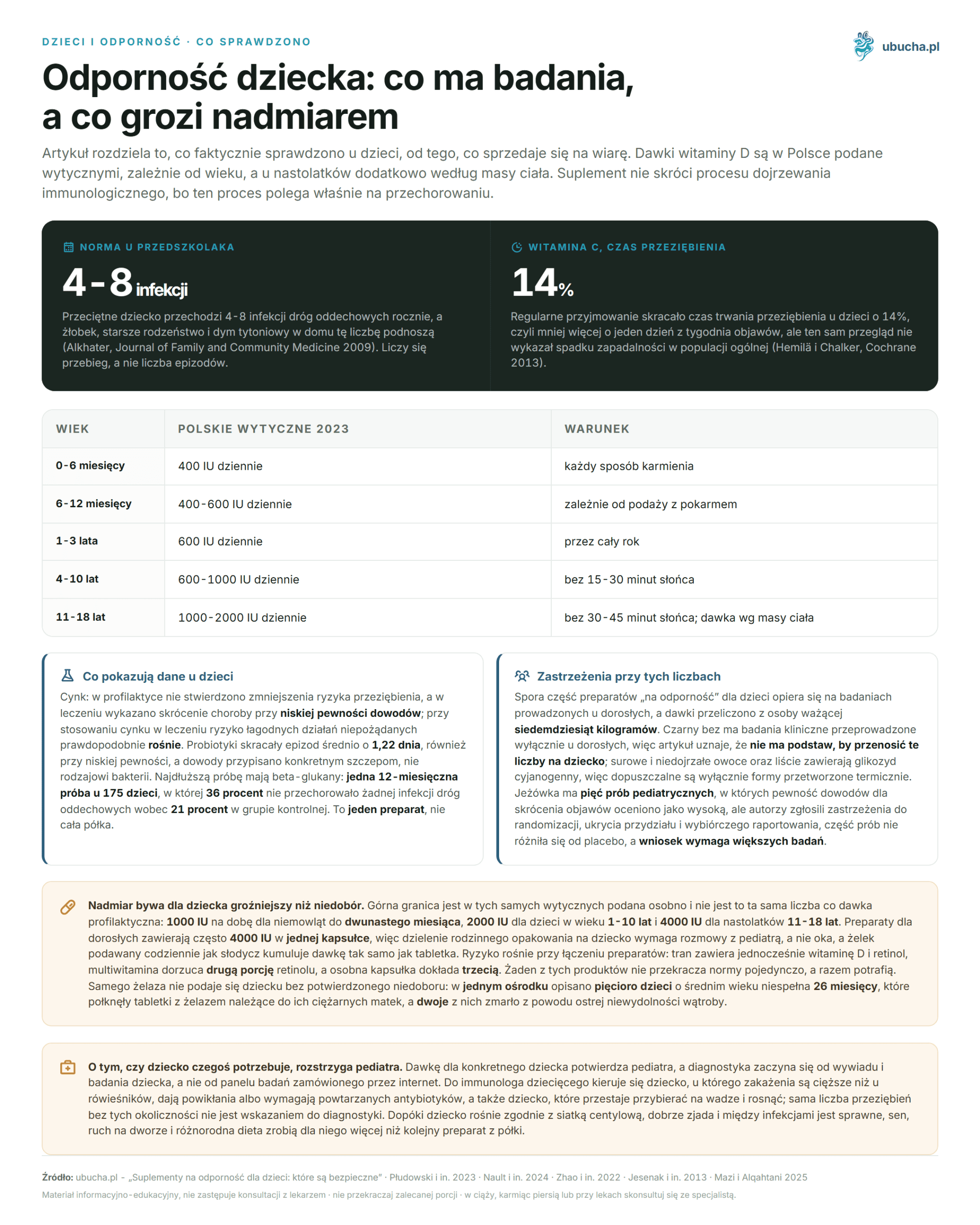
• The average child experiences 4-8 respiratory infections per year, and daycare raises this number (Alkhater, Journal of Family and Community Medicine 2009).
• Vitamin C shortens colds in children by 14%, but does not reduce incidence (Hemilä and Chalker, Cochrane 2013).
• Probiotic evidence is attributed to specific strains, not the type of bacteria.
• Excess retinol, vitamin D, and iron is a real threat to young children, not just a theory.
How many infections per year are considered normal for a preschooler?
An average child experiences four to eight respiratory infections per year, and daycare, older siblings, and tobacco smoke at home increase this number (Alkhater, Journal of Family and Community Medicine 2009). A child with normal immunity grows normally, responds to standard treatment, and looks healthy between infections.
This distinction does more good for the parent than any preparation. A runny nose every three weeks from November to March looks like a series, but spread over twelve months, it falls within the same range cited by pediatric literature. The first year in a peer group is usually the worst because the child encounters dozens of viruses it has never seen before. Each of these infections leaves an immunological memory, so the second season in the same group usually looks different.
We have noticed in conversations with parents that the pressure to "boost immunity" increases not when the child is sicker, but when they are sick more often than a neighborhood friend who does not attend preschool. This comparison makes no sense because the difference is made by exposure, not the efficiency of the immune system. A supplement will not shorten the process of immunological maturation because this process is precisely about getting sick.
The conditions under which it is worth stopping counting infections and starting diagnostics are described later in the text. Until then, accept a simple rule: the course matters, not the number of episodes.
How much vitamin D should a child receive in Poland?
Here, the official standard applies, not the parent's decision. The guidelines by Płudowski and colleagues from 2023 recommend 400 IU daily for infants up to six months, regardless of feeding method, and 600 IU year-round for children from the first to the third year of life, as there are restrictions on sun exposure (Płudowski et al., Nutrients 2023).
| Age | Polskie wytyczne 2023 | Condition |
|---|---|---|
| 0-6 months | 400 IU dziennie | from the first days of life, any method of feeding |
| 6-12 months | 400-600 IU dziennie | depending on dietary intake |
| 1-3 lata | 600 IU dziennie | throughout the year |
| 4-10 lat | 600-1000 IU dziennie | when there are no 15-30 minutes of sun on exposed forearms and legs, between 10 and 15, without sunscreen, from May to the end of September. |
| 11-18 lat | 1000-2000 IU dziennie | as above, but guidelines require 30-45 minutes; dose according to body weight. |
The scale of deficiency in the Polish population is real and highly seasonal. In a multicenter study of 720 healthy children aged 9-13 years, the concentration of 25(OH)D was measured twice: after winter in March and after summer in October. In March, deficiency was found in 64 percent of the subjects, and severe deficiency in another 20.2 percent, meaning over four-fifths of the children. In October, it was 25.9 and 0.1 percent respectively (Chlebna-Sokół et al., European Journal of Nutrition 2019). The authors conclude that supplementation should occur year-round, not just in winter.
The upper limit is given separately in the same guidelines and is not the same number as the preventive dose. The table of tolerable upper intake of cholecalciferol states 1000 IU per day for infants up to twelve months, 2000 IU for children aged 1-10 years, and 4000 IU for adolescents aged 11-18 years (Płudowski et al., Nutrients 2023, table 2). Adult preparations often contain 4000 IU in one capsule, so dividing a family package for a child requires a conversation with a pediatrician, not just a glance.
Does vitamin C shorten a child's cold?
It does shorten it, but less than the label promises, and it does not prevent illness. A Cochrane review from 2013, involving over 11,000 participants, found no reduction in the incidence of colds in the general population. Regular intake, however, shortened the duration of colds in children by 14 percent, compared to 8 percent in adults (Hemilä i Chalker, Cochrane Database of Systematic Reviews 2013).
It's worth translating that 14 percent into days. If a child's cold lasts seven days, a 14 percent reduction means about one day less. This is a fair and realistic result, but it does not match the promise of 'the child will stop getting sick' suggested by the packaging. The effect was observed with regular intake throughout the season, not just taking the preparation on the first day of a runny nose. In therapeutic studies, meaning those started after symptoms appeared, there was no consistent effect.
A separate issue is the dosage. The Cochrane review included trials using at least 0.2 grams daily, and some studies in children reached 1-2 grams. This is multiple times the amount a child gets from food, and it is not a recommendation to replicate at home. A child's need for vitamin C is met by a diet rich in fruits and vegetables, and the amount of the supplement, if it is to be given at all, should be determined by a pediatrician. Excess vitamin C does not accumulate like fat-soluble vitamins, but in larger amounts, it can cause diarrhea and stomach pains.
Does zinc help a child with a cold?
Data on children is weak and partly directly negative. A Cochrane review from 2024 included 34 studies and 8526 participants, including 12 studies in children. No reduction in the risk of colds was found in prevention, and treatment showed a shortening of illness with low certainty of evidence and great heterogeneity of results (Nault i in., Cochrane Database of Systematic Reviews 2024). The same review notes on the cost side that the use of zinc in treatment likely increases the risk of mild adverse effects.
The most telling study is a pediatric one from 1998. Macknin and colleagues gave 249 students zinc gluconate lozenges five or six times a day. The time to symptom resolution was nine days in both groups, and there was no difference for any of the nine assessed symptoms. However, 60 percent of children taking zinc reported an unpleasant taste compared to 38 percent in the placebo group (Macknin i in., JAMA 1998). A lozenge requires dissolving in the mouth for several minutes, which a small child will not do, and with infants, there is additionally a risk of choking.
There is one situation where zinc in children has stronger foundations. A 2016 Cochrane review included six studies and 5193 children aged two to 59 months, and the incidence of pneumonia was 13 percent lower in the zinc groups (Lassi i in., Cochrane Database of Systematic Reviews 2016). It is worth reading this result more closely: the effect reached 21 percent where diagnosis was confirmed by chest examination or X-ray, and disappeared with a definition based solely on accelerated breathing. The quality of evidence was rated as low. Transferring this to a well-fed Polish preschooler eating meat and dairy is an overreach, as the studies were conducted in areas where zinc deficiency is a population phenomenon. Supplementation without confirmed deficiency is not justified here, and excess zinc impairs copper absorption.
Which probiotic has evidence in children?
Evidence has been attributed to specific strains, not the type of bacteria. A Cochrane review from 2022 included 23 studies and 6950 individuals, including children from the first month of life. Probiotics reduced the percentage of participants with at least one upper respiratory infection and shortened episodes by an average of 1.22 days, with low certainty of evidence (Zhao i in., Cochrane 2022).
The best-documented strain in pediatrics is Lactobacillus rhamnosus GG. In a study by Hojsak et al., 281 children from nurseries received this strain or a placebo for three months. The risk of upper respiratory infections decreased by one-third, and the number of days with symptoms was significantly lower. The effect on gastrointestinal infections was not confirmed, as the result did not reach statistical significance (Clinical Nutrition 2010).
In the treatment of acute diarrhea, the picture is more nuanced. A meta-analysis by Szajewska et al. from 2019 included 18 studies and 4208 children; the same strain shortened diarrhea by an average of 0.85 days, but a large study published a year earlier found no effect, and the benefit was mainly seen in European countries (Alimentary Pharmacology and Therapeutics 2019). This is not a Cochrane review, although it is sometimes labeled as such.
The practical conclusion for parents is this: the packaging must include the full designation of the strain along with the alphanumeric symbol, as the name of the genus alone does not indicate whether it has been tested. We discuss more about the differences between strains in our post about choosing a probiotic for gut health and immunity.
Do black elderberry and echinacea work in children?
In the case of elderberry, clinical trials have been conducted on adults. A trial involving 312 long-haul flight passengers showed a shorter total duration of colds and milder symptoms, but the difference in the number of illnesses was not significant (Tiralongo i in., Nutrients 2016). An earlier trial for influenza involved 60 people aged 18-54, who were given syrup four times a day for five days; symptoms resolved an average of four days earlier than with placebo (Zakay-Rones i in., Journal of International Medical Research 2004).
Therefore, there is no basis for transferring these numbers to children. The raw material also has its own limitation: raw and unripe fruits and leaves contain cyanogenic glycosides, so only thermally processed forms are permissible. We describe the comparison of raw materials in our post about aronii i czarnym bzie.
Echinacea has a systematic review of pediatric studies from 2025. Five trials met the inclusion criteria, and the authors reported concerns about randomization, allocation concealment, and selective reporting. Nevertheless, they rated the certainty of evidence as high for symptom reduction and decreased antibiotic use, and moderate for infection prevention (Mazi i Alqahtani, Journal of Family and Community Medicine 2025). However, they themselves write that effectiveness depended on the form and dose, some trials did not differ from placebo, and the conclusion requires further research.
Which ingredients have studies conducted on children?
Most of the ingredients discussed here have some trials conducted on children, not just adults; the exception is black elderberry. The difference between them lies elsewhere: in how many of these trials exist, how long they lasted, and whether the outcome concerned the number of illnesses or just the duration of symptoms. You can find the comparison in the table below.
The least known on the Polish shelf are beta-glucans, and they have the longest trial here. One hundred seventy-five children around six years old, with more than five respiratory infections in the previous year, received syrup with pleuran, which is a beta-glucan from the oyster mushroom, or a comparative preparation for twelve months. In the beta-glucan group, 36 percent of children did not experience a single respiratory infection during this time, compared to 21 percent in the control group (Jesenak i in., International Immunopharmacology 2013). It is worth noting a detail of the design: both groups received vitamin C, the difference was made by the beta-glucan itself. This is a single study of one preparation, not evidence for the entire shelf.
| Ingredient | What the data shows in children | Podstawa |
|---|---|---|
| Vitamin D | prevention of deficiency, doses specified by guidelines | official standard |
| Vitamin C | shorter cold duration by 14%, incidence unchanged | Cochrane review |
| Zinc | brak efektu w profilaktyce, w leczeniu wynik niepewny | low certainty |
| Probiotics | fewer episodes, shorter course, effect dependent on strain | low certainty |
| Elderberry | studies exclusively in adults | intermediate data |
| Echinacea | five pediatric trials, shorter symptoms, and fewer antibiotics | methodological concerns |
| Beta-glucans | one 12-month trial with 175 children, 36% without infection versus 21% | jeden preparat |
Czym grozi przedawkowanie witamin u dziecka?
Fat-soluble vitamins accumulate, so exceeding the standard is not just a theory for a child. EFSA in its 2024 opinion maintained the upper limit for retinol at 3000 micrograms of retinol equivalent per day for adults and recalculated it for younger groups, obtaining values from 600 micrograms for infants to 2600 micrograms for teenagers (EFSA Journal 2024). The critical effect on which this limit was based was teratogenicity, and hepatotoxicity was also assessed.
The risk increases when combining preparations. Cod liver oil contains both vitamin D and retinol, a multivitamin adds a second dose of retinol, and a separate capsule with vitamin D adds a third. None of these products exceed the norm individually, but together they can. The same logic applies to vitamin D, for which Polish guidelines set an upper limit of 2000 IU daily for children aged 1-10 years.
Another trap is the form of the preparation. A case report in Pediatric Emergency Care described a twenty-month-old girl admitted with loss of appetite, increasing weakness, and drowsiness, who was found to have severe hypercalcemia and vitamin D overdose. The source was calcium and vitamin D3 gummies given to her by her mother several times a day for weeks, even months; the child required intensive therapy, and hypercalcemia initially did not resolve after standard treatment (Doyle i in., Pediatric Emergency Care 2021). The authors describe this as a case of neglect in a family with a mother suffering from mental illness, so it is not a typical household accident. The takeaway for parents is practical: a gummy given daily like a candy accumulates the dose just like a tablet. We describe how preparations in this form differ from each other in the post about vitamin jellies.
The most extreme example concerns iron. In one center, five children with an average age of just under 26 months swallowed iron tablets belonging to their pregnant mothers; two of them died from acute liver failure (Chandran i in., Journal of Family Medicine and Primary Care 2023). The authors conclude with a direct appeal for primary care physicians to talk to parents about the safe storage of iron preparations. Iron itself should not be given to a child without confirmed deficiency.
When do recurrent infections require diagnostics?
It is not the number of colds that matters, but their course. A child is referred to a pediatric immunologist if infections are more severe than in peers, cause complications, or require repeated antibiotics, as well as a child who stops gaining weight and growing. The author of the cited study emphasizes that in a child with a functioning immune system, development proceeds normally (Alkhater 2009).
There are also less obvious situations. An infection caused by a microorganism that usually does not cause disease in a healthy child, an organ abscess, chronic oral thrush after infancy, and a family history of primary immunodeficiency are concerning. According to the cited study, primary immunodeficiencies occur even once in 2000 live births, so they are not rare enough to dismiss outright.
More often than an immune deficiency, something simpler stands behind a series of infections: allergy, enlarged adenoids, reflux, tobacco smoke in the home, or simply the first year in a group. Diagnostics begins with an interview and examination of the child, not with a panel of tests ordered online. Results of immunological tests in a small child without clinical context can be misleading, as norms change with age.
As long as the child is growing according to the percentile chart, eating well, and is active between infections, sleep, outdoor activity, and a varied diet will do more for them than another product from the shelf. It’s a boring answer, but it is backed by better data than most things sold under the banner of immunity.
Frequently Asked Questions
How many infections per year is normal for a preschooler?
An average child experiences four to eight respiratory infections per year, and daycare, older siblings, and tobacco smoke at home increase this number (Alkhater 2009). A child with normal immunity grows normally, responds to standard treatment, and looks healthy between infections. The mere count of illnesses is not a cause for concern.
Does vitamin C prevent colds in children?
No. The Cochrane review from 2013, involving over 11,000 participants, did not show a decrease in incidence in the general population. Regular intake, however, shortened the duration of colds in children by 14 percent, or about one day from a week of symptoms. This is a real but modest effect.
How much vitamin D does a child receive according to Polish guidelines?
The 2023 guidelines recommend 400 IU daily for infants up to six months, 400-600 IU up to one year, 600 IU throughout the year for children aged 1-3 years, 600-1000 IU for children aged 4-10 years, and 1000-2000 IU for teenagers when sunlight exposure is insufficient. The dose for a specific child is confirmed by a pediatrician.
Is zinc in lozenges suitable for children?
Rather not. In a study published in JAMA in 1998, involving 249 students, zinc gluconate lozenges did not shorten colds compared to placebo, and 60 percent of children reported an unpleasant taste compared to 38 percent in the placebo group. In younger children, there is a risk of choking on the lozenge.
Does every probiotic work the same?
No. Evidence was attributed to specific strains, not to the type of bacteria. The Cochrane review from 2022 included 23 studies and 6950 people, including children from the first month of life, with low certainty of evidence. On the label, look for the full strain designation with an alphanumeric symbol.
When to take a child to an immunologist?
When infections are more severe than in peers, lead to complications, require repeated antibiotics or hospitalization, when a child stops gaining weight and growing, or when the infection is caused by atypical microorganisms. The mere number of colds without these circumstances is not an indication for diagnostics.
If after talking to the pediatrician it turns out that the child actually needs something, you can browse the assortment in the category supplements. A broader overview of the topic can also be found in the post about it, what is safe in children's supplementation.
This article is for informational and educational purposes and does not constitute medical advice. Before starting supplementation, consult your doctor, especially if you are taking medications regularly, are pregnant or breastfeeding, or have a chronic illness.
Author: Michał Waluk · Opublikowano: 2026-06-02 · Aktualizacja: 2026-08-14