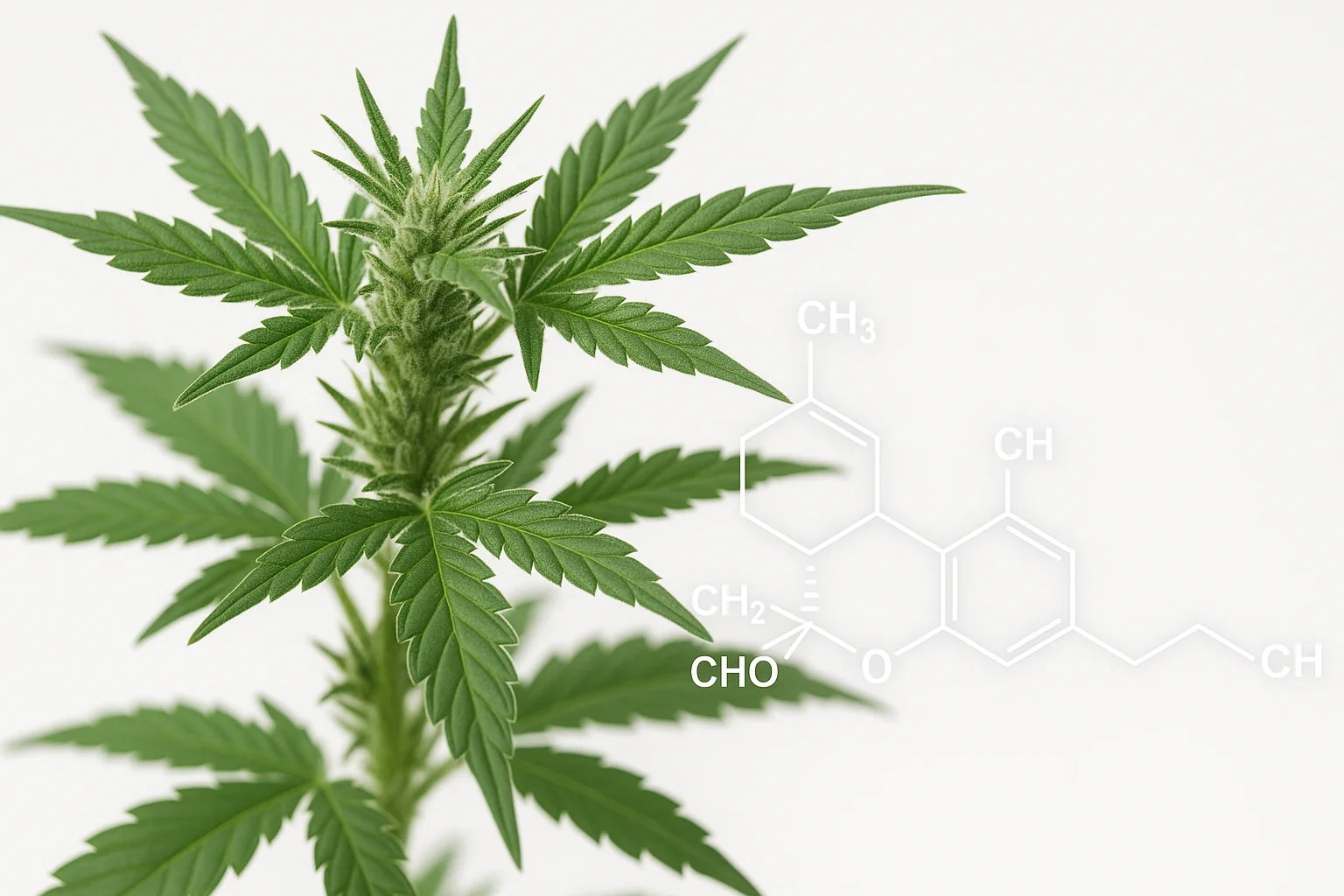

THCA - what it is, how it works, and how it differs from THC
THCA — what is it, how does it work, and what does it help with? A clear guide from u Bucha.
When buying hemp flower, you look at the label and see “THCA 18%” instead of “THC 18%.” This is not a printing error. THCA and THC are two different molecules, although they are chemically very similar. The raw cannabis plant does not produce THC - it creates THCA, which only becomes psychoactive when exposed to heat. This difference is significant from both a physiological and legal perspective. In this article, we explain what THCA is, how it is formed, what distinguishes it from THC, and what current scientific research says about it.
KEY INFORMATION
• THCA does not bind to CB1 receptors and does not cause intoxication - unlike THC, which has a strong affinity for these receptors (Rock et al., British Journal of Pharmacology, 2013).
• THCA is an acidic precursor to THC: heating above 100°C triggers decarboxylation and converts THCA into psychoactive THC.
• Preclinical studies indicate the anti-inflammatory potential of THCA by inhibiting COX-1 and COX-2.
• The legal status of THCA in Poland in 2026 remains ambiguous - THC is a controlled substance, while its acidic form may not be.
What is THCA and how is it formed in the cannabis plant?
THCA (tetrahydrocannabinolic acid) is the dominant cannabinoid in fresh, unheated cannabis plants. The living plant does not directly synthesize THC - it produces THCA in the biosynthesis process, starting from cannabigerolic acid (CBGA) as the parent compound (Rock et al., British Journal of Pharmacology, 2013). Therefore, raw flower contains almost exclusively THCA, not THC.
Biosynthesis occurs in the plant's secretory glands, called trichomes. It is there that enzymes convert CBGA into THCA with the help of THCA synthase. Throughout the plant's growth, THCA accumulates in the trichomes as a storage form. Only after harvesting and drying - and then heating - does it begin to convert into THC.
Why does the plant produce THCA instead of THC right away? Scientists suggest that the acidic form serves a protective function: THCA is chemically more stable and degrades more slowly at room temperature. From the plant's perspective, this is a proven evolutionary solution.
We have noticed that many consumers of hemp flowers are surprised that the label shows “THCA” instead of “THC.” This is because European regulations regarding industrial hemp regulate THC content after decarboxylation, but producers often report the raw THCA content, as it predominates in fresh flower. This difference in reporting can be misleading.
THCA vs THC - a comparative table of the main differences
THCA and THC are two forms of the same molecule - they differ by one carboxyl group (-COOH). However, this slight chemical change translates into fundamental differences in biological activity, legal status, and methods of consumption. The table below gathers the most important features of both compounds in one place.
| Feature | THCA | THC |
|---|---|---|
| What it is | Cannabinolic acid (precursor to THC) | Tetrahydrocannabinol (active form) |
| Psychoactivity | None - does not bind to the CB1 receptor | Tak - silne powinowactwo do CB1 |
| How it is produced | Biosynthesis in the living cannabis plant | Decarboxylation of THCA (heat, time, UV) |
| Legal status in Poland 2026 | Unregulated directly, gray area | Controlled substance (list I-N) |
| Potential applications | Anti-inflammatory, neuroprotection (preclinical studies) | Pain, nausea, appetite (higher level of evidence) |
| How to consume | Raw herb (juice, smoothie), unheated | Vaporization, smoking, edibles after decarboxylation |
Key takeaway from the table: the same hemp herb can behave completely differently depending on whether you heat it. Unheated provides THCA without psychoactive effect. Burned or vaporized, it converts THCA into THC and completely changes the action profile.
Decarboxylation: why heating THCA changes everything?
Decarboxylation is a chemical reaction in which THCA loses a carboxyl group (-COOH) and becomes THC. Studies using gas chromatography show that heating at 110-120°C for 30-60 minutes converts about 70-80% of THCA into THC (Veress et al., Journal of Chromatography, 1990). This means that smoking or vaporizing the herb almost entirely activates THCA to its psychoactive form.
However, the reaction is not a one-time switch. It occurs gradually, and its intensity depends on three factors: temperature, exposure time, and the presence of oxygen. Even storing the herb in heat (e.g., in a heated car) slowly triggers decarboxylation. UV radiation also accelerates this process, though more slowly than heat.
So how to preserve THCA in its unchanged form? The herb should be kept in an airtight container, in a cool and dark place. Juice from raw hemp leaves or frozen fresh plants retain THCA virtually unchanged. This method of consumption is of particular interest to researchers examining unactivated cannabinoids as an alternative to traditional forms.
Is THCA psychoactive and is it legal in Poland?
THCA is not psychoactive in its unheated form. A key study by Rock and colleagues from 2013 showed that THCA does not significantly bind to CB1 receptors in the endocannabinoid system, which are responsible for the intoxicating effects of THC (Rock et al., British Journal of Pharmacology, 2013). Without this binding, there are no effects characteristic of recreational cannabis.
The legal status of THCA in Poland in 2026 is a gray area. The Act on Counteracting Drug Addiction (Journal of Laws from 2023) lists THC as a controlled substance on list I-N, but does not directly refer to THCA as a separate compound. From the perspective of industrial hemp regulations, the THC content after decarboxylation matters, and industrial hemp in the EU must contain less than 0.3% THC in dry mass (EUR-Lex, Regulation 1307/2013).
Does this mean that THCA is fully legal? No. The gray area is not the same as a lack of regulation. Law enforcement can interpret the regulations broadly, especially if the product contains THCA at concentrations that would exceed THC limits when heated. Before deciding to purchase or possess THCA-rich products, consult the situation with a lawyer.
What do studies say about the potential of THCA?
Research on THCA is promising, although still early. Ruhaak and colleagues demonstrated in 2011 that THCA inhibits the activity of COX-1 and COX-2 enzymes - the same ones that block popular non-steroidal anti-inflammatory drugs (Ruhaak et al., European Journal of Pharmacology, 2011). This cellular-level action suggests anti-inflammatory potential, although so far only in laboratory models.
Our observations indicate that individuals interested in cannabinoids without psychoactive effects are increasingly asking about THCA and CBD as two different “entrances” to cannabis plants. This is a trend that appears both in customer inquiries and in EMCDDA reports noting a growing interest in raw cannabis juice as a source of non-psychoactive THCA.
In the area of neuroprotection, preliminary preclinical studies indicate that THCA may protect nerve cells from the neurotoxic effects of the MPP+ factor (associated with the Parkinson's disease model). These results were published in Phytomedicine (Moldzio et al., 2012) and although they sound promising, the studies were conducted on cell cultures and animal models. Clinical confirmations in humans are still a long way off - premature conclusions should not be drawn.
THCA is not a miracle cure. It is a compound with real potential that requires more robust clinical research. Many substances show promise in vitro and in animal models, but the effects do not always translate to humans. Therefore, consider the available data as a starting point for discussion with your doctor, not as definitive therapeutic recommendations. Science is just beginning to understand the full spectrum of action of acidic cannabinoids - THCA is one of the more interesting candidates for further clinical research in the coming years.
Frequently Asked Questions
What is THCA and how does it differ from THC?
THCA (tetrahydrocannabinolic acid) is the acidic precursor to THC naturally present in the fresh cannabis plant. It does not bind to CB1 receptors, so it does not cause intoxication. Only heating the flower - through smoking, vaporizing, or baking - converts THCA into psychoactive THC (Rock et al., British Journal of Pharmacology, 2013).
Is THCA legal in Poland in 2026?
The legal status of THCA in Poland remains ambiguous. The Act on Counteracting Drug Addiction (Journal of Laws of 2023) directly regulates THC, not its acidic precursor. Cannabis flower with THC content below 0.3% (a requirement for industrial hemp according to EUR-Lex) operates in a gray area. Before purchasing or possessing it, it is advisable to consult a lawyer.
How to use THCA to avoid decarboxylation?
To preserve THCA in its inactive form, the flower or fresh cannabis plants should be consumed without heating: in juices, smoothies, or as raw plant material. Heating above 100-110°C initiates decarboxylation and gradually converts THCA into psychoactive THC (Veress et al., Journal of Chromatography, 1990).
Does THCA have medicinal properties?
Preclinical studies suggest that THCA may inhibit the COX-1 and COX-2 enzymes responsible for inflammation (Ruhaak et al., European Journal of Pharmacology, 2011). These are promising results; however, the available data pertains to cell and animal models. Clinical studies in humans are needed to confirm these effects.
What percentage of THCA converts to THC during decarboxylation?
At temperatures of 110-120°C, after 30-60 minutes, about 70-80% of THCA is converted to THC (Veress et al., Journal of Chromatography, 1990). The conversion is not complete - there always remains a certain amount of unconverted THCA, especially at lower temperatures or shorter exposure times.
This article is for informational and educational purposes and does not constitute legal advice. The legal status described in the article is valid as of the publication date - regulations regarding cannabis may change. Consult a lawyer or current legal acts before making decisions.
Author: Michał Waluk · Published: 2026-05-04 · Updated: 2026-05-04