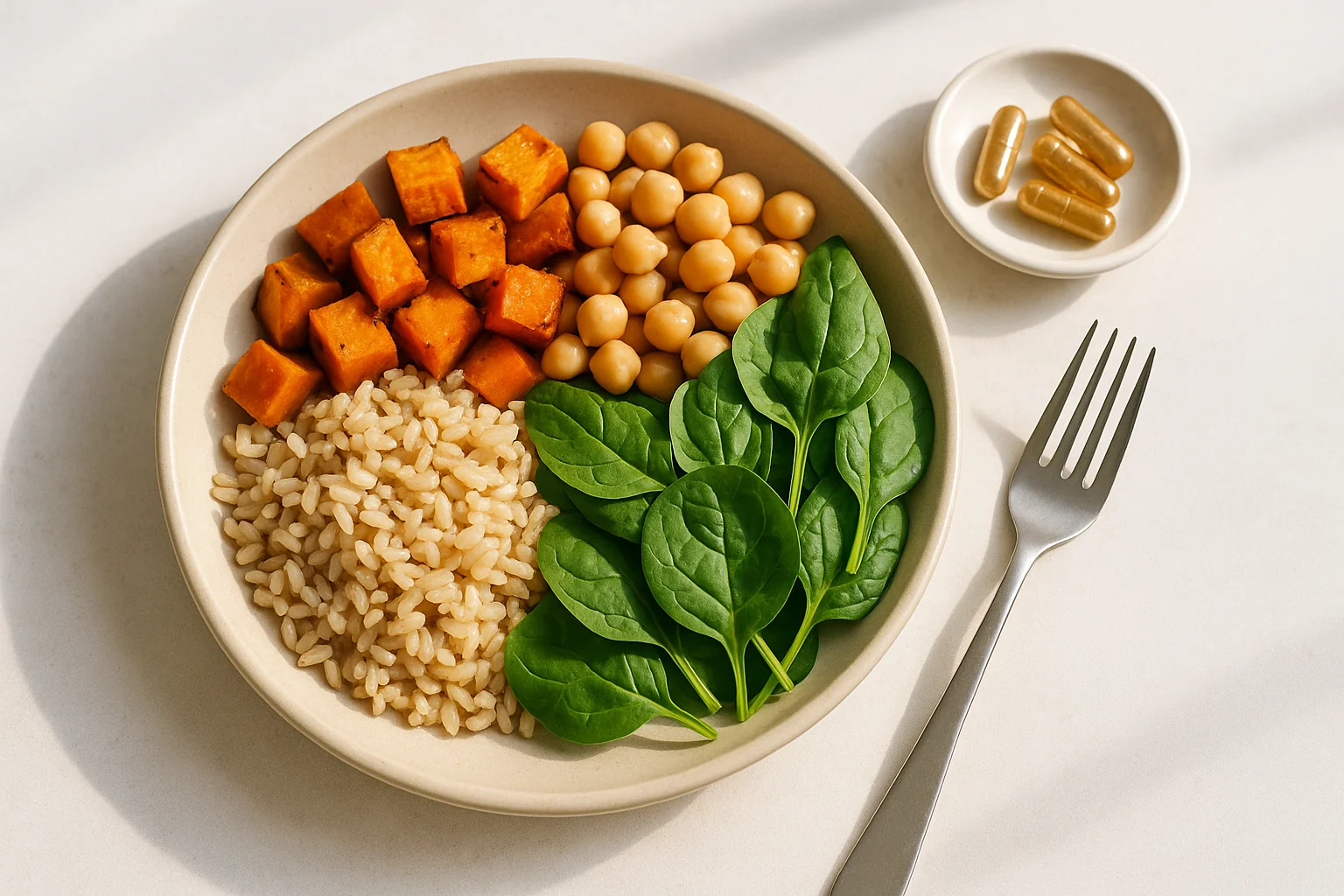

Supplements for vegetarians and vegans: what is lacking in a plant-based diet and how to supplement
A plant-based diet requires B12, DHA from algae, and vitamin D. Verified dosages, forms of supplements, and a testing panel based on scientific reviews.
A plant-based diet can be complete, but it does not become complete on its own. A review of 18 studies published in Nutrition Reviews found a deficiency of vitamin B12 in 62% of pregnant vegetarians and in 11-90% of older individuals on a meatless diet, regardless of country of residence and age. This is not an exotic exception, but a predictable consequence of a diet in which several nutrients simply do not occur or occur in poorly absorbable forms. The good news is that the list of deficiencies is short and well-documented. Six nutrients, a few specific dosages, and one testing panel once a year eliminate most of the risk. Below you will find each of them separately: how much to take, in what form, and how to know when a supplement is unnecessary.
KEY INFORMATION
• B12 is the only absolutely essential supplement on a vegan diet, with deficiencies found in 21-41% of teenagers (Pawlak et al., Nutrition Reviews, 2013).
• The conversion of ALA from flax and hemp to DHA reaches 9% in women, while it is lower in men.
• The Institute of Medicine recommends an iron requirement for vegetarians that is 1.8 times higher than for meat-eaters.
• The upper tolerable intake level of zinc in the European Union is 25 mg per day, not 40 mg.
Does a vegan need to supplement vitamin B12?
Yes, without exception. No plant product provides bioavailable B12 in amounts that cover daily requirements. A review of 18 studies (Pawlak et al., Nutrition Reviews, 2013) found a deficiency in 62% of pregnant vegetarians, in 25-86% of children, and in 21-41% of teenagers, more often in vegans than in vegetarians.
Cobalamin is produced exclusively by microorganisms. Animal products contain it because animals obtain bacteria from feed or receive supplements in farming. Seaweeds, unfortified nutritional yeast, and tempeh do not suffice. Deficiency acts insidiously, as the liver holds a reserve for 3-5 years, and fatigue, tingling in the limbs, and memory disturbances accumulate slowly over this time. Before the level drops to a critical value, some damage to the nervous system may already be irreversible.
| Daily dose of extract | Dose | Dlaczego tak |
|---|---|---|
| Daily | 50-100 µg cyjanokobalaminy | Najprostszy schemat, forma tania i stabilna |
| Dwa razy w tygodniu | 1000-2000 µg | A higher dose compensates for passive absorption |
| Kontrola | Raz w roku | B12 w surowicy razem z kwasem metylomalonowym |
We have noticed that the most common mistake is not refusing supplementation, but relying on fortified food. The amounts of B12 in plant-based drinks and cereals can be small and variable between batches, and covering 2.4 µg daily from such food alone requires precision that no one can maintain for a year. A tablet costs a few zlotys a month and removes all this uncertainty.
Where to get DHA on a plant-based diet without fish?
From marine algae oil. Fish obtain DHA precisely from algae and plankton, so algae oil leads to the same source via a shorter route. The body can convert alpha-linolenic acid from flax and hemp into DHA, but it does so poorly: in young women, the conversion reached 9%, while in men it is lower.
A review by Burdge and Calder (Reproduction Nutrition Development, 2005) summarized this unequivocally. Increasing ALA intake raises the proportion of EPA in plasma lipids, erythrocytes, and breast milk, while DHA does not increase, and with high ALA intake, it can even decrease. In an isotopic study Burdge i Wootton (British Journal of Nutrition, 2002) young women converted 9% of the provided ALA into DHA, and about 22% burned it as carbon dioxide within the first day. Flax alone is not enough.
Practically, it looks simple. An adult needs 250-500 mg of DHA per day from algae of the genus Schizochytrium or Nannochloropsis. During pregnancy and breastfeeding, a reasonable range is 400-600 mg. Take the capsule with a meal containing fat, as it is absorbed significantly better than on an empty stomach. After opening, keep the package in the refrigerator, as omega-3 fatty acids oxidize quickly. Algal oil has one more advantage over fish oil: it carries no risk of mercury or dioxins from wild catch.
How much iron does a vegetarian need and when should they supplement it?
The Institute of Medicine sets the requirement for vegetarians at 1.8 times higher than for meat-eaters, as heme iron is absorbed at 20-30%, while non-heme iron from plants is absorbed at 1-10% (Austin i in., European Journal of Clinical Nutrition, 2025). For women before menopause, this amounts to about 32 mg per day, and for men about 14 mg.
However, this number can be overestimated. A review of plant-based diets in children from 2025 points out that the intestine adapts to low supply and gradually increases absorption, so the multiplier of 1.8 may require downward revision. Therefore, the decision to supplement should be based on results, not just dietary declarations.
Check ferritin, not just morphology. A value below 30 µg/l indicates depleted stores, even before anemia appears, and that’s when supplementation makes sense. At 30-70 µg/l, a diet with beans, lentils, tofu, and pumpkin seeds, combined with vitamin C, is usually sufficient. Hunt (American Journal of Clinical Nutrition, 2003) It states directly that vegetarians have lower iron stores, women before menopause struggle to meet the recommended intake from food alone, but the benefits of routine supplementation have not been demonstrated for everyone.
The form of the supplement matters for the stomach. Malate, fumarate, and amino acid chelate are better tolerated than the cheaper sulfate. Do not combine iron with coffee, tea, calcium, or zinc, as these block absorption. Vitamin C in a dose of 50-100 mg or acidic additions to meals improve the absorption of non-heme iron.
Which vitamin D to choose on a plant-based diet and in what dose?
From October to March, skin synthesis in Poland practically ceases, so this topic concerns everyone, not just vegans. EFSA (2012) It has established the upper tolerable intake level for adults at 100 µg, or 4000 IU per day. The typical autumn-winter dose is below this limit, usually around 2000 IU.
Vegans have an additional problem with the form. Regular D3 comes from sheep lanolin and is suitable for vegetarians, but not for vegans. An alternative is D3 from lichens, such as Cladonia rangiferina, which is biochemically identical and fully plant-based. Ergocalciferol, or D2, is also plant-based, but raises the concentration of the active form in the blood less effectively.
It is worth knowing who actually benefits from supplementation. A meta-analysis of individual data from 25 studies (Martineau i in., BMJ, 2017) included 11,321 participants and showed protection against respiratory infections at an odds ratio of 0.88. However, the effect was very unevenly distributed. In individuals with a baseline concentration of 25(OH)D below 25 nmol/l, the odds ratio was 0.30, while in those above this value, it was only 0.75. High-dose bolus doses did not work at all, unlike daily and weekly doses. The practical conclusion is: the supplement corrects deficiency, it does not boost immunity in someone who does not have a deficiency. You can read more about seasonal immune support in the post Supplements for autumn and immunity.
Does a plant-based diet provide enough calcium?
It depends on the selection of plants, not just on the mere elimination of dairy. In the EPIC-Oxford cohort, which included 65,429 people, vegans had the lowest intake of calcium, vitamin B12, vitamin D, and zinc among the four dietary groups compared (Davey i in., Public Health Nutrition, 2003).
The problem lies in bioavailability. Oxalates in spinach and Swiss chard bind calcium so effectively that only about 5% is absorbed, which is practically nothing. Tofu made with calcium salts, broccoli, kale, and fortified plant drinks behave quite differently, where absorption reaches 40-60%. That’s why two diets with the same number of milligrams on the label can yield completely different effects.
The practical threshold is simple. If you drink 200-300 ml of fortified plant drink daily and eat tofu, you probably do not need a separate supplement. If you drink plant drinks rarely or choose calcium-free versions, a supplementation of around 500 mg per day is reasonable, preferably in the form of citrate, which is absorbed better than carbonate and is less dependent on stomach acidity.
How much zinc does a vegan need and what is the safe limit?
A plant-based diet usually provides a lot of zinc, but it is poorly absorbable. Phytic acid from whole grains and legumes binds this element in the intestine. Hunt (American Journal of Clinical Nutrition, 2003) It summarizes that the absorption of iron and zinc is lower on a meat-free diet, but the available assessment methods do not yet allow for a definitive conclusion on whether this translates into a real deficiency.
Before reaching for a capsule, improve your kitchen. Soaking legumes, sprouting seeds, and fermentation reduce phytic acid content, so sourdough bread, tempeh, and tofu release zinc better than raw grains. Shelled hemp seeds are also a good source, containing 9.9 mg of zinc per 100 g according to the USDA FoodData Central database. You can find them in the section hemp food.
If you supplement, aim for 10-15 mg per day in the form of citrate or picolinate. Here, there is a discrepancy that makes it easy to overdose. American standards set an upper limit of 40 mg per day, while in the European Union, a lower value of 25 mg applies. With prolonged use of doses above this limit, zinc displaces copper and leads to its deficiency, including anemia and neurological symptoms. Take the supplement away from iron, as both compete for the same transporters.
Where to get iodine if you don’t eat fish or dairy?
The safest sources are iodized salt or a supplement containing 150 µg of iodine per day. Fish, seafood, and dairy are excluded on a vegan diet, and terrestrial plants contain as much iodine as was in the soil, which is usually very little in Poland.
Seaweeds seem like an obvious solution and that’s why they can be dangerous. A review Croce i in. (Frontiers in Endocrinology, 2025) shows that people on plant-based diets, especially vegan ones, risk both iodine deficiency and excess. Excess comes from seaweeds and from supplements bought without control, as the iodine content in a sheet of nori or in kelp can vary by several dozen times between batches. The authors point out women of childbearing age and children as groups most at risk of consequences for the thyroid.
A simple rule suffices. Iodized table salt used daily covers most of the requirement, and those who use little salt should opt for a supplement with potassium iodide or iodate in a standard dose. Leave seaweeds as a flavoring addition, not as a source of iodine. During pregnancy, dosing is determined by a doctor, as the requirement increases, and the margin between too little and too much is narrow.
How to arrange a minimal set and how to monitor yourself?
A healthy adult vegan needs three supplements regularly: vitamin B12, DHA from algae, and vitamin D from October to March. The rest is adjusted according to results, not just in case. This set costs less than a single private visit and covers the biggest gaps.
Supplement iron, zinc, and iodine selectively. Once a year, perform a complete blood count with a smear, ferritin, serum B12, 25(OH)D, and TSH, and if anything deviates from the norm, repeat the measurement after 3-4 months of taking the supplement and check if the dose is effective. Vegan packages cost 150-200 PLN in Polish laboratories.
With vitamin D, remember to interpret the result. Many laboratories consider anything above 20 ng/ml as normal, although the optimal range is considered to be 30-50 ng/ml. Therefore, a result near the lower limit does not mean the issue is resolved.
Most deficiencies are corrected within 3-6 months, and a well-planned plant-based diet is safe in the long term. However, safe does not mean maintenance-free. We described how supplementation priorities change at different stages of life in our post Suplementy dla kobiet po 40.
Frequently Asked Questions
Does a vegan need to supplement vitamin B12?
Yes, without exception. No plant product provides bioavailable B12 in the necessary amount. Pawlak i in. (Nutrition Reviews, 2013) found a deficiency in 62% of pregnant vegetarians and in 21-41% of teenagers. Dose: 50-100 µg of cyanocobalamin daily or 1000-2000 µg twice a week.
Where to get DHA on a plant-based diet without fish?
From seaweed oil, because algae are the primary source of DHA in the food chain. The conversion of ALA from flax and hemp to DHA reached 9% in young women (Burdge i Wootton, British Journal of Nutrition, 2002), while in men it is lower. A typical dose is 250-500 mg of DHA per day.
Does every vegetarian need to supplement iron?
No. The Institute of Medicine recommends an iron requirement for vegetarians that is 1.8 times higher, as non-heme iron is absorbed at 1-10% compared to 20-30% for heme iron. Supplementation is determined by ferritin levels, not just diet. Below 30 µg/l it makes sense, above 70 µg/l it usually does not.
How much vitamin D should a vegan take?
From October to March, usually 2000 IU per day, with an upper tolerated level of 4000 IU (EFSA, 2012). Choose D3 from lichens instead of D3 from sheep lanolin. Metaanaliza BMJ z 2017 roku showed that the benefit mainly accrues to those with a real deficiency.
How much zinc daily and what is the safe upper limit?
Supplementally 10-15 mg per day in the form of citrate or picolinate. The upper tolerable intake level in the European Union is 25 mg per day, not 40 mg as in American standards. Exceeding this limit for a long time can lead to copper deficiency.
Do hemp seeds help on a plant-based diet?
They help, although they cannot replace a supplement. One hundred grams of shelled hemp seeds contains 31.6 g of protein, 9.9 mg of zinc, and 7.95 mg of iron (USDA FoodData Central, item 170148). A review from Frontiers in Nutrition (2025) highlights the beneficial profile of fatty acids, but ALA from hemp will not meet the demand for DHA.
You can find supplements supporting a plant-based diet in the section supplements in the u Bucha store.
This article is for informational and educational purposes and does not constitute medical advice. Before starting to use cannabis or CBD for therapeutic purposes, consult a doctor, especially if you are taking other medications, are pregnant, or breastfeeding.
Author: Michał Waluk · Opublikowano: 2026-06-22 · Aktualizacja: 2026-08-07