
HHC - what it is, how it works, and whether it is legal in Poland 2026
HHC — what it is, how it works, and what it helps with. An understandable guide from u Bucha.
A new category of products labeled "HHC" has appeared on the hemp market in Poland and immediately raised questions. Hexahydrocannabinol is a cannabinoid that exists in trace amounts in nature, but on the market, it functions almost exclusively as a laboratory product. It is a hydrogenated form of THC, which means it is chemically more distant from THCA, while exhibiting similar psychoactive properties. According to the EMCDDA report from 2023, HHC has become one of the fastest-growing new cannabinoids in the European market. This article explains what HHC is, how it is produced, how it affects the body, what research says, and what its legal status is in Poland in 2026.
KEY INFORMATION
• HHC (hexahydrocannabinol) is a hydrogenated, semi-synthetic form of THC with a similar but milder psychoactive profile.
• HHC binds to CB1 and CB2 receptors of the endocannabinoid system, causing euphoria and relaxation that is weaker than THC (EMCDDA, 2023).
• In Poland in 2026, HHC is not explicitly listed as a controlled substance, which means a legal gray area, not legality.
• Lack of long-term clinical studies - the precautionary principle is justified.
What is HHC and how is it produced?
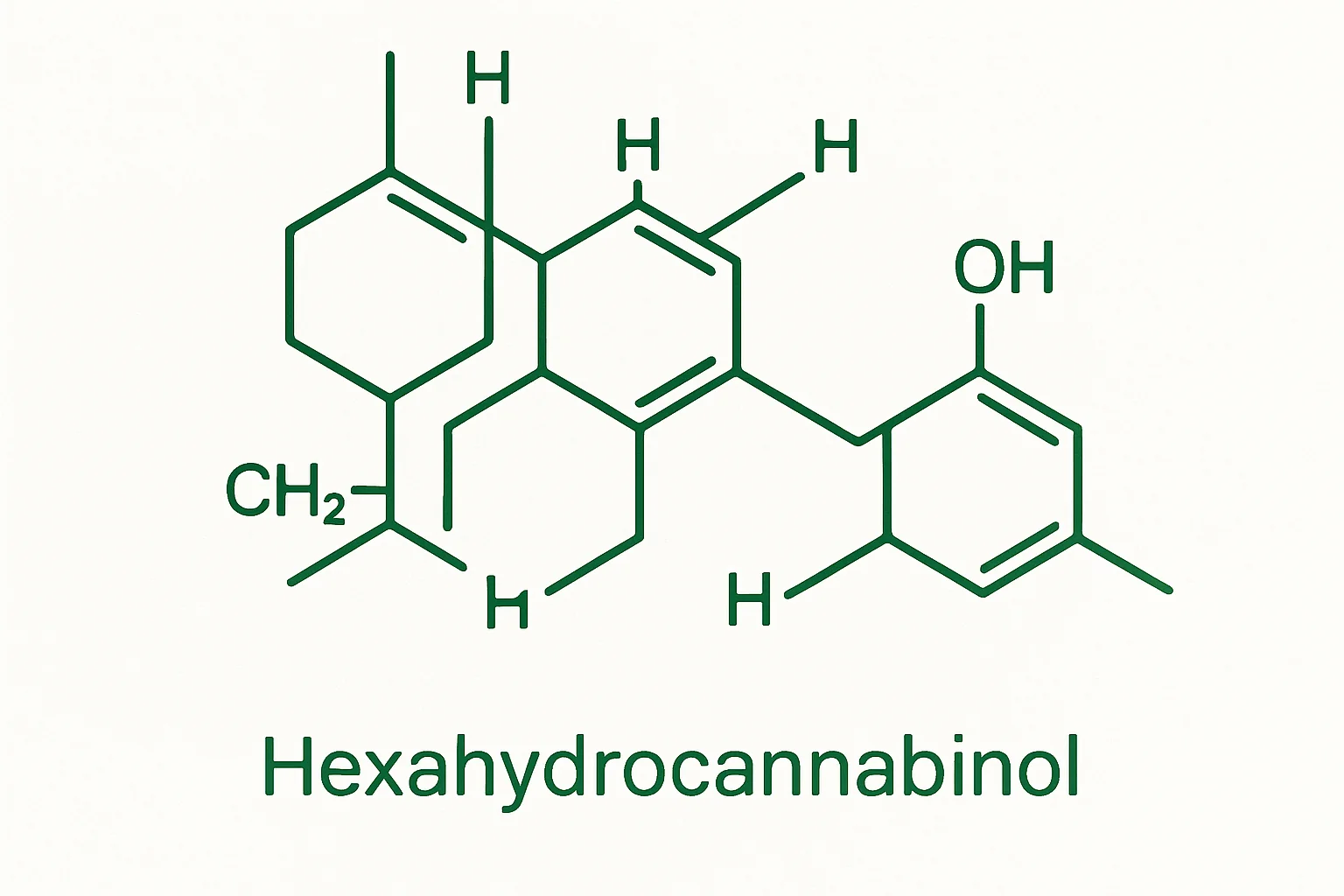
HHC (hexahydrocannabinol) is a semi-synthetic cannabinoid created by hydrogenating THC in laboratory conditions. The process involves adding hydrogen atoms to the double bonds of the THC molecule, stabilizing its chemical structure. In nature, HHC is found in pollen and seeds of cannabis in trace, non-economical amounts (Ujváry & Hanuš, Drug Testing and Analysis, 2016). Market products containing HHC are almost always the result of a chemical process.
Hydrogenation is the same reaction that the food industry uses to harden vegetable fats. In the case of HHC, a catalyst (usually palladium or nickel) and hydrogen under pressure convert THC into a more stable molecule. The result is two isomers: 9R-HHC (more active, binding more strongly to CB1) and 9S-HHC (less active). The ratio of both isomers depends on the production process, making standardization of products on the market difficult.
We have noticed that HHC sellers often describe the product as "natural cannabinoid" - technically true, as HHC exists in nature, but misleading, as what enters the market is practically entirely synthetically produced. This difference matters for both safety profile assessment and the interpretation of regulations regarding new psychoactive substances.
HHC vs THC vs CBD - comparison table
HHC, THC, and CBD are three different cannabinoids with different mechanisms of action, legal profiles, and applications. The table below compares them based on the most important features to help clarify how these three compounds actually differ from each other.
| Feature | HHC | THC | CBD |
|---|---|---|---|
| What it is | Hydrogenated THC (semi-synthetic) | The main psychoactive cannabinoid of cannabis | Non-psychoactive cannabinoid of cannabis |
| Psychoactivity | Yes - about 70-80% the strength of THC | Tak - silna | No |
| How it is produced | Hydrogenation of THC in the laboratory | Decarboxylation of THCA (heat) | Biosynthesis in the cannabis plant |
| Legal status in Poland 2026 | Gray area (not listed) | Controlled substance (list I-N) | Legal with THC below 0.3% |
| Potential applications | Recreational (no clinical studies) | Pain, nausea, appetite (clinical evidence) | Anxiety, sleep, inflammation (clinical studies) |
| How to consume | Vaporization, oils, gummies (non-standard market) | Vaporization, smoking, edible | Oils, capsules, flower, gummies |
The table shows that HHC occupies a middle ground between THC and CBD: it is psychoactive like THC, but to a lesser extent, and at the same time lacks the same level of evidence as CBD. It is a hybrid in terms of profile, not a clear alternative to any of the other cannabinoids.
How does HHC affect the body?
HHC works by binding to the endocannabinoid receptors CB1 and CB2, similar to THC, although with lower affinity. The CB1 receptor is mainly responsible for effects in the central nervous system - euphoria, altered perception, and relaxation. CB2 is more associated with the immune system. The pharmacological profile of HHC is similar to THC but assessed at about 70-80% of its strength (Ujváry & Hanuš, Drug Testing and Analysis, 2016).
The duration of HHC action is typically 2-4 hours, which is comparable to THC when vaporized. The chemical stability of the HHC molecule translates to a longer shelf life for products - it is more resistant to oxidation and high temperatures than THC. This feature was originally sought by researchers working on cannabinoid analogs for pharmaceutical purposes.
It is worth noting that the effect depends on the ratio of the 9R and 9S isomers in a given batch of the product. 9R-HHC binds to CB1 significantly more strongly than 9S-HHC. Without laboratory confirmation of the product's composition, the consumer does not know what ratio of isomers they are purchasing. This is a practical gap in market standardization that is worth keeping in mind.
Is HHC legal in Poland in 2026?
In Poland in 2026, HHC is not explicitly listed on the list of controlled substances attached to the Act on Counteracting Drug Addiction (Journal of Laws of 2023, item 172). This means there is no explicit prohibition, but it does not imply full legality. Law enforcement may apply general regulations regarding new psychoactive substances or analogs (Journal of Laws 2023, item 172). This is a gray area, not a green light.
The European landscape is changing rapidly. France banned HHC in June 2023. Austria, Slovakia, and Switzerland took similar steps in 2024. The EMCDDA noted HHC in its report on new psychoactive substances, indicating the need for EU monitoring (EUDA, new psychoactive substances (NPS)). Polish regulations may change at any time.
We have noticed that the argument "not on the list = legal" is a logical fallacy that appears in descriptions of HHC products. Polish criminal law does not require a substance to be named explicitly in order to be prosecuted as an analog of a controlled substance or as a new psychoactive substance. The assessment always depends on the circumstances of the specific case and interpretation by law enforcement. Legal consultation before purchase is a reasonable decision, not an exaggeration.
What do scientific studies say about HHC?
The scientific basis for HHC is significantly more modest than for THC or CBD. The studies by Ujváry and Hanuš from 2016 are one of the key academic sources describing the pharmacological profile of HHC and its isomers (Ujváry & Hanuš, Drug Testing and Analysis, 2016). The authors indicated that 9R-HHC has a distinctly higher affinity for the CB1 receptor than 9S-HHC, which explains the variability of effects between batches of products.
The EMCDDA in its 2023 report noted the increasing turnover of HHC in Europe and recorded the first reported cases of adverse effects: tachycardia, anxiety, and confusion at high doses. The report emphasizes the complete lack of controlled clinical studies on humans - knowledge about safety is based on analogies with THC and spontaneous reports (EUDA, new psychoactive substances (NPS)).
There are no clinical studies on the long-term use of HHC. There are no randomized trials with a control group. All knowledge about the potential applications of HHC comes from analogies to THC and user reports. This is insufficient to draw therapeutic conclusions. If you are looking for cannabinoids with a real evidence base, CBD and THC medical products (where available) have a much stronger scientific backing.
Frequently Asked Questions
What is HHC?
HHC (hexahydrocannabinol) is a semi-synthetic cannabinoid produced by hydrogenating THC - adding hydrogen atoms to the double bonds of the molecule. The effects of HHC are similar to THC but are usually milder and shorter. HHC is naturally present in hemp seeds in trace amounts; however, the market is almost exclusively supplied with laboratory-produced products (Ujváry & Hanuš, Drug Testing and Analysis, 2016).
How does HHC affect the body?
HHC binds to CB1 and CB2 receptors of the endocannabinoid system in a manner similar to THC, although with lower affinity. Effects include euphoria, relaxation, and altered perception, but they are milder than with THC. The duration of action is typically 2-4 hours. There is a lack of controlled clinical studies on humans - knowledge mainly comes from the pharmacological profile and user reports (EMCDDA, 2023).
Is HHC legal in Poland in 2026?
In Poland, in 2026, HHC is not explicitly listed on the list of controlled substances in the Act on Counteracting Drug Addiction (Dz.U. from 2023.). This means a state of non-regulation, not illegality. Law enforcement may apply legal analogies, and the regulatory landscape is changing. Several EU countries have already banned HHC in 2023-2024. Consult a lawyer before purchasing.
How does HHC differ from THC?
HHC and THC are structurally close: HHC is a hydrogenated form of THC, without double bonds in the cyclohexyl ring. HHC is chemically more stable, resistant to oxidation and heat. The psychoactive effects of HHC are estimated to be 70-80% the strength of THC. THC is a controlled substance in Poland; HHC is not explicitly listed on this list until 2026 (Ujváry & Hanuš, Drug Testing and Analysis, 2016).
Is HHC safe?
Data on the safety of HHC is very limited. There are no long-term clinical studies on humans. The EMCDDA reported the first reports of adverse effects of HHC in 2023, including cases of tachycardia and anxiety at high doses. The precautionary principle is justified, especially in the absence of product standardization on the market (EUDA, new psychoactive substances (NPS)).
This article is for informational and educational purposes and does not constitute legal advice. The legal status described in the article is valid as of the publication date - regulations regarding cannabis may change. Consult a lawyer or current legal acts before making decisions.
Author: Michał Waluk · Published: 2026-05-04 · Updated: 2026-05-04