
Terpenes in CBD: what they are and how they affect the action of hemp oil
Myrcene, beta-caryophyllene, linalool, limonene, and pinene in CBD oil: what each of them does, whether the entourage effect is proven, and what you lose with an isolate.
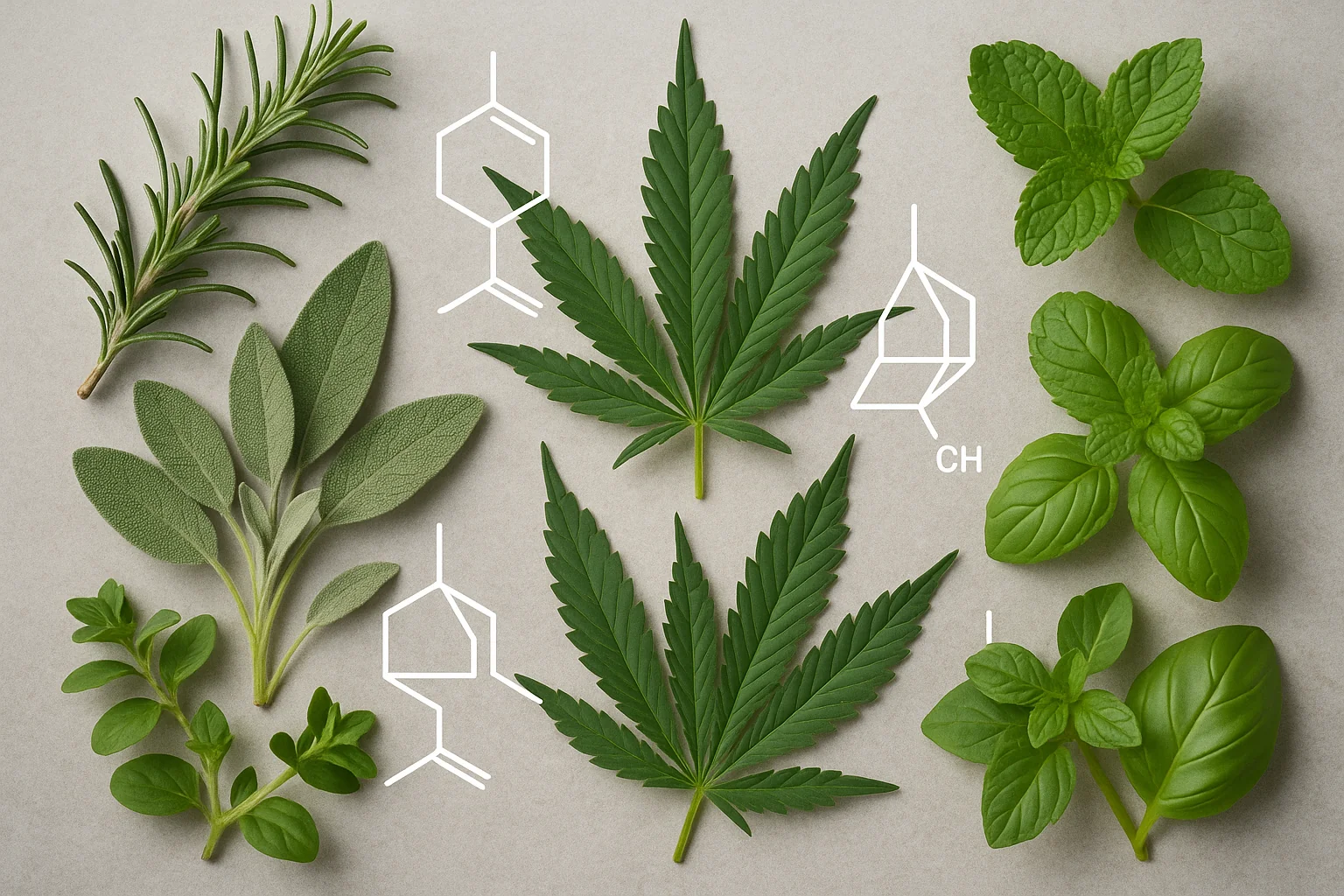
The scent of full-spectrum oil comes from terpenes, the same compounds responsible for the aroma of pine forests, lemon peels, and lavender. Manufacturers are eager to build a narrative around them, claiming they determine the action of the product. Part of this story has solid chemical foundations, while part has not gone beyond hypothesis, and the difference between the two is rarely explained. Below, we go through the five most important cannabis terpenes, what is really known about the entourage effect, and the question of what exactly you lose by choosing an isolate.
KEY INFORMATION
• Terpenes are produced in the same glandular trichomes as cannabinoids and remain in full-spectrum oil together with CBD.
• Beta-caryophyllene binds directly to the CB2 receptor, as the only terpene (Gertsch et al., PNAS, 2008).
• Efekt entourage to hipoteza z 2011 roku, nie ustalenie potwierdzone klinicznie.
• In drug-resistant epilepsy, CBD-rich extracts worked at lower doses than pure CBD (Pamplona et al., 2018).
• You can check the terpene profile only in the certificate of analysis; most manufacturers do not test it.
What are terpenes and why do cannabis plants produce them?
These are volatile organic compounds responsible for the smell of plants, produced in cannabis in the same glandular trichomes where cannabinoids are formed. They are not an additive or contaminant, but a product of the same biochemical pathway, which explains why they end up in the extract together with CBD.
The plant does not produce them for us. Terpenes serve defensive functions: they deter herbivores and feeding insects, inhibit the growth of fungi, and at the same time attract pollinators. Their concentration increases in response to stress and tissue damage, which is why a crushed flower smells more intense than an untouched one.
Over a hundred different terpenes have been identified in cannabis, but practically significant are a few of the most abundant. Their proportions vary between strains enough that the terpene profile is sometimes used to distinguish chemotypes, just like cannabinoid content. They are also unstable: they evaporate at room temperature and degrade under the influence of light and heat, so oil kept in a clear bottle on a windowsill loses them faster than CBD.
This instability has a consequence worth knowing when comparing products. The extraction method determines how many terpenes survive to the bottle. Supercritical carbon dioxide extraction conducted at low temperatures preserves the most, ethanol extraction performs worse, and steam distillation, sometimes used in purification, removes most. Therefore, two oils with identical declared CBD content can differ radically in terpene profile, and this is not due to the quality of the raw material, but to the technology.
The carrier itself also matters. Terpenes dissolve in fats just like cannabinoids, so MCT or hemp oil retains them without issue. However, an opened bottle loses them with each use, as the most volatile fractions evaporate with every opening. Six months after opening, the terpene profile of the product looks different than on the day of laboratory testing, although the CBD content remains practically the same.
Which terpenes are most commonly found in CBD oils?
The five below usually constitute the majority of the terpene profile of cannabis extract. It is worth noting right away that data on their effects mostly come from studies on terpenes themselves at concentrations much higher than those in the oil.
| Terpene | Aroma | Attributed effects | Where else it occurs |
|---|---|---|---|
| Myrcene | earthy, musky | calming, relaxing | chmiel, mango, tymianek |
| Beta-caryophyllene | pieprzny, korzenny | przeciwzapalne przez CB2 | black pepper, cloves |
| Linalool | kwiatowy, lawendowy | soothing, sleep-supporting | lawenda, bazylia |
| Limonene | cytrusowy | mood-enhancing | citrus peels, juniper |
| Alpha-pinene | piney, resinous | supporting alertness | fir needles, rosemary, sage |
Myrcene dominates in most strains, and it is attributed to the distinction between "relaxing" and "stimulating" strains, popular in dispensaries. The basis for this division is weaker than its popularity suggests: it relies on the threshold content of myrcene, which has not been confirmed in human studies.
Alpha-pinene is the most unstable of this group and evaporates the fastest. If the oil smelled like pine on the day of purchase, and after six months it no longer does, it doesn't mean it has completely gone stale; it means that this particular component disappeared first. Limonene and linalool last longer, while beta-caryophyllene, as a sesquiterpene with a larger molecule, is the most resistant to time and temperature.
Does beta-caryophyllene really act like a cannabinoid?
Yes, and it is the only terpene that can be said with certainty. Gertsch et al. (PNAS, 2008) demonstrated that beta-caryophyllene selectively binds to the cannabinoid receptor CB2, which is mainly found on immune system cells, not in the brain.
This finding has two implications. First, it explains the anti-inflammatory effects attributed to this compound, as CB2 activation inhibits the release of inflammatory mediators. Second, the lack of affinity for the CB1 receptor means that it does not produce any psychoactive effects, regardless of the dose.
An interesting fact that helps organize thinking about the entire category: beta-caryophyllene is a common food ingredient, found in black pepper, cloves, and oregano. So if someone had a meal with pepper today, they ingested a dietary cannabinoid, probably in a larger amount than from a few drops of oil. Terpenes are not exotic; they are simply everywhere.
It is worth drawing a conclusion from this that cools some of the marketing enthusiasm. Since beta-caryophyllene is a common ingredient in spices, and its content in CBD oil is measured in fractions of a percent, the amount taken with a few drops is negligible compared to that from a daily diet. Claiming that the anti-inflammatory effect of the oil comes from this terpene would require demonstrating that this method of administration and this specific amount matter, which no one has done.
The remaining terpenes have weaker foundations. Limonene, linalool, or myrcene are sometimes described as affecting mood and sleep, but studies usually concern inhaling essential oils or administering pure compounds to animals in doses incomparable to those in CBD preparations. This does not mean they do not work; it means it is unknown whether they work in this quantity and in this form.
Czy efekt entourage jest udowodniony?
Not to the extent suggested by marketing. The term itself and the most frequently cited argument come from Russo's work (British Journal of Pharmacology, 2011), which compiled the pharmacology of individual cannabinoids and terpenes and indicated areas where their interaction is likely. This is a review paper formulating a hypothesis, not a study confirming it.
The most concrete data comes from a completely different source. Pamplona et al. (Frontiers in Neurology, 2018) gathered clinical observations regarding drug-resistant epilepsy in children and compared CBD-rich extracts with pure cannabidiol. Full-spectrum extracts showed improvement at significantly lower doses, with a similar response rate to treatment.
However, before you take this as evidence, three caveats. This is a meta-analysis of observational data, not a randomized study, so the groups were not comparable by design. It concerns one neurological indication at doses several dozen times higher than those used in supplements. And it does not determine whether the difference is due to terpenes, other cannabinoids, or the difference in the pharmacokinetics of the extract itself. The hypothesis remains open, not confirmed.
It is worth noting that there is nothing far-fetched in the hypothesis itself. The interaction of plant substances is a well-documented and uncontroversial phenomenon in pharmacology, and Russo points out specific, verifiable mechanisms: beta-caryophyllene acting through CB2, limonene affecting membrane permeability, pinene inhibiting acetylcholinesterase. The problem is not that the thesis is unbelievable, but that no one has tested it directly yet.
The test that is missing would actually be simple to design: the same dose of CBD, once as an isolate, once as a full-spectrum extract, in the same individuals, with blinding and measurement of a hard endpoint. The lack of such a study after several years of the topic's popularity says more about the funding of cannabis research than about the hypothesis itself. Until then, "full spectrum works better" remains an assumption, not a conclusion.
How to match the terpene profile to the goal?
The honest answer is: to a limited extent and rather by trial and error than from a table. Assigning terpenes to effects is mainly based on studies of essential oils at concentrations incomparably higher than in drops of CBD oil, where their content is measured in fractions of a percent.
From a practical point of view, a simpler rule can be helpful. Profiles dominated by myrcene and linalool, which smell earthy or floral, tend to work better in the evening. Profiles with a distinct citrus or pine note, rich in limonene and pinene, are often better received during the day. This is an observation from user reports, not a conclusion from clinical research, and I would treat it as a starting point, not a rule.
Do not ignore your own nose either. If the smell of the oil is repulsive to you, you will use it inconsistently or not at all, and with CBD, regularity matters more than the terpene composition. Scent preference is a practical argument in this case, not a whim.
There is one more mechanism that is rarely mentioned, which explains some of the perceived differences without referring to pharmacology. Smell affects us through associations and through the direct connection of smell with the limbic system, so a distinctly lavender note may calm before any component has a chance to be absorbed. This is not an illusory effect or a reason to be dismissed, but a different mode of action than what the label suggests.
If you want to check this for yourself, change one thing at a time. The same manufacturer, the same CBD concentration, a different terpene profile, for two weeks each. Comparing products that differ simultaneously in potency, carrier, and brand will tell you nothing about terpenes, as there are too many variables, and the difference in the CBD dose itself will overshadow everything else.
What do you lose by choosing an isolate instead of full spectrum?
All terpenes, all other cannabinoids, and flavor, while gaining predictability and the absence of THC. Which set is better depends on why you are reaching for the product, not on which variant is more expensive.
An isolate is pure cannabidiol in the form of a white powder, without smell or taste. It works when THC must be completely excluded, when you need precise dosing in milligrams, or when you add it to a dish whose flavor you do not want to change. Full-spectrum preparations retain the complete plant components, including trace amounts of THC below the legal threshold, while the broad-spectrum variant is a compromise: terpenes remain, THC is removed.
There is no objectively better choice here, even though stores usually suggest otherwise. If you are subject to drug tests, isolate or broad-spectrum are the only sensible options, and no hypothesis about the interaction of ingredients changes that. We have detailed the differences between variants in the text about full spectrum i broad spectrum, and the impact on mental performance in the article about CBD a koncentracji.
The last thing concerns verification. The terpene profile is only listed in the certificate of analysis, in a separate section stating the content in milligrams per gram or in percentages. The vast majority of producers only test cannabinoids, as testing terpenes incurs additional costs. Therefore, a declaration of a rich terpene profile without such a section in the certificate is a claim that cannot be verified.
If you do receive a certificate with terpenes, pay attention to three things. The testing date should correspond to the batch number on the bottle, as the terpene profile changes significantly more between batches than the CBD content. The total amount of identified terpenes in a decent full-spectrum extract usually ranges between one and three percent by weight; values clearly higher suggest the addition of terpenes from external sources, which in itself is not a flaw, but it is also not what the label promises. It is also worth checking whether the testing was conducted by an external laboratory rather than the manufacturer's quality control department.
Terpenes added after extraction are, by the way, a separate category of products, increasingly common on the market. They can be sourced from plants other than cannabis, such as limonene from citrus fruits, and are chemically identical to those from the plant. A product with such an addition may smell more intense than a natural extract, but then the scent ceases to be an indicator of anything regarding the quality of the cannabis raw material.
Frequently Asked Questions
What are terpenes in CBD oil?
These are volatile aromatic compounds produced in the same glandular hairs as cannabinoids, responsible for the smell and taste of cannabis. In full-spectrum oil, they remain together with CBD. The plant produces them to deter herbivores and attract pollinators, not for effects in humans.
Czym jest efekt entourage?
This is a hypothesis that cannabinoids and terpenes work together differently than separately. It was formulated by Russo (British Journal of Pharmacology, 2011) based on the pharmacology of individual components. There are very few clinical studies comparing full extract with pure CBD in humans.
Which terpene in CBD helps with sleep?
Most often, myrcene and linalool are indicated, the same terpene that gives lavender its scent. However, the data comes from studies on terpenes themselves at concentrations many times higher than in the oil, so transferring them to a few drops in the evening is quite a simplification.
Which terpene has anti-inflammatory effects?
Beta-caryophyllene is the one with the strongest basis among the entire group. Gertsch et al. (PNAS, 2008) demonstrated that it binds directly to the CB2 receptor, making it the only terpene that is also a dietary cannabinoid.
Is terpene oil better than isolate?
The only concrete data comes from a meta-analysis of observational studies in drug-resistant epilepsy, where CBD-rich extracts showed improvement at lower doses than pure CBD (Pamplona i in., 2018). These are observational data concerning one indication, not proof of general superiority.
How to check the terpene profile of CBD oil?
In the certificate of analysis, in the section for terpene designations provided in milligrams per gram or in percentages. Most producers only test cannabinoids, so the absence of such a section is the norm. Without it, a declaration of a rich terpene profile remains unverifiable.
You can find the oils available in the store in the category hemp oils.
This article is for informational and educational purposes and does not constitute medical advice. Before starting to use cannabis or CBD for therapeutic purposes, consult a doctor, especially if you are taking other medications, are pregnant, or breastfeeding.
Author: Michał Waluk · Opublikowano: 2026-06-22 · Aktualizacja: 2026-08-07