
Mescaline and peyote - botany, culture, and research status
Meskalina i pejotl — co to, co mowia badania i status prawny w Polsce. u Bucha.
Peyote and mescaline are among the longest documented psychoactive substances used ceremonially in the world - artifacts indicate use dating back over 5700 years. At the same time, mescaline is a controlled substance in Poland and most countries worldwide, and the plant itself - peyote - is one of the slowest-growing cacti on our planet. This article serves as an educational introduction: it discusses botany, cultural history, and the current status of scientific research on mescaline. It does not contain instructions for use or recommendations.
KEY INFORMATION
• Peyote (Lophophora williamsii) contains over 50 alkaloids, with mescaline (Bruhn et al., Economic Botany, 1978; Metzner, 2004).
• The oldest evidence of ceremonial use of peyote dates back to around 3700 BC - found in Texas (Schultes, 1938).
• Mescaline is a controlled substance in Poland (Schedule I-P of the Act on Counteracting Drug Addiction) - possession and cultivation are illegal.
• Research on the therapeutic potential of mescaline is still in its infancy - there are no registered RCTs analogous to psilocybin studies.
Botany: what exactly is peyote?
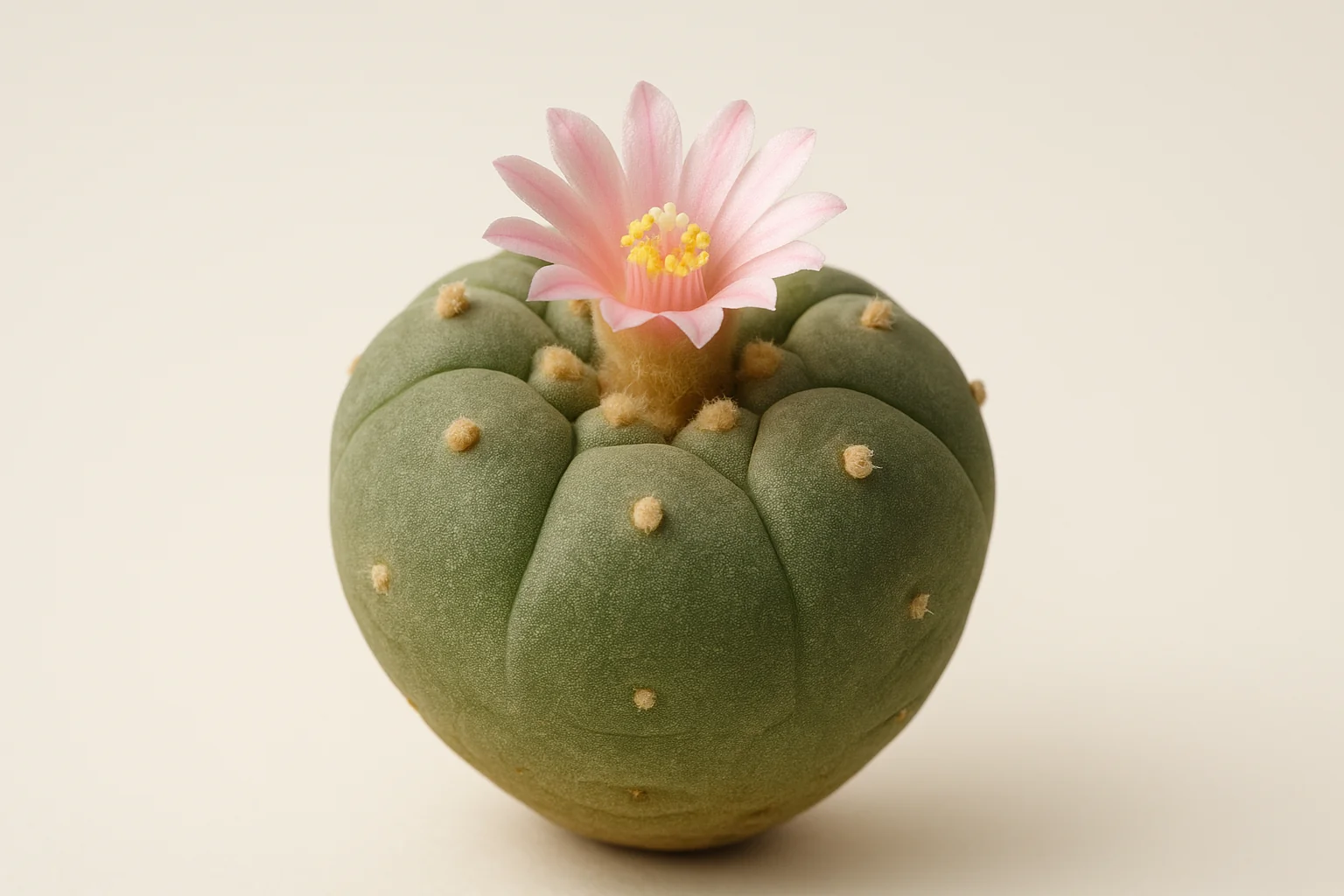
Peyote (Lophophora williamsii) is a small, spineless cactus from the Cactaceae family, growing naturally on dry plateaus and in canyons of central Mexico (the states of Chihuahua, Coahuila, Tamaulipas, San Luis Potosí) and in southern Texas. Its Polish name "peyote" comes directly from the Nahuatl language (peyotl), the ancient language of the Aztecs. Botanically, it is closely related to Lophophora diffusa - a species containing significantly less mescaline.
The plant grows in nature to a diameter of 7-12 cm and a height of 5-7 cm. It grows extremely slowly - it takes 10 to even 30 years to reach maturity, depending on the conditions. The visible above-ground part (the so-called "head" or mescal button) is actually a modified shoot, while underground lies a long, carrot-like "radish" - the main part of the plant. Dried peyote heads contain 1% to 6% mescaline based on dry weight; the concentration depends on age, habitat, and season (Anderson, 1980).
In addition to peyote, mescaline is found in other cacti: Echinopsis pachanoi (San Pedro cactus, Peru), Echinopsis peruviana (Peruvian cactus) and Pelecyphora aselliformis. It is also present in much smaller concentrations in several species of the genus Trichocereus. All these plants have been or are used in the traditions of indigenous cultures of Latin America.
Cultural history: from pre-Columbian ceremonies to the Native American Church
The oldest dated evidence of ceremonial use of peyote comes from artifacts discovered in the Shumla caves in western Texas, radiocarbon dated to around 3700-3400 BC (Terry et al., Journal of Archaeological Science, 2006). Mentions of peyote appear in Aztec codices predating the Spanish conquest. The first European descriptions come from 16th-century missionaries - Bernardino de Sahagún described the ceremonial drink made from peyote by the Huicholes (Wirraritari) as a "drunken cactus" with visionary properties.
The cultural significance of peyote continues in the tradition of the Huicholes (Wixaritari) from the Mexican state of Jalisco - one of the few indigenous nations that has maintained the continuity of peyote ceremonies to this day. The annual Huichole pilgrimage to Wirikuta (Real de Catorce, San Luis Potosí) - the place where peyote grows - is listed as an intangible cultural heritage by UNESCO in Mexico.
We have noticed that popular discussions about peyote often overlook its status as an endangered plant. Lophophora williamsii is listed in Appendix II of the CITES Convention (Convention on International Trade in Endangered Species) - protection includes international trade. Increased interest in psychedelics over the last decade has led to a rise in illegal harvesting of wild populations in Texas and Mexico, threatening the natural habitats of the plant.
The Native American Church (NAC), formally established in 1918, is a Native American religious movement that combines elements of Christianity with traditional ceremonies involving peyote. It is estimated to have 200,000-400,000 members. In the United States, the use of peyote in religious ceremonies by Native Americans has been exempted from the Controlled Substances Act - an exception recognized by the Supreme Court and confirmed by the American Indian Religious Freedom Act Amendments (1994).
Chemistry: mescaline and other alkaloids of peyote
Mescaline (3,4,5-trimethoxyphenethylamine) belongs to the group of phenethylamines - the same group as dopamine, adrenaline, and amphetamine. Its chemical synthesis was the first successful synthesis of a psychedelic: it was accomplished by Arthur Heffter in 1919, and Ernest Späth confirmed the structure in 1919. However, peyote contains over 50 different alkaloids: in addition to mescaline, there are also mescalosides, anhalonine, norinescaline, and lofophine.
The main mechanism of action of mescaline is agonism at serotonin receptors, particularly 5-HT2A - the same receptors that are the key target of psilocybin and LSD. Despite structural differences (mescaline is a phenethylamine, while psilocybin and LSD are tryptamines/ergolines), these substances produce similar psychedelic effects due to their shared receptor mechanism (Nichols, Pharmacological Reviews, 2016). Mescaline lasts 8-12 hours - longer than psilocybin (4-6 hours) and shorter than LSD (8-14 hours).
Legal status: Poland and Europe
In Poland, mescaline is a psychoactive substance listed in Schedule I-P of Appendix No. 2 to the Act of July 29, 2005 on Counteracting Drug Addiction (Journal of Laws of 2023, item 1939). This means a ban on the production, processing, alteration, import, export, transport, possession, and trade. Peyote, as a plant containing a psychoactive substance, is subject to the same restrictions (Act on Counteracting Drug Addiction, Journal of Laws 2023).
Similar regulations apply in other EU countries - mescaline is controlled under the 1971 UN Convention on Psychotropic Substances (Schedule I). Exceptions for indigenous religious ceremonies, applicable in the USA and Canada, do not apply in Polish and European legal systems. Some countries, like the Netherlands, previously exploited legal loopholes allowing the legal sale of San Pedro cacti as ornamental plants - but not as a source of psychoactive substances.
It is worth noting that the cultivation of peyote cactus as an ornamental plant without the intention of producing a controlled substance is legally ambiguous in Poland. Due to the risk of criminal sanctions and the protective status of the plant under CITES, any form of possession associated with the intent to obtain a substance is legally risky. This article is for educational purposes only and does not constitute legal advice.
Status of scientific research: what do we know in 2026?
The revival of research on psychedelics, which gained momentum around 2010, has primarily focused on psilocybin, MDMA, and ketamine. Research on mescaline has lagged behind - mainly because access to the substance is more difficult, and large funding organizations (MAPS, Compass Pathways) have concentrated resources on substances with a stronger base of preliminary data.
Our observations indicate that mescaline is often mentioned in survey studies alongside psilocybin and LSD as a "classic psychedelic", which may blur significant pharmacological and cultural differences. The study by Agin-Liebes et al. (2021), published in ACS Pharmacology & Translational Science, analyzed 452 experiences with mescaline and found that respondents reported a reduction in symptoms of depression, anxiety, and addiction. However, this survey study - without a control group, without randomization. It is not evidence of clinical efficacy.
As of 2026, no phase III clinical trials with mescaline have been registered. Phase II trials (with psilocybin: USONA Institute; with MDMA: MAPS) are a decade ahead of mescaline. An additional difficulty: mescaline requires higher doses based on weight compared to other psychedelics, and its long duration of action (8-12 hours) complicates the clinical protocol. Some researchers (Imperial College London, Johns Hopkins Center for Psychedelic and Consciousness Research) are conducting observational comparative studies between substances, but there is still a long way to go to clinical trial results with mescaline as a drug (Johns Hopkins Center for Psychedelic Research, 2026).
Frequently Asked Questions
What is mescaline and where does it come from?
Mescaline (3,4,5-trimethoxyphenethylamine) is a natural psychoactive alkaloid primarily found in peyote (Lophophora williamsii) and San Pedro cacti (Echinopsis pachanoi). It belongs to the group of phenethylamines and mainly acts as an agonist of serotonin receptors 5-HT2A (Nichols, Pharmacological Reviews, 2016).
What is peyote (Lophophora williamsii)?
Peyote is a small, spineless cactus growing in central Mexico and the southern USA. It is one of the slowest growing plants - reaching maturity after 10-30 years. It contains over 50 alkaloids. It is listed in Appendix II of CITES as an endangered plant. Dried heads contain 1-6% mescaline based on dry weight.
What is the legal status of mescaline and peyote in Poland?
Mescaline is a psychotropic substance listed as Schedule I-P under the Act on Counteracting Drug Addiction (Dz.U. 2023 poz. 1939). Possession, cultivation, and trade of peyote and mescaline are illegal in Poland. Exceptions for indigenous religious ceremonies applicable in the USA and Canada do not apply under Polish law.
Is mescaline being researched scientifically?
Yes, but the research is preliminary. A survey study by Agin-Liebes et al. (2021, n=452) suggested potential effects in depression and addictions. There are currently no registered RCTs involving mescaline. Research on psilocybin and MDMA is over a decade ahead of mescaline in the clinical pathway.
How does mescaline differ from psilocybin and LSD?
Mescaline is a phenethylamine, while psilocybin and LSD are tryptamines/ergolines. Despite different structures, all act as agonists of 5-HT2A (Nichols, 2016). Mescaline lasts 8-12 hours (longer than psilocybin), requires higher doses, and has a slightly different subjective profile - described as more visual.
Where does peyote appear in culture?
The oldest evidence of ceremonial use dates back to around 3700 BC (Terry et al., 2006). Peyote is a central element of Huichole (Mexico) and Native American Church (USA, Canada) ceremonies. It appears in literature, including Aldous Huxley's "The Doors of Perception" (1954) and in the works of the beat generation. The Huichole tradition associated with peyote is protected by UNESCO in Mexico.
This article is for informational and educational purposes and does not replace consultation with a doctor. If you are pregnant, breastfeeding, taking medications, or have chronic conditions, consult the use of supplements or herbs with a specialist.
Author: Michał Waluk · Published: 2026-05-04 · Updated: 2026-05-04